Australian Mathematics Competition: 2027 Dates, Fees & More
Schools enter children into most Australian maths competitions — parents can't just book a spot, and entries often close months early. This guide covers every major competition: the year levels each one takes, the latest fee, and how to get your child entered.

- Which Maths Competitions Can Australian Students Enter?
- Have the 2026 Competitions Closed, and What Are the 2027 Dates?
- What Is the Australian Mathematics Competition, and Should Your Child Sit It?
- What Comes After the AMC? The Olympiad Pathway
- Is ICAS Maths a Competition or an Assessment?
- How Does Cuemath Prepare a Child for Competition Maths?
- Frequently Asked Questions
Ask a parent when they first heard about the Australian Mathematics Competition and many will say June, a few weeks after their child's school had already placed the order. That is the catch with maths competitions for Australian students. Schools enter children; parents cannot. There is no family sign-up page for the AMC, and no reminder email when the window shuts.
Timing is the second catch. Most 2026 papers have now been sat, and no organiser has released 2027 dates. This makes September the month to act. Schools decide in Term 4 and January what they will run, so a short email now still reaches the maths coordinator while the decision is open.
Maths competition scores are useful.
Understanding how your child thinks is even more valuable.
A child can score well and still struggle with unfamiliar problems. Our free one-on-one assessment helps uncover reasoning skills, problem-solving habits, and areas where your child is ready to grow.
Which Maths Competitions Can Australian Students Enter?
Four organisations run almost every competition worth entering. There is no single calendar for all of them.
| Competition | Year Levels | When It Runs | Fee | Source |
|---|---|---|---|---|
| APSMO Maths Quest, Explorer, Games & Olympiad | Years 1–8 | May–September | Not published | APSMO |
| Kangourou sans Frontières (KSF) | Years 3–12 | Late March | AU$5.50 | AMT |
| AMT Maths Challenge | Years 3–10 | March–June | AU$24–30 | AMT |
| 🏆 Australian Mathematics Competition (AMC) | Years 3–12 | Early August | AU$9.30 | AMT |
| AMC Early Primary | Years 1–2 | October (Pilot) | Free | AMT |
| Australian Junior Mathematics Olympiad (AJMO) | Up to Year 8 | September | AU$12.50 | AMT |
| Australian Intermediate Mathematics Olympiad (AIMO) | Years 7–10 | September | AU$25.90 | AMT |
| ICAS Mathematics | Years 2–12 | Late August | AU$21.95 | ICAS |
| Maths Talent Quest | Foundation–Year 12 | Year-round | Free–AU$52 | MAV |
| Bebras Computational Thinking Challenge | Years 3–12 | Two windows yearly | Free | AMT |
Have the 2026 Competitions Closed, and What Are the 2027 Dates?
Yes, most of them. As of September 2026, the main sittings for this year are done, and none of the four organisers has published 2027 dates yet. Here's where each competition stands right now.
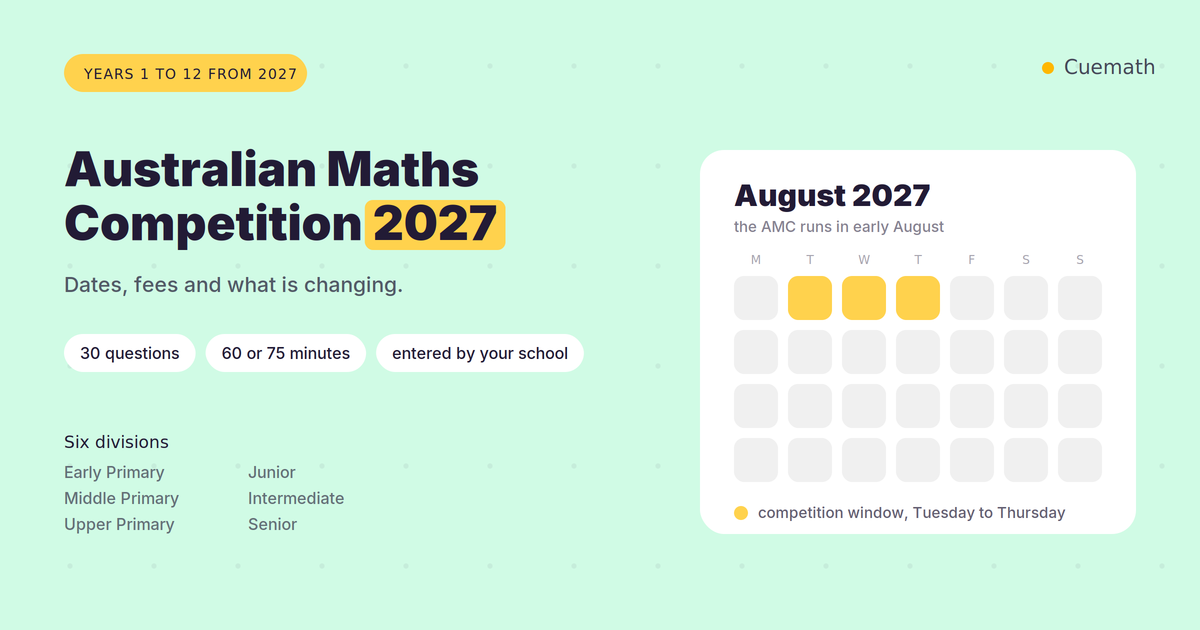
- Australian Mathematics Competition — sat 4 to 6 August 2026, with online entries closed on 31 July (AMT). The 2027 date is not yet announced. The AMC has run in early August, so expect a similar window.
- Kangourou sans Frontieres — sat 24 to 26 March 2026, entries closed 20 March (AMT). No 2027 date published yet. Late March is the pattern, which makes it a Term 1 decision.
- AIMO and AJMO — both sat on 10 September 2026, entries closed 4 September (AMT AIMO, AMT AJMO). 2027 dates not yet announced; September is the usual month.
- ICAS Mathematics — sat 24 to 28 August 2026, with parent entries closing 24 July (ICAS). The 2027 calendar is not out, though ICAS is already taking school registrations for 2027 (ICAS).
- APSMO contests — ran 6 May, 10 June, 29 July and 9 September in 2026 (APSMO). The 2027 dates are not on the program page yet. Contests start early in Term 2.
- Maths Talent Quest — 2026 entries closed 31 July, with the awards ceremony on 26 October at the University of Melbourne (MAV). 2027 dates not yet released.
Two things are still open right now. First, the AMT is running a free trial of a new AMC Early Primary paper for Years 1 and 2, from 12 to 23 October 2026, online only. This becomes a regular part of the AMC from 2027 (AMT).
Second, you can still talk to your child's school. That's the whole reason to read this in September, while there's time to act.
What Is the Australian Mathematics Competition, and Should Your Child Sit In It?
The AMC started in 1978, and it's the competition most Australian schools already know (AMT). If you're wondering which competition to start with from Year 3 onwards, this is usually the answer.
For 2026, the Australian Maths Trust listed the Australian Mathematics Competition (AMC) entry fee at AU$9.30 per student. Schools place the order and may either cover the cost themselves or pass it on to families.
Bundle discounts may apply for some Australian Maths Trust competitions. Schools should always check current pricing before registrations open.
It's worth knowing the format before your child sits it, because two details change how they should approach the paper.
- Five divisions — Middle Primary (Years 3 and 4), Upper Primary (5 and 6), Junior (7 and 8), Intermediate (9 and 10) and Senior (11 and 12) (AMT).
- Thirty questions, 135 marks — 25 multiple choice and five needing an integer answer (AMT).
- Marks rise steeply — questions 1 to 10 are worth three marks each, while the last five are worth 6, 7, 8, 9 and 10 (AMT).
- No penalty for a wrong answer — so an unanswered question is a wasted one. Tell them to guess (AMT).
- Calculators are allowed only in Middle and Upper Primary — every other division works with pencil and paper (AMT).
- Time allowed — 60 minutes for primary divisions, 75 for secondary (AMT).
What Comes After the AMC? The Olympiad Pathway
For a small number of students, the AMC is just the first step, not the main event. The AMT runs a pathway of harder competitions above it, and added a new starting point in 2026.
- AJMO, new in 2026 — for students up to Year 8, ten problems in 90 minutes, online only, with a single integer answer from 0 to 999 and no written proofs (AMT).
- Who AJMO is for — the AMT built it as an easier way in, for students curious about olympiad-style problems but not ready for the harder paper (AMT).
- AIMO — pitched at Year 10 level, four hours, ten questions, two of which need written solutions that may include proofs (AMT).
- How hard AIMO is — the AMT says it expects only a small number of students to complete the whole paper (AMT).
- Where it leads — AIMO results are used to identify students for the AMT's olympiad pathway and high-performance programs (AMT).
- Pick one, not both — the two sat on the same day in 2026, so schools choose the more suitable paper for each student (AMT).
Is ICAS Maths a Competition or an Assessment?
It's easy to mix these up. ICAS is actually an online academic assessment, run by ICAS Assessments, built on the Janison platform and supported by the University of Sydney. It covers Mathematics from Year 2 to Year 12 (ICAS).
Find Out Whether Your Child Is Ready to Be Stretched
In a free trial class, a Cuemath coach works through unfamiliar problems with your child and tells you honestly where they sit. Advanced learning and competition-style problems are included in every plan, at every price point.
Book a Free Trial ClassCancel any time with a full refund on unused classes.
How Does Cuemath Prepare a Child for Competition Maths?
This section describes what's already included in a standard Cuemath plan.
- The model — live one-on-one online tutoring for Foundation to Year 10, two to three classes a week, aligned to the Australian Curriculum and state syllabuses (Cuemath Australia).
- Extension isn't an upsell — every plan already includes advanced learning for competitions, on top of homework help and exam prep (Cuemath pricing).
- Fees depend on plan length, not need — asking for competition-style work does not move a family to a different price (Cuemath pricing).
- What a coach can spot that a marked script can't — whether a child stopped at question 24 because they misread it, didn't know where to start, or started but lost confidence. Each of those needs a different fix.
Talk to Someone Before You Commit to Anything
A Cuemath counsellor can talk through which competitions suit your child's year level and temperament, and whether extension work makes sense right now. The first class is free and there is nothing to cancel if you decide against it.
Talk to a Maths ExpertNo hidden fees. Two line items only: coaching and platform.
Frequently Asked Questions
Can a parent enter a child in a maths competition directly?
Usually, no. The Australian Maths Trust says only staff at a verified school, home school or coaching clinic can register students for competitions like the AMC. APSMO doesn't accept individual entries either, since students compete in school teams. ICAS is the exception — it offers a parent payment option through schools, plus public testing centres.
How much do maths competitions cost in Australia?
The latest published prices run from free to about AU$52. Kangourou sans Frontieres was AU$5.50 per student, the AMC AU$9.30, the AJMO AU$12.50 at an introductory rate, ICAS Mathematics AU$21.95 per subject, the AIMO AU$25.90, and the Maths Talent Quest AU$52 per entry for MAV members. Bebras is free.
How hard is the Australian Mathematics Competition?
Not as hard as the name suggests, for most students. The Australian Maths Trust designs the AMC so students of all abilities can attempt it from Year 3 up — not just strong mathematicians. Marks start at three points for the easiest questions and rise to ten for the hardest. There's no penalty for guessing, so every attempted question still counts.
What is a good score in the Australian Mathematics Competition?
A Distinction or High Distinction. A Credit already covers the top 55% of a year level, so most students who sit the paper earn some kind of award. A Distinction (top 20%) or High Distinction (top 3%) is where a result really stands out, and a prize or medal is even rarer than that.
When are the 2027 maths competition dates announced?
None of the major Australian organisers had published 2027 dates as of September 2026. The Australian Maths Trust opened its 2026 registrations on 27 January that year, so a similar late-January window is likely. ICAS is already accepting school registrations for 2027 without publishing its sitting calendar.
What is the youngest year level that can enter a maths competition?
Year 1. APSMO runs Maths Quest for Years 1 and 2, and the Australian Maths Trust piloted a free AMC Early Primary paper for Years 1 and 2 from 12 to 23 October 2026, with that division joining the standard AMC from 2027. The Maths Talent Quest accepts investigations from Foundation upwards.
Is the AMC harder than ICAS Mathematics?
They're different, not one harder than the other. The AMC uses new, unfamiliar problems written each year by educators and academics, with marks rising from three to ten across the paper. ICAS Mathematics tests skills straight from the curriculum and reports results by skill area against students nationally. A child who's strong at school maths often does better on ICAS.
Are calculators allowed in maths competitions?
Rarely. The Australian Maths Trust permits pocket or scientific calculators only for the CAT competition and for the Middle and Upper Primary divisions of Kangourou sans Frontieres and the AMC. Every other division works without one. Printed language dictionaries are permitted across all AMT competitions.
Do maths competitions help with NAPLAN?
Not directly. NAPLAN is sat in March by Years 3, 5, 7 and 9 and assesses curriculum content, while competition problems are written to sit outside the curriculum sequence. The overlap is in reasoning and multi-step word problems, which both reward. Treat a competition as extension rather than preparation for a national test.
What if my child's school runs no maths competitions at all?
You still have two options. ICAS says a child whose school doesn't take part may be able to sit the test at one of its testing centres. Registered home schools and coaching clinics can also register directly with the Australian Maths Trust, using its home school registration form. Otherwise, the practical first step is asking the maths coordinator in Term 4.
Sources
- Australian Maths Trust — Australian Mathematics Competition
- Australian Maths Trust — Kangourou sans Frontières
- Australian Maths Trust — Australian Junior Mathematics Olympiad
- Australian Maths Trust — Australian Intermediate Mathematics Olympiad
- Australian Maths Trust — Maths Challenge
- Australian Maths Trust — Run Competitions and Programs
- APSMO — Maths Olympiad Years 5 and 6
- APSMO — Competitions and Programs
- ICAS Assessments — entry fees
- ICAS Assessments — achievement levels
- ICAS Assessments — test dates
- ICAS Assessments — Mathematics
- ICAS Assessments — registration and testing centres
- Mathematical Association of Victoria — Maths Talent Quest

I write because I like understanding things properly, and I've never been able to do that quietly.
Six years in, what still interests me most isn't the writing itself. It's the person on the other side. Who are they, what were they actually worried about when they opened this page, and did they leave with what they came for? Most content fails that last test. It answers the easy question instead of the one that was asked.
At Cuemath, I write for parents and students in India and around the world. That range is the part I enjoy. A parent in Bangalore and a parent in Canada are asking about the same child, but not always in the same words, and that difference matters.
So I research before I write. Not just search results. Forums, reviews, the long comment threads where somebody finally admits what they're really confused about. That's usually where the useful thing is hiding.
I also spend time on how people find this writing at all, since a growing number of them now ask an AI instead of typing into Google. But that only works if the writing is clear to begin with. There's no shortcut around that part.