How to Teach Subtraction Using a Number Line (New Math Explained)
Your child's homework has hops and arrows where the subtraction used to be. Here's the exact reasoning behind it, broken into the three skills kids build between Grade 1 and Grade 3, plus practice they can try today.

Teaching subtraction can feel a little different than it did when we were kids. Instead of simply memorizing rules, today’s math often focuses on helping children understand why subtraction works—and a number line is a great tool for making that idea visual.
A number line helps children build a strong foundation because it connects the numbers they see on paper with an action they can imagine. Instead of wondering why they need to “borrow” or follow a set of steps, kids can visually track what happens when numbers get smaller. This approach encourages number sense, confidence, and deeper understanding, skills that will support them as they learn more advanced math concepts.
In this guide, we’ll show you how to teach subtraction using a number line in a simple, kid-friendly way. Your child will learn to see subtraction as “moving backward” along the numbers, making problems easier to picture and understand.
To make learning easier, we’ve also included free subtraction worksheets and practice exercises that children can use to reinforce these skills. These activities give kids a chance to practice moving along the number line, solving subtraction problems step by step, and building accuracy through hands-on practice.
- The One Rule: Bigger Number First, Then Hop Left
- Why Your Child's Teacher Starts Here Instead of Borrowing
- Three Hopping Skills Your Child Will Build, In Order
- Skill 1: Counting Back One Hop at a Time
- Skill 2: Jumping to a Friendly Number
- Skill 3: Splitting the Jump Into Tens, Then Ones
- Where the Hops Go Wrong
- Make It a Game, Not a Worksheet
- What 1:1 Attention Catches That a Worksheet Can't
- Frequently Asked Questions
- Sources
School math + test prep + skills AI can't match, at $0 cost.
Everything your child needs from Grade K to 12, curriculum mastery, test prep, and enrichment math, is now in one free app.
Simple log in with email, nothing else
The One Rule: Bigger Number First, Then Hop Left
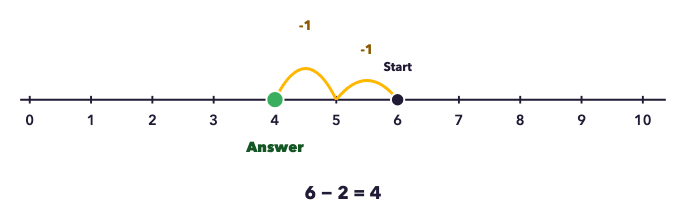
Every number line subtraction problem follows one fixed rule: mark the first number, then move left by exactly the size of the second number. Take 6 − 2—start at 6, hop left twice, and land on 4. That's it; the same rule holds whether the numbers are single digits or two-digit numbers with regrouping.
Direction is the part kids mix up most, because addition on a number line moves right. Subtraction always moves left—no exceptions in Grade 1–3 math. Once that single rule is automatic, everything else in this guide is just changing how big each hop is.
Try it yourself:
Why Your Child's Teacher Starts Here Instead of Borrowing
Schools teach the number line before the stack-and-borrow method for one reason: a hop is visible, and “borrow a 1” isn’t.
- A first or second grader can watch a hop happen. “Borrow a 1 from the tens column” describes a rule with no picture attached.
- Second grade Common Core standards name number line diagrams as a required tool for addition and subtraction—why this shows up in nearly every US classroom around that age.
- Same logic as teaching a ten frame before column addition: visual first, abstract later.
- The number line isn’t new. English mathematician John Wallis used a horizontal line for positive and negative numbers as early as 1685.
- What changed in 2010 wasn’t the tool—it was making “draw a number line” a required step before a child ever sees the column method.
- By 3rd or 4th grade, “borrowing” is the same backward ten-jump a child already practiced here, just written on paper instead of drawn on a line.
Want to see the hops happen instead of just reading about them?
Three Hopping Skills Your Child Will Build in Order
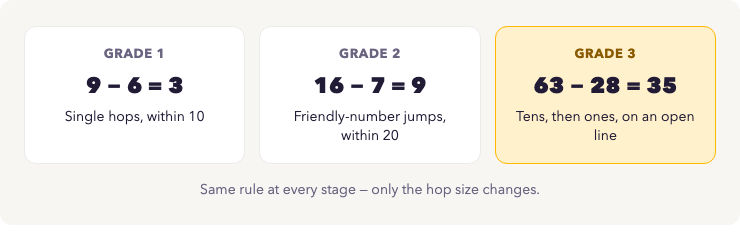
The rule from above never changes. What changes, from grade over grade, are how big a single hop is allowed to be from one unit at a time to grouped jumps to full tens?
Skill 1: Counting Back One Hop at a Time
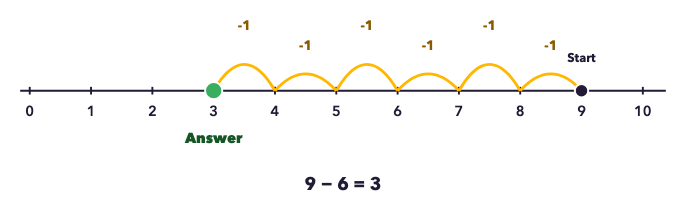
This is where every child starts: one hop equals one unit, and the numbers stay under 10. For 9 − 6, that's six single hops—8, 7, 6, 5, 4, 3—landing on 3.
How to walk through it:
- Mark the first number (9) on a number line that runs at least a few spaces past it.
- Hop left one space at a time, counting out loud, once for every unit in the second number (6 hops).
- Whatever number the last hop lands on is the answer.
Practice Yourself:
Skill 2: Jumping to a Friendly Number
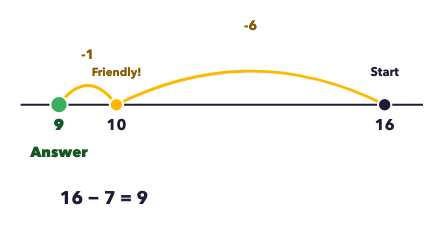
Once single hops feel slow, kids start grouping them, usually by aiming for a round number first, the same “friendly number” thinking behind number bonds in addition. For 16 − 7: hop back 6 to land on the friendly number 10, then one more hop back to land on 9.
How to walk through it:
- Draw a blank (open) line and write the first number (16) on the left end.
- Find the nearest ten below it (10) and jump there first; that's a hop of 6.
- Jump the leftover amount (1 more) to finish the subtrahend (7 total).
- The landing spot is the answer: 16 − 7 = 9.
Practice Yourself:
Skill 3: Splitting the Jump Into Tens, Then Ones
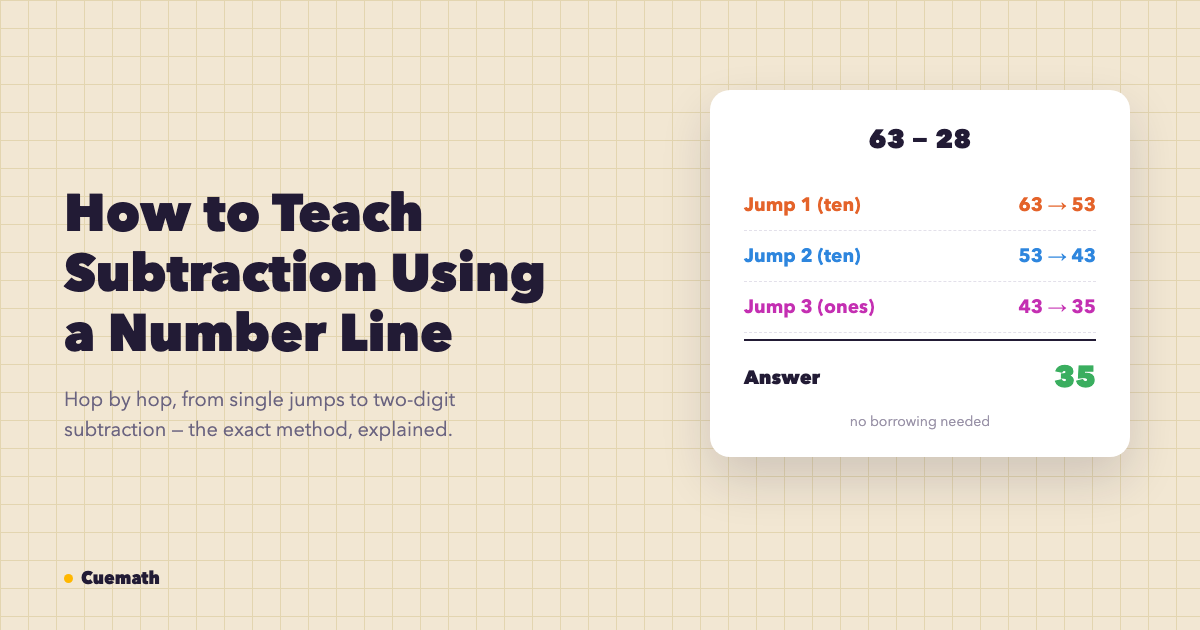
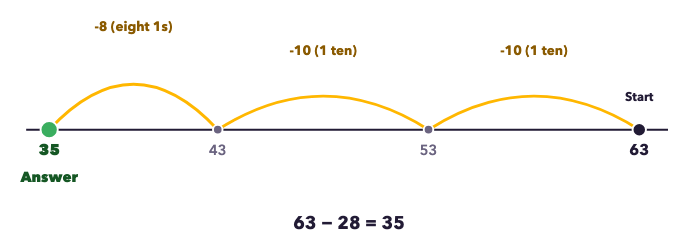
By Grade 3, kids split the second number into tens and ones and take one full jump per ten before finishing with the ones; no regrouping is needed on paper. For 63 − 28: split 28 into 2 tens and 8 ones, jump back the tens first (63 → 43), then the ones (43 → 35).
How to walk through it:
- Mark the first number (63) on an open number line.
- Split the second number (28) into tens and ones: 2 tens, 8 ones.
- Jump back a full ten at a time: 63 → 53 → 43, then jump back the ones: 43 → 35.
- The landing spot is the answer: 63 − 28 = 35.
Practice Yourself:
Mixed Practice: All Three Skills. One of each; see if you can tell which skill each problem calls for before you start hopping.
Where the Hops Go Wrong
Most errors on a number line trace back to one of four habits, not a misunderstanding of subtraction itself.
| Mistake | What It Looks Like | The Fix |
|---|---|---|
| Miscounted hops | Solving 50 − 17: the ten-jump is right (50 → 40), but the child only makes 6 one-hops instead of 7, landing on 34 instead of 33 | Mark every single hop with a tick or a dot instead of counting silently |
| Wrong direction | Child jumps right out of addition habit | Say "left is less" out loud before drawing the first hop |
| Splitting the wrong number | Child breaks the first number into tens and ones instead of the second | Circle the second number (the one being taken away) before drawing anything |
| Losing the running total | Child only writes the final answer, not the number after each jump | Write the new landing number after every single hop, not just the last one |
Make It a Game, Not a Worksheet
A number line works just as well outside a worksheet as on one.
- Sidewalk Number Line: Chalk a number line from 0 to 20 outside. Call out a problem—"14 minus 6!"—and have your child hop backward the right number of spaces, landing on the answer with their feet.
- Race to Zero: Roll two dice, subtract the smaller number from the larger, and move a game piece backward that many spaces on a printed number line board. First piece to land exactly on zero wins.
- Stair-Step Subtraction: Stand your child on a numbered stair and call out a problem. They step down one stair per unit and say the new number out loud at each step.

What 1:1 Attention Catches That a Worksheet Can't
A worksheet only grades the final landing number. A tutor watches the hops themselves, asking, "Why did that jump go right?" or "How many total hops was that?" and catches a wrong-direction jump or a miscount before it hardens into a habit. That kind of question-first coaching, instead of just marking answers wrong, is the core of Cuemath's MathFit approach: guide a child to catch their own mistake instead of just handing them the correct one.
Reviews rotate automatically — real Cuemath parents, Trustpilot
Here's a leveled set to try first.
Easy (single hops, within 10):
Medium (friendly-number jumps, within 20):
Hard (tens-and-ones jumps, two-digit):
Keep the Practice Going in the Free Cuemath App
Daily 5-minute workouts turn today's number line hops into fast, confident subtraction. 100% free, no credit card needed.
Get the Free AppFor Students in Grades K to 12 Worldwide
Keep Exploring New Math
- The Lattice Method: A 700-Year-Old Math Trick for Multiplication
- The Distributive Property in Multiplication: Why New Math Teaches It Early
- Partial Products: The Multiplication Method That Comes Before Carrying
- The Box Method for Multiplication: A Step-by-Step Guide for Parents
- What Is the Area Model in Math? The New Way Schools Teach Multiplication
Frequently Asked Questions
What is number line subtraction?
Number line subtraction is a method of subtracting two numbers by starting at the first number on a marked line and hopping backward by the value of the second number. The number a child lands on after the last hop is the answer. Schools introduce it in Grade 1 because it makes the “taking away” part of subtraction visible instead of abstract.
How do you subtract on a number line step by step?
Mark the first number on the line, then hop backward—to the left—once for every unit in the second number. For 10 − 6, that means starting at 10 and hopping back 6 spaces to land on 4, so 10 − 6 = 4. For bigger numbers, group hops into tens and ones instead of counting one by one.
Which direction do you jump on a number line to subtract?
You always jump left, or backward, when subtracting a positive number. This is the opposite of addition, which moves right on a number line. Subtracting a negative number flips this back to a rightward jump, but that's a topic for later grades, not Grades 1–3.
What's the difference between number line subtraction in Grade 1 and Grade 3?
The underlying rule stays identical across every grade—mark the first number, hop backward by the second—but the size and grouping of each hop change. Grade 1 uses single-unit hops within 10, Grade 2 groups hops around friendly numbers within 20, and Grade 3 splits two-digit numbers into ten jumps and one jump on an open number line.
What is an open number line, and why does my child's teacher use one?
An open number line is a blank line with no numbers pre-marked, where a child writes in only the numbers they land on during each jump. Teachers use it because it scales to any size number without needing a pre-printed line long enough to cover every value, and it forces a child to track each jump deliberately instead of reading off a fixed scale.
How do you subtract 2-digit numbers on a number line?
Split the second number into tens and ones, then jump back a full ten at a time before finishing with the ones. For 54 − 19, that means starting at 54, jumping back 1 ten to land on 44, then jumping back 9 ones to land on 35, so 54 − 19 = 35.
Where can I find free number line subtraction worksheets?
Cuemath's subtraction worksheets page has free, printable number line subtraction worksheets organized by grade, alongside the leveled practice problems in this guide. A printed sheet gives kids room to draw their own hops by hand, which builds the skill faster than typing answers on a screen.
Is number line subtraction the same as counting back?
Number line subtraction and counting back use the same backward logic, but counting back is usually done mentally with nothing drawn, while number line subtraction uses a visual line to track each jump. Counting back mentally works fine for small subtrahends under 5; past that, most kids need the line to avoid losing count.
Sources
- Common Core State Standards Initiative—Mathematics—official K-12 math standards; Grade 2 standards explicitly require number line diagrams for addition and subtraction within 100.
- National Council of Teachers of Mathematics (NCTM)—professional standards body for math education in the US.
- Illustrative Mathematics—nonprofit, CCSS-aligned K-12 curriculum resource used by US districts.
- ERIC—Institute of Education Sciences, US Dept. of Education—federally funded database of peer-reviewed education research on number line instruction.

I was never the kid who loved math. I was much more interested in books, stories, and writing, and, somewhere along the way, I became even more curious about people. Why do we learn differently? Why does something make sense to one child but not another? And what makes a student feel confident enough to keep trying?
That curiosity led me to study Applied Psychology, where I learned more about how children think, learn, and make sense of the world around them.
My love for writing did the rest. What started as something I simply enjoyed became a career. Over the past five years, I've worked as a freelance writer across edtech, SaaS, B2B, travel, lifestyle, and healthcare, learning how to write for very different audiences without losing the human side of the story.
Today, I'm an SEO Content Writer & Editor at Cuemath, where I get to bring many of these interests together. Working in education, and especially around math, has made me even more curious about what happens behind the screen or textbook: what parents worry about, what students struggle with, and what actually helps them learn.
That's also how I like to research. I don't just look at search results and call it a day. I go where parents and students actually talk: forums, reviews, communities, and conversations with real families. Because sometimes the most useful insight isn't hiding in a keyword; it's in a parent's question, a student's frustration, or a small detail someone shares about their learning experience.
I write because I'm curious. I research because I want to understand. And I love turning what I learn into content that feels genuinely useful to the people reading it.