The Distributive Property in Multiplication: Why New Math Teaches It Early
Your child's homework shows multiplication broken into boxes and smaller pieces, and it looks nothing like what you learned. This guide explains the real math rule behind it—the distributive property—and why schools now teach it years earlier than they used to.

Ever watch your child tackle a multiplication problem and think, “Wait… why are they doing it that way?” You’re not alone! Today’s elementary math can look different from the way many parents learned it, and the distributive property is a perfect example.
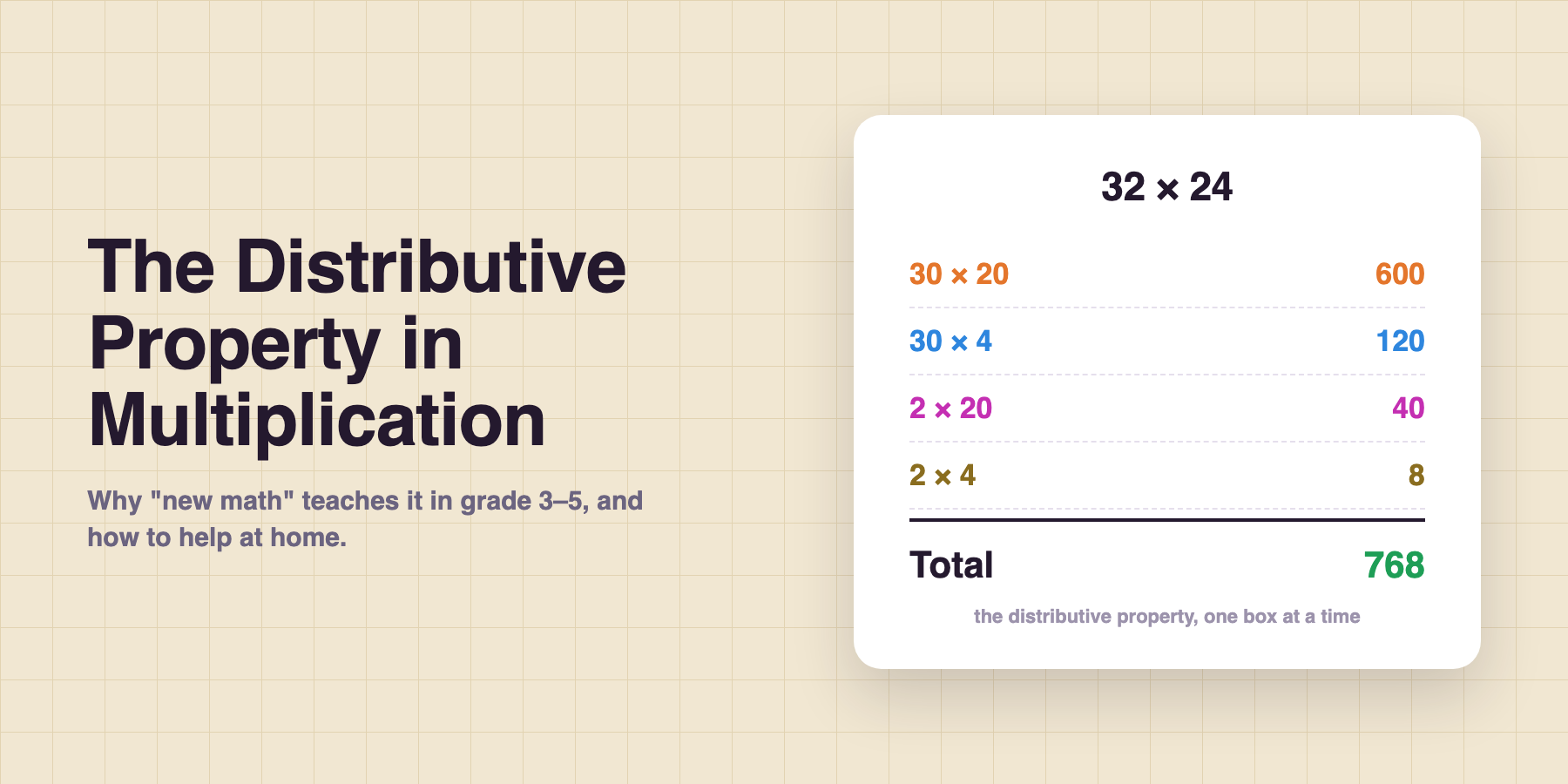
Despite its big, grown-up name, the idea is surprisingly simple: break a tricky multiplication problem into smaller, friendlier pieces. Think of it as giving your child a math problem they can actually manage, one bite at a time.
Take this example below, and instead of treating it as one big problem, a child might break:
Nothing magical happened; we simply split the problem into parts we already know how to solve, then put those parts back together.
So why does this show up in elementary school? Because math is about more than getting the right answer. Teachers want children to see how numbers work, spot patterns, and develop strategies they can use when the numbers get bigger and the problems get harder. The distributive property becomes a useful building block for mental math, multi-digit multiplication, fractions, algebra, and much more.
In this guide, we’ll take the mystery out of the distributive property, show what it looks like in everyday multiplication, and explain why learning to break numbers apart and put them back together is such an important math skill.
School math + test prep + skills AI can't match, at $0 cost.
Everything your child needs from Grade K to 12, curriculum mastery, test prep, and enrichment math, is now in one free app.
Simple log in with email, nothing else
- What Is the Distributive Property in Multiplication?
- Why Does the Box Method Look So Different?
- How the Box Method Works, Step by Step
- Why Common Core Moved This to Grade 3 and 4
- Does My Child Still Need the Standard Algorithm?
- How to Help at Home
- Try It Yourself (5 Questions)
- Box Method vs. Area Model vs. Partial Products
- How Cuemath Tutors Teach This
- Full Practice Challenge (10 Questions)
- FAQ
- Sources
What Is the Distributive Property in Multiplication?
The distributive property says a number multiplied by a sum equals that number multiplied by each part of the sum, then added together: a × (b + c) = (a × b) + (a × c). It always comes down to the same three steps.
The same three steps every time, no matter how big the numbers get. Take 7 × 6: instead of treating it as one big fact, a child might break 6 into 5 + 1, multiply 7 by each part, then add the results.
The same idea works for bigger numbers too. Take 5 × 23: split 23 into 20 + 3, multiply 5 by each part, then add the results.
| Step | Calculation | Result |
|---|---|---|
| Split the second factor | 23 = 20 + 3 | — |
| Multiply each part | 5 × 20 and 5 × 3 | 100 and 15 |
| Add the parts (100 + 15) | 115 | |
Every box your child draws in class is a picture of this exact equation—one box per multiplication, then addition to finish.
Why Does the Box Method Look So Different From How I Learned It?
The box method looks unfamiliar because most US schools taught the distributive property only in algebra, if at all, before Common Core. Common Core introduced it as a grade 3 standard (3.OA.5, "properties of operations") and made it the foundation of multi-digit multiplication in grade 4. Most parents learned the standard algorithm—stack the numbers, multiply, carry—without ever seeing the reasoning underneath it drawn out. Your child is learning the same rule you did, just years earlier and with the steps shown instead of hidden inside a shortcut.
The box method isn’t the only "new math" strategy that looks unfamiliar for this reason. New math replaced several old techniques with visual, number-sense-first strategies: number bonds and ten frames for addition in the early grades and subitizing before kids even start counting formally.
How the Box Method Uses the Distributive Property, Step by Step
Take a harder example: 34 × 26. Split both numbers into tens and ones—34 becomes 30 + 4, and 26 becomes 20 + 6—then multiply every combination.
Both factors split into tens and ones before any multiplying starts.
| Step | Calculation | Result |
|---|---|---|
| 1 | 30 × 20 | 600 |
| 2 | 30 × 6 | 180 |
| 3 | 4 × 20 | 80 |
| 4 | 4 × 6 | 24 |
| Total (600 + 180 + 80 + 24) | 884 | |
That's the whole trick: four boxes, four partial products, and one sum. 34 × 26 = 884, and the box method just shows every piece of that addition instead of hiding it inside carried digits.
The method doesn't change as the numbers get bigger—there are just more parts to multiply and add. Here's one worked example for each size a grade 3-5 student typically sees.
2-Digit × 1-Digit—46 × 7
| Step | Calculation | Result |
|---|---|---|
| 1 | 40 × 7 | 280 |
| 2 | 6 × 7 | 42 |
| Total (280 + 42) | 322 | |
3-Digit × 1-Digit—214 × 6
| Step | Calculation | Result |
|---|---|---|
| 1 | 200 × 6 | 1,200 |
| 2 | 10 × 6 | 60 |
| 3 | 4 × 6 | 24 |
| Total (1,200 + 60 + 24) | 1,284 | |
3-Digit × 2-Digit—142 × 23 (a Grade 5 Stretch Problem)
| Step | Calculation | Result |
|---|---|---|
| 1 | 100 × 20 | 2,000 |
| 2 | 100 × 3 | 300 |
| 3 | 40 × 20 | 800 |
| 4 | 40 × 3 | 120 |
| 5 | 2 × 20 | 40 |
| 6 | 2 × 3 | 6 |
| Total (2,000 + 300 + 800 + 120 + 40 + 6) | 3,266 | |
Why Did Common Core Move This Rule to Grades 3 and 4?
Before Common Core, most state standards kept the distributive property in middle-school algebra, where it showed up as a rule for simplifying expressions like 4(x + 3). Common Core pulled it down into grade 3 as one of the core "properties of operations" kids use to understand multiplication and division, then leaned on it directly in grade 4 to multiply multi-digit numbers by breaking a two-digit factor into tens and ones. Grade 5 extends the same idea to larger numbers and asks kids to explain why the strategy works, not just execute it. The property itself didn't change—the grade it's introduced in did.
Does My Child Still Need to Learn the Standard Algorithm?
Yes, Common Core still expects students to know the standard stack-and-carry algorithm fluently by the end of grade 5. The box method comes first because it shows why the standard algorithm works: every digit carried in the traditional method is really one of the partial products from the box, just combined into a faster, more compact format. A child who learns the box method first sees what each digit in the standard algorithm actually represents, instead of memorizing a sequence of steps.
How to Help at Home Without Confusing Things Further
It undercuts what the teacher is building toward.
Do this before checking the final answer—the reasoning matters more than a fast right answer.
Grid paper, an egg carton, or coins, before moving to numbers on a page alone.
5s and 10s first, before moving to harder ones like 6s, 7s, and 8s.
Try It Yourself
Box Method vs. Area Model vs. Partial Products: What's the Difference?
These three terms confuse parents more than the math itself does—they're the same rule shown three slightly different ways.
| Term | What it looks like | Same rule? |
|---|---|---|
| Box Method / Area Model | A grid split into rows and columns for tens and ones | Yes—distributive property |
| Partial Products | Each multiplication written on its own line, then added | Yes—distributive property |
| Standard Algorithm | Numbers stacked, multiplied digit by digit, with carrying | Yes, compressed into carried digits |
Same numbers, two layouts. Here is 34 × 26 written both ways:
| 30 | 4 | |
|---|---|---|
| 20 | 600 | 80 |
| 6 | 180 | 24 |
Same four numbers—600, 180, 80, 24—for 34 × 26. Partial products lists them; the box method arranges them in a grid.
If your child's teacher uses a different name for the same grid or writes each piece on its own line instead—that's partial products, covered step by step in our companion guide—it's still this rule.
For more worked examples of either approach, see our dedicated guides to Box Method Multiplication and Area Model Multiplication.
Want Your Child to See the Why, Not Just the Steps?
The Cuemath app has free concept videos and unlimited practice on the distributive property, box method, and partial products—all in one place.
Explore It FreeFor Students in Grades K to 12 Worldwide
How Cuemath Tutors Teach the Distributive Property
- Cuemath tutors don’t hand a child the box method as a set of steps to copy—they use a "cue, don’t tell" approach, asking questions until the student sees why splitting a number into tens and ones works, then let the student build the box themselves.
- This matches the "Understanding" pillar of Cuemath's MathFit framework: a child who can explain why 34 × 26 breaks into four smaller multiplications retains the strategy longer than one who just memorizes a grid template.
- In 1:1 live sessions, a tutor can slow down on exactly the step a specific child gets stuck on, usually splitting the second factor correctly or keeping track of which partial product goes where instead of moving the whole class forward regardless.
Full Practice Challenge
Not Sure Your Child Has the Place-Value Foundation the Distributive Property Needs?
Book a Free Evaluation100% Free · No Credit Card Needed · Takes About 15 Minutes
Frequently Asked Questions
What is the distributive property in multiplication?
The distributive property says a number times a sum equals that number times each part of the sum, added together—for example, 5 × 23 = (5 × 20) + (5 × 3). Cuemath tutors use this same rule to explain the box method and partial products, since both are just visual or written versions of this one equation.
Why do schools teach the distributive property earlier than they used to?
Common Core moved the distributive property from middle-school algebra into grade 3, where it's introduced as a property of multiplication, then used directly in grade 4 to multiply multi-digit numbers. Cuemath's grade 3-5 curriculum follows this same sequence, so a child's Cuemath sessions match what their school is doing that week.
Is the box method the same thing as the distributive property?
Yes—the box method is a visual way to show the distributive property, splitting each factor into tens and ones and multiplying every combination. Cuemath tutors draw the same grid a classroom teacher would, so the strategy looks familiar to the child even in a 1:1 session.
What grade learns the distributive property?
Common Core introduces the distributive property in grade 3 (as a property of operations) and uses it directly for multi-digit multiplication in grade 4, extending to larger numbers in grade 5. Cuemath tutors adjust how deep they go into the property based on the child's current grade and school pace.
Will my child stop learning the standard multiplication algorithm?
No—Common Core still expects students to master the standard stack-and-carry algorithm by the end of grade 5. Cuemath tutors treat the box method as the step that makes the standard algorithm make sense, not a replacement for it.
What's the difference between the box method and partial products?
The box method organizes the same multiplications inside a grid, while partial products lists each multiplication as its own line before adding them—both come from the distributive property. Cuemath tutors show a child both formats, so a switch in vocabulary from one teacher to the next doesn't feel like new math.
How do I help my child with distributive property homework without confusing them?
Ask your child to explain each box out loud instead of reteaching the standard algorithm you learned, since introducing a second method too early is what actually causes confusion. Cuemath tutors use the same "explain it back" approach in live sessions, which is why 1:1 support often clears up a stuck step faster than repeating the same worksheet at home.
Why does a two-digit multiplication problem turn into four smaller ones?
Splitting both factors into tens and ones creates four possible pairings—tens×tens, tens×ones, ones×tens, and ones×ones—and the distributive property says all four have to be multiplied and added to get the right answer. Cuemath tutors walk through exactly this breakdown with a child until the pattern becomes automatic, not just memorized.
Sources
- Common Core State Standards—Grade 3, 3. OA.5—The official standard introducing properties of multiplication at grade 3.
- Southwest Schools—Parent Tips, Grade 4 Module 3—District parent guide on grade 4's use of the distributive property.
- Scholastic — Guide to Non-Standard Multiplication Methods — Teacher-written parent letter on why schools teach the box method before the standard algorithm.
- ScienceDirect—Challenges in students' use of the distributive property—Peer-reviewed research on where students struggle with this property.

I was never the kid who loved math. I was much more interested in books, stories, and writing, and, somewhere along the way, I became even more curious about people. Why do we learn differently? Why does something make sense to one child but not another? And what makes a student feel confident enough to keep trying?
That curiosity led me to study Applied Psychology, where I learned more about how children think, learn, and make sense of the world around them.
My love for writing did the rest. What started as something I simply enjoyed became a career. Over the past five years, I've worked as a freelance writer across edtech, SaaS, B2B, travel, lifestyle, and healthcare, learning how to write for very different audiences without losing the human side of the story.
Today, I'm an SEO Content Writer & Editor at Cuemath, where I get to bring many of these interests together. Working in education, and especially around math, has made me even more curious about what happens behind the screen or textbook: what parents worry about, what students struggle with, and what actually helps them learn.
That's also how I like to research. I don't just look at search results and call it a day. I go where parents and students actually talk: forums, reviews, communities, and conversations with real families. Because sometimes the most useful insight isn't hiding in a keyword; it's in a parent's question, a student's frustration, or a small detail someone shares about their learning experience.
I write because I'm curious. I research because I want to understand. And I love turning what I learn into content that feels genuinely useful to the people reading it.