What Are Number Bonds? The New Math Strategy Behind Every Addition Problem
Number bonds are the building block behind almost every addition and subtraction problem your child will solve in elementary school. Here's what they actually are, why schools teach them this way, and how to help at home.

🗓️ Last Updated: October 2026
Have you ever wondered why children can learn to count so quickly but then get completely confused when they are asked to do something like 7 + ? = 10?
This is where number bonds can be a huge help.
Number bonds are an easy way to help children understand that numbers can be broken into smaller parts and those parts can be put together to make the whole.
Think of it as a number puzzle.
e.g., we have 5:
2 + 3 is 5.
So we can write 2 + 3 = 5.
Here 5 is the whole, and 2 and 3 are the parts.
You can even make it a little game with your child:
“I have 5 apples. I give you 2. How many do I have left?”
Your child can see that 2 + 3 equals 5.
And that’s the magic of number bonds; they help kids see how numbers fit together rather than just remembering addition facts.
Number bonds are a way of helping children to see the connection between the numbers, rather than saying to a child, 'Learn lots of individual facts.'
In this blog we’ll be looking at number bonds in a fun and simple way and how you can practice them with your child at home, using everyday objects, quick games, and easy activities.
- A number bond shows how a whole number splits into parts. 3 + 7 = 10 is a bond, not a new topic.
- Kindergartners split numbers up to 10, 1st graders add and subtract within 20, and 2nd graders know every one-digit sum from memory (Common Core K.OA.3, 1.OA.6, 2.OA.2).
- A 2009 peer-reviewed study found kindergarten number sense predicts math achievement all the way through 3rd grade.
- A child who freezes when a bond is reversed (“10 minus 6?”) hasn’t fully learned it. Both directions matter.
- Cuemath tutors teach the “why” behind each bond through guided questions, not answers handed over.
- What Is a Number Bond?
- Why Do Schools Teach This Instead of “Just Adding”?
- Number Bonds to 10 and 20: The Full List
- How to Use Number Bonds for Subtraction
- Number Bonds by Grade
- Does This Actually Help Kids Learn Math Better?
- The Real Problem: Parents Weren’t Taught This
- How a Cuemath Tutor Makes Number Bonds Click
- How to Practice Number Bonds at Home
- FAQs
What Is a Number Bond?
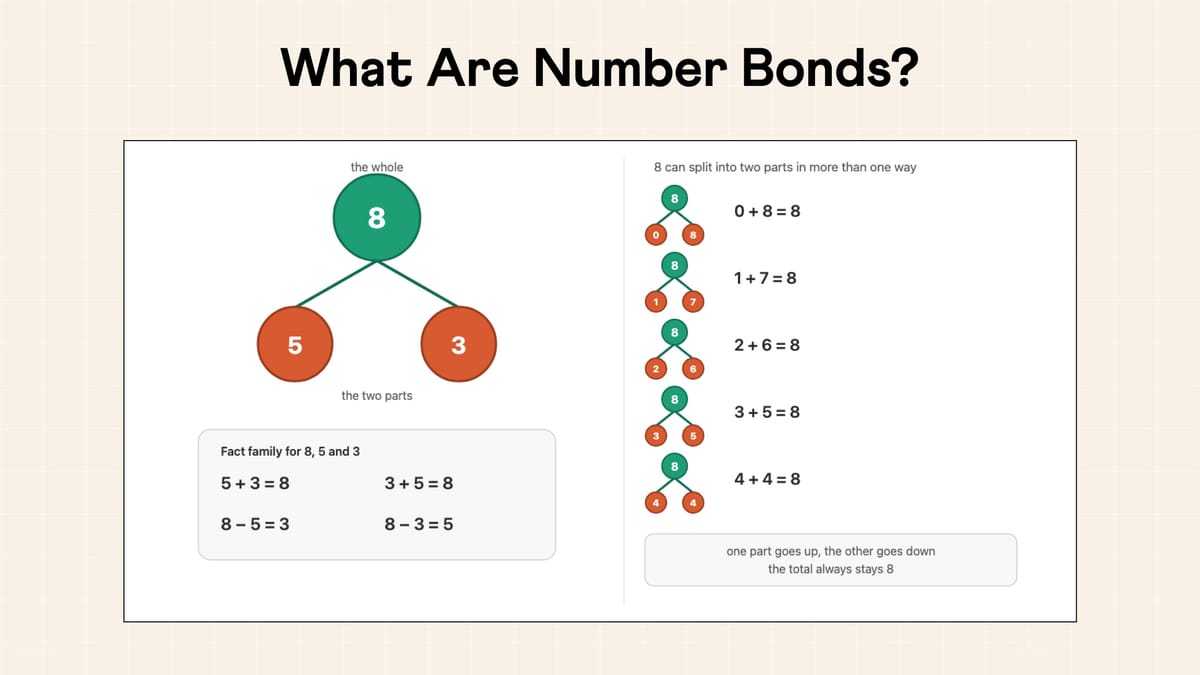
A number bond is a simple diagram that shows how a number (the whole) splits into two parts. For example, 10 splits into 3 and 7, so 3 + 7 = 10 and 10 − 7 = 3. Kids use number bonds to learn addition and subtraction facts together and to see how numbers fit.
One circle for the whole. Two circles for the parts. That’s the entire idea:
Read it either direction: 3 + 7 = 10, or 10 − 7 = 3. One diagram, four facts, which is why one number bond gives you a whole “fact family.” That’s the same fluency our Math Facts Practice guide builds on.
One number bond, four related facts. That’s the whole “fact family.”
Why Do Schools Teach This Instead of “Just Adding”?
The addition most parents learned teaches how to get an answer: stack the numbers, carry the 1. Number bonds teach why the answer works. A child who understands that 7 and 3 “bond” to 10 can solve 47 + 3 or 10 − 7 the same way, instead of learning a new rule for each. That’s the real difference behind “new math” vs. “old math.” See our full New Math vs. Old Math guide for the grade-by-grade comparison.
- 8 → 4 + 4
- 26 + 4 = 30
- 30 + 4 = 34
Same problem, same answer. One method reaches it through a memorized rule, the other through a number relationship.
- 13 → 10 + 3
- 10 − 8 = 2
- 2 + 3 = 5
1st grade level: the same bridging idea works in reverse for subtraction.
- 26 → 3 + 23
- 47 + 3 = 50
- 50 + 23 = 73
2nd grade level: bigger numbers, same bridging strategy.
Teachers call this strategy making ten, and the 1st grade Common Core standard names it directly (1.OA.6): 8 + 6 becomes 8 + 2 + 4 = 10 + 4 = 14. The same idea runs backward for subtraction, so 13 − 4 becomes 13 − 3 − 1 = 9.
Number Bonds to 10 and 20: The Full List
Kindergartners usually start even smaller, with the number bonds to 5: 0 + 5, 1 + 4 and 2 + 3. Once those feel easy, move on to 10.
Every bigger bond builds on these two sets. Bonds to 10 come first:
Every bond to 10, at a glance: the full set worth memorizing first.
Bonds to 20 follow the same pattern with a ten added to one part:
All 11 bonds to 20. Each one is a bond to 10 with an extra 10 added: 3 + 7 becomes 13 + 7.
Bonds to 100 work the same way with tens: 30 + 70, 60 + 40. For a number like 36, bond the ones to 10 (6 + 4) and the tens to 90 (30 + 60), so 36 + 64 = 100.
How to Use Number Bonds for Subtraction
A number bond turns subtraction into a missing-part question. To solve 10 − 4, put 10 in the whole circle and 4 in one part, then ask: what goes with 4 to make 10?
- Write the whole on top. For 10 − 4, that is 10.
- Put the number you take away in one part. That is 4.
- Find the missing part. 4 and 6 make 10, so 10 − 4 = 6.
For bigger numbers, subtract down to 10 first. For 15 − 7, split 7 into 5 and 2: 15 − 5 = 10, then 10 − 2 = 8. The 1st grade standards call this decomposing a number leading to a ten (1.OA.6).
Number Bonds by Grade
Here's what the Common Core standards ask for at each grade. Kindergartners split numbers up to 10 into pairs and find the partner that makes 10 (K.OA.3, K.OA.4). 1st graders add and subtract within 20 and become fluent within 10, using strategies like making ten (1.OA.6). By the end of 2nd grade, children add and subtract within 20 fluently and know every sum of two one-digit numbers from memory (2.OA.2). More on what else is covered in What Do 1st Graders Learn in Math, or check where a 2nd grader stands with our 2nd grade math problems.
Number bonds are taught by name through 2nd grade, but the part-whole thinking keeps coming back with each new operation:
- Sees a small number as two parts, like 3 and 2 making 5
- Uses real objects and counters before any written numbers
- Ties bonds directly to addition and subtraction fact families
- Adds and subtracts within 20, fluent within 10 (Common Core 1.OA.6)
- Partitions two-digit numbers into tens and ones
- Knows all one-digit sums from memory and bridges through 10 in two-digit problems (2.OA.2)
- The same part-whole thinking, now applied to groups: 12 is 4 groups of 3
- Knowing 3 × 4 = 12 also gives 12 ÷ 3 = 4 and 12 ÷ 4 = 3, a multiplication fact family
- The whole/parts idea extends to decimals: 0.3 and 0.7 bond to make 1.0
- Also shows up in fractions, like ½ and ½ making a whole
From 3rd grade on, it's the same skill applied to new numbers. Knowing that 4 groups of 3 make 12 gives 12 ÷ 3 = 4, and 0.3 and 0.7 bond to make 1.0 the same way 3 and 7 make 10. A child who's solid on number bonds in 2nd grade isn't starting from scratch when multiplication tables or fractions show up.
Does This Actually Help Kids Learn Math Better?
Yes. A child who masters number bonds doesn’t just get faster at today’s worksheet, they build a skill that keeps paying off. They move from counting on fingers to solving problems in their head, handle multi-digit addition and subtraction without learning a new trick for every problem, and walk into fractions, multiplication, and algebra already comfortable with how numbers relate to each other.
The research backs this up: a 2007 study found kindergarten number sense explained 66% of a child’s 1st-grade math score, and a related 2009 study found the same skill kept predicting performance all the way through 3rd grade.
The Real Problem: Parents Weren’t Taught This
Number bonds come from Singapore Math and spread through US classrooms with Common Core-aligned curricula after 2010, so most parents never learned them in school. That's the real source of homework frustration. Number bonds aren't harder; explaining “carry the 1” draws on 20+ years of practice, while explaining a number bond means learning it alongside your child.
+8
Can you beat your kid at their own homework?
Three problems, solved the way schools teach them now. No carrying, no borrowing, no "because that's how I learned it."
48 + 37 = ? Rule: no carrying.
See how your kid does it
Break 37 into a bond of 2 and 35. Give the 2 to 48 to make a friendly 50. Then 50 + 35 = 85.
403 − 198 = ? Rule: no borrowing.
See how your kid does it
Start at 198 and jump forward: +2 to 200, +200 to 400, +3 to 403. Add the jumps: 2 + 200 + 3 = 205. No zeros to borrow from.
? + 38 = 100 Rule: no column subtraction.
See how your kid does it
Bond 38 up to the next ten: +2 makes 40. Then bond 40 to 100: +60. The missing part is 2 + 60 = 62.
Your kid has already won this round. 😄
Hand over the screen. In the free Cuemath app, your child practices these methods every day, and can show you how it's done.
100% Free • No Card Needed • A Few Minutes a Day
How a Cuemath Tutor Makes Number Bonds Click
A tutor’s job isn’t to hand over the answer. It’s to ask the question that gets a child there themselves. That’s the “cue, don’t tell” approach behind every Cuemath 1:1 session: instead of saying “10 minus 3 is 7,” a tutor asks “if 3 and something make 10, what’s that something?”
Cuemath’s MathFit framework builds this through interactive simulations that show the “why behind the what" and “Teach It Back” moments where a child explains the bond in their own words. A tutor can tell instantly whether a child truly gets it or is just repeating a memorized line, something a worksheet can’t catch.
Not Sure Where Your Child’s Number Bonds Are Shaky?
A free evaluation finds the exact gap: bonds to 10, 20, or the reverse-subtraction step, in one short session.
Book a Free EvaluationFor Students in Grades K to 12 Worldwide
How to Practice Number Bonds at Home
Classrooms use the Concrete-Pictorial-Abstract (CPA) method. It works just as well at your kitchen table:
Start with the bonds to 10 in the list above; every bigger bond builds on them. More routines in How to Teach 1st Grade Math at Home.
Find the missing part in each bond: bonds to 5, 10, 20 and 100, plus two subtraction bonds. Answer all 10, then press Check My Answers.
Want more practice on paper? Print Cuemath's free number bonds worksheets for kindergarten, number bonds worksheets for 1st grade, or the full set of number bonds worksheets.
⚠️ 3 common number bond mistakes
Learning only one direction. Kids memorize “6 and 4 make 10” but freeze on “10 minus 6?” Practice both directions; that is the real test of understanding.
Splitting the wrong number. In 26 + 8, splitting 26 doesn't help. Splitting 8 into 4 + 4 gets to the next ten. Ask, “How far is it to the next ten?”
Counting up every time. If your child counts on fingers from 7 to 10 to find the partner, the bond isn't automatic yet. Keep practicing bonds to 10 until the answer comes instantly.
Number bonds need repetition to stick, and that’s what the Cuemath app is for between live sessions. Daily workouts run five quick exercises across memory, fluency, understanding, application, and reasoning. Practice mode drills bonds to 10, 20, or 100 on demand, and Arena’s Speed Rush turns bond recall into a timed game instead of a worksheet.
One App, Every Angle Your Child Needs for Number Bonds
Quick daily practice on bonds to 10, 20 and 100, plus Speed Rush and math battles your child will actually want to play. Free to try, no card needed.
100% Free • No Card Needed • A Few Minutes a Day
Frequently Asked Questions
What are number bonds in math?
Number bonds in math show how a number splits into two parts that add up to it, like 3 and 7 making 10. One number bond gives four facts: two additions and two subtractions.
What is a number bond to 20?
A number bond to 20 is any pair of numbers that adds up to 20, like 12 + 8, 15 + 5 or 10 + 10. There are 11 of them, from 0 + 20 to 10 + 10, and each one is a bond to 10 with an extra ten added.
What is the purpose of number bonds?
Number bonds help children see how numbers relate, so they can add and subtract by reasoning instead of counting on their fingers. They also link addition and subtraction, which makes later topics like regrouping and mental math easier.
How do you use number bonds for subtraction?
Put the starting number in the whole circle and the number you take away in one part, then find the missing part. For 10 − 4, ask what goes with 4 to make 10; the answer is 6.
What are examples of number bonds?
Number bonds to 10 are the classic example: 1+9, 2+8, 3+7, 4+6, and 5+5 all bond to make 10. Each pair also gives two subtraction facts (10−1=9, 10−9=1), so one bond covers four related math facts.
Are number bonds the same as fact families?
No, but they are closely linked. A number bond is the picture of a whole and its two parts, and a fact family is the set of four equations that picture gives you: the bond 3, 7 and 10 produces 3 + 7 = 10, 7 + 3 = 10, 10 − 3 = 7 and 10 − 7 = 3.
What is another name for number bonds?
Number bonds are also called number pairs, complements, or part-part-whole models. The term comes from Singapore Math, and US curricula often use “part-part-whole” for the same idea.
Can a number bond have more than two parts?
Yes, a number bond can have more than two parts, like 10 = 2 + 3 + 5. Schools start with two parts because that maps directly onto addition and subtraction facts, then add more parts once two-part bonds are automatic.
How do you explain number bonds to a child?
Start with objects they can physically split into two groups, like 10 crackers split into a pile of 4 and a pile of 6. Once that clicks, drawing the bond as connected circles and writing 4 + 6 = 10 comes easily.
What age should kids learn number bonds?
Kids start number bonds in kindergarten, around age 5, by splitting numbers up to 10 into pairs. In 1st grade (ages 6–7) they add and subtract within 20, and by the end of 2nd grade the Common Core expects them to know every sum of two one-digit numbers from memory.
Do 4th graders still use number bonds?
Yes, 4th graders still use number bonds, just with bigger numbers and new operations: multiplication and division fact families, plus decimal and fraction bonds like 0.3 + 0.7 = 1. A 4th grader who is shaky on bonds to 10 or 20 should review those first, since the bigger bonds build directly on them.
Are number bonds the same as “new math”?
Number bonds are one specific strategy inside what people call “new math,” teaching that favors number relationships over memorized steps. They’re not a separate curriculum, just one building block schools use for number sense.
Why is my child using number bonds instead of the addition I learned?
Understanding how numbers break apart makes later concepts (regrouping, fractions, algebra) easier to grasp, not because the old method was wrong. A child who understands the bond behind 47 + 8 can solve it several ways instead of relying on one memorized procedure.
How can I tell if my child understands number bonds or is just memorizing them?
Ask them to work a bond backward. If they know 6 + 4 = 10 but freeze on “10 minus 6,” they’ve memorized one direction, not the relationship.
Does Cuemath teach number bonds?
Yes. Cuemath’s 1:1 tutoring builds number bonds through the MathFit framework, using guided questions so a child works out the “why” rather than being told, reinforced with daily practice in the Cuemath app between sessions.
Sources
- Jordan, Kaplan, Ramineni & Locuniak (2009), Developmental Psychology, via NIH/PMC: peer-reviewed longitudinal study linking early number competence to later math achievement
- Jordan, Kaplan, Locuniak & Ramineni (2007), Learning Disabilities Research & Practice, 22(1): source of the 66% kindergarten number sense finding
- Common Core State Standards, Kindergarten Operations & Algebraic Thinking: official standard for number bond fluency to 10 at kindergarten
- Making Sense of Number Bonds, from Maths No Problem: Concrete-Pictorial-Abstract (CPA) method
- Trustpilot: Cuemath Reviews
- Common Core State Standards, Grade 1 Operations & Algebraic Thinking (1.OA.6): add and subtract within 20, making ten
- Common Core State Standards, Grade 2 Operations & Algebraic Thinking (2.OA.2): fluency within 20, one-digit sums from memory

I was never the kid who loved math. I was much more interested in books, stories, and writing—and, somewhere along the way, I became even more curious about people. Why do we learn differently? Why does something make sense to one child but not another? And what makes a student feel confident enough to keep trying?
That curiosity led me to study Applied Psychology, where I learned more about how children think, learn, and make sense of the world around them.
My love for writing did the rest. What started as something I simply enjoyed became a career. Over the past five years, I’ve worked as a freelance writer across edtech, SaaS, B2B, travel, lifestyle, and healthcare, learning how to write for very different audiences without losing the human side of the story.
Today, I’m an SEO Content Writer & Editor at Cuemath, where I get to bring many of these interests together. Working in education—and especially around math—has made me even more curious about what happens behind the screen or textbook: what parents worry about, what students struggle with, and what actually helps them learn.
That’s also how I like to research. I don’t just look at search results and call it a day. I go where parents and students actually talk—forums, reviews, communities, and conversations with real families. Because sometimes the most useful insight isn’t hiding in a keyword; it’s in a parent’s question, a student’s frustration, or a small detail someone shares about their learning experience.
I write because I’m curious. I research because I want to understand. And I love turning what I learn into content that feels genuinely useful to the people reading it.