What do 1st Graders Learn in Math: 8 Core Topics
In 1st grade, math focuses on building strong foundations, not speed or memorization. In this blog, I share the core topics that every 1st grade student should know. I also share teaching approaches used by Cuemath tutors. These methods help children connect math to real life.

🗞️ Last updated: October 2026
If you’re a parent of a 1st grader, you’ve probably wondered:
- What should my child be learning in math?
- How can I help without confusing them?
- Why does Common Core math feel so different, and is it actually better?
Many parents worry about teaching math the wrong way or feel stuck when their child says, “I hate math; it is just worksheets.”
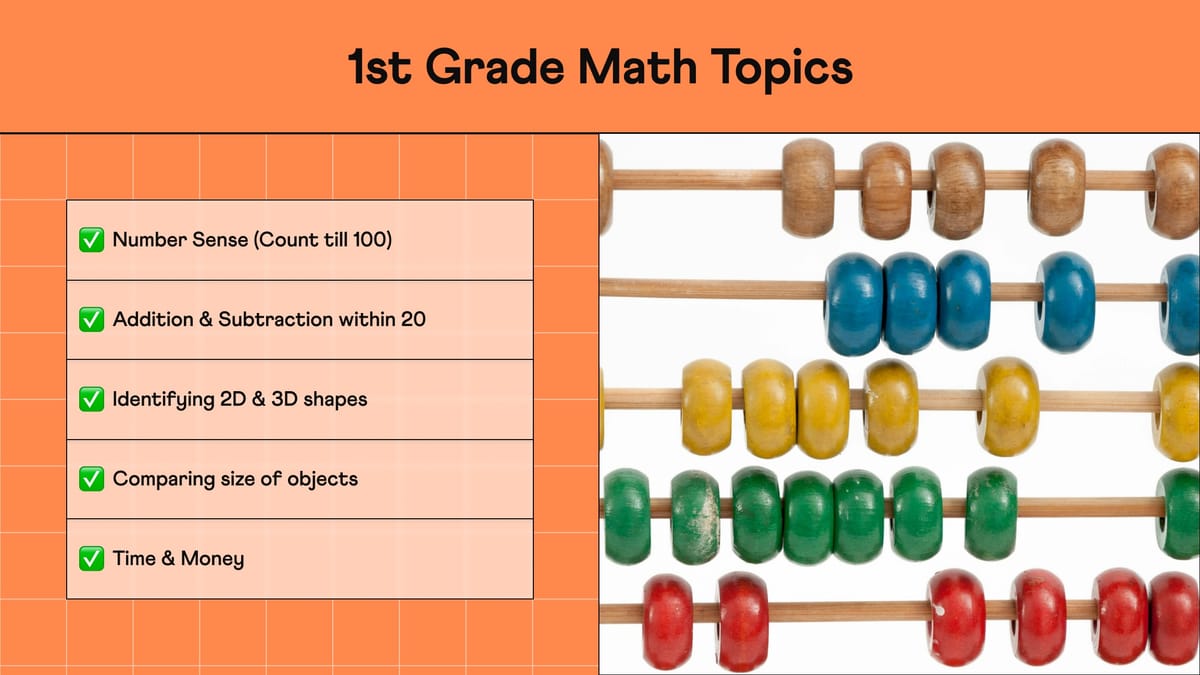
In 1st grade, students learn to count to 120, add and subtract within 20, understand tens and ones, and work with shapes, length, time, and simple graphs, with an emphasis on understanding how math works, not memorizing steps.
So in this blog, I'll discuss core 1st-grade math topics that build the foundation for elementary and middle school. I will also share some teaching methods that our Cuemath tutors use to make sure children not only learn math concepts in 1st grade, but they can also apply them in real life.
| Key Takeaways | |
|---|---|
| What 1st graders learn | Counting to 120, adding and subtracting within 20, place value, sorting, shapes, length and graphs, time to the half hour, and halves and fourths |
| The big new idea | Place value: 42 means 4 tens and 2 ones |
| What feels different | Schools ask children to explain how they solved a problem, using tools like ten frames and number lines |
| Where kids get stuck | Counting by ones instead of tens, and counting on fingers for facts within 10 |
| How to help | 15 to 20 minutes a day of real-life math, plus asking "How did you figure that out?" |
The 8 Core Topics 1st Graders Learn in Math
Here are the eight topics at a glance, with the Common Core standard each one comes from. Most US states use these standards or base their own on them.
| Topic | What your child learns | Standard |
|---|---|---|
| 1. Counting and number sense | Count, read and write numbers to 120 | 1.NBT.1 |
| 2. Addition and subtraction | Add and subtract within 20; facts within 10 quickly; word problems | 1.OA.1–8 |
| 3. Place value | Tens and ones; compare two-digit numbers; 10 more and 10 less | 1.NBT.2–6 |
| 4. Patterns and sorting | Sort objects into groups and count each group | 1.MD.4 |
| 5. Shapes | Name shapes by their sides and corners; combine 2D and 3D shapes | 1.G.1–2 |
| 6. Measurement and data | Order objects by length; measure with same-size units; read simple graphs | 1.MD.1–2, 1.MD.4 |
| 7. Time (and money in some states) | Tell time to the hour and half hour | 1.MD.3 |
| 8. Equal shares | Split circles and rectangles into halves and fourths | 1.G.3 |
1. Counting & Number Sense (Up to 120)
By the end of 1st grade, children count to 120 starting from any number, and read and write numbers up to 120.
Common challenges:
- Kids know how to count, but make mistakes when numbers aren’t in order.
- Many can count out loud but lose track when counting real objects, or when they start from a number other than 1.
Expert-Backed, Fun Ways to Build Number Sense
Here’s what Cuemath tutors recommend:
- Post a hundred chart where your child sees it daily (fridge/bedroom door). Every morning, point to today’s date and ask: “What comes one before today? What will tomorrow be?”
- Ask, “What comes before 36? After 89?” in random real-life moments (car rides, shopping).
- On a napkin, write: “18, __, 20” - challenge your child to fill in the blank, then switch roles.
Try it yourself:
2. Addition & Subtraction Within 20
Children learn to add and subtract within 20 (like 13 + 5 or 17 − 8) and to know facts within 10 quickly. They solve them mentally and in real-life word problems, not just on worksheets.
Common Challenges:
Relying on counting fingers or tally marks slows progress as numbers get larger.
Children who still count by ones for facts like 8 + 7 often stay slow into 3rd grade. Others can add with blocks but freeze when the same math shows up as a word problem.
Expert-Backed, Real-Life Ways to Teach:
- Questions related to snacks or play, build mental math, and make 1st grade math feel meaningful, like “We have 15 crackers and you ate 8. How many left?”
- Use two dice or playing cards to “build 10.” E.g., turn over a 7—ask, “What do you need to make 10?”
- Ask your child, “How did you find 9 + 6?” Kids who explain their thinking develop problem-solving skills faster.
Schools often teach this with ten frames and number bonds.
Addition and Subtraction Strategies Your Child Will Bring Home
If your child’s homework looks different from how you learned math, it’s usually one of these five strategies. The 1st grade standards name each one, so your child may be asked to show which strategy they used.
| Strategy | What it means | Example |
|---|---|---|
| Count on | Start at the bigger number and count up | 3 + 9: start at 9, then 10, 11, 12 |
| Make a ten | Split one number to fill a ten first | 8 + 5 = 8 + 2 + 3 = 10 + 3 = 13 |
| Break apart to ten | Subtract down to 10 first, then the rest | 13 − 4 = 13 − 3 − 1 = 10 − 1 = 9 |
| Think addition | Use a known addition fact to subtract | 8 + 4 = 12, so 12 − 8 = 4 |
| Use an easier fact | Turn the problem into one your child knows, like a double | 6 + 7 = 6 + 6 + 1 = 12 + 1 = 13 |
Try it yourself:
3. Understanding Place Value
1st graders learn that a number like 42 means 4 tens and 2 ones. Place value is the base for adding and subtracting bigger numbers, regrouping (“carrying” and “borrowing”) and mental math in later grades.
Common breakdowns:
- Kids read numbers but don’t know what the digits really mean.
- They count by ones instead of seeing and grouping by tens. This becomes a habit that creates trouble with later regrouping and mental math.
Expert-Backed, Practical Ways to Teach Place Value:
- Take 34 small items (beans, coins, LEGO bricks). Ask: “Can we make any groups of ten? How many tens? How many ones left?”
- Pick a number (e.g., 36). Ask: “Can you show me 36 as 3 tens and 6 ones? As 20 + 16? As two 15s plus 6?”
Try it yourself:
4. Patterns, Sorting & Categorization
Kids sort objects by size, color or shape, and count how many are in each group. Patterns aren’t a separate Common Core standard, but they matter: a Vanderbilt study that followed 517 children found that patterning knowledge in preschool and 1st grade predicted their math achievement in 5th grade.
Common Challenges:
Kids over-rely on memorizing one pattern (ABAB) and struggle to generalize. When sorting by more than one feature (size and color), children may freeze or mix up groups.
Expert-Backed, Practical Ways to Teach Patterns & Sorting:
Build patterns with real objects, not just on paper. Challenge children during chores: “Let’s line up your cars: red, blue, red, blue. What’s next?”
Try it yourself:
Find Out Which 1st Grade Topics Your Child Has Down
A free 1:1 evaluation with a Cuemath tutor checks counting, place value and addition, and shows you what to practice next.
Book a Free Evaluation100% free · No credit card · About 30 minutes
5. Geometry: 2D & 3D Shapes
Children classify shapes based on their features and compare similarities and differences. They learn to talk about shapes using terms like corners, edges, faces, and curves.
Common Challenges:
- Kids often memorize names but don’t connect them to real-life objects.
- Parents may focus only on 2D shapes, leaving 3D shapes (like cubes, cylinders) under-explored.
Expert-Recommended Ways to Teach Geometry:
- Challenge your child: “Let’s spot 5 rectangles and 3 cylinders at home/in the park.” Extend the question: “What’s different between this rectangle and your square sticker?
- Notice and talk about shapes in the world around you—geometry is everywhere.
Try it yourself:
6. Measurement & Data
When students learn math in 1st grade, they also study the basics of measurement and data.
- Measure length: Using same-size units like paper clips or blocks, laid end to end with no gaps. Rulers come in 2nd grade.
- Compare and order: Put three objects in order from longest to shortest.
- Collect and show data: Tally marks and picture or bar graphs with up to three categories.
Where Kids and Parents Struggle:
Kids often leave gaps between paper clips, overlap them, or mix up “taller” and “longer.”
Research-Backed Ways to Teach:
- Measure a table with spoons or paper clips, then ask: “How many spoons long is it?”
- Line up three toys from shortest to longest.
- Track family shoe sizes or snack counts, and draw a simple bar graph together.
Try it yourself:
7. Time & Money
In 1st grade, children tell time to the hour and half hour on analog and digital clocks. “Quarter past” and five-minute times come in 2nd grade.
Money isn’t in the 1st grade Common Core standards; it starts in 2nd grade. Some states teach coins earlier: Texas 1st graders learn pennies, nickels, dimes and quarters and their values.
Here’s what you can do:
- Ask every morning: “What time is it? When is lunch?”
- Point out: “It’s 7:30—where are the big and little hands?”
- If your state teaches coins in 1st grade, give your child a handful and ask them to sort the coins and name each one.
Try it yourself:
8. Equal Shares (Early Fractions)
Here’s what’s taught in 1st grade:
- Equal parts: Split circles and rectangles into two or four equal shares, and use the words halves, fourths and quarters.
- More shares, smaller pieces: A pizza cut into fourths has smaller slices than one cut in half. Thirds come in 2nd grade, and writing fractions like 1/2 starts in 3rd grade.
Why do students find fractions difficult?
- Kids recite fraction words but don’t see what “equal parts” means in real life.
- 1st grade math worksheets alone don’t make fractions visual or meaningful.
Expert-Approved, Practical Fraction Teaching:
- Ask, “If we eat 2 out of 4 pieces, what part is left?” Tweak the language and logic.
- Use store-bought or homemade puzzles to build and match different fractional parts.
- Divide toys or treats among friends, discuss: “Do we all get fair shares? Why or why not?”
Try it yourself:
One App, Every Angle Your Child Needs for 1st Grade Math
A short daily math workout for your 1st grader, with puzzles and games on counting, place value and addition. Free to try, no card needed.
100% Free • No Card Needed • A Few Minutes a Day
Free 1st Grade Math Worksheet (10 Questions)
Ready to see what your child knows? This 10-question review covers the main 1st grade skills. Your child can answer right here and get a score.
Covers adding and subtracting within 20, tens and ones, comparing numbers, missing numbers and word problems. Answer all 10, then press Check My Answers.
Mathematical Thinking Starts in 1st Grade: How to Build it With Cuemath?
Most worksheets and apps check one thing: is the answer right? In 1st grade, how your child got there matters more. Now that AI can solve any 1st grade problem in a second, the skills worth building are the ones AI can’t do for your child: spotting a pattern, checking whether an answer makes sense, and explaining why it works.
What a Cuemath class does differently:
| What most practice does | What a Cuemath tutor does |
|---|---|
| Gives the answer when your child is stuck | Asks a question that leads your child to it ("cue, don't tell") |
| Checks whether the answer is right | Has your child explain their thinking out loud. The Talk-o-Meter tracks how much your child talks in class |
| Moves at a fixed pace | Adjusts every class to your child's pace, with the same tutor over time |
| Drills facts for speed | Adds a puzzle or brain teaser to build reasoning |
Classes are live and 1:1, aligned to the Common Core, and taught by tutors chosen from the top 1% of applicants and trained in child psychology.
See How Your 1st Grader Thinks Through a Problem
In a free 1:1 evaluation, a Cuemath tutor works through a few problems with your child and shows you where their understanding is strong and where it needs work.
Book a Free Evaluation100% free · No credit card · About 30 minutes
Frequently Asked Questions (FAQs)
How do I help my 1st grader with math at home?
Use hands-on activities (blocks, daily games, sorting, measuring) to build confidence—don't just do worksheets.
How to teach math to a 1st grader?
The best way to teach math to a 1st grader is to keep it hands-on, visual, and fun. At this age, kids learn best when they can touch, see, and play with numbers.
- Use objects around the house, like blocks, coins, or snacks, to help them add, subtract, or understand place value.
- Start with real-world problems like: “You had 5 strawberries and ate 2. How many are left?”
- Support their thinking with tools like number lines and ten frames, and don’t worry about speed; instead, focus on helping them explain their thinking.
- Look for activities that build number sense, addition/subtraction strategies, and early place value understanding. These are the building blocks of grade 1 math.
What are the core topics in 1st grade math curriculum?
In 1st grade, children learn to add and subtract within 20, understand place value (tens and ones), count to 120, sort and graph data, measure length, tell time to the half hour, and split shapes into halves and fourths. Money is a 2nd grade topic in the Common Core.
How to teach Common Core math in 1st grade?
Teaching Common Core math in grade 1 focuses on conceptual understanding and problem-solving. Use hands-on tools like number lines, ten-frames, and visual models. Encourage students to try different approaches to solve problems and ask them to explain their thought processes. Real-world examples and consistent practice help build a strong foundation.
What are some popular ‘would you rather’ questions for 1st grade?
Here are some popular ‘Would You Rather’ questions for 1st grade math. These questions help to engage kids in simple math problems naturally:
- Would you rather have 5 apples or 3 apples and 2 more?
- Would you rather add 4 + 3 or 2 + 5?
- Would you rather count to 20 by ones or by twos?
- Would you rather have 10 candies and eat 3 or have 8 candies and eat 1?
- Would you rather group toys in sets of 2 or sets of 5?
These questions help students understand basic addition, subtraction, counting, and grouping concepts appropriate for 1st graders.
Are 1st graders introduced to math word problems?
Yes. 1st graders solve word problems that add and subtract within 20. While their reading is still developing, they often solve them with support, using drawings and objects.
What are some math terms 1st graders should know?
Common math terms for 1st graders include:
- Add, addition, sum
- Subtract, subtraction, difference
- Number line, number sentence
- More, less, equal, total, part, whole
- Shapes (circle, triangle, square, rectangle, cube, cylinder)
- Measure, length, data, bar graph, tally mark
- Time, clock, hour, half hour
Does Cuemath offer 1st grade math worksheets?
Yes. Cuemath has free 1st grade math worksheets with puzzles and pictures that practice core skills. For more practice, see these 40 1st grade math problems with answers.
What math should a 7-year-old know?
Most 7-year-olds are in 1st or 2nd grade. By the end of 1st grade, children count to 120, add and subtract within 20 (within 10 quickly), understand tens and ones, measure length, tell time to the half hour, and split shapes into halves and fourths. In 2nd grade, they move on to numbers up to 1,000, adding and subtracting within 100, and money.
Is first grade math hard?
For most children, no. The topics are simple, but two shifts can be hard: moving from counting by ones to strategies like making a ten, and place value, knowing that 42 means 4 tens and 2 ones. Short daily practice with real objects helps with both.
How is 1st grade math different from kindergarten?
In kindergarten, children count to 100 and add and subtract within 10. In 1st grade, they count to 120, add and subtract within 20, and learn place value. See what kindergartners should know and how to teach 1st grade math at home.
Sources
- Common Core State Standards, Grade 1 Number & Operations in Base Ten: counting to 120, tens and ones
- Common Core State Standards, Grade 1 Operations & Algebraic Thinking: adding and subtracting within 20, word problems
- Common Core State Standards, Grade 1 Measurement & Data: length, time to the half hour, data
- Common Core State Standards, Grade 1 Geometry: shapes, halves and fourths
- Vanderbilt University: Early math knowledge related to later achievement (2016): patterning and later math
- Texas Administrative Code §111.3, Grade 1 Mathematics: coins in Texas 1st grade
- Common Core State Standards, Kindergarten Counting & Cardinality: counting to 100 in kindergarten

I was never the kid who loved math. I was much more interested in books, stories, and writing, and, somewhere along the way, I became even more curious about people. Why do we learn differently? Why does something make sense to one child but not another? And what makes a student feel confident enough to keep trying?
That curiosity led me to study Applied Psychology, where I learned more about how children think, learn, and make sense of the world around them.
My love for writing did the rest. What started as something I simply enjoyed became a career. Over the past five years, I've worked as a freelance writer across edtech, SaaS, B2B, travel, lifestyle, and healthcare, learning how to write for very different audiences without losing the human side of the story.
Today, I'm an SEO Content Writer & Editor at Cuemath, where I get to bring many of these interests together. Working in education, and especially around math, has made me even more curious about what happens behind the screen or textbook: what parents worry about, what students struggle with, and what actually helps them learn.
That's also how I like to research. I don't just look at search results and call it a day. I go where parents and students actually talk: forums, reviews, communities, and conversations with real families. Because sometimes the most useful insight isn't hiding in a keyword; it's in a parent's question, a student's frustration, or a small detail someone shares about their learning experience.
I write because I'm curious. I research because I want to understand. And I love turning what I learn into content that feels genuinely useful to the people reading it.