How to Teach 1st Grade Math at Home: A Practical Guide for Parents
After speaking with dozens of Cuemath tutors who teach K–2 students every day, one insight comes up again and again: parents also want to help students learn math at home, but they are unsure where to focus or how to support learning without turning home into another classroom.

📕 Last Updated: October 2026
The best way to teach 1st-grade math at home is to focus on core concepts, use everyday activities like cooking and play, and pair simple home practice with expert guidance to build confidence and understanding.
You know 1st-grade math is foundational. You want your child to feel confident with numbers, not anxious or dependent on memorization. In this blog, I discuss two things that work best:
- Clear expectations of what 1st graders actually need to know
- Simple, real-world math strategies that Cuemath tutors regularly recommend to parents
| Key Takeaways | |
|---|---|
| What 1st graders learn | Counting to 120, tens and ones, adding and subtracting within 20, shapes and halves, length, time and simple graphs |
| The big new idea | Place value: 34 means 3 tens and 4 ones |
| How to practice | 15 to 20 minutes a day, through cooking, play, stories and the kitchen clock |
| What to ask | "How did you figure that out?" Explaining builds understanding |
| When to get help | If the same gaps keep coming back, a free evaluation can pinpoint them |
What Math Should a 1st Grader Know? A Curriculum Checklist
Cuemath tutors consistently remind parents that the 1st-grade math curriculum isn’t about speed or worksheets—it's about building understanding that lasts. When this foundation is strong, children progress faster and with far less frustration later on.
Here are the main 1st grade goals from the Common Core State Standards, which most US states use or base their own standards on. For a longer walk-through, see what 1st graders learn in math.
| Skill area | By the end of 1st grade, your child can… | Standards |
|---|---|---|
| Counting and place value | • Count, read and write numbers to 120 • Know 34 is 3 tens and 4 ones • Compare two-digit numbers with >, = and < • Find 10 more or 10 less in their head | 1.NBT.1–3, 1.NBT.5 |
| Addition and subtraction | • Add and subtract within 20 (within 10 quickly) • Solve word problems within 20 • Add three numbers • Know = means "the same as" • Add within 100 using tens and ones | 1.OA.1, 1.OA.2, 1.OA.6, 1.OA.7, 1.NBT.4 |
| Shapes and equal shares | • Tell shapes apart by sides and corners • Combine shapes (two squares make a rectangle) • Split circles and rectangles into halves and fourths | 1.G.1–3 |
| Measurement, time and data | • Order three objects by length • Measure with same-size units like paper clips • Tell time to the hour and half hour • Sort data into up to three groups | 1.MD.1–4 |
Many schools teach this with ten frames and number bonds, so your child may come home using both.
Is Your 1st Grader Behind, On Track, or Ready for More?
Use these signs to check where your child is. Some 1st graders need more support, and others need more challenge.
| What you notice | What it may mean | What to try |
|---|---|---|
| Reads 2 tens and 2 ones as "40" | Place value hasn't clicked yet | Straw Bundles (activity 4) for a week |
| Still counts on fingers for 3 + 4 late in the year | Facts within 10 aren't automatic yet | Dice games and ten frames |
| Gets 8 + 5 right but can't say how | Getting answers without understanding | Ask "How did you figure that out?" |
| Finishes fast and calls math "boring" | May be ready for more | Harder word problems and puzzles, not faster drills |
| Avoids math or gets upset | Confidence, more than skill | Shorter sessions, an easier start, praise the strategy |
If the same signs last a few weeks, a free evaluation can pinpoint the gap.
Find Out Which 1st Grade Skills Your Child Has Down
A free 1:1 evaluation with a Cuemath tutor checks counting, place value and addition, and shows you what to practice next.
Book a Free Evaluation100% free · No credit card · About 30 minutes
Simple 1st Grade Math Activities You Can Do Today
One thing I emphasize strongly: Good math practice doesn’t need special materials or extra time.
In fact, Cuemath tutors regularly share simple home strategies with parents.
| Activity | Builds | You need |
|---|---|---|
| 1. Kitchen Math | Counting, adding, halves | Plates, an apple |
| 2. Playtime Math | Comparing, adding | Blocks, a dice game |
| 3. Story Time Math | Word problems | Any picture book |
| 4. Straw Bundles | Tens and ones | 30 to 40 straws, rubber bands |
| 5. Clock Check | Time to the half hour | A clock or paper plate |
1. Kitchen Math (While Cooking or Snacking)
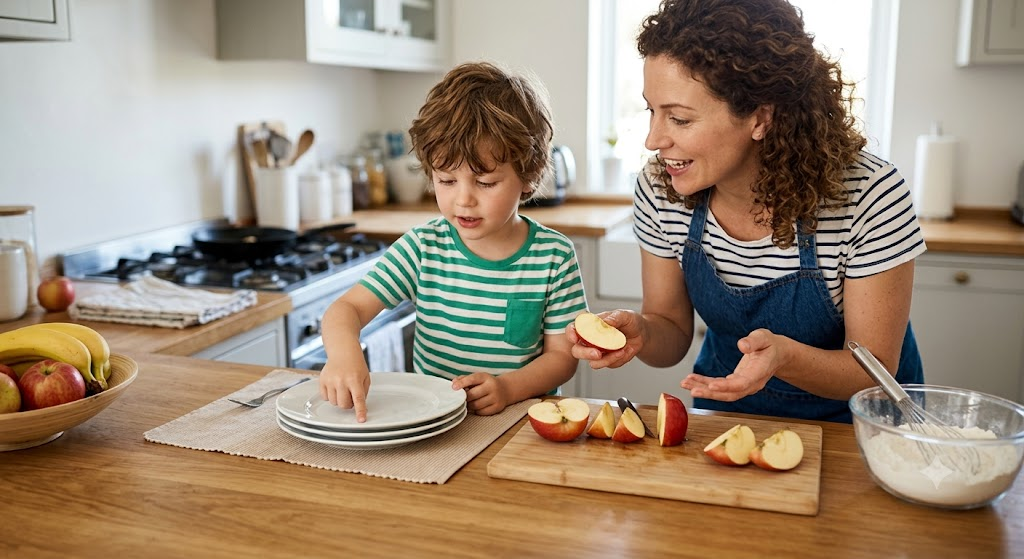
Your kitchen is a powerful math lab. Don't plan a lesson; just talk about what you're doing.
- The Activity: Ask your child to count the plates needed for dinner (one for each person). While splitting an apple, count the slices. Ask, "If I give you 2 slices and keep 2, do we have an equal amount?"
- The Logic Behind: It builds one-to-one correspondence, addition, and equal shares (halves)—without a worksheet in sight.
Try it yourself:
2. Playtime Math (With Toys They Already Have)
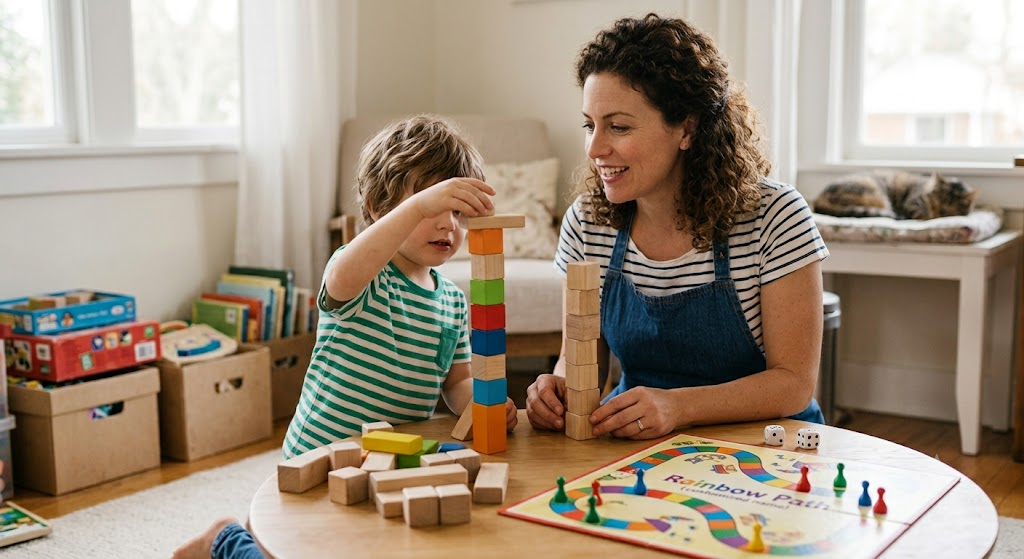
Let playtime lead the learning, because it is full of math.
- The Activity: While playing with building blocks, ask questions like, "Can you build a tower that is 10 blocks tall?" or "Your tower is taller than mine. How many more blocks did you use?" Board games with dice are also fantastic for teaching instant addition.
- The Logic Behind: Children learn comparison, addition, and spatial reasoning while staying engaged—no resistance, no pressure.
Try it yourself:
3. Story Time Math (During Bedtime Reading)
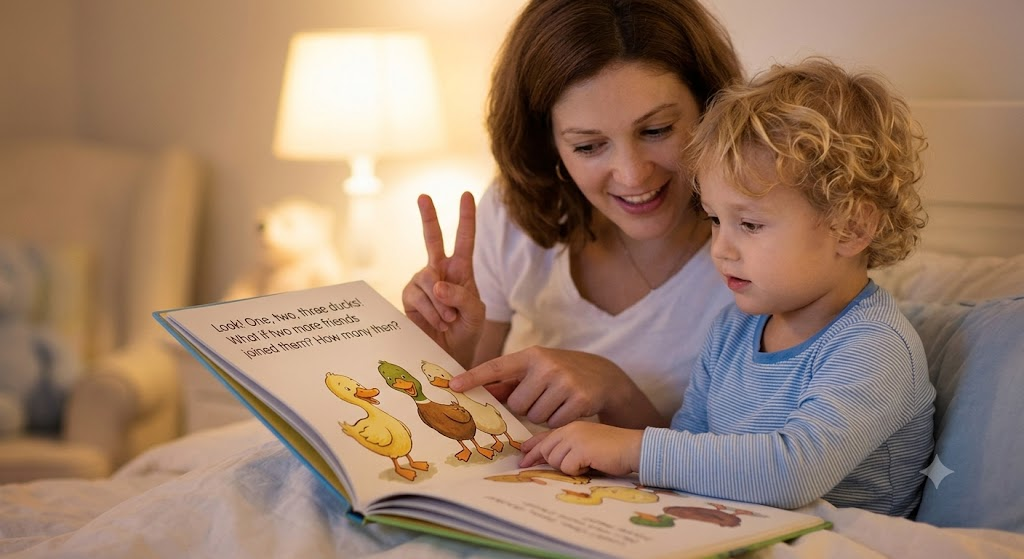
Turn passive reading into an interactive math moment.
- The Activity: Pick a book and ask your child to count the number of ducks on the page. Ask "what if" questions: "There are 3 friends in this story. What if 2 more friends joined them? How many would there be then?"
- The Logic Behind: It prepares children for word problems by making numbers feel meaningful and familiar.
Try it yourself:
4. Straw Bundles (Tens and Ones)
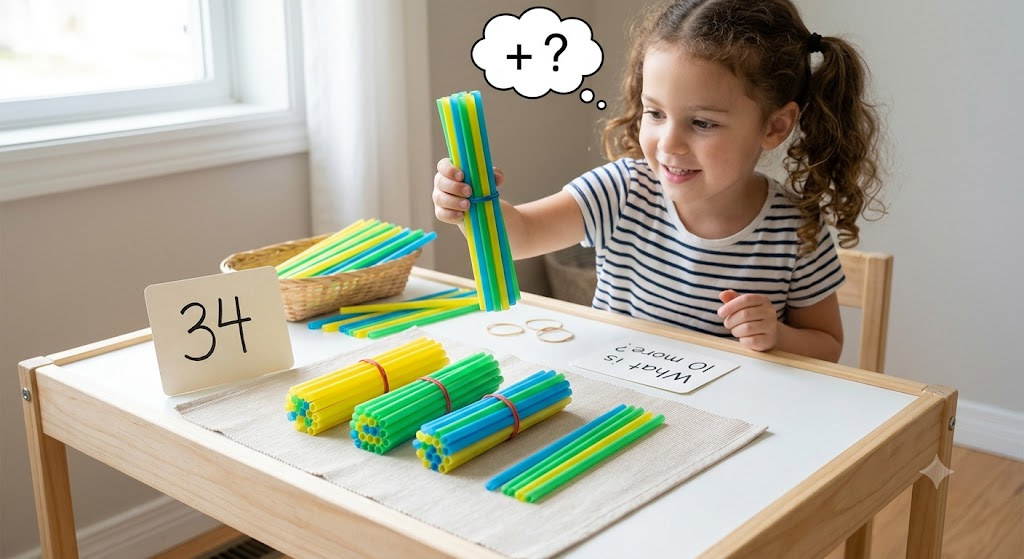
- The Activity: Give your child 30 to 40 straws or craft sticks and a few rubber bands. Bundle them in groups of 10. Ask them to show 34 (3 bundles and 4 loose sticks), then ask, "What is 10 more?" They add one bundle and get 44.
- The Logic Behind: Seeing 10 ones become 1 ten is the main place value idea in 1st grade, and it makes adding within 100 much easier later.
Try it yourself:
5. Clock Check (Telling Time)
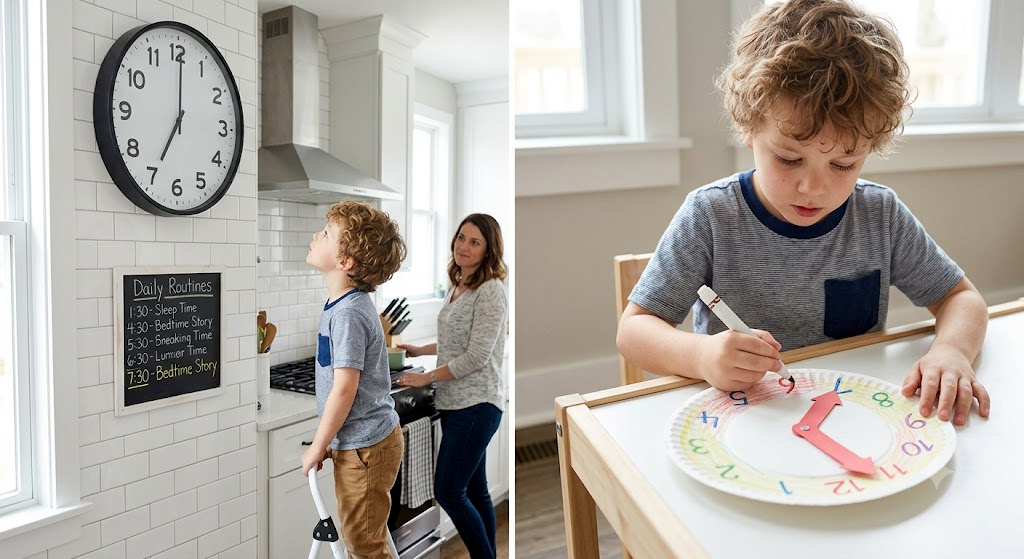
- The Activity: In the hour or half hour, ask your child to read the kitchen clock: "It says 7:30. What happens at 7:30?" Make a paper plate clock and take turns setting a time for the other person to read.
- The Logic Behind: 1st graders learn to tell time to the hour and half hour, and tying times to daily routines makes the clock feel useful.
Try it yourself:
Want more ideas? Try these 8 fun math activities for 1st grade, these free 1st grade math games, or 40 practice questions with answers.
One App, Every Angle Your Child Needs for 1st Grade Math
Between activities, the Cuemath app gives your 1st grader a short math workout every day, plus puzzles and games. Free to try, no card needed.
100% Free • No Card Needed • A Few Minutes a Day
Free 1st Grade Math Worksheet (10 Questions)
Ready to see what your child knows? This 10-question review covers the main 1st grade skills. Your child can answer right here and get a score.
Covers adding and subtracting within 20, tens and ones, comparing numbers, missing numbers and word problems. Answer all 10, then press Check My Answers.
How Cuemath Teaches 1st Grade Math (and What Most Practice Misses)
Most worksheets and apps check one thing: is the answer right? In 1st grade, how your child got there matters more. A child who sees that 8 + 5 is the same as 10 + 3 is building the thinking that makes 2nd and 3rd grade math easier.
This matters more now that AI can solve any 1st grade problem in a second. What AI can't do is the thinking for your child: spotting a pattern, checking whether an answer makes sense, and explaining why it works. Cuemath classes are built around that thinking.
| What most practice does | What a Cuemath tutor does |
|---|---|
| Gives the answer when your child is stuck | Asks a question that leads your child to it ("cue, don't tell") |
| Checks whether the answer is right | Has your child explain their thinking out loud. The Talk-o-Meter tracks how much your child talks in class |
| Repeats the same drill | Shows the "why" on a shared whiteboard, like bundling 10 ones into a ten |
| Moves at a fixed pace | Adjusts every class to your child's pace, with the same tutor over time |
| Practices speed only | Adds a puzzle or brain teaser to build reasoning |
Classes are live and 1:1, aligned to the Common Core, and taught by tutors chosen from the top 1% of applicants and trained in child psychology. Between classes, the Cuemath app gives your child a short daily workout.
Daily games and puzzles you can play after Cuemath class
See How Your Child Thinks Through a Problem
In a free 1:1 evaluation, a Cuemath tutor works through a few problems with your child and shows you where their understanding is strong and where it needs work.
Book a Free Evaluation100% free · No credit card · About 30 minutes
Frequently Asked Questions (FAQs)
What are the most important math skills for a 1st grader?
The most crucial skills are counting and place value up to 120 (tens and ones), adding and subtracting within 20, quick facts within 10, and solving simple word problems.
How long should a 1st grader practice math each day?
Consistency is more important than duration. 15-20 minutes of focused, engaging practice per day is far more effective than one long, stressful session per week.
How can I help my 1st grader with math word problems?
Encourage them to visualize the problem. Have them draw pictures or use small objects (like beans or buttons) to act out the story. The goal is to turn the words into a concrete scenario they can see and manipulate.
My 1st grader says they hate math. What should I do?
Focus on changing the experience. Move away from worksheets and pressure. Play math-based board games, use the "Kitchen Math" or "Playtime Math" ideas above, and celebrate their effort and strategic thinking, not just getting the right answer. Keep it light, positive, and connected to their world.
What is "number sense," and why is it important in 1st grade?
Number sense is a child's intuitive understanding of numbers. It includes knowing their value, how to compare them (more than/less than), and how they relate to each other. It's the most critical foundation for all future math, as it allows children to calculate flexibly instead of just memorizing rules.
Should a 1st grader be memorizing multiplication tables?
No. First grade focuses on the building blocks of addition and subtraction. They count by 10s in 1st grade, skip count by 5s and 100s in 2nd grade, and learn multiplication facts by heart in 3rd grade.
How do I explain subtraction to a 1st grader?
Use tangible objects. Start with a small group of items (e.g., 8 raisins), then "take away" a few and ask how many are left. This visual, hands-on method makes the concept of "taking away" concrete before introducing the minus symbol.
What are some fun math games for a 1st grader?
Simple board games with dice (like Chutes and Ladders) are excellent for practicing counting and addition. Card games like "War" (where the higher number wins) or "Go Fish" (for number recognition) are also fun and effective.
For more, see these free 1st grade math games.
How can I help my child if they are struggling with math?
First, stay positive and reduce any pressure. Go back to basics and use hands-on tools like blocks or beads to make concepts visual. Focus on one small skill at a time and celebrate their effort and small wins. If struggles persist, seeking expert guidance can provide a personalized plan to rebuild their confidence.
Should my 1st grader know addition facts by heart?
Facts within 10, yes. The Common Core expects 1st graders to add and subtract within 10 quickly and to work within 20 using strategies. Knowing all sums of two one-digit numbers by heart is a 2nd-grade goal.
Do 1st graders learn place value?
Yes. Place value is the biggest new idea in 1st grade: children learn that 34 means 3 tens and 4 ones, compare two-digit numbers, and find 10 more or 10 less.
Sources
- Common Core State Standards, Grade 1 Operations & Algebraic Thinking: adding and subtracting within 20, word problems, the equals sign
- Common Core State Standards, Grade 1 Number & Operations in Base Ten: counting to 120, tens and ones, adding within 100
- Common Core State Standards, Grade 1 Measurement & Data: length, time to the half hour, data
- Common Core State Standards, Grade 1 Geometry: shapes, halves, and fourths
- Common Core State Standards, Grade 2 Operations & Algebraic Thinking: addition facts by heart by the end of 2nd grade

I was never the kid who loved math. I was much more interested in books, stories, and writing, and, somewhere along the way, I became even more curious about people. Why do we learn differently? Why does something make sense to one child but not another? And what makes a student feel confident enough to keep trying?
That curiosity led me to study Applied Psychology, where I learned more about how children think, learn, and make sense of the world around them.
My love for writing did the rest. What started as something I simply enjoyed became a career. Over the past five years, I've worked as a freelance writer across edtech, SaaS, B2B, travel, lifestyle, and healthcare, learning how to write for very different audiences without losing the human side of the story.
Today, I'm an SEO Content Writer & Editor at Cuemath, where I get to bring many of these interests together. Working in education, and especially around math, has made me even more curious about what happens behind the screen or textbook: what parents worry about, what students struggle with, and what actually helps them learn.
That's also how I like to research. I don't just look at search results and call it a day. I go where parents and students actually talk: forums, reviews, communities, and conversations with real families. Because sometimes the most useful insight isn't hiding in a keyword; it's in a parent's question, a student's frustration, or a small detail someone shares about their learning experience.
I write because I'm curious. I research because I want to understand. And I love turning what I learn into content that feels genuinely useful to the people reading it.