How to Pick a Homeschool Math Curriculum: The Spine Decision
Your spine is the one curriculum the year runs on. Four differences the makers print themselves separate the major programs - and all four are checkable before you buy.

Meta description: Six programs, four printed differences: how each one sequences topics, how much parent time it needs, what it prints about placement, and where it ends.
---
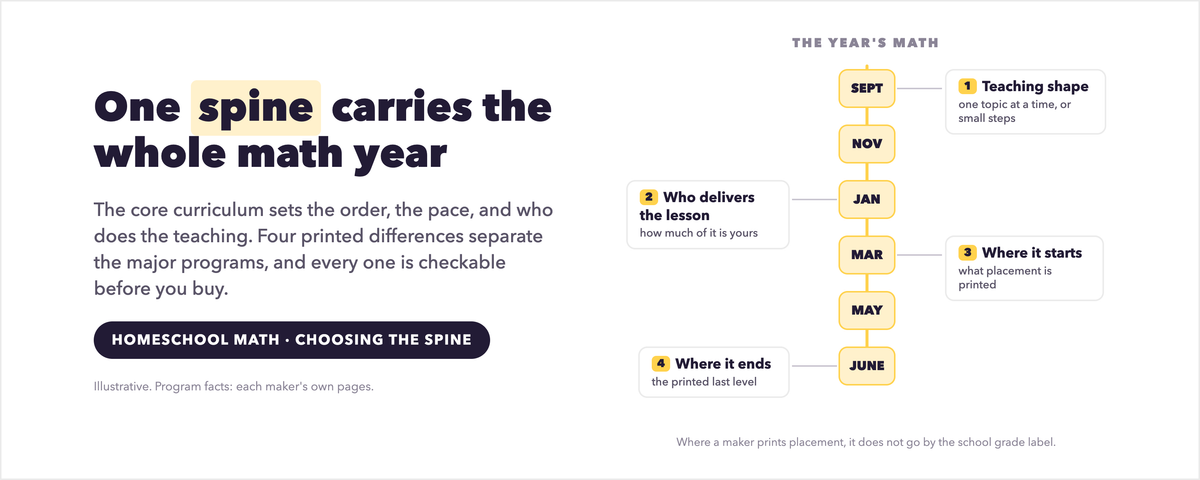
Your math spine is the one core curriculum the year is built on: it sets the order of topics, the pace, and what "done for today" means. Apps, drill sheets, and games hang off it. They are not it. Brand reputation will not settle which spine to pick, but four printed differences will, and each one is checkable on the maker's own pages: how the program sequences teaching, how much of each lesson you personally deliver, how it places your child at entry, and where it ends. This page walks the four, in the makers' own words, across six programs: Beast Academy, Dimensions Math, Saxon Math, Math Mammoth, Math-U-See and RightStart. These six are the ones whose own pages state enough to check; if a program is not here, we could not verify these four things from its own pages. And if you use an all-in-one curriculum, the box already contains a math course: that course is your spine, and the same four checks apply to it.
Table of Contents - Check 1: One topic at a time, or small steps all year - Check 2: Who delivers the lesson - Check 3: What each program prints about placement - Check 4: Where it ends - The six programs side by side - Deciding in one afternoon - FAQs
Check 1: One topic at a time, or small steps all year
The biggest printed split is sequencing. Math Mammoth calls itself "mastery-oriented and organized into chapters by topics," and Math-U-See focuses on mastering concepts "before moving on to a new topic": one theme at a time, finished before the next. Saxon's publisher prints the opposite shape: "an incremental approach gives students the time to understand and practice a small concept before adding the next step," with skills distributed across the whole year. Homeschoolers call these the mastery and spiral families. Three spines sit on their own axes: Dimensions Math runs on the publisher's Concrete, Pictorial, Abstract approach; RightStart teaches through the Cotter Abacus, with card games as its practice; and Beast Academy carries its instruction in comic-style Guide books.
Two of those names hide what they mean. Concrete, Pictorial, Abstract (CPA) is the publisher's way of walking a child through one idea three times: first with physical objects, then with drawings of those objects, then with numbers and math symbols. The Cotter Abacus is RightStart's main teaching tool, in its maker's words "a specially designed two-sided abacus that is both kinesthetic and visual," grouped in fives and tens, with place value to the thousands on its back side.
None of this ranks them. It tells you what a stuck week looks like: camped on one hard chapter, or meeting the hard idea in small pieces for months.
Check 2: Who delivers the lesson
Spines assume different teachers, and four of the six say so on their own pages. Math Mammoth puts the explanations in the student books and asks little preparation time of the teacher. Math-U-See prints the opposite shape: you present each lesson and work through it with your child, with weekly preparation dropping to a few minutes once you know the program. RightStart's elementary and intermediate lessons are written to guide the teacher through each day and each year, and at home that teacher is you. Dimensions Math prints a role rather than a clock: its Home Instructor's Guides are made for one-on-one teaching, and the publisher counts them among the books you need. Their exact words are in the table's parent-time column.
The other two say nothing here. Neither the Saxon program page nor the Beast Academy books page states what the teaching adult does. Both are silences in what those pages print, not claims about how those programs run at home.
Be honest about your hours before comparing anything else. A spine built for a teaching parent, run by a busy one, fails on schedule, not on math.
Check 3: What each program prints about placement
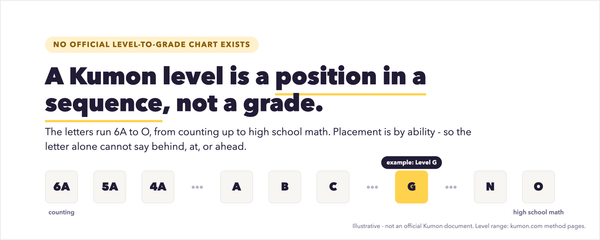
Where a maker prints placement guidance at all, it does not seat a child by grade label alone. Beast Academy points new families to a placement test chosen by the child's age. Singapore Math Inc. offers free placement tests for its elementary levels, says outright that they exist to find gaps and "should not be scored," and publishes start rules rather than tests for grades 6-8. Math Mammoth calls a placement test before starting "fairly important." Math-U-See names its levels with Greek letters rather than an age or a grade and starts placement from an evaluation of current mastery. RightStart is "set up with levels, rather than grades" and publishes an interactive placement tool.
Saxon is the one blank in that list. Its own homeschool address, saxonhomeschool.com, redirects to the publisher's homeschool page, which names Saxon Math among its homeschool math programs and sends homeschool buyers to a partner retailer.
So where a maker prints its design, your child will not enter the spine at their school grade number. That is the design, not a problem to fix.
Check 4: Where it ends
Every spine's own pages show where it runs out, and the answers differ widely. Four stop before high school: Singapore Math Inc. states its programs "do not continue beyond Grade 8"; Math Mammoth is a K-8 series; Beast Academy's books run out at Level 5; and the highest RightStart levels named on its own site are G and H. Two run further: Math-U-See's 13 levels reach calculus, and Saxon is sold as a complete K-12 program.
If your pick ends before high school, a second decision is already on your calendar. That decision has its own page: where thirteen programs end and what their makers say comes next. Of the six here, that page maps Beast Academy and Dimensions Math. Read it before you commit, not after.
The six programs side by side
| Program | Printed span | Teaching shape, in its maker's words | Parent time, in its maker's words | Entry placement |
|---|---|---|---|---|
| Beast Academy | ages 6-13, Levels 1-5 | Guide and Practice materials, with instruction in comic-style format | Not stated on the books page | Placement test, chosen by the child's age |
| Dimensions Math, from Singapore Math Inc. | grades PK-5 and grades 6-8 | Concrete, Pictorial, Abstract (CPA) approach | Home Instructor's Guides, "specifically for teaching Dimensions Math in a one-on-one setting" | Free placement tests for the elementary levels, made to find gaps and not to be scored, with start rules for grades 6-8 |
| Saxon Math | grades K-12, through Algebra 1, Geometry, Algebra 2 | Incremental approach, with skills distributed across the year | Not stated on the program page | Not stated on the program page |
| Math Mammoth | grades K-8 | Mastery-oriented, chapters by topics | "Nearly self-teaching for many children," with "fairly little preparation time from the teacher" | Placement test before starting, which the maker calls "fairly important" |
| Math-U-See | 13 levels, Primer through Calculus | Mastery of a concept before a new topic, with Greek-letter levels | Instructor presents each lesson, with weekly preparation "only a few minutes" once you know the program | Interactive placement tool, starting from an evaluation of current mastery |
| RightStart | levels rather than grades, highest named G and H | Cotter Abacus as primary tool, with card-game practice | Lessons that "guide the teacher day-by-day and year-by-year" | Interactive placement tool, for level and curriculum |
Every cell comes from the program's own published pages, checked 2026-09-18. Where a page states nothing for a cell, the cell says so.
A naming note on row two: parents say "Singapore Math", "Dimensions" and "Primary Mathematics" as if they were three programs. On the publisher's own pages, Singapore Math Inc. is the company, and Dimensions Math and Primary Mathematics are the two core program lines on its homeschool menu; this page checks Dimensions Math.
Deciding in one afternoon
Shortlist two spines whose teaching shape and parent-time model fit your actual week. Those are the two middle columns of the table. Run both makers' placement tests with your child, and expect the starting points to differ, because each test places within its own sequence. Then check where each spine ends against how many years you plan to homeschool.
Read prices off the maker's own pages. Four of the six have a price or shop page on their own site: Dimensions Math, Math-U-See, RightStart, and Math Mammoth, which prints its prices on the curriculum page linked above. One trap: RightStart's own shop menu lists "Book Bundles" and "Supply Kits" as separate categories, so the first number you see there is not the whole year.
If your shortlist also holds outside programs - a center, a class, or a tutor - the vetting questions for those live in Before You Pick a Math Program. This page covers only the spine you run at home.
None of the placement tools we read tells you where your child stands against grade standards overall. A free Cuemath MathFit evaluation is a live session that maps exactly that, and the read is useful for placing a child into any spine on this page. It is not the spine, and it does not replace one.
Know where your child stands before you pick the spine
A free Cuemath MathFit evaluation reads where your child stands against grade standards before you place them anywhere.
Book a Free EvaluationFor students in Grades K to 12 worldwide.
FAQs
What exactly is a math "spine" in homeschooling?
It is homeschool-community shorthand, not a product category, so don't expect a box to say "spine" on it. The test is simple: if you dropped this one resource, would math stop at your house until you replaced it? If yes, that is your spine. If nothing passes that test, you have supplements arranged around a hole.
Is an all-in-one homeschool curriculum enough for math?
It can be. What the box format hides is that its math course has its own placement logic and its own endpoint, separate from the reading and science around it. A child can be on-level for the box and sitting at the wrong level in its math.
Do I have to pick a grade level to start?
No. Even the grade-numbered series here, Math Mammoth and Dimensions Math, point you to a placement test or a published start rule rather than the grade label.
How much of my day will homeschool math take?
The makers state parent time unevenly, so the only reliable number is your own: read the lesson-flow page for the spine you are weighing, then time one real sample lesson with your child before buying a year of it.
Can we change spines mid-year?
Yes. Treat it as a placement event, not a restart of the year. Run the new maker's placement test. Expect it to seat your child somewhat behind where the old spine left off, because topic orders differ between programs. Keep the old materials until your child is past the seam. What you should not do is average the two: two spines run in parallel give you two half-sequences.
Two placement tests gave my child different starting points. Which is wrong?
Probably neither. Singapore Math Inc. frames its tests as gap-finders, and Math-U-See's tool likewise starts from what is already mastered and looks for conceptual gaps. Two different starting points are information about the programs' orderings, not a contradiction about your child.