How to Help My Child Catch Up in Math After Missing School
A child who missed weeks of school and is now behind in math has a known hole, not a mystery. The missed unit sits on the teacher's calendar with dates on it.

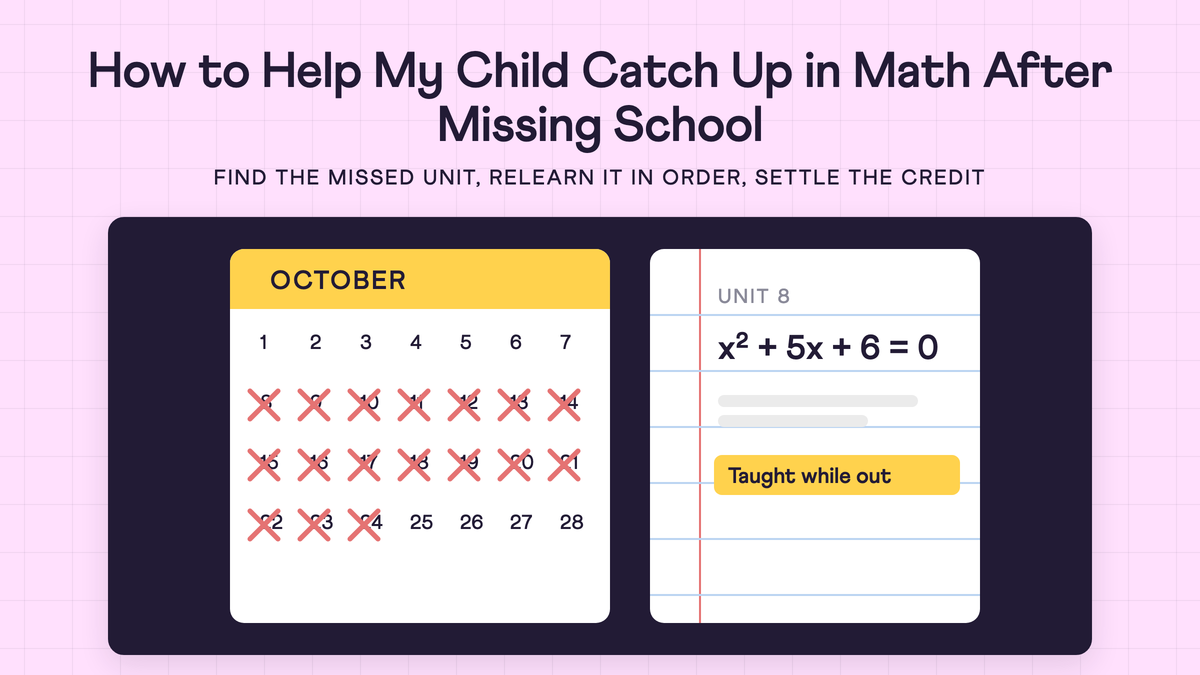
A child who missed weeks of school and is now behind in math has a known hole, not a mystery. The missed unit sits on the teacher's calendar with dates on it. Three things to do. First, get the list of what the class covered on the days your child was out. That means the teacher's unit list for those dates, the class's online course page or gradebook, and the assignments and tests due in that span. Second, relearn in the course's order: the missed unit first, then only the part of the current unit that stands on it.
Third, ask the school for its rules by name: the make-up work deadline, the attendance-for-credit rule (the share of class days a student must attend to get credit for the course), and what an incomplete grade means there. The example below is a missed unit on equations with x², which are quadratic equations. Falling behind in math this way is a list, and a list can be worked.
How to get the list of missed topics
- Email the teacher with the dates and ask for the units and lessons the class covered between the first day absent and the day back.
- Open the class's online course page or gradebook. Lessons and assignments post by date; a blank or a zero inside that span is a missed item with a name on it.
- List every assignment and test due in that span. Each one names a topic, and the test your child could not do names the unit.
- Put it all in one list, in the order the class taught it. That is the relearn order.
The teacher holds both the list and the deadline. Cupertino Union School District in California prints the rule on its attendance page: the teacher of a class the student missed "shall determine" "what assignments the pupil shall make up and in what period of time the pupil shall complete those assignments." Ask for both in the same email.
Relearn in the course's order: the quadratic example
If the course follows the Common Core State Standards for Mathematics, or a state version close to them, the public standards page lists what the course teaches, line by line. Quadratic equations are one line, coded HSA.REI.B.4: "Solve quadratic equations in one variable." The line right before it is linear equations: "Solve linear equations and inequalities in one variable, including equations with coefficients represented by letters." Under the quadratic line, the standard names a method called completing the square, and then lists the ways to solve a quadratic equation, from simple cases a student can see at a glance to "taking square roots, completing the square, the quadratic formula and factoring, as appropriate to the initial form of the equation."
So one order for this child is short: linear equations first, if your child wobbles on them; then completing the square; then each of the other ways the standard lists, one at a time; then only the part of the current unit that uses a quadratic. Everything else in the current unit waits.
A child who learns by hearing the teacher explain needs the explanation again, not a worksheet. Two places to get it. One is the teacher, before or after school or in whatever help period the school runs (question 2 below). The other is a free video lesson per topic, watched in the order above, with one problem worked after each. The sign that the unit holds is three problems from the missed unit's test or review sheet, done with the video closed.
If the missed unit is relearned and the current work still breaks, something older may sit under it. Our page on a child behind in math is for working out which earlier skill that is.
The school's rules to ask for by name
Every school prints its own. The examples below show the shape of the words; your own district's page is the one that counts.
First, size the absence. Attendance Works, a nonprofit that tracks school attendance, defines chronic absence as "missing 10 percent or more of school days due to absence for any reason," and counts "excused, unexcused absences and suspensions." New Jersey's Department of Education puts the same line in days: "Missing only two days a month would result in being Chronically Absent from school." Missing several weeks in one term is more than two days a month.
Make-up work: whether the absence was excused. Cupertino Union's attendance page says a student with an excused absence "shall be allowed to complete all assignments and tests missed during the absence that can be reasonably provided and, upon satisfactory completion, shall be given full credit." Unexcused is the other side of the line: among the potential effects of unexcused absences, the page lists "Student report cards may be noted as incomplete" and "Students may not be allowed to 'make-up' missed assignments." So whether the school recorded each absence as excused can decide whether the make-up door is open. For an illness, that depends on the verification the school accepts. The same page says that after seven absences or tardies for illness that were not verified in the ways it lists, further ones "may require verification by a physician," and "Failure to provide verification may result in unexcused subsequent absences."
Credit: a share of class days, with a door back. The Texas Education Code, section 25.092, in a copy saved December 11, 2025, reads: "a student in any grade level from kindergarten through grade 12 may not be given credit or a final grade for a class unless the student is in attendance for at least 90 percent of the days the class is offered." The next paragraph is the door back. A student in attendance for "at least 75 percent but less than 90 percent" of the days "may be given credit or a final grade for the class if the student completes a plan approved by the school's principal." Each district's board also appoints "attendance committees to hear petitions for class credit or a final grade." In Texas, then, the words to ask for are the principal's plan and the attendance committee.
Policy: every district writes one. Ask for your district's attendance policy by that name, and for its definition of an unexcused absence. For a high schooler, the counselor holds the credit question.
If the absences come with a diagnosis, a school plan is a separate ask; our page on an IEP or 504 plan for math says what each holds and how to ask in writing. A plan changes how your child is taught and tested; it does not teach the missed unit.
Three questions for the teacher
- Which units and lessons did the class cover between [first day absent] and [day back], and which assignments and tests were due in that span?
- What is the make-up deadline for each, and when can my child hear the missed unit explained again: before school, after school, or in a help period?
- Where does my child stand on credit for this course under the school's attendance rule, and what is the plan if the days fall short?
The answer to the first question is the relearn list. Keep the other two in writing, and copy the counselor on the third.
A child who cannot get out of bed for school needs the school's attendance team and a doctor. The math catch-up above waits for that.
Where Cuemath fits
Cuemath is live, one-on-one online math tutoring for grades K through 12. For a child who missed weeks of school, the free evaluation below shows whether the missed unit is the only hole or whether an older one sits under it, so the relearning starts in the right place.
See whether the missed unit is the only hole
A free Cuemath MathFit evaluation, our skills-and-gaps check, is a live, one-on-one session that shows where your child is solid and where a gap sits, in your child's own work. No credit card, and the report is yours either way.
Book a Free EvaluationFor students in Grades K to 12 worldwide.
FAQs
How do I help my child catch up in math fast?
Start with the list of missed topics, not with everything. Ask the teacher for the units covered on the dates your child was out, and then relearn those in the course's order: the missed unit first, then only the part of the current unit that stands on it. Everything else in the current unit waits.
Can my child still pass the year after missing weeks of school?
That depends first on two printed rules at your school: attendance for credit, and make-up work. Texas's rule in its Education Code is "at least 90 percent of the days the class is offered," with a door back at 75 percent through "a plan approved by the school's principal," and an attendance committee that "may give class credit or a final grade to a student because of extenuating circumstances." Cupertino Union gives "full credit" for work made up after an excused absence. Ask your school for its two rules by name.
What is chronic absence?
Attendance Works defines it as "missing 10 percent or more of school days due to absence for any reason," and counts "excused, unexcused absences and suspensions." New Jersey's Department of Education says it this way: "Missing only two days a month would result in being Chronically Absent from school."
What if the school says the work cannot be made up?
Ask whether the school recorded each absence as excused or unexcused; that is the line the rules draw. Cupertino Union's page lists "Students may not be allowed to 'make-up' missed assignments" among the effects of unexcused absences, while an excused absence earns "full credit" for the work made up. For illness, the same page says that after seven unverified absences or tardies for illness, further ones "may require verification by a physician." Credit recovery, a way to earn the credit after a course was failed or missed, is a separate ask; Texas's handbook describes a program meant to give students "the opportunity to recover that credit."
Does an IEP or 504 plan teach the missed unit?
No. A plan changes how your child is taught and tested; it does not teach the missed unit. New Jersey's attendance rule says that for a student with a disability, the attendance plan "shall be applied, where applicable, in accordance with the student's individualized education program." What each plan holds, and how to ask for one in writing, is on our page on an IEP or 504 plan for math. The relearn order above is the same either way.
My child learns by listening to the teacher explain. What then?
Get the explanation again, in the course's order. Ask the teacher when your child can hear the missed unit explained: before school, after school, or in a help period the school runs. Between those, use a free video lesson per topic, one topic at a time, with one problem worked after each. The sign that it held is three problems from the missed unit with the video closed.