Is a B in AP Chem Bad? What Top STEM Colleges Print
Your child is in Advanced Placement (AP) Chemistry, an A looks out of reach, and the target list is the top STEM colleges. Here is what their own admissions pages print.

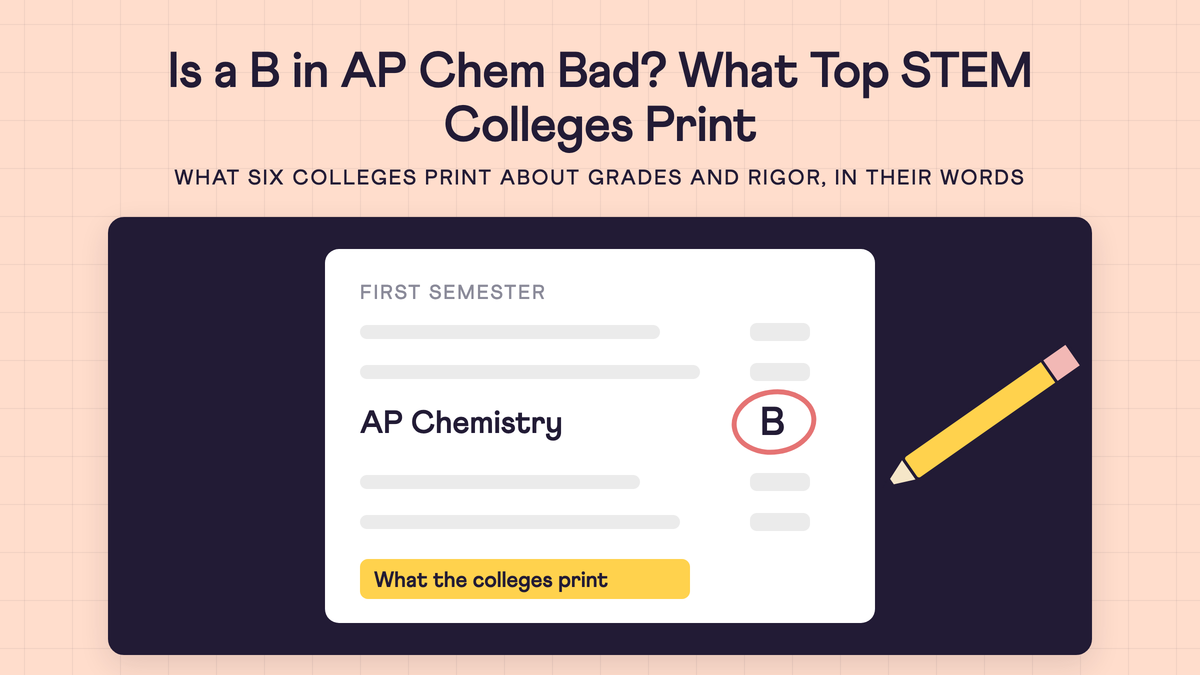
Your child is in Advanced Placement (AP) Chemistry, an A looks out of reach, and the target list is the top STEM colleges. Here is what their own admissions pages print. None of the six pages quoted here prints a rule for one grade in one course. Caltech's review page says: "No single grade, test score, course, essay, activity, award, or recommendation determines an admission decision." Four of the six tell students to take the hardest courses their school offers. MIT prints: "you should be taking the most challenging math and science courses available at your school." Georgia Tech prints: "You should demonstrate success in the most rigorous curriculum available at your high school." Stanford hopes for courses "among the most demanding available at your school," and Caltech reads for "engagement with challenging material."
One page prints arithmetic. In the University of California's GPA calculation, a B is 3 points and each semester of an AP course adds 1 honors point. So a B in AP Chemistry carries 4 points, the same as an A in a course with no honors point.
What six colleges' own admissions pages print
Here is what each college's own page printed when we read it on November 5, 2026, with the page linked.
| College | What the page prints about grades and rigor | Page |
|---|---|---|
| MIT | "grades and scores are important in understanding your academic preparedness for MIT." Its preparation guidance: "you should be taking the most challenging math and science courses available at your school." | What we look for, Foundations |
| Caltech | "No single grade, test score, course, essay, activity, award, or recommendation determines an admission decision." Caltech reads preparation through "the rigor and content of a student's coursework, performance over time, depth of understanding." Its course list: "Four years of math, including one year of calculus" and one year of chemistry. | How we review, Academic requirements |
| Stanford | "We do not have a set of required courses for admission to Stanford." It recommends "four years of rigorous mathematics, including calculus," and hopes "your curriculum includes courses that are among the most demanding available at your school." | Prepare |
| Georgia Tech | It wants to see "how you stretched and challenged yourself relative to the curriculum that was available at your school." It reads the transcript's GPA, "weighted, if available." | Academic preparation |
| Carnegie Mellon | "We pay close attention to your curriculum rigor, the grades you've earned and the work you've accomplished." For its College of Engineering, four years of math "and preferably calculus," and one year of chemistry. | Academic requirements |
| University of California | Its factors include the GPA "including additional points for completed UC-certified honors courses" and "Recent, marked improvement in academic performance." | How applications are reviewed, GPA requirement |
A B in the AP class, or an A in the regular class
The pages do not pose that choice in those words. What they add to the rigor lines above is Caltech's other half: "Simply taking advanced coursework is not the same as demonstrating a deep understanding of the material."
The University of California prints the points. It converts grades: "A=4 points, B=3 points, C=2 points, D=1 points. (Pluses and minuses don't count.)" The page then says: "Give yourself an extra point for each semester of a UC honors-level course, with a maximum of 8 points between 10th and 11th grades." AP courses count as honors courses. So, per semester, a B in AP Chemistry is 4 points, an A in a class with no honors point is 4 points, and an A in AP Chemistry is 5. A B+ or a B- is the same 3 points. Among the other limits the page prints: "For 10th grade, you cannot use more than 4 honors points," and "Grades of D or F in an honors course do not earn an extra point."
Georgia Tech reads the GPA "taken directly from your high school transcript," weighted if the school weights it. When a school gives no GPA, Georgia Tech recalculates one from core courses, with "0.5 points added for AP, IB, Dual Enrollment, AS & A Levels." The MIT, Caltech, Stanford, and Carnegie Mellon pages quoted here print no point value for an AP grade.
The grade and the exam score travel separately
The course grade sits on the transcript. The AP exam score goes to the college on a score report, and the College Board says, "Most U.S. colleges offer credit or advanced placement, or both, for qualifying AP scores." The college-by-college credit list is on the AP credit by college page. For AP Chemistry itself, the College Board names the college equivalent as a one-year introductory college general chemistry course and the recommended prerequisites as "High school courses in chemistry and Algebra II."
What the NACAC survey prints
NACAC is the National Association for College Admission Counseling, the admissions officers' own association. Its Factors in the Admission Decision page says: "For the Fall 2023 admission cycle, NACAC member four-year colleges reported that the most important factors in admission decisions were grades in high school courses and strength of the high school curriculum." Its table prints the share of 185 colleges that rated each factor quoted here as of considerable importance:
- grades in college prep courses: 76.8%
- total high school grades: 74.1%
- strength of high school curriculum: 63.8%
- admission test scores (ACT, SAT): 4.9%
- subject test scores (AP, IB): 1.1%
What to do next
- Read the target colleges' own pages, linked in the table. The University of California adds that its campuses "often apply these factors differently" and links each campus's selection process.
- Ask the school counselor what the school's profile says. The counselor sends a document with the transcript that describes the school's courses. Georgia Tech's page prints: "To help us better understand your high school and its curriculum, your counselor will submit a School Report form and/or School Profile with your transcript." That document is how a college sees which hard courses were available.
- Finish the course, because the transcript grade is what the pages read. MIT's coursework form asks for grades "as found on your school transcript," and Caltech says, "We must be able to review semester or in-progress grades for first-time courses by the application deadline."
- If there is a reason behind the grade, Stanford's page names where it goes: the Additional Information section of the application.
Where Cuemath fits
Cuemath is live, one-on-one online math tutoring for grades K through 12. It teaches math, not chemistry. The College Board lists Algebra II among AP Chemistry's recommended prerequisites, so part of the course runs on that algebra. If the lost points sit on that side, the free evaluation below shows which Algebra 2 and Precalculus skills hold, in your child's own work. If the trouble is the chemistry itself, the chemistry teacher is the right first call.
See which Algebra 2 skills hold under the chemistry
A free Cuemath MathFit evaluation, our skills-and-gaps check, is a live, one-on-one session that shows where your child is solid and where a gap sits, in your child's own work. No credit card, and the report is yours either way.
Book a Free EvaluationFor students in Grades K to 12 worldwide.
FAQs
Does a B in an AP class count as an A?
In the University of California's points, yes, per semester: a B is 3 points plus 1 honors point for an AP course, 4 in all, the same as an A in a course with no honors point. UC caps the extra points at 8 across 10th and 11th grades, at most 4 of them in 10th. Georgia Tech adds 0.5 for AP when it recalculates a GPA for a school that provides none. The MIT, Caltech, Stanford, and Carnegie Mellon pages print no point value.
Should my child drop to regular chemistry?
No page quoted here poses that choice or prints a rule for it. What four of the six print is the instruction to take the most challenging courses available at the school, and Caltech adds, "Simply taking advanced coursework is not the same as demonstrating a deep understanding of the material." The school counselor's School Profile is where a college reads which courses the school offered. The choice is the family's, with the teacher and the counselor.
Will one B ruin a 4.0 GPA?
No page here prints a rule about one B. The number on the transcript follows your school's own GPA rule, and Georgia Tech reads that number "taken directly from your high school transcript." The University of California recalculates by its own rule, where a B in an AP course is 4 points, and sets minimums of 3.0 for California applicants and 3.4 for nonresidents.
Is one B in sophomore year bad?
The pages print no rule for one grade in one year. Two name time: Caltech reads "performance over time," and the University of California lists "Recent, marked improvement in academic performance" among its factors. UC counts grades from the summer after 9th grade through the summer after 11th, and caps 10th-grade honors points at 4.
What GPA do you need for MIT?
MIT's pages print no GPA figure. Its What we look for page says, "grades and scores are important in understanding your academic preparedness for MIT." Its statistics page prints applicant and admitted counts and a "Middle 50% score range of admitted students," and no GPA. The one page here with a printed GPA line is the University of California's: 3.0 for California applicants, 3.4 for nonresidents.
Do colleges see the AP Chemistry exam score or the class grade?
Both, separately. The grade is on the transcript, and MIT's coursework form asks for it "as found on your school transcript." The exam score reaches a college on a score report. In NACAC's fall 2023 survey, 1.1% of colleges rated subject test scores (AP, IB) as of considerable importance, against 76.8% for grades in college prep courses. What colleges' pages say about taking and reporting an AP exam is on our AP Precalculus exam page.
Parents say a child who struggles to a B may struggle to keep up at a top college. Do the colleges say that?
None of the pages quoted here says anything about keeping up after admission. What they print about the course itself is Caltech's line: "Simply taking advanced coursework is not the same as demonstrating a deep understanding of the material," and its review page's "performance over time." Whether the B came from the chemistry or from the algebra under it is the question to settle with the teacher.