How to Choose a Maths Tutor in Australia: 5-Point Scorecard
Anyone in Australia can call themselves a maths tutor, so the checking is up to you. This guide gives you five checks, fair prices in AUD, the questions to ask on a first call and a scorecard you can run on any tutor.

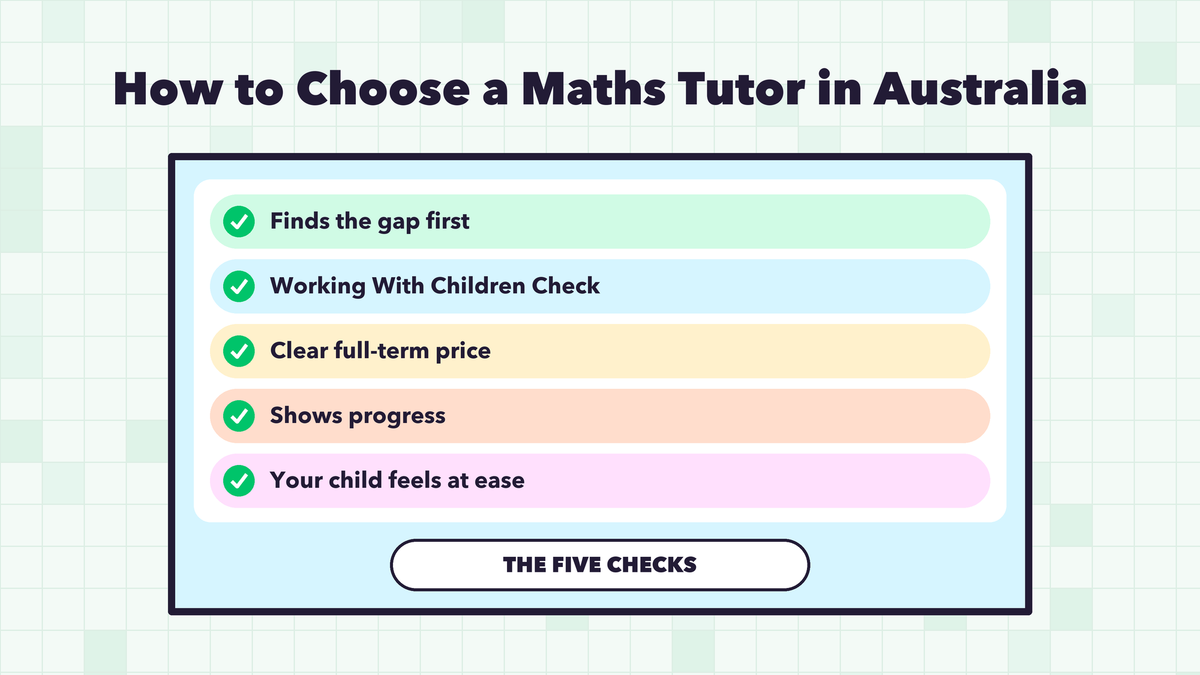
To choose a good maths tutor, check five things. The tutor finds out what your child is stuck on before teaching. You can confirm they are safe and qualified. You get a clear price for the whole term. They show you how your child is going. And your child feels at ease with them. If a tutor does all five, that is a strong choice.
You have to do this checking yourself, because there are no national rules on tutor training or safety checks.
- Does your child need a maths tutor yet?
- What does a good maths tutor do?
- How much does a maths tutor cost in Australia?
- How do you check a maths tutor is safe?
- Which questions should you ask before you choose?
- What are the red flags when choosing a maths tutor?
- How to choose a maths tutor with a five-point scorecard
- Frequently Asked Questions
- Finds the gap first. Ask how they will work out what your child already knows before they teach.
- You can verify who they are. Ask for a Working With Children Check (or your state’s equivalent) and check the number yourself.
- The full-term price is clear. Compare the cost of a whole term, not the hourly rate, and get the exit terms in writing.
- You see progress. Agree two or three goals with your child’s teacher, ask for regular updates, and review at week 12.
- Your child feels at ease. Let your child meet the tutor before you decide.
Does your child need a maths tutor yet?
Not every maths worry needs a paid tutor. Some struggles fade with time and practice at home. Others come back every week, and a tutor can help with those.
Here is what that help looks like.
A Year 4 child reads: “Mia has 24 stickers and gives a third to her brother. How many does she have left?” Your child spots 24 and 3, divides, and writes 8. The sum is right, but it answers a different question.
A good tutor does not mark it wrong and show the steps again. They ask your child to draw 24 stickers in three groups and circle the ones Mia keeps. Your child sees two groups left, so the answer is 16. Next time, before reaching for a sum, your child stops and asks, “What is the question actually asking?” That habit helps with every word problem, in class and in tests.
Sort what you are seeing into two piles.
Want an Outside View Before You Pick a Tutor?
Book a free one-on-one maths session with Cuemath and watch how your child works through problems. You pay nothing unless you later choose a plan.
Book a Free 1-on-1 Maths Evaluation100% free · One short online session · Ask as many questions as you like
What does a good maths tutor do?
A good tutor works out why the homework was hard. An average tutor helps your child finish tonight’s homework. The difference shows up in the first session and every session after.
Here is how that looks in practice.
A Year 5 child keeps losing marks on fractions. The average tutor sets ten more fraction worksheets. The good tutor notices the child cannot say whether 3/4 or 5/8 is bigger without drawing a picture, goes back to equivalent fractions, and rebuilds from there.
Qualifications matter less than fit, with one exception.
A tutor with a teaching degree is not automatically better. A university student training to teach, who has tutored six-year-olds for three years, can suit a nervous Year 2 child better than a teacher with ten years in Year 11. Swap the child, a Year 9 student facing harder algebra, and the experienced teacher is the better match.
Test this on the first call. Ask, “How will you find out what my child already knows?” A vague answer tells you a lot.
How much does a maths tutor cost in Australia?
A good math tutor cost in Australia, like Cuemath, start at $17 a class. The price depends on your child’s year level and plan length, and longer plans cost less per class.
Each plan is billed as two items, a coaching fee and a platform fee. The platform fee is $39 on the 3-month plan, $78 on the 6-month plan and $0 on the 12-month plan. For KG to Year 2 on the 3-month plan, that is a $546 coaching fee plus a $39 platform fee, billed every 13 weeks. Every plan includes the school-aligned curriculum, NAPLAN, OC and selective prep, homework help, progress reports and the Parent App, with no add-ons.
For comparison, the Australian Tutoring Association gives A$55 to A$180 an hour as the range for teacher-trained private tutors, and group classes cost A$10 to A$15 an hour per child. A class and an hour are not the same length, so compare what a full term costs and what it includes. Before you pay anyone, ask what the price covers, how much you pay up front, and what happens if you stop.
How do you check a maths tutor is safe?
Check three things: a verified Working With Children Check, the tutor’s qualifications and experience, and how they treat your child in class. Anyone in Australia can call themselves a tutor, and a 2025 University of Sydney study found tutors are not consistently required to pass background checks.
1. The check. In Australia each state issues its own. NSW lists tutors as needing a Working With Children Check, Victoria lists coaching or private tuition for children, and Queensland requires a blue card if a paid role includes tutoring. Ask for the number and look it up on your state’s verification page. “I’ve been checked” without a number tells you nothing.
2. Qualifications and experience. Ask what they studied, how long they have taught children your child’s age, and how they were selected and trained. A high maths score is not enough. A primary child needs someone who understands how children first learn number.
3. How they treat your child in class. Watch the first lesson if you can. A good tutor asks your child to explain their thinking, waits for the answer, and does not hand over the steps. Your child should feel safe saying “I don’t get it”. You should get updates without chasing.
How Cuemath handles these
- Selection and experience: Cuemath says only the top 1% of applicants become coaches. They are chosen for maths expertise, trained to teach the Cuemath way, and matched to each child by year, goal and pace. Your child keeps the same coach in every session.
- In class: coaches cue instead of tell. A Cuemath coach looks for the habit behind a wrong answer and asks questions until your child finds the fix. Cuemath’s Talk-o-Meter tracks how much your child speaks in class.
- Updates: plans include daily and monthly progress reports and the Parent App.
Which questions should you ask before you choose?
Treat the first call as an interview. Meet the tutor before you sign up. Use these eight questions as your call script. After two or three calls the differences are easy to see, and the answers give you the scores for the five-point scorecard below.
| Ask | A good answer sounds like | A worrying answer sounds like |
|---|---|---|
| How will you find out what my child already knows? | A short test or some questions, then a plan based on what they find | “We’ll start with the homework.” |
| What would you teach in the first month? | Specific skills, in a sensible order | “Whatever the school is doing.” |
| Which curriculum do you follow? | The Australian Curriculum and your state syllabus, named | “My own method,” with no mention of what school expects |
| How will I know it’s working? | Agreed goals, regular updates and a review date | “You’ll see it in the marks.” |
| Can I sit in, or stay close by? | Yes, easily | They do not want you there |
| What do you need from us between lessons? | Short, specific tasks | Nothing, or hours of extra work |
| What happens if we want to stop or change tutor? | A clear policy, in writing | You are locked in, or pay a fee to leave |
| What checks have you had? | A clear answer, with proof you can check | They avoid the question |
Source: Cuemath Australia editorial guide. Meeting the tutor first, and the topics to ask about, follow Zunica, The Conversation (19 January 2026).
What are the red flags when choosing a maths tutor?
Given below is the list the main warning signs: promises of rapid or dramatic results, and a reluctance to explain teaching approach and qualifications. Here are five signs to watch for, including those three.
- A promise of results. “Your child will jump a NAPLAN band in a term.” Nobody can promise that. Ask how they track progress instead.
- Unclear about checks or training. Ask again, politely, in writing. A good tutor will not mind.
- Only worksheets and drills. Ask what they teach beyond tonight’s homework.
- They do not want you nearby. For a young child, walk away.
- Pressure to sign today. A good tutor gives you time to think.
One red flag is a question to ask. Three is an answer.
How to choose a maths tutor with a five-point scorecard?
Ask the same five questions about every tutor, and give 0, 1 or 2 points for each. As a guide, 8 or more out of 10 is a strong choice, and under 5 means keep looking. That threshold is our own suggestion, not a research finding.
| Question | 0 points | 1 point | 2 points |
|---|---|---|---|
| Do they find the gap first? | Homework only | Asks some questions | Uses an assessment and shows you a plan |
| Can you verify who they are? | Vague | Says they are checked | Gives you evidence you can check yourself |
| Is the full-term price clear? | Unclear, or a large upfront cost | Clear, but locked in | Clear, shows the term cost, and a way out in writing |
| Will you see progress? | No updates | Informal chats | Agreed goals, regular reports and a review date |
| Does your child click with them? | Uncomfortable | Fine | Engaged, and asks to go back |
Source: Cuemath Australia editorial scorecard.
| Question (0, 1 or 2 points) | Tutor A | Tutor B | Tutor C |
|---|---|---|---|
| Do they find the gap first? | |||
| Can you verify who they are? | |||
| Is the full-term price clear? | |||
| Will you see progress? | |||
| Does your child click with them? | |||
| Total out of 10 |
A tutor who scores 2 on the first and last questions, and does well on the rest, is worth trying for a term. The last question is your child’s call, so let them meet the tutor before you decide.
If you want a starting shortlist to run the scorecard on, our guide to personalised maths tutoring in Australia compares seven options on assessments, tutor checks and prices. Parents already comparing named providers can also read how Cuemath compares with Kumon and with Cluey Learning.
Ready to Put Cuemath Through Your Scorecard?
Book a free one-on-one session and bring the five scorecard questions with you. If Cuemath is not the right fit for your child, you pay nothing.
Book a Free 1-on-1 Maths EvaluationOnline and one-on-one · Unused classes refunded if you cancel
Frequently Asked Questions
How do I choose a maths tutor for my child in Australia?
Choose a maths tutor in Australia by talking to your child and their teacher, agreeing two or three measurable goals, and checking each tutor on five things. Do they find what your child is stuck on first? Can you verify their Working With Children Check? Is the full-term cost clear? Will you get regular progress updates? Does your child feel at ease with them?
How much does a maths tutor cost in Australia?
Cuemath’s one-to-one maths classes in Australia start at A$17 a class, while the Australian Tutoring Association gives A$55 to A$180 an hour for teacher-trained private tutors. Cuemath’s rate depends on year level and plan length.
Is online maths tutoring as good as in-person tutoring?
Online maths tutoring is as good as in-person when lessons are live and two-way, the tutor can see your child’s working, and sessions happen regularly. Younger children do better online with a parent nearby and a writing tablet or paper to show the tutor. Choose the format your child stays focused in.
How many maths tutoring sessions a week does my child need?
Most children need one or two short, focused sessions a week, though there is no single right amount. It depends on your child’s goal and Year level. A University of Sydney maths lecturer says short, good-quality sessions work best. Set two or three measurable goals and review progress with the classroom teacher after a few months.
What are the warning signs of a bad maths tutor?
The main warning signs of a bad maths tutor are promises of fast results, big payments up front, and being unclear about training or checks. Others include avoiding contact with parents or the school, relying only on worksheets and test drills, not wanting a parent nearby with a young child, and pressure to sign on the spot.
How do I know if a maths tutor is working?
You know a maths tutor is working when, by week 4, they can name your child’s specific gap and the plan, and by week 12 your child tries questions without being asked and the teacher notices a change. If nothing has changed by week 12, talk to the tutor and the teacher, then change the plan, the frequency, or the tutor.
Sources
- NSW Office of the Children’s Guardian: who needs a Check
- NSW Office of the Children’s Guardian: verify a WWCC
- Victorian Government: who requires a Working with Children Clearance
- Queensland Government: blue cards for private teaching, coaching or tutoring
- Queensland Government: exemption cards for registered teachers
- National Assessment Program: NAPLAN key dates
- NSW Government: NAPLAN key dates
- ACARA: Australian Curriculum, Mathematics
- University of Sydney: Unregulated and unfair: How private tutoring is falling short for families (30 September 2025)
- Ben Zunica, The Conversation: Thinking of a tutor for your child? 5 things to consider first (19 January 2026)

I write because I like understanding things properly, and I've never been able to do that quietly.
Six years in, what still interests me most isn't the writing itself. It's the person on the other side. Who are they, what were they actually worried about when they opened this page, and did they leave with what they came for? Most content fails that last test. It answers the easy question instead of the one that was asked.
At Cuemath, I write for parents and students in India and around the world. That range is the part I enjoy. A parent in Bangalore and a parent in Canada are asking about the same child, but not always in the same words, and that difference matters.
So I research before I write. Not just search results. Forums, reviews, the long comment threads where somebody finally admits what they're really confused about. That's usually where the useful thing is hiding.
I also spend time on how people find this writing at all, since a growing number of them now ask an AI instead of typing into Google. But that only works if the writing is clear to begin with. There's no shortcut around that part.