Algebra 2 Word Problems: 3 Examples and Where to Practice
The word problems on an Algebra 2 test, what a parents' board called "application problems," are written into the standards the course is built on. Three examples in their shape, and three places a 9th grader can practice that kind alone.

The word problems on an Algebra 2 test, what a parents' board called "application problems," are written into the standards the course is built on. Where a school builds the course on the Common Core State Standards for Mathematics, or on a state version close to them, the high school algebra and functions standards ask for more than a formula. Their verbs are derive, create, rearrange, build, construct, and explain. One standard reads: "Derive the formula for the sum of a finite geometric series (when the common ratio is not 1), and use the formula to solve problems. For example, calculate mortgage payments." A test built on that line can ask for the derivation, the mortgage payment, or both.
So a problem the student has not seen before is not a trick. It is the standard, read out loud. Below: the standards that produce these problems, three examples in their shape, and three places a 9th grader can practice that kind alone.
The standards behind the word problems
Each code is the standard's address on the standards site. HSA means high school algebra and HSF high school functions; CED is Creating Equations, BF is Building Functions, LE is Linear, Quadratic, and Exponential Models, REI is Reasoning with Equations and Inequalities, and SSE is Seeing Structure in Expressions.
| Standard | What it asks the student to do, in the standard's own words |
|---|---|
| HSA.CED.A.1 | "Create equations and inequalities in one variable and use them to solve problems. Include equations arising from linear and quadratic functions, and simple rational and exponential functions." |
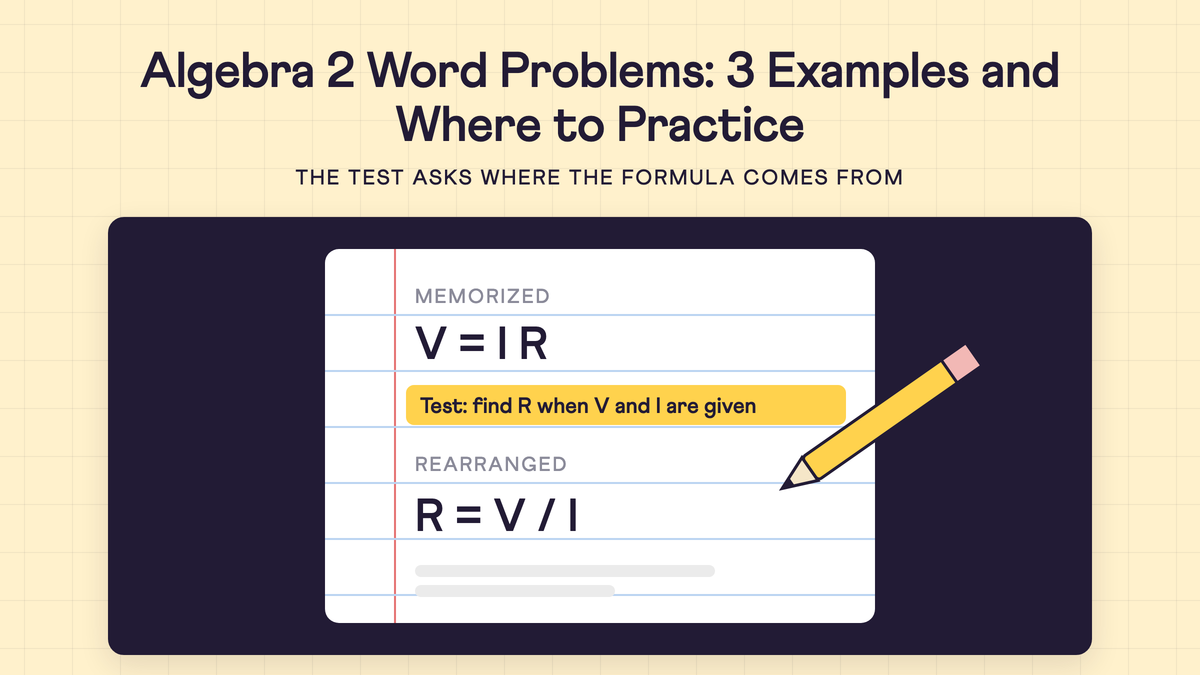
| HSA.CED.A.4 | "Rearrange formulas to highlight a quantity of interest, using the same reasoning as in solving equations. For example, rearrange Ohm's law V = IR to highlight resistance R." |
| HSF.BF.A.1 | "Write a function that describes a relationship between two quantities." Its first part: "Determine an explicit expression, a recursive process, or steps for calculation from a context." |
| HSF.LE.A.2 | "Construct linear and exponential functions, including arithmetic and geometric sequences, given a graph, a description of a relationship, or two input-output pairs (include reading these from a table)." |
| HSA.REI.A.1 | "Explain each step in solving a simple equation as following from the equality of numbers asserted at the previous step, starting from the assumption that the original equation has a solution." |
The CED lines sit under the heading "Create equations that describe numbers or relationships." HSF.BF.A.1 sits under "Build a function that models a relationship between two quantities." Which lines fall in Algebra 2 and which in Algebra 1 is the school's or its state's call, because the standards document says: "These standards do not mandate the sequence of high school courses." The course syllabus does.
What these problems look like
Three examples in that shape. A test will use its own numbers, but the verb is the same.
- Create (HSA.CED.A.1). A phone plan costs $20 a month plus $0.10 for each text. Write an equation for one month's bill, then find how many texts make the bill $35. The setup is the work: 20 + 0.10t = 35, so t = 150.
- Rearrange (HSA.CED.A.4). Ohm's law is V = IR. Write R in terms of V and I, and name the step that is the same as solving an equation. Divide both sides by I: R = V / I.
- Derive (HSA.SSE.B.4). A message is sent to 1 person, who sends it to 2 more, each of whom sends it to 2 more, for 10 rounds in all. How many people receive it? Let S = 1 + r + r² + ... + rⁿ⁻¹, with r not equal to 1. Multiply both sides by r, subtract the second line from the first, and solve for S. The derivation gives S = (1 - rⁿ) / (1 - r); with r = 2 and n = 10, the total is 1,023.
A child who can do the algebra in each problem but not the setup has the skill and lacks the setup. That is the pile the verbs above describe.
Where a 9th grader can practice this kind of problem alone
Khan Academy's Algebra 2 course. The page lists 12 units: Polynomial arithmetic, Complex numbers, Polynomial factorization, Polynomial division, Polynomial graphs, Rational exponents and radicals, Exponential models, Logarithms, Transformations of functions, Equations, Trigonometry, and Modeling. Each unit ends in a unit test, and the course ends in a "Course challenge." The skill names that match the verbs above are "Construct exponential models" in Unit 7 and, in Unit 12, "Manipulate formulas," "Equations & inequalities word problems," and "Modeling with multiple variables." If he already works there every day, those four are the items to add.
IXL's Algebra 2 page. It lists skills in lettered groups, from "A. Function concepts" to "UU. Matrices." Skill names that carry the verbs include "Rearrange multi-variable equations" and "Write exponential functions: word problems." The page says you can "select a skill plan that aligns to your textbook, state standards, or standardized test."
Art of Problem Solving's Intermediate Algebra. The store page calls it "A comprehensive textbook covering Algebra 2 and topics in Precalculus," lists topics from "complex numbers, quadratics and conic sections, polynomials" to "exponents and logarithms, piecewise-defined functions, functional equations, and much more," and says the book "contains over 1600 problems." The line that matches a student who gets stuck on problems he has not seen is the book's own: "Each section starts with problems, so the student has a chance to solve them without help before proceeding."
Those are the facts the three pages print. Khan Academy and IXL list practice by skill name; the AoPS book puts the problems before the explanation.
How to find which lines his test is built on
- Ask the teacher for the course syllabus. It names the textbook and often the standards the course follows.
- Open the textbook's chapter reviews. The items that start with derive, write, rearrange, construct, or explain are the kind the standards above ask for.
- Match each chapter to its page on the standards site: Creating Equations, Building Functions, Seeing Structure in Expressions, Reasoning with Equations and Inequalities, and Linear, Quadratic, and Exponential Models. The example inside a standard, mortgage payments or Ohm's law, is the kind of situation a test can pose.
- On the site he already uses, open the unit or group with the same name and work the items whose names start with Construct, Write, Rearrange, or Model.
- When a test comes back, sort each missed item into two piles: the equation was set up wrong, or the setup was right and the algebra slipped. The first pile is the one the standards above describe, and the one the three examples train.
Where Cuemath fits
Cuemath is live, one-on-one online math tutoring for grades K through 12. Its free evaluation is a 55-minute skills-and-gaps check run by a specialist, with a written report and a learning plan. For a 9th grader who wants to work alone, the evaluation shows which parts of Algebra 2 hold and where the gap sits, so his own practice starts in the right unit.
See which parts of Algebra 2 hold before the next test
A free Cuemath MathFit evaluation, our skills-and-gaps check, is a live, one-on-one session that shows where your child is solid and where a gap sits, in your child's own work. No credit card, and the report is yours either way.
Book a Free EvaluationFor students in Grades K to 12 worldwide.
FAQs
What is a word problem in Algebra 2, and is it the same as an "application problem"?
The same thing: a problem that starts from a situation, not a formula. The standards write it as a verb: "Create equations and inequalities in one variable and use them to solve problems." The formula is a middle step of the answer, not its start. The phone-plan example above is the shape.
Why does the test ask where a formula comes from?
Some standards ask for exactly that. HSA.SSE.B.4 says "Derive the formula for the sum of a finite geometric series." HSA.REI.B.4.a says "Derive the quadratic formula from this form." A test written to those lines can ask for the derivation, and the third example above is one.
Are these standards used in every state?
This page does not keep a list of the states that use them. The standards' site has a page named "Standards in Your State" in its navigation, and the standards document says the standards "do not dictate curriculum, pedagogy, or delivery of content." The course syllabus names the standards the course follows.
Which of these standards are in Algebra 2 rather than Algebra 1?
The standards document does not assign its lines to courses. It says "These standards do not mandate the sequence of high school courses." The school's split is in its syllabus and its textbook's chapters. A child who took Algebra 1 in 8th grade is on the track described on our Algebra 1 in 8th grade page.
The board's replies said AMC 10 and AMC 12 prep books. Do they cover Algebra 2?
Partly. On the AMC page of the Mathematical Association of America, as it read on October 23, 2026 (the site did not open for us, so we read a copy saved on that date), the AMC 10 is for "grades 10 and below" and "Advanced topics like trigonometry, advanced algebra, and advanced geometry are excluded." The AMC 12, for "grades 12 and below," "covers the full high school mathematics curriculum, including trigonometry, advanced algebra, and advanced geometry." Both run in November, in an A and a B version.
My child wants to study alone. What should we ask the school?
Ask for three things: the course syllabus, the textbook's name and edition, and whether a past test or its review sheet can come home. Then match the chapters to the standards pages in step 3 above.