IEP vs 504 for Math (ADHD, Dyscalculia): What Each Holds
Two school plans can help a child who has ADHD, dyslexia, dyscalculia, or autism and is behind in math, and both start with a request from you. An IEP (Individualized Education Program) comes under IDEA (the Individuals with Disabilities Education Act), the federal special education law.

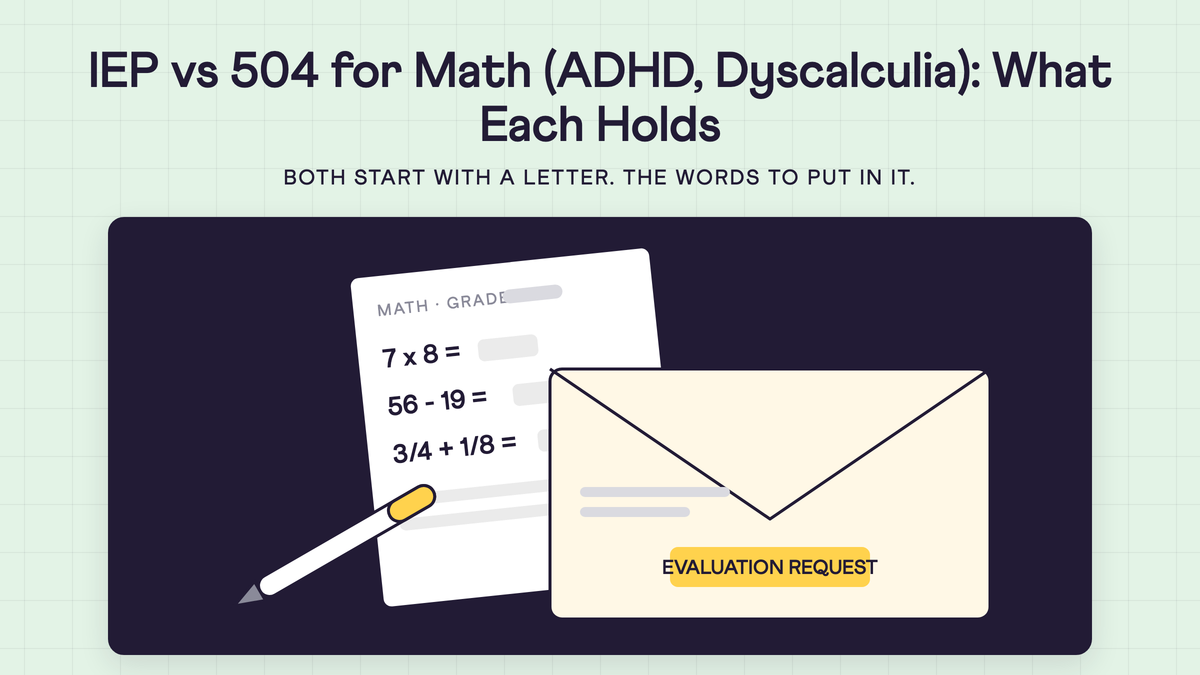
Two school plans can help a child who has ADHD, dyslexia, dyscalculia, or autism and is behind in math, and both start with a request from you. An IEP (Individualized Education Program) comes under IDEA (the Individuals with Disabilities Education Act), the federal special education law. It is "a written statement for each child with a disability," with measurable goals and the services that go with them. A 504 plan comes under Section 504 of the Rehabilitation Act, a civil rights law. It holds accommodations: changes in how your child is taught and tested, such as a calculator on a math test. The IDEA rule's list of learning disability areas names math twice: "Mathematics calculation" and "Mathematics problem solving." ADHD sits under the category the rule calls "other health impairment." The door to both plans is an evaluation, the school's own testing and review of your child. Ask for it in writing. Once you sign the consent form, your written permission for the testing, the IDEA clock is 60 days unless your state sets its own. The 504 rule sets no day count for the evaluation.
The two plans side by side
| IEP | 504 plan | |
|---|---|---|
| The law | IDEA, the federal special education law | Section 504 of the Rehabilitation Act, a civil rights law |
| Who qualifies | A child with a listed disability ("an other health impairment," which includes ADHD, or "a specific learning disability," for example) who "needs special education and related services" | A child with an impairment that "substantially limits one or more major life activities"; the Cupertino Union School District's 504 page, in California, lists "concentrating" and "learning" among them |
| What it holds for math | "A statement of measurable annual goals," the services with their "frequency, location, and duration," and test accommodations | Accommodations and services. On the Texas state test, for example: a calculator, math manipulatives, supplemental aids, oral administration, and, with state approval, a math scribe or an extra day |
| Who decides | The IEP team, which New Jersey's Department of Education parents page says "is comprised of the student's parents, teachers, and other professionals" | "a group of persons, including persons knowledgeable about the child" (the 504 rule); in Texas, "the Section 504 committee" |
What the IDEA rule says about math
The IDEA rule's definition of a specific learning disability names "mathematical calculations." The same sentence names dyslexia. A second section, 34 CFR 300.309, lists the eight areas a team looks at, and two of them are math: "Mathematics calculation" and "Mathematics problem solving." The rule prints them as separate items, so a finding can be in one, the other, or both. The word dyscalculia is not in the rule (34 CFR 300.8 and 300.309, and 20 U.S.C. 1401, read on November 4, 2026). It is the word parents use; the National Institute of Child Health and Human Development (NICHD) calls it a "math learning disability." At school, the finding uses the rule's two areas.
ADHD is a different category. The rule names "attention deficit disorder or attention deficit hyperactivity disorder" under "other health impairment." It counts when it "Adversely affects a child's educational performance." The category does not narrow the evaluation. The rule says the child "is assessed in all areas related to the suspected disability," and the evaluation must find every need the child has for special education and related services, not only the needs that usually go with the category.
What each plan does for math
For a child behind in math, an IEP means a written statement of where your child is now (the rule's term is present levels), a math goal with a number on it, a named service with how often and for how long, and test accommodations on paper. The IDEA rule requires each one: "A statement of measurable annual goals," how progress toward them "will be measured," the services with "the anticipated frequency, location, and duration," and the accommodations for "State and districtwide assessments." It also states how the disability affects progress in "the general education curriculum," the rule's name for the classes every child takes.
A 504 plan holds accommodations and services. Texas's education agency defines accommodations as "changes to materials or procedures that enable students to participate meaningfully in learning and testing." Its state-test guide lists the supports on the test, several of them for math: "a four-function calculator that a student can use for mathematics and science calculations," mathematics manipulatives, supplemental aids, oral administration, and, with state approval, a mathematics scribe or an extra day. In Texas those decisions "are made by the Section 504 committee and documented in the student's individual accommodation plan (IAP)." Cupertino Union's classroom example is "flexible seating, a fidget." Your district's list will have its own names. The 504 rule itself lists none (34 CFR 104.33 and 104.35, read on November 4, 2026), so name the math trouble in your request and ask what the plan can change.
The learning disability finding is made against "State-approved grade-level standards." A plan changes how your child is taught and tested and what support comes with it. It does not by itself find the missing skill; our page on a child behind in math is about working that out.
How to ask for an evaluation
- Put it in writing. The IDEA rule says "either a parent of a child or a public agency may initiate a request for an initial evaluation," and the three school pages we read (New Jersey's, Montgomery County's, Cupertino Union's) want the request in writing. Send it by email or on paper and keep a dated copy. Attach a copy of any outside report, such as a pediatrician's letter; the rule counts "information provided by the parent."
- Address it to the principal and the school's special education team. The team's name varies: in Montgomery County, Maryland, it is "the screening IEP team"; in New Jersey, the Child Study Team. For a 504 plan, Cupertino Union says to "contact the school site administration who will connect you to their site's 504 coordinator." Our advice: ask about both plans in the same letter.
- Use these words: "I am requesting an initial evaluation of my child, [name], grade [x], for special education under IDEA and for a Section 504 plan. I am concerned about [mathematics calculation / mathematics problem solving / attention in class]. Please send me the consent form, and please give me your decision in writing." Name the area in the rule's words; that is the list the team works from.
- Sign the consent form. The IDEA clock is 60 days from "receiving parental consent for the evaluation," or your state's own timeframe. Montgomery County prints its version: the evaluation meeting is to be held "no later than 60 calendar days from the screening IEP team’s receipt of the parent/guardian authorization for assessments."
- Expect more than one test. The rule requires "a variety of assessment tools and strategies" and says the child "is assessed in all areas related to the suspected disability." Bring the math work you have kept and the teacher's notes.
- Go to the meeting. New Jersey's page puts you on the IEP team: it "is comprised of the student's parents, teachers, and other professionals." The 504 decision is made by "a group of persons, including persons knowledgeable about the child." If the answer is no, ask for it in writing. Then ask about an IEE, an independent educational evaluation, which Montgomery County's page says a parent "may request" when they disagree with the school's assessment.
In California, the state's new K-2 math screening is a separate step from this evaluation; the page on California's math screening law says what it is and is not.
Where Cuemath fits
Cuemath is live, one-on-one online math tutoring for grades K through 12. Its free evaluation is a 55-minute skills-and-gaps check run by a specialist, with a written report and a learning plan. While the school's clock runs, Cuemath's evaluation shows where the math gap sits and what your child can already do (what happens in the hour). It is not a diagnosis, and it does not replace the school's evaluation.
See where the math gap sits while the school's clock runs
A free Cuemath MathFit evaluation, our skills-and-gaps check, is a live, one-on-one session that shows where your child is solid and where a gap sits, in your child's own work. No credit card, and the report is yours either way.
Book a Free EvaluationFor students in Grades K to 12 worldwide.
FAQs
What is the difference between an IEP and a 504 plan for math?
An IEP is a written plan under IDEA with "measurable annual goals," named services, and test accommodations, for a child who "needs special education and related services," meaning teaching designed for the child. A 504 plan holds accommodations and services for a child whose impairment "substantially limits one or more major life activities," such as learning. On a math test that can mean a calculator, manipulatives, or supplemental aids. An IEP adds a goal and a service on top.
Does ADHD qualify a child for an IEP?
It can. The IDEA rule lists "attention deficit disorder or attention deficit hyperactivity disorder" under "other health impairment," which applies when it "Adversely affects a child's educational performance," and the team must find that the child "needs special education and related services." If the team finds the child needs supports but not special education, the IDEA door closes and the 504 door stays separate, so ask about both plans in one letter.
Is dyscalculia a recognized learning disability?
The IDEA rule does not print the word (34 CFR 300.8 and 300.309, and 20 U.S.C. 1401, read on November 4, 2026). It names "mathematical calculations" in its definition of a specific learning disability, and "Mathematics calculation" and "Mathematics problem solving" as two of the eight areas a team looks at. The NICHD calls dyscalculia a "math learning disability." Ask for an evaluation in those two areas.
How long does the school have to evaluate my child?
The IDEA rule says within "60 days of receiving parental consent for the evaluation," or the state's own timeframe. Montgomery County, Maryland, prints 60 calendar days from the signed authorization or 90 from the referral, "whichever is sooner." The IDEA clock starts at consent, not at your first letter; Montgomery County's 90-day line starts at the referral. Either way, sign the form when it arrives.
Does my pediatrician's ADHD letter count?
Yes, as information. The IDEA rule says the evaluation uses "a variety of assessment tools and strategies," "including information provided by the parent," and may not use "any single measure or assessment as the sole criterion." Send a copy with your request. The school still runs its own evaluation, and the team makes the finding.
What if the school says no?
Ask for the decision in writing. Montgomery County's page says a parent "may request an IEE," an independent educational evaluation, when they disagree with the school's assessment. They may also pay for a private evaluation, which "is submitted in writing and reviewed by the IEP team." Ask your own district what it offers. A tutoring check is not a diagnosis and not the school's evaluation.