How to Help My Child With Math: What Is Actually Missing
A missing building block, fluency that is not there yet, or shaken confidence: three problems that look identical at the kitchen table and need different fixes.

Homework that should take twenty minutes takes an hour and ends in a fight. The teacher writes "needs support in math" on the report card. Your child has started saying "I hate math" and sounding like they mean it. Search for how to help my child with math and you will find worksheet sites, apps, and games. Most of them assume you already know what the problem is.
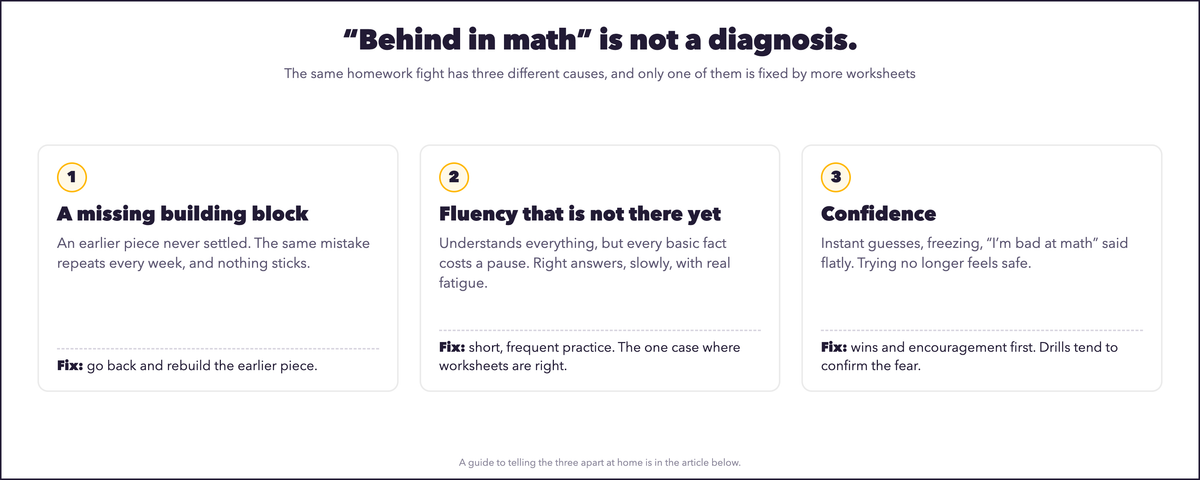
You probably do not, because "behind in math" is not a diagnosis. It tells you where your child is, not why. A low score on a report card has the same limit: it gives position, not cause. So do the district diagnostics: an i-Ready placement level tells you where your child sits, never why. Underneath "behind" usually sits one of three problems. They look identical at the kitchen table, they need different fixes, and the popular fix, more worksheets, is right for exactly one of them.
The useful news: you can usually tell the three apart at home, by watching your child work. Here is what each one looks like.
The first possibility: a missing building block
Math stacks. Each year's topics stand on pieces laid in earlier years. Fractions stand on division and place value. Algebra stands on fractions. When one of those earlier pieces never settled, this year's topic has nothing to hold it up. The child in front of fourth grade homework may really be stuck on a second grade skill, and no amount of fourth grade effort will fix that.
Signs this is your child:
- The trouble is concentrated. One strand collapses, say anything involving fractions, while other topics are fine.
- The errors repeat. You see the same mistake every week, not random slips.
- Nothing sticks. Your child follows the steps with you on Monday, then cannot do them alone on Thursday. A memorized routine with a hole under it does not hold.
- They cannot explain why. Ask why the rule works, not what to do next. A right answer the child cannot explain is fragile knowledge, and fragile knowledge usually sits over a gap.
The fix runs backward: find the earlier piece and rebuild it. This is the one problem extra worksheets cannot touch. More pages of this year's topic just give the child more chances to fail at something they cannot start.
The second possibility: fluency that is not there yet
Some children understand everything and still drown. They can tell you what multiplication means. But 7 times 6 costs them a pause and some fingers, and so does every other basic fact. Each small step eats attention, so a problem with five steps arrives at step four with nothing left.
Signs this is your child:
- Given unlimited time, the work comes out right.
- Fingers, tally marks, or long silences on facts their classmates answer cold.
- Homework is slow and draining. Your child is genuinely tired afterward.
- New ideas land fine in the lesson, then fall apart a week later in mixed work.
Understanding is not the problem here. Speed is. And this is the one case where the popular fix is the right fix: short, frequent practice at the right level does exactly this job. If your instinct said "more worksheets," this is the child that instinct is right about. For the facts and methods the Common Core says a child should do fluently at each grade, see our page on drilling or reasoning.
The third possibility: confidence, or math anxiety
Math anxiety in children is easy to misread, because the math underneath may be fine. What broke is the child's belief that trying is safe.
Signs this is your child:
- Instant guessing. A wrong answer half a second after the question, because a guess ends the moment.
- Freezing. Tears, stalling, or a blank stare before the first problem has even been read.
- "I'm bad at math," said flatly, as a fact about themselves rather than a complaint about tonight.
- The same child handles numbers happily when nothing is at stake: keeping score in a game, splitting a bill, doing a puzzle.
Here the popular fix backfires. A child who knows the concepts but second-guesses their answers needs encouragement and problems they can win, not harder ones. Praise the effort, not the smartness. Piling drills onto an anxious child rarely builds skill. More often it confirms the fear.
How to tell which one, at your own table
Pick one problem from this week's homework that went wrong. On a calm afternoon, not in the middle of a homework fight, sit down together and say: "Do this one out loud for me, and I promise not to correct anything."
Then keep the promise. Do not teach. If your child stalls, ask "What do you notice?" or "What would you try first?" and nothing more. This is harder than it sounds, and the urge to jump in is strong. Hold back anyway. The brain that does the work is the brain that learns, and today you are not there to teach. You are there to see where the work breaks.
- Breaks at the start, on the idea itself. "I don't know what this is asking," about a topic from an earlier year. Missing building block.
- Slow but sound. Finger counting, long pauses, the right answer in the end, real fatigue. Fluency.
- Breaks before the math begins. A refusal, an instant guess, "I can't" before the problem is read. Confidence.
Two honest cautions. One problem is a clue, not a verdict, so watch a handful over a week or two before you settle on an answer. And the three problems mix. A gap left alone long enough grows anxiety around the whole subject. If you see two at once, the question is not which one is real. Both are. The question is which one to fix first.
What a proper evaluation adds
Watching at home gets you a strong hunch. It will not get you certainty, and it will not tell you exactly where the solid ground ends, which is what a rebuilding plan needs.
A proper evaluation is the same watching done with a trained eye. Someone works through problems with your child live, watches how they think rather than just what they answer, and adjusts the difficulty in real time to find the true level. That last part matters because the informative problems sit in a narrow band: too easy builds false confidence and shows nothing; too hard produces shutdown and shows nothing either. Finding that band for one particular child is exactly what a parent with one worksheet cannot do.
This is what Cuemath's MathFit evaluation is built to do. A MathFit Specialist works with your child one on one, watching where things break just as described above, with the level adjusted early instead of letting the child struggle at the wrong height. The family then gets the picture in writing, as a MathFit Report: what is missing, where the solid ground is, and what to rebuild first. You end up knowing what you are fixing before anyone starts fixing it.
What to do this week
- Run the kitchen-table watch above. One problem, out loud, no correcting.
- Write down what you saw in plain words. "Stops at the start of any fraction problem." "Counts on fingers for 7 plus 6." "Guesses instantly, then shuts down." Plain observations beat labels.
- Match the fix to the miss. A building-block gap needs rebuilding from the earlier piece. Missing fluency needs short, frequent practice. Shaken confidence needs wins and encouragement first, harder work later.
- If you want the hunch confirmed, book a MathFit evaluation and bring your notes. What you watched at home is exactly what a MathFit Specialist wants to hear about, and the MathFit Report will tell you whether your kitchen table got it right.
This page is written to be useful whether or not you ever speak to us. The kitchen-table watch costs nothing, takes one afternoon, and will often tell you which of the three you are looking at. Where we help is the part that is genuinely hard to do at home: finding the exact piece that is missing rather than narrowing it to a hunch. That is what the evaluation described above is, and it is free.
Not Sure What Is Actually Missing?
Bring your kitchen-table notes to a free MathFit evaluation. A MathFit Specialist confirms what you saw, and the MathFit Report puts it in writing.
Book a Free EvaluationFor Students in Grades K to 12 Worldwide
Frequently Asked Questions
How can I help my child with math at home?
Start by finding out which problem you have. Pick one problem from this week's homework, and on a calm afternoon ask your child to do it out loud while you promise not to correct anything. What you see tells you what is missing: a break at the start on the idea itself, slow but sound work on the basics, or a shutdown before the math even begins.
Why is my child behind in math?
"Behind" is not a diagnosis; it tells you where your child is, not why. Underneath it usually sits one of three problems: a missing building block from an earlier year, fluency that is not there yet, or shaken confidence. They look identical at the kitchen table and they need different fixes.
Are more worksheets the answer?
For exactly one of the three. Short, frequent practice at the right level is the right fix for missing fluency. It cannot touch a building-block gap, and piling drills onto an anxious child rarely builds skill; more often it confirms the fear.
What does math anxiety look like in children?
Instant guessing, because a wrong answer ends the moment. Freezing before the first problem is read. "I'm bad at math," said flatly, as a fact. And the same child happily handling numbers when nothing is at stake, like keeping score in a game.
My child follows the steps in the lesson, then cannot do them alone a week later. What does that mean?
Usually one of two things. A memorized routine sitting over a gap does not hold, which points to a missing building block. Or the ideas land fine but the basics still cost too much attention, which points to fluency. Time is the tell: given unlimited time, the fluency child gets it right.
When is it worth getting a proper evaluation?
When you want the hunch confirmed. Watching at home narrows it down; it will not tell you exactly where the solid ground ends, which is what a rebuilding plan needs. A MathFit evaluation is that same watching done with a trained eye: a MathFit Specialist works with your child one on one and adjusts difficulty in real time, and the family gets the picture in writing as a MathFit Report. It is free, and you can bring your kitchen-table notes.