Your child's i-Ready diagnostic score: what the number is, and what it is not
The report came home with a number and a phrase like "on grade level." Read the phrase before the number: what the score decides depends on your district, not on the test.

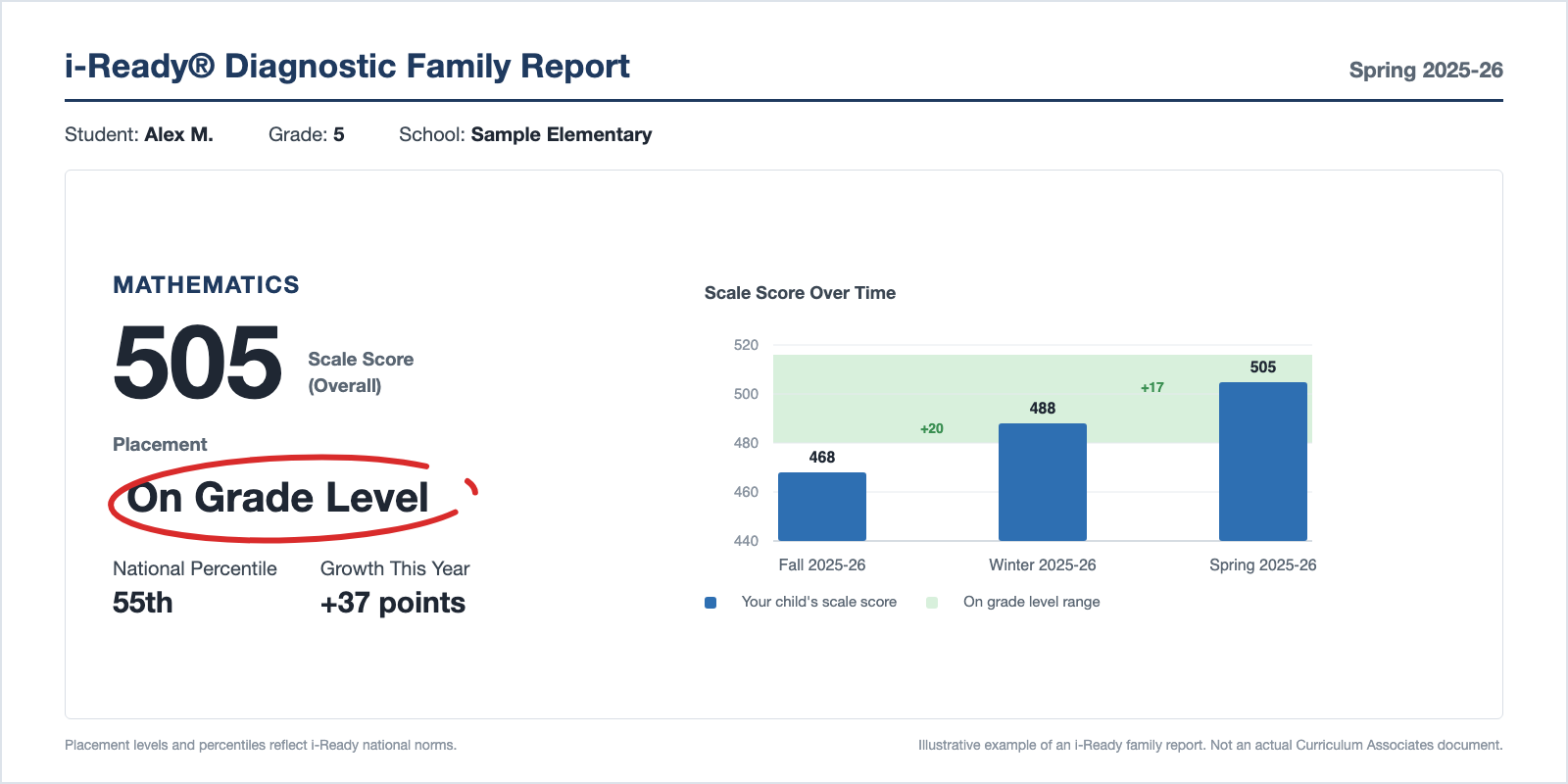
The report came home with a number on it and a phrase like "on grade level." Short answer: read the phrase before the number. The scale score by itself tells you very little. The placement level tells you where your child sits against this year's expectations. And what the score decides, if anything, depends on your district, not on the test.
What the i-Ready diagnostic is
The i-Ready Diagnostic is a computer-adaptive assessment from Curriculum Associates. Adaptive means the test adjusts to the student as they answer, so two children in the same class can see different questions. The publisher has renamed it i-Ready Inform, but school pages have not all caught up - the Forsyth district page cited below still uses the i-Ready Diagnostic name - so this page uses it too.
Per the publisher, students complete it three times a year: fall, winter, and spring. Your district sets its own calendar, but the three-sitting shape is the design.
Each sitting produces a scale score. The report then turns that score into several more readable things. The two to read first:
- A placement level. It says whether the student is above grade level, on grade level, one grade level below, or two or more grade levels below. This is relative to the child's own grade and to the point in the year.
- A national percentile. i-Ready norms are percentile ranks: how your child's score compares with nationally representative samples of students in the same grade, at the same point in the year.
The scale score is the raw material. The placement level and the percentile are the parts written for humans.
What the number is not
Three things parents often read into the number that it does not carry.
It is not a gifted label. Some districts feed the score into gifted referral, and one is shown below. But the score triggers a process; it does not decide one. In that district, a referral goes to a committee, and the district's own page warns that referral does not guarantee testing.
It is not a fixed ranking. The test runs three times a year because the number is expected to move. One sitting is a snapshot. The publisher's own growth guidance says students do not all grow at the same rate and should not share one growth goal.
It is not a single-number verdict. In the two district uses we verified for this page, the score sat next to other measures both times: other tests, grades, or teacher input. It never stood alone. And it is not a MAP score: if your district reads one test and your child took the other, our i-Ready vs MAP page explains why the two numbers cannot be swapped.
The same score, two different jobs
Here is why the number only means something next to your district's rules. Two verified districts gave the same score two different jobs.
Forsyth County Schools, Georgia: a gifted-referral trigger. Forsyth drives automatic gifted referral from the i-Ready Diagnostic in grades K-8. A student at the 90th national percentile or higher in reading and/or math is automatically referred to the district's Gifted Eligibility Team. Students at the 85-89th percentile can be referred through each school's equitable process. Parents can also refer their child at any time by requesting a referral form from the school's gifted coordinator, and referrals are tied to the i-Ready administrations during the year.
Notice what the score does and does not do here. It refers. The Gifted Eligibility Team decides whether the child is tested at all, and the actual gifted testing runs in its own windows: for 2026-27 these are August 31 - September 11 for grades 1-8 and March 1 - March 11 for grades K-8. Eligibility then follows Georgia's state framework, not the i-Ready score by itself.
One more caution: this referral rule is newer than it looks. The archived 2024-25 version of the same district page used only generic norm-referenced-test language, with no i-Ready mention at all. And the current criteria are still labeled for the 2025-2026 school year. A district can give this score a job it did not have last year, and it can take that job away. Check the live district page, not a forum thread from two years ago.
Cupertino Union, California: a math placement criterion, now retired. Cupertino Union once used i-Ready scale scores as posted cut scores for accelerated math placement. In the district's 2024-25 posting, Algebra 1 in 7th grade listed an i-Ready Diagnostic scale score of 548 or greater among its named measures. Those cut scores stayed posted through at least early 2025. Then the district changed diagnostic vendors. The current page decides acceleration with multiple assessment measures; the named ones include a standards-based assessment administered in March, NWEA adaptive diagnostic scores from during the year, and first-semester course grades. The page keeps its own list open ("multiple assessment measures," "will include"), and teacher verification appears as an additional measure in every criteria table.
So a parent in Cupertino who found "i-Ready 548" in an old forum thread and drilled toward that number would be preparing for a criterion that no longer exists. Same test, same scale, and the job is gone.
Two districts. In one, the score opens a gifted-referral door this year. In the other, it once gated a math course and now gates nothing. The number means what your district currently does with it.
What to do with the report
Three things, in order.
- Read the placement level first, not the scale score. "On grade level" or "one grade level below" is the part that answers a parent's real question. The bare number does not answer it.
- Ask the school one question: which decisions, if any, use my child's i-Ready score this year? Gifted referral, math placement, reading support, or none. There is no national answer. The CogAT, for example, has no national test date; its windows are district-determined. i-Ready use is just as local. If the answer is "none," the report is information for the teacher, and you can read it calmly.
- Watch growth across sittings, not one sitting. The test runs fall, winter, and spring, and the later reports show movement, which is what the design measures. One low sitting at the start of a school year is a data point, not a verdict on your child.
Where Cuemath fits
We do not administer i-Ready and we cannot change the placement level on your child's report. Cuemath teaches math in live one-on-one online sessions for grades K to 12, so our work starts after the report comes home.
If that report came back one or two grade levels below, the useful next question is which specific things are missing, and a placement level does not tell you that. A free Cuemath evaluation works out where it actually broke, which is the part you can do something about.
Report says below grade level? Find out what is actually missing.
A free Cuemath evaluation finds the specific skills behind the placement level, so you know what to work on.
Book a free evaluationFor students in Grades K to 12 worldwide.
FAQs
What is a good i-Ready diagnostic score?
There is no single good score. The scale score on its own means very little, because it only has meaning relative to your child's grade and the point in the school year. That is why the report translates it into two more readable things: a placement level, and a national percentile. Read those two first, and treat the scale score as the raw material behind them.
What do the i-Ready placement levels mean?
The placement level says where your child sits against grade-level expectations at that point in the year: above grade level, on grade level, one grade level below, or two or more grade levels below. It is relative to your child's own grade and to the season of the sitting, so a fall result is judged against fall expectations, not end-of-year ones.
Does the i-Ready score decide my child's math placement?
Only if your district says it does. In the district uses we verified for this page, the score never stood alone: it sat next to other tests, grades, or teacher input. Cupertino Union in California once posted i-Ready cut scores for accelerated math, then dropped them after changing testing vendors. Ask your school one question: which decisions, if any, use my child's i-Ready score this year.
Is the i-Ready diagnostic a gifted test?
No. It is a general diagnostic of reading and math skills. Some districts use a high score as a trigger for gifted referral. Forsyth County Schools in Georgia, for example, automatically refers students at the 90th national percentile or higher. Even there, the score only opens a referral. A Gifted Eligibility Team decides whether the child is tested, and eligibility follows the state's framework.
My child's score went down since the last sitting. Should I worry?
Not from one drop. Students sit the diagnostic three times a year, in fall, winter and spring, because the number is expected to move. The test is also adaptive, meaning it adjusts as your child answers, so a single sitting is a snapshot of one morning. What is worth reading is the direction across sittings, not the gap between two of them. The publisher's own growth guidance says students do not all grow at the same rate and should not share one growth goal. If a drop repeats across sittings, that is the point to ask the teacher what changed.
Can my child fail the i-Ready diagnostic?
No. The diagnostic places a student on a scale; it does not pass or fail anyone. Because it is adaptive, it is designed to find the edge of what your child currently knows, which means every child meets questions they cannot do. That is the test working, not your child struggling.
Should my child prepare for the i-Ready diagnostic?
Preparing for a specific number can backfire. A parent in Cupertino who found the old "i-Ready 548" cut score in a forum thread and drilled toward it would be preparing for a criterion that no longer exists. The test is adaptive and finds your child's current level either way. If the report shows gaps, the useful work is fixing the specific missing skills, not chasing a score.
What is i-Ready Inform?
i-Ready Inform is the new name for the i-Ready Diagnostic. Curriculum Associates states it on its own site: the adaptive assessment previously named i-Ready Diagnostic is now i-Ready Inform. It is the same test, and only the name has changed. Many school and district pages still use the old name, so you may see both.