Math Class Is Too Easy for My Child. What Can the School Do?
Your child says the math in class is too easy. The question is what the school can do about it this year, not whether she can test into a faster course in middle school.

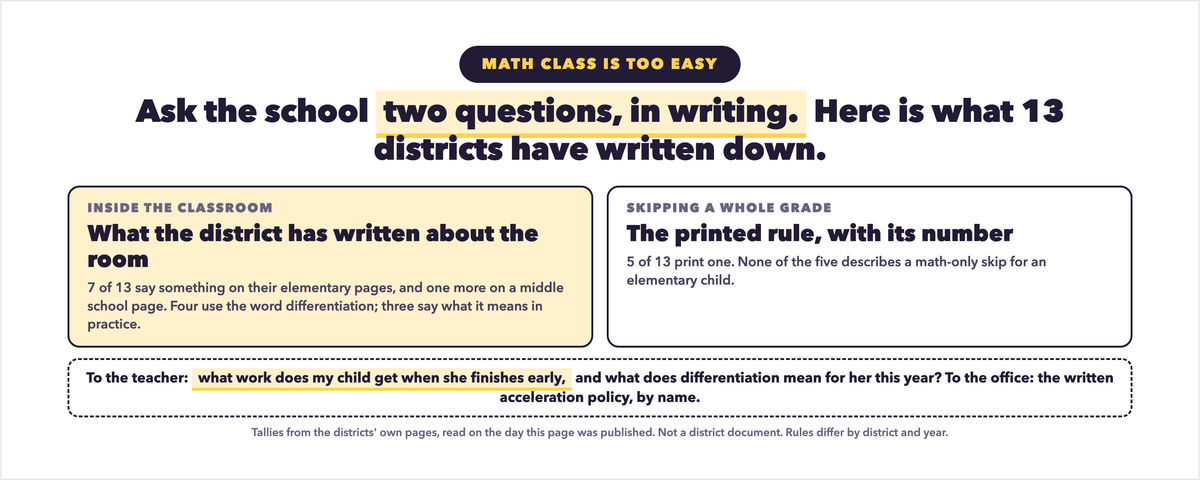
Your child says the math in class is too easy. The question is what the school can do about it this year, not whether she can test into a faster course in middle school. We read the pages of 13 school districts. Seven say something about the elementary classroom, and Palo Alto says it on a middle school page. Five print a rule for skipping a whole grade, from Evergreen's 98th percentile to Plano's 80% on four subject tests; those rules are further down.
Find your district in the table below. Evergreen School District and San Jose Unified are separate districts with separate rules, so check which one your address belongs to.
Your first step is two written questions. Ask the teacher, in writing, what work your child gets when she finishes early, and what differentiation (changing the work for one child inside a mixed class) means for her this year. Ask the school office for the district's written acceleration policy by name; the table gives the page for each district that has one. The skip rule is there if you want it; the classroom question is the one to send first. A written answer is something you can point back to later in the year.
What the districts have written about class work
Seven districts say something about the elementary classroom on their own pages, and Palo Alto says it on a middle school page. Four of them (Irvine, Palo Alto, Forsyth County and Fremont) use the word differentiation: the teacher changing the work inside one mixed classroom. Three say what that means in practice: Irvine, Palo Alto and Forsyth County.
Irvine Unified runs cluster classes in every elementary school in grades 4-6: a small group of identified children inside a regular class, or in its words "a small group of GATE program students within a mixed-ability, general education classroom" (GATE is Gifted and Talented Education). Its page says differentiated instruction "is provided within the school day and in the general education classroom through the use of flexible groupings, supplemental materials, and varied learning activities." It adds that differentiation "is not accomplished by assigning GATE students more homework or special at-home projects." A child gets in through a yearly screen of every 3rd through 5th grader and qualifies by scoring in the top 20% of the grade.
Palo Alto Unified suspended gifted identification when the state ended GATE funding and says it serves "high achieving and gifted students regardless of GATE identification." Its page defines the word: teachers "may differentiate the content (what is being taught), process (how it is being taught), and/or product (how the student demonstrates knowledge and understanding of the content)." That page is a middle school's; the district's own math page says nothing about acceleration or differentiation for an elementary child.
Forsyth County offers gifted services in all its schools for grades 1-12 to students who meet the state's eligibility rules. Its service models "may include resource pull-out classes, cluster grouping with a gifted-endorsed teacher, the advanced content model," and honors and Advanced Placement courses. Each school picks its own model. Its gifted-endorsed teachers use "curriculum compacting, flexible grouping, and tiered assignments."
Fairfax County lists its classroom support in steps. All students get critical and creative thinking lessons and access to AAP curriculum and strategies (AAP is Advanced Academic Programs). Identified students in grades K-6 get Subject-Specific Services, "AAP curriculum lessons in the general education setting in areas of academic strength." In grades 3-6, Part-Time Services add more than one subject, led by the school's Advanced Academic Resource Teacher. Fairfax evaluates every student for both "during the spring screening window in May," and the full-time program with its referral deadline is on our Fairfax AAP page.
Round Rock ISD (ISD is Independent School District) calls talent development the first tier of its gifted services: identified students "are clustered with other students identified for gifted services and are placed with a teacher who has the training in teaching gifted that is required by the state." It adds: "Beginning in 3rd grade, accelerated math instruction is provided for those who show a need for service."
Fremont Unified says it "provides support for gifted and talented (GATE) students through differentiated instruction." It cut funding for the CogAT (the Cognitive Abilities Test) in February 2020, and its 2026-27 page says no test for GATE eligibility is given this year.
Cupertino Union answers in the questions and answers on its LCAP, the Local Control and Accountability Plan that every California school district must prepare. In its 2025-26 answers to parents' questions, Cupertino says most of its students "perform well above state standards, and teachers are accustomed to meeting the needs of high achievers." A year earlier, asked for a gifted plan, it pointed to personalized learning, where "Instruction is adapted to meet learning needs and styles," and told parents who feel a need is not met to "reach out to your child's teacher first, followed by the school administration." It names no program.
Plano ISD moves the child to a different class rather than changing the work in the room. Math Rocks, for grades 4-8, "replaces the students' regular mathematics class" with grade-level standards plus enrichment. It runs at cluster campuses. There is no application; invitation letters go out in early April. Its other routes are on our Plano page.
The other five districts (Evergreen, San Jose Unified, Sunnyvale, Frisco and Lexington) say nothing about the classroom for a child who is ahead on the district pages we read. Who tests for gifted programs, and when, is on our gifted testing page.
The grade-skip rules, with their numbers
Five districts print a rule for moving a child up a whole grade. None of the five describes a math-only skip for an elementary child.
Cupertino Union calls a grade change "not the primary means of addressing areas of need" but possible case by case, "at the discretion of the administration of the school/district," weighing achievement and "social and emotional growth." A child must have attended for 20 school days before a parent can request acceleration, and the page sends parents to the school's site administration.
Evergreen School District asks for "a signed letter" to the principal's office, "physical copies" only. A meeting follows within four weeks of the letter or the start of school, whichever is later. If the findings support it, the school psychologist tests the child within four weeks of those findings, and the child "must score at the 98th percentile in all areas" of the standardized tests. A student study team meeting, with the parents, teacher and principal, then decides the placement.
Plano ISD tests children in grades 1-5 in four subjects: science, social studies, mathematics and language arts. A child needs "80% or higher" on each test, gets "3 continuous hours per assessment," and must pass all four.
Round Rock ISD, grades K-5, uses exams from Texas Tech University and the University of Texas, aligned to the Texas state standards: a child "may accelerate a full grade level by successfully taking exams in math, science, social studies, and language arts." Register by August 1 (early) or August 10 (late) for August testing, or by April 15 for the grade-level exam, through the campus counselor. The page does not print a pass mark.
Frisco ISD uses Credit by Exam Without Prior Instruction, which gives "grade-level or course credit" for work not yet taught, at "80% mastery or higher." It calls the exam "intended for a very small percentage of learners." Two windows serve 2027-28 placement. In the first, applications run January 4 to February 17, 2027, and tests run March 22 to April 5. In the second, applications run April 19 to May 14, 2027, and tests run July 12 to 15, and the parent starts with the campus counselor.
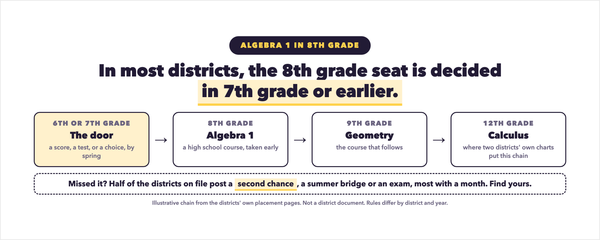
San Jose Unified prints no whole-grade rule; its math page says students "cannot skip or take concurrent math courses." Its advanced math pathways start in middle school. So do the accelerated courses in Sunnyvale, Forsyth County and Evergreen. Those are on our 8th-grade Algebra 1 page and our Cupertino, Sunnyvale and San Jose comparison.
| District | Written about the classroom | Grade-skip rule | Where it is posted |
|---|---|---|---|
| Cupertino Union, CA | Teachers are used to high achievers; instruction adapted to each learner; no program named | Administration's discretion; achievement plus social and emotional growth; 20 school days attended first | Promotion and Retention page |
| Evergreen School District, CA | Not on the district pages we read; the faster math course starts in 7th grade | Signed letter to the principal; meeting within four weeks; 98th percentile in all areas; student study team decides | Acceleration and Retention Process, K-8 |
| Fairfax County, VA | Subject-Specific and Part-Time Services in the general classroom; all students screened each May | None printed on the AAP pages | Advanced Academic Programs page |
| Forsyth County, GA | Gifted services in grades 1-12: pull-out classes, cluster grouping or advanced content; compacting, flexible grouping, tiered assignments | None printed; at DeSana Middle School, accelerated math starts in 6th grade, by 4th-grade state scores and a 5th-grade test | Academics page; DeSana Middle School accelerated math page |
| Fremont Unified, CA | GATE support through differentiated instruction; no GATE eligibility test this year; the work itself not described | None printed on the GATE page | GATE Overview |
| Frisco ISD, TX | Not on the district pages we read | Credit by Exam Without Prior Instruction, 80% mastery; two windows for 2027-28 placement, through the campus counselor | Credit by Exam Without Prior Instruction page |
| Irvine Unified, CA | GATE cluster classes in grades 4-6; flexible groupings and supplemental materials in the school day; not extra homework | None printed; APAAS (Alternative Program for Academically Advanced Students) for grades 4-6, by application | Elementary Advanced Learning page |
| Lexington, MA | Not on the district pages we read; the K-5 math page marks its support information coming soon | None printed | K-5 Mathematics Curriculum page |
| Palo Alto Unified, CA | Differentiation by content, process or product, on a middle school page; nothing for K-5 | None printed | Fletcher Middle School GATE page |
| Plano ISD, TX | Math Rocks replaces the math class, grades 4-8, at cluster campuses | Four subjects at 80% each, three hours per test, two attempts; placement at the start of a school year | Grades 1-5 Credit for Acceleration page |
| Round Rock ISD, TX | Gifted services cluster identified students with a gifted-trained teacher; accelerated math from 3rd grade for those who show a need | K-5 full grade by exams in four subjects; register by August 1, August 10 or April 15; no pass mark printed | Examination for Acceleration page; Gifted Services page |
| San Jose Unified, CA | Not on the district pages we read; no gifted program listed | No whole-grade rule printed; students cannot skip or take concurrent math courses | Mathematics page |
| Sunnyvale School District, CA | Not on the district pages we read; no gifted program listed | None printed; accelerated math courses start in middle school | Programs of Choice page |
If your district is not on this list
Three questions get you the same table for your own district, and the school office can answer each in writing.
- What does the district call its classroom support for advanced learners, and on which page is it described? The words to look for are differentiation, cluster, enrichment and talent development.
- Is there a written whole-grade or single-subject acceleration policy, and what does it require? Ask for the policy by its name and number; Cupertino files it under promotion and retention, Evergreen under acceleration and retention.
- What is the entry rule for the faster math course in middle school, and in which grade is it decided? Our method page shows how to find and read that rule.
Where Cuemath fits
Cuemath is live, one-on-one online math tutoring. The rules above run on the measures and tests each district names, and none of them names an outside evaluation. What an outside evaluation can show you, in your child's own work, is how far ahead she is and where the first gap sits, which is something concrete to bring when you ask the teacher for harder work.
See where your child stands in math
A free Cuemath MathFit evaluation, our skills-and-gaps check, is a live, one-on-one session that shows where your child is solid and where a gap sits, in your child's own work. No credit card, and the report is yours either way.
Book a Free EvaluationFor students in Grades K to 12 worldwide.
FAQs
Can my child skip a grade in math only?
Not in writing, in the five districts that print a skip rule: none of the five describes a math-only skip for an elementary child. Plano and Round Rock test four subjects for an elementary skip, and Round Rock's page offers single-subject acceleration to secondary students. Cupertino speaks of acceleration "to the next grade or course" and Frisco of "grade-level or course credit," and neither says whether that covers one subject for an elementary child. Round Rock's gifted services add accelerated math instruction from 3rd grade for identified children who show a need. Otherwise the single-subject move comes at the middle school entry rule, which our 8th-grade Algebra 1 page lists district by district.
Will a summer program or an outside class move my child up?
In Evergreen and San Jose Unified, no. Evergreen's middle school FAQ says completing summer programs "does not qualify students to skip classes or be placed in advanced classes for the coming school year." San Jose Unified "does not accept outside coursework for middle school math" acceleration. For any other district, ask before paying for a course with that aim.
What does differentiation mean on a district page?
Differentiation means the teacher changes the work for your child inside the regular mixed classroom: what is taught, how it is taught, or how she shows what she knows. That is Palo Alto's definition, and its middle school page places GATE students "within heterogeneous classrooms," mixed-ability rooms, where they "receive challenge via differentiated instructional strategies." Fremont uses the word without saying what the work is, and Cupertino's 2025-26 answer on advanced students does not use it at all. The word by itself does not say what changes for your child, so when you ask the teacher, ask which of the three changes for her.
Do we have to apply for a gifted program, or does the school find my child?
In Irvine, Plano and Fairfax the school screens every child in the grades it names, and Fairfax also takes a parent's referral. Irvine screens every 3rd through 5th grader "automatically" within the school day, over the course of the year, while its APAAS takes a parent application from January 4. Plano picks Math Rocks students from the assessment history of all its 3rd, 4th and 5th graders, with no application. Fairfax evaluates every student in May; outside that window, a parent can submit the Subject-Specific or Part-Time Services Referral Form to the school's Advanced Academic Resource Teacher.
Is there a separate gifted class my child could move into, rather than skipping a grade?
Yes, in at least three districts, each with its own entry rule. Irvine's APAAS, an elementary program option for grades 4-6, takes applications from January 4 to February 12, 2027; its cluster classes are not separate, since they sit inside a regular class. Plano's Math Rocks replaces the math class in grades 4-8, by invitation in early April, and an identified child at a school without it may transfer to the cluster school. For Fairfax's full-time program in grades 3-8, a central selection committee decides who gets in, and Forsyth County lists resource pull-out classes as one model its schools may use. The testing windows for these and the other districts are on our gifted testing page.
When would my child actually move up a grade?
In Plano, only at the start of a school year. Plano accepts a request "at any time during the school year," but placement in a new grade happens only at the start of a school year, whenever the test was taken. In Frisco, the current windows place children for the 2027-28 school year. For applications that close February 17, 2027, parents approve by February 19 and scores arrive by April 24. For applications that close May 14, 2027, parents approve by May 17 and scores arrive by July 31, and Frisco's November and January test windows are for high school one-semester courses only.