OC Test Preparation (2027): How to Get Ready for the Maths Section?
The OC Test decides entry to opportunity classes, and its maths section surprises many well-prepared children. This guide shows how to prepare for it using the maths your child already knows.

The Opportunity Class (OC) Placement Test is the entry test for opportunity classes. These are Year 5 and Year 6 classes at some NSW public primary schools, and children get a place based on how they do in the test. It is for children in Year 4. Parents apply online between November and February. Children sit the test on a computer in early May, and families get the outcome in September.
Start early because the maths questions test how your child thinks, not what they have memorised. That kind of thinking grows with short, regular practice over weeks, and it is much harder to build in the last few days.
See Where Your Child Stands in Maths
Book a free MathFit evaluation. A specialist shows you how your child thinks through problems, and you watch live.
Book a Free EvaluationFree · Online · Kindergarten to Year 10
What to Expect in the OC Test Maths Section?
OC test has three sections: Reading, Mathematical Reasoning and Thinking Skills.
| Section | Questions | Time | Weighting |
|---|---|---|---|
| Reading | 14 (3 have multiple parts) | 40 minutes | 33.3% |
| Mathematical Reasoning | 35 | 40 minutes | 33.3% |
| Thinking Skills | 30 | 30 minutes | 33.3% |
Source: NSW Department of Education, Opportunity class practice tests (page last updated 22 July 2026).
Important: Every Mathematical Reasoning question has five answer options, which gives your child about 68 seconds per question. The test is on a computer at a test centre. Calculators are not allowed, and each child gets two A4 sheets for working out, with more on request.
Suggested Reading: When to Start Preparations for OC & Selective Test 2027?
Why Knowing the Maths Is Not Enough?
Knowing a rule means your child can work out 50 ÷ 8 and say "6 remainder 2". Reasoning means they use that fact when the question doesn't announce it.
Try this one: Egg cartons hold 8 eggs. Mia needs 50 eggs for a bake sale. How many cartons must she buy? The sum is the same, but the answer is 7, not 6. Six cartons hold 48 eggs and leave her 2 short. A child who stops at the calculation picks 6 every time, and 6 will be one of the answer options.
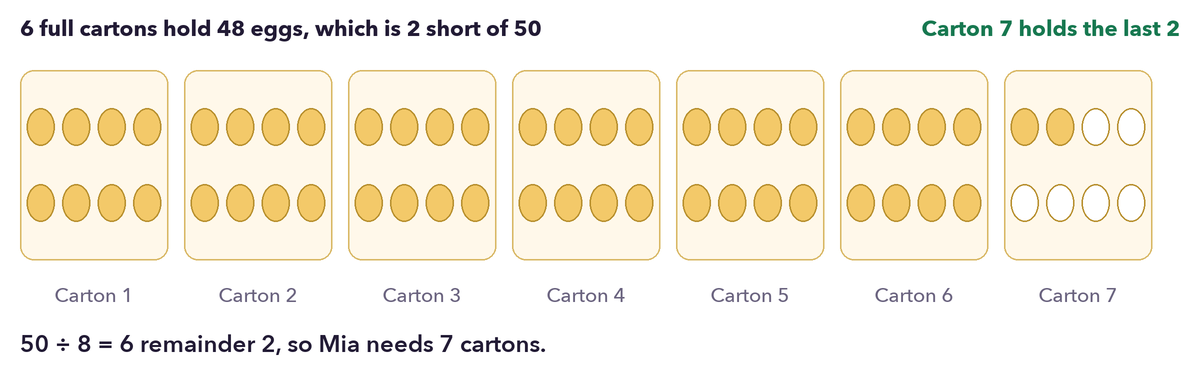
That gap, between doing the sum and checking it answers the question, is where many marks are won or lost.
Source: Cuemath Mock Tests
8 Maths Skills to Practise for the OC Test 2027
The OC Test maths section uses only Year 3 and Year 4 maths from the NSW syllabus (Stage 2). There is no separate OC syllabus. The test mixes these skills in new ways. Your child has to choose a method, solve the problem and explain their thinking, and the syllabus asks for exactly that.
| Skill area | What to do | Try this (Cuemath Examples) |
|---|---|---|
| Number sense and place value | Estimate first. Ask "About how big should the answer be?" | Is 398 × 5 more or less than 2,000? Answer: Less, it is 1,990. |
| Missing numbers | Read "=" as "is the same as". | 48 + ☐ = 100 − 27. What goes in the box? Answer: 25. |
| Fractions | Draw it. Check which whole the fraction is "of". | A pizza has 8 slices. Tom eats a quarter and Sara eats 2 slices. What fraction is left? Answer: One half. |
| Multi-step word problems | Underline the real question before starting. | Ella has $20 and buys three notebooks at $4.50 each. How much change? Answer: $6.50. |
| Patterns and number rules | Say the rule in words, then test it on every number. | 4, 7, 13, 25, … (double, then take away 1). What comes next? Answer: 49. |
| Measurement | Learn 1 m = 100 cm = 1,000 mm and 1 kg = 1,000 g. | Which is longest: 1.2 m, 115 cm or 1,090 mm? Answer: 1.2 m. |
| Shapes, symmetry and folding | Predict first. Then fold paper and check. | Fold a square in half twice and punch one hole. How many holes when you unfold it? Answer: Four. |
| Graphs and chance | Test each statement on its own. Mark it tick or cross. | A bag has 3 red, 5 blue and 2 yellow counters. Is blue more, less or equally likely than not blue? Answer: Equally likely. |
What Do OC-Style Maths Practice Questions Look Like?
The six questions below are original, written by Cuemath. They are not official OC Test questions. Each uses the five-option format of the real section and runs from warm-up to stretch. Let your child try each one on paper with no calculator and no timer. Worked answers are after Question 6.
Question 1 (warm-up). Which of these numbers is closest to 4,000?
A. 3,909 B. 4,099 C. 3,889 D. 4,101 E. 4,090
Question 2 (warm-up). Ava's swimming lesson starts at 4.35pm and lasts 50 minutes. The drive home takes 25 minutes. What time does she get home?
A. 5.25pm B. 6.00pm C. 5.50pm D. 5.10pm E. 6.50pm
Question 3 (medium). There are 32 students in a class. A quarter walk to school. A third of the rest come by car. The others catch the bus. How many catch the bus?
A. 8 B. 16 C. 24 D. 12 E. 10
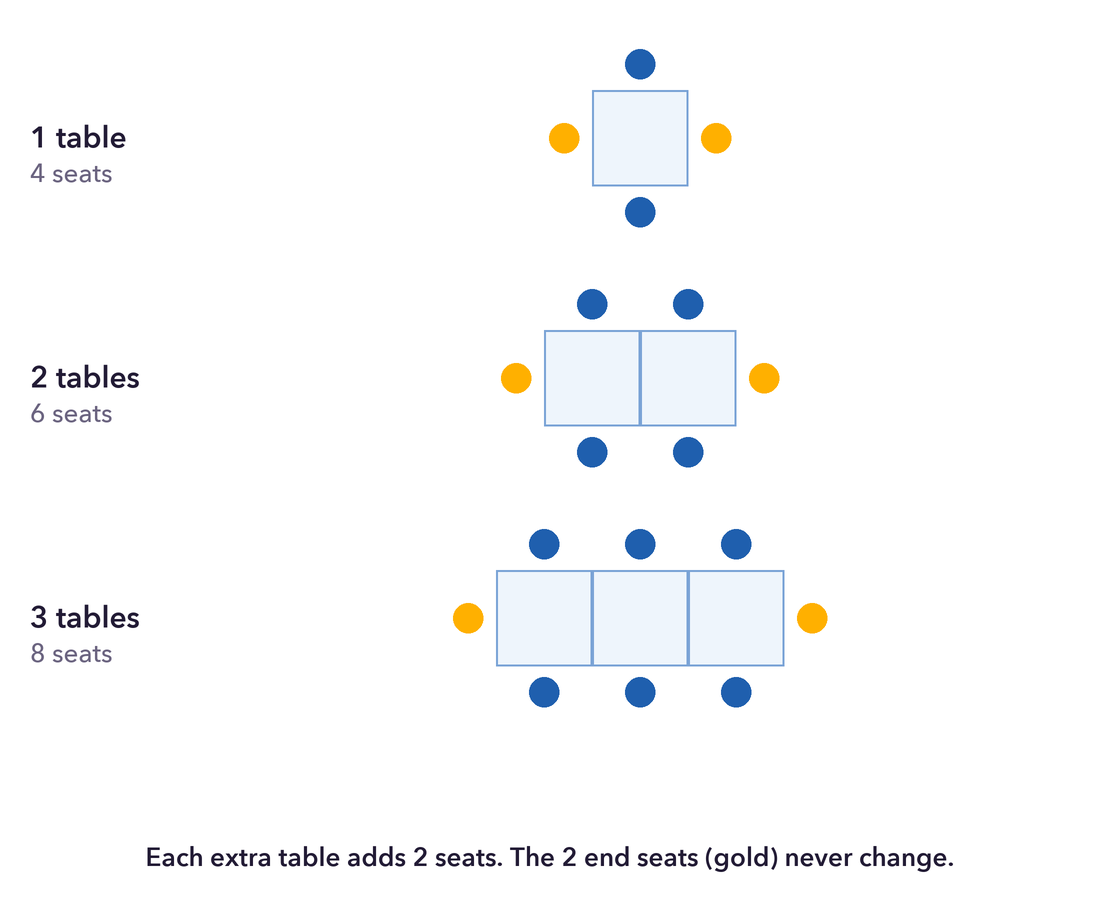
Question 4 (medium). Square tables each seat one person on each side. Pushed together in a row, 1 table seats 4 people, 2 tables seat 6 and 3 tables seat 8. How many tables in a row seat 20 people?
A. 10 B. 5 C. 18 D. 9 E. 8
Question 5 (stretch). Leo uses the digits 2, 5 and 8 once each to make three-digit numbers. How many of the numbers he can make are greater than 500?
A. 4 B. 6 C. 2 D. 3 E. 5
Question 6 (stretch). A banana and an apple together weigh 300 g. Two bananas and the same apple weigh 420 g. How much does the apple weigh?
A. 120 g B. 150 g C. 180 g D. 210 g E. 240 g
Worked Answers
Try all six first. Then open the answers below.
Show answers and worked solutions
Question 1: E (4,090). Work out each gap from 4,000: 91, 99, 111, 101 and 90. The smallest is 90. Option A is the trap: 3,909 looks close because it starts with 39, but it is 91 away.
Parent tip: If your child picks A, ask them to write each gap down. Once the gaps are on paper, the answer is clear.
Question 2: C (5.50pm). Jump to the next o'clock first: 4.35pm + 25 minutes = 5.00pm. Add the other 25 minutes of the lesson to reach 5.25pm. Add the 25-minute drive to reach 5.50pm. Option A (5.25pm) is when the lesson ends, before the drive. Option B (6.00pm) is 85 minutes after 4.35pm, which comes from adding 10 minutes too many.
Parent tip: Draw a timeline and jump to the next o'clock first. It prevents most mistakes when time crosses the hour.
Question 3: B (16). A quarter of 32 is 8, so 8 walk. That leaves 24. A third of 24 is 8, so 8 come by car. 24 − 8 = 16 catch the bus. Option E (10) comes from taking a third of 32 instead of 24.
Parent tip: When your child reads "of the rest", ask "The rest of what?" and have them write that number down.
Question 4: D (9). Each extra table adds 2 seats, one on each long side. The 2 end seats never change, so seats = 2 × tables + 2. Then 20 − 2 = 18, and 18 ÷ 2 = 9 tables. Check: 2 × 9 + 2 = 20. Option B (5) comes from dividing 20 by 4, which ignores the seats lost where tables join.
Parent tip: Draw 1, 2 and 3 tables with dots for chairs and ask "What changes each time we add a table?"
Question 5: A (4). List the numbers in order so none are missed: 258, 285, 528, 582, 825, 852. That is six numbers. The four that start with 5 or 8 are greater than 500.
Parent tip: Ask "How do you know you've found them all?" Listing in a sensible order is the habit to praise.
Question 6: C (180 g). The only difference between the two scales is one extra banana. The mass rises by 420 − 300 = 120 g, so a banana weighs 120 g. The apple weighs 300 − 120 = 180 g. Option A (120 g) is the banana, not the apple.
Parent tip: Ask "What is different between the first scale and the second?" That one question solves most problems of this kind.
Want to See How Your Child Thinks Through Problems Like These?
A free MathFit evaluation shows which maths skills to practise first.
Book a Free EvaluationFree · Online · Kindergarten to Year 10
How Can Parents Help Their Child Prepare for the OC Test?
You don't need to be a maths teacher. Most of what makes home practice useful is how you respond when your child is stuck. In roughly this order:
- Check school maths first. Look at recent class work or ask the teacher which Year 4 topics are shaky. OC-style questions sit on top of these.
- Keep sessions short and regular. Fifteen to twenty focused minutes a few times a week is easier to keep up than one long Sunday session.
- Ask for the explanation, not just the answer. "How did you get that?" is your most useful question. A child who can explain it understands it.
- Keep a mistake log. Write down each wrong answer, which option was picked and why. Read it back every week.
- Start untimed, then add the clock. Accuracy first. Timed practice only helps once the method is solid.
- Practise moving on. If a question takes far longer than a minute, make a sensible choice and move on.
On an ordinary Tuesday, your child tries three questions and gets two right. The useful conversation is about the third: which answer they picked, what they were thinking and what they would check next time. Five calm minutes on that is worth more than ten new questions.
Can Cuemath Help With OC Test Preparation?
Yes, if your child knows the Year 4 maths but loses marks on how questions are worded, and you can’t tell why. A Cuemath tutor watches your child work, finds the habit behind each wrong answer and picks the next practice to fix it.
- One tutor who sees every step. Classes are live, one-on-one and online. Your child writes each step in front of the tutor, so the tutor can tell a misread question from a missing concept. A score sheet can’t show that difference.
- Hints, not answers. Cuemath tutors ask questions that lead your child to the answer, like the parent tips under each practice question above. Your child learns to explain their thinking, and Mathematical Reasoning rewards exactly that.
- An OC plan that matches the real test. It has nine topic chapters: number systems, operations, fractions, decimals, early algebra, measurement, geometry, chance and data, and logical reasoning. Four full-length mock tests follow. Each mock has 35 questions with five options, the same as the official section, and covers all eight skill areas in this guide.
- One program for school maths and OC. The same tutor covers both, and the focus moves toward the test as May gets closer.
- Progress you can see. You follow your child’s progress and message the tutor in the Cuemath parent app.
Start with the free MathFit evaluation. In 55 minutes, your child works through 15 questions with a MathFit Specialist across four areas: Fluency, Understanding, Application and Reasoning. You watch the whole session. A written report reaches your inbox within three hours, and it is yours whether or not you continue. You will know which of the eight skill areas to practise first.
Ready to Start OC Maths Preparation?
Begin with a free MathFit evaluation and get a clear starting point for your child.
Book a Free EvaluationFree · Online · Kindergarten to Year 10
FAQs
How do I prepare for the OC Test maths section?
Build on the Year 3 and Year 4 maths your child already knows. Practise reasoning with place value, missing numbers, fractions, multi-step word problems, patterns, measurement, shapes and graphs. Ask your child to explain answers, review every mistake, and add timed practice.
What maths skills should Year 4 students practise for the OC Test?
Year 4 students should practise number sense and place value, missing-number sentences, fractions, multi-step problems with money and time, number patterns, measurement units, shape and position, and reading graphs. The Department says questions draw on the NSW curriculum up to Year 4, so your child does not need to learn extra content.
Are mock tests useful for OC Test preparation?
Yes, when you use them as feedback. A full mock shows how your child handles 35 questions in 40 minutes, which question types cause trouble and whether time runs out. Review every mistake afterwards. One mock score does not predict the real result, because practice papers vary in difficulty.
How often should my child practise OC maths questions?
Three or four sessions a week of 15 to 20 minutes suits most Year 4 children, plus a weekly mistake review. Adjust this for your child's skills and the time until the test.
Can my child use a calculator in the OC Test?
No. Calculators are not allowed in any part of the OC Test. Each child gets two A4 sheets for working out and can ask for more. Practise without a calculator at home so mental and written methods feel natural on test day.
When should my child start practising Mathematical Reasoning?
Light practice can start once your child is secure in Year 3 maths, often in Term 4 of Year 3 for a test in May of Year 4. Keep early practice untimed and leave full timed mocks for the last two or three months.
How can I help my child get better at maths reasoning?
Ask "How do you know?" more often than "Is it right?". Encourage an estimate before calculating, a drawing for fraction and pattern questions, and a final check that the answer matches the question. Review wrong answers calmly and look for patterns in the mistakes.
What is the format of the OC Test now?
The OC Test is computer-based, with three multiple-choice sections: Reading (14 questions, 40 minutes), Mathematical Reasoning (35 questions, 40 minutes) and Thinking Skills (30 questions, 30 minutes). The Department says all tests are now done on computers.
Sources
- NSW Department of Education: Opportunity class practice tests
- NSW Department of Education: Placement test
- NSW Department of Education: Application process
- NSW Department of Education: online OC practice tests
- NESA: Mathematics K–10 Syllabus (2022) outcomes

I write because I like understanding things properly, and I've never been able to do that quietly.
Six years in, what still interests me most isn't the writing itself. It's the person on the other side. Who are they, what were they actually worried about when they opened this page, and did they leave with what they came for? Most content fails that last test. It answers the easy question instead of the one that was asked.
At Cuemath, I write for parents and students in India and around the world. That range is the part I enjoy. A parent in Bangalore and a parent in Canada are asking about the same child, but not always in the same words, and that difference matters.
So I research before I write. Not just search results. Forums, reviews, the long comment threads where somebody finally admits what they're really confused about. That's usually where the useful thing is hiding.
I also spend time on how people find this writing at all, since a growing number of them now ask an AI instead of typing into Google. But that only works if the writing is clear to begin with. There's no shortcut around that part.