Drilling or Reasoning? What Common Core Math Asks by Grade
Both. Your child's math class, or the program you pay for, may lean one way: many pages of problems, or fewer problems and more talk about why.

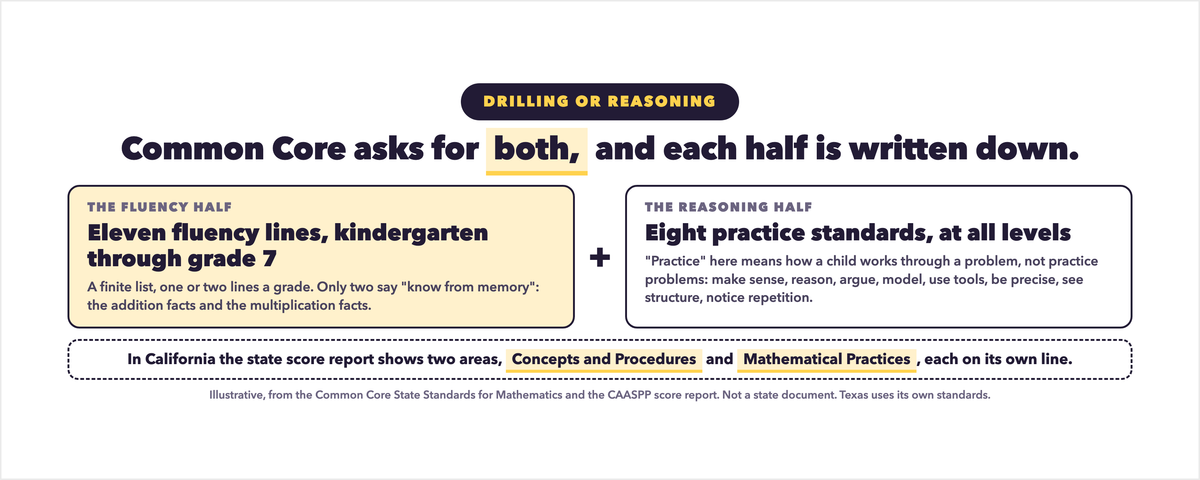
Both. Your child's math class, or the program you pay for, may lean one way: many pages of problems, or fewer problems and more talk about why. The Common Core State Standards for Mathematics asks for both halves of that, and it names each one.
The fluency half, the drilling side, is a short list: 11 lines, kindergarten through grade 7, that say "fluently" or "fluency." The reasoning half is eight practices the standards call the Standards for Mathematical Practice. "Practice" here means how a child works through a problem, not a page of drill. On the balance between the two halves, the document's own sentence is that the content standards are "a balanced combination of procedure and understanding."
Your first step this week: find your child's grade in the table below, then hold one week of worksheets against that row and against the eight practices. A page of 40 one-digit products is working the grade 3 memory line. A page that asks for one problem solved two ways, or for a written reason, is working the first or third practice. Both kinds are in the standards. Once your child has taken California's state test, given in grades 3 through 8 and 11, there is a second step: the score report prints two performance areas, each with its own label, as the California section below shows.
The fluency half: 11 fluency lines
The Common Core defines procedural fluency, borrowing a phrase from a National Research Council report, as "skill in carrying out procedures flexibly, accurately, efficiently and appropriately." Speed on its own is not in that definition. The definition says efficiently; it does not say fast. In the same sentence the standards define conceptual understanding as "comprehension of mathematical concepts, operations and relations," so the two terms sit side by side in the document itself. The table lists every standard in kindergarten through grade 8 that says "fluently" or "fluency," with the line's number in the document.
| Grade | What the child must do fluently | Code |
|---|---|---|
| Kindergarten | Add and subtract within 5 | K.OA.5 |
| Grade 1 | Add and subtract within 20, with fluency within 10, using strategies such as counting on and making ten | 1.OA.6 |
| Grade 2 | Add and subtract within 20 using mental strategies; know the addition facts to 9 + 9 from memory; add and subtract within 100 | 2.OA.2, 2.NBT.5 |
| Grade 3 | Multiply and divide within 100; know the times tables to 9 × 9 from memory; add and subtract within 1000 | 3.OA.7, 3.NBT.2 |
| Grade 4 | Add and subtract multi-digit whole numbers using the standard algorithm | 4.NBT.4 |
| Grade 5 | Multiply multi-digit whole numbers using the standard algorithm | 5.NBT.5 |
| Grade 6 | Divide multi-digit numbers, and add, subtract, multiply and divide multi-digit decimals, using the standard algorithm | 6.NS.2, 6.NS.3 |
| Grade 7 | Solve simple equations with one unknown, inside word problems | 7.EE.4a |
| Grade 8 | No standard says "fluently" or "fluency" | none |
The code is the line's number in the document, for anyone who wants to check it; you do not need it. Grade 7's line is about equations of the forms px + q = r and p(x + q) = r, solved inside word problems. The full document is a PDF at corestandards.org/wp-content/uploads/2023/09/Math_Standards1.pdf.
Only two lines from kindergarten through grade 8 say "know from memory." Yes, Common Core asks for the times tables up to 9 × 9 from memory: standard 3.OA.7 says that by the end of grade 3 a child should "know from memory all products of two one-digit numbers." The other line is 2.OA.2, the addition facts by the end of grade 2.
Most of the other lines name a method. Grades 1 and 2 name strategies such as counting on and place value. Grade 3 says "strategies and algorithms based on place value." Grades 4 to 6 say "the standard algorithm." Kindergarten's line names no method, and grade 7's is about solving equations. The grade 5 overview says students "finalize fluency with multi-digit addition, subtraction, multiplication, and division" that year.
The eight practice standards
Before any grade's content, the standards set out eight practices. The document says they describe expertise that "mathematics educators at all levels should seek to develop in their students." In its words:
- Make sense of problems and persevere in solving them.
- Reason abstractly and quantitatively.
- Construct viable arguments and critique the reasoning of others.
- Model with mathematics.
- Use appropriate tools strategically.
- Attend to precision.
- Look for and make use of structure.
- Look for and express regularity in repeated reasoning.
The descriptions make room for shortcuts and remembered facts. Under the eighth, proficient students "notice if calculations are repeated, and look both for general methods and for shortcuts." Under the seventh, the example is a multiplication fact: students "will see 7 × 8 equals the well remembered 7 × 5 + 7 × 3." Under the first, students "check their answers to problems using a different method, and they continually ask themselves, 'Does this make sense?'"
The standards then say why the two halves sit together: "Students who lack understanding of a topic may rely on procedures too heavily."
What California's score report shows
The math test inside the CAASPP, California's state test (the California Assessment of Student Performance and Progress), is the Smarter Balanced Summative Assessment, given in grades 3 through 8 and 11. The state's leaflet says it measures the California Common Core standards, "which focus on concepts and procedures, problem solving and modeling/data analysis, and communicating reasoning." The test has two parts. The first is a computer-adaptive section, which picks questions to match the child's performance. The second is a performance task, a real-world problem the child solves and explains; the leaflet says it lets students apply "higher-order thinking skills by evaluating information and developing and communicating a solution to a real-world problem."
The score comes back three ways: an overall score (placed in one of four levels) and two performance areas, which the leaflet calls "Composite Area 1: Concepts and Procedures, and Composite Area 2: Mathematical Practices." Each area gets its own label. On the state's sample 2025-26 Student Score Report, written for a sample child named Jenny, the two areas are printed as questions. Concepts and Procedures asks, "How well did Jenny apply mathematical concepts and procedures to solve problems?" Mathematical Practices asks, "How well did Jenny apply strategies to solve complex problems and explain the reasoning for the solution?"
In that sample the two labels differ: At or Near Proficient on the first area and Below Proficient on the second (those are the report's own labels). That is the reading to look for on your own child's report: two areas, two labels. What your district does with the score is on our CAASPP page; the level names and the statewide results are on the results page.
What Palo Alto Unified and Sunnyvale Middle School say
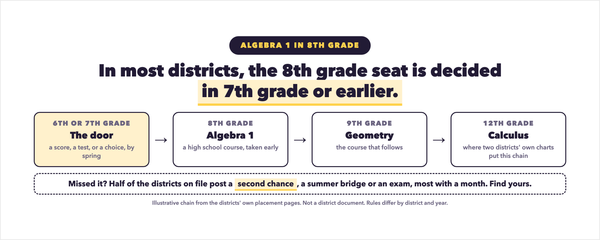
Palo Alto Unified's math page says students "who wish to accelerate beyond the already compacted middle school math program may participate in the Math Validation Process," which "consists of one paper-and-pencil assessment." The assessments "consist of multiple-choice (MC) and free-response questions (FRQ)," and "Participation in the math validation process is optional."
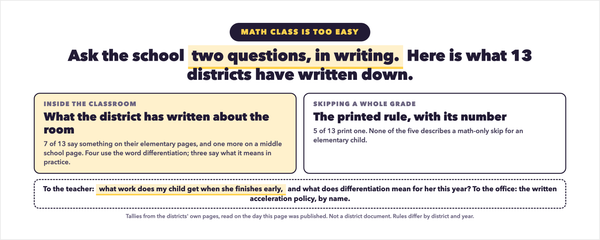
Sunnyvale Middle School's course pages say this about homework: "Since a big focus of the common core is building problem-solving thinking, perseverance, and communicating our thinking, homework will not be the usual computational problem set." Instead, it says, homework "may be trying to solve one problem multiple ways." How to find your own district's rule is on our method page.
Where Cuemath fits
Cuemath is live, one-on-one online math tutoring. Its free evaluation is a skills-and-gaps check that looks at reasoning, application, fluency and understanding for your child's grade.
See where your child is solid, and where the first gap sits
A free Cuemath MathFit evaluation, our skills-and-gaps check, is a live, one-on-one session that shows where your child is solid and where a gap sits. No credit card, and the report is yours either way.
Book a Free EvaluationFor students in Grades K to 12 worldwide.
FAQs
Does Common Core require memorizing the multiplication facts?
Yes. Standard 3.OA.7 says that by the end of grade 3 a child should "know from memory all products of two one-digit numbers." The matching addition line is 2.OA.2: by the end of grade 2, "know from memory all sums of two one-digit numbers." No other line from kindergarten through grade 8 says "know from memory."
Does the document say anything against shortcuts or memorizing?
Not as a rule. The eighth practice says proficient students "look both for general methods and for shortcuts," and the seventh uses a remembered fact, 7 × 8 as 7 × 5 + 7 × 3, as its example of seeing structure. The document's caution runs the other way: "Students who lack understanding of a topic may rely on procedures too heavily." Its introduction contrasts a student who can "summon a mnemonic device" with one "who can explain where the mnemonic comes from," and calls understanding and procedural skill "equally important."
When does the document first require the standard algorithm?
Grade 4, for adding and subtracting multi-digit whole numbers (4.NBT.4). Multiplication of multi-digit whole numbers follows in grade 5 (5.NBT.5), and division, with decimals for all four operations, in grade 6 (6.NS.2 and 6.NS.3). From grade 1 to grade 3 the fluency lines name strategies; grade 3 says "strategies and algorithms based on place value" without the word "standard."
Where do the two halves meet inside a grade's standards?
Often in the standards that begin with the word "understand." The document says expectations that begin with that word "are often especially good opportunities to connect the practices to the content." When you read your child's grade standards, those lines are a good place to look for the practices and the content together.
My child is in kindergarten to grade 3. Is there a state score to read yet?
Not yet. The test is given in grades 3 through 8 and 11, so the first report comes after your child takes the test in grade 3. When it arrives, and what your district does with it, is on our CAASPP page. Before then, the fluency lines in the table are what to check against.
My child is in Texas. Does this list apply?
No. Texas uses its own standards, the Texas Essential Knowledge and Skills (TEKS), which the Texas Education Agency calls "the state standards for what students should know and be able to do." The grade lines above are from the Common Core document; the agency posts the TEKS on its site.