Does the CAASPP Test Matter? What the Math Score Decides
Your child's report from the CAASPP, California's state test, is home, and the question is simple: does this score matter? In California the state test is not a grade, and it is not a gate by itself.

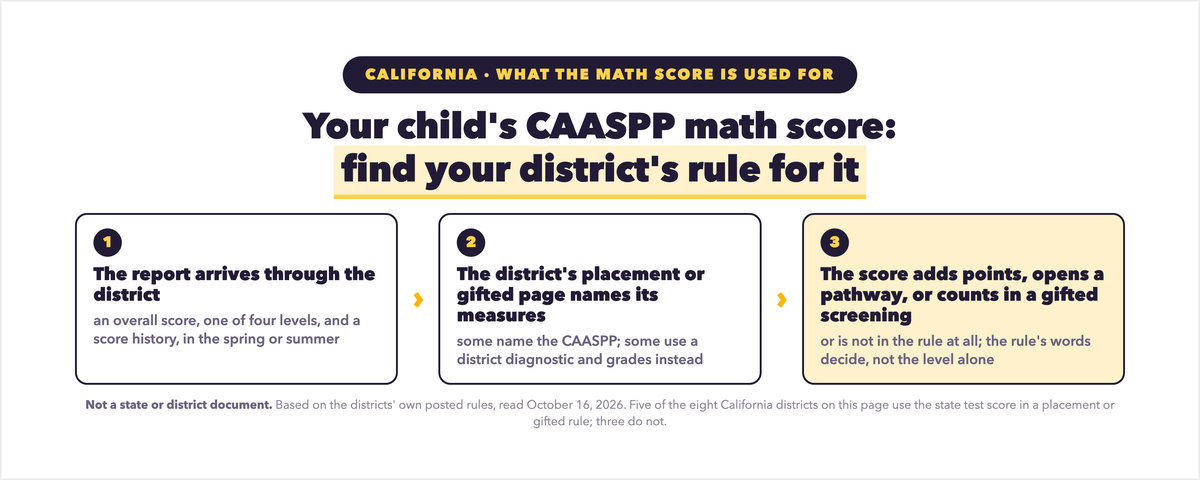
Your child's report from the CAASPP, California's state test, is home, and the question is simple: does this score matter? In California the state test is not a grade, and it is not a gate by itself. What the math score decides depends on the district. Of the eight California districts whose placement rules we keep on file, five use it in a posted rule. If you want what the number and the level mean, our results page has the new labels and the statewide numbers.
San Jose Unified scores it as points toward accelerated math. Evergreen uses it for automatic entry to its accelerated pathway. Irvine feeds it into gifted screening. Fremont uses state assessment data at 9th grade placement. San Mateo Union sets a 2600 bar for summer acceleration. The other three, Cupertino Union, Sunnyvale, and Palo Alto, place by their own tests and grades.
Your first step is to find your district's rule, usually a page or a PDF on the district site. San Jose alone has more than one school district (Evergreen School District is also in San Jose), so check which district your address belongs to. Our method page shows how to find and read one.
What the test is, in the state's words
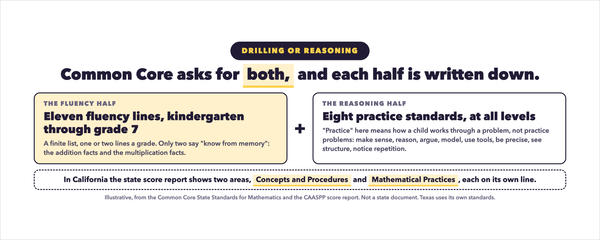
CAASPP stands for the California Assessment of Student Performance and Progress. The math test inside it is the Smarter Balanced Summative Assessment, which parents and districts also call the SBAC (short for Smarter Balanced Assessment Consortium). The state's leaflet says it "is administered in grades three through eight and grade eleven" and "consists of a computer-adaptive assessment and a performance task." The performance task is a real-world problem the child solves and explains. Each child gets an overall score and one of four levels; the level names changed on the 2025-26 reports, but the score ranges for each level did not. Our results page has the new labels and the statewide numbers. The report also prints two performance areas, each with its own label; what the standards behind each area ask of a child is on our page on drilling or reasoning.
The five districts that use the score in a rule
None of the five places a child on the score alone; each pairs it with other measures, so read what your district pairs it with.
San Jose Unified runs middle school math placement as a point system. Its 2026-27 criteria document scores "Math CAASPP from the last 2 years; whichever is higher." A Level 4 earns 2 points and a Level 3 earns 1 point. For incoming 6th graders, the other two measures are the percentile on the i-Ready Diagnostic (an adaptive test the district gives) and the winter progress report. Each measure earns 0 to 3 points. On the i-Ready, the 90th percentile or higher earns 3 points, the 80th earns 2, and the 70th earns 1. A total of five or more points places a child in Accelerated Math 6. A child who starts in Math 6 still has, in the district's words, "a variety of pathways to accelerate into Algebra 1 in middle school."
Evergreen School District uses it as one of three conditions for automatic entry. Its academics page says students who "exceed 5th and 6th grade standards, as measured by the Smarter Balanced assessment (CAASPP), meet minimum proficiency on a 6th grade diagnostic placement exam and maintain satisfactory grades" are enrolled in the accelerated 7th grade pathway without applying. Parents may keep an eligible child in the traditional sequence.
Irvine Unified uses it for gifted screening, not math placement. The district screens every 3rd through 5th grader for GATE, the Gifted and Talented Education program, through what it calls a Multiple Criteria Measure. In 3rd grade the achievement measures are the "CAASPP ELA and Math Scale score" (ELA is English language arts) and the fall and winter STAR Reading and Math scores (STAR is a test the district gives all students), with a writing sample and the Naglieri Nonverbal Ability Test, or NNAT. Eligibility is "the top 20% of his/her grade level." The other gifted screenings we track are on our gifted testing page.
Fremont Unified uses it at 9th grade placement. Its placement policy, required under Senate Bill 359, California's 2015 math placement law, uses the 8th grade course and grade, state assessment data, and district benchmarks.
Every Fremont 9th grader also takes a course-specific checkpoint test in the first three weeks of school. A family that disagrees can file the Request to Review Math Placement form.
San Mateo Union High School District sets a number. Its Math Placement Criteria document lists, among the conditions for Geometry Summer Acceleration at four of its high schools, an "8th Grade CAASPP score greater than 2600 (if available)," next to an A- or better in Algebra 1 and 70% proficiency on the NWEA MAP test (Measures of Academic Progress, made by the testing company NWEA). CAASPP scale scores run in the 2000s; the 2025-26 sample report prints the grade 5 math range as 2220 to 2740. The compacted pathway at Aragon and Burlingame (three courses in two years) asks for a "CAASPP: 7th grade score minimum of 2600." The document frames both as recommendations for students who meet the listed criteria.
| District | What the CAASPP math score feeds | The rule, in short | Where it is posted |
|---|---|---|---|
| San Jose Unified | Middle school math placement points | Score of 4 = 2 points, 3 = 1 point; 5+ points for Accelerated Math 6 | Middle School Math Placement Criteria and Process 2026-2027 |
| Evergreen School District | Automatic entry to the accelerated 7th grade pathway | Exceed 5th and 6th grade standards, plus a diagnostic exam and grades | Academics and Curriculum page |
| Irvine Unified | GATE screening, grades 3 through 5 | CAASPP scale scores with STAR, plus a writing sample and the NNAT in 3rd grade or trimester grades in 4th and 5th; top 20% of the grade | Elementary School Programs page |
| Fremont Unified | 9th grade math placement | State assessment data with the 8th grade course, grade and district benchmarks | Math Information page |
| San Mateo Union High School District | Summer and compacted acceleration | 8th grade score above 2600 (summer option) or 7th grade score of at least 2600 (compacted pathway), with grades and MAP | Math Placement Criteria document |
The three that do not name it
Cupertino Union, Sunnyvale School District, and Palo Alto Unified place by their own measures. We keep a file on each district's posted rule. For these three, re-read on the day this page was published, no placement measure is a state test score. Cupertino's named measures are a March placement assessment, NWEA diagnostic scores, and first-semester grades, with teacher verification in every criteria table. Sunnyvale issues a recommendation from "two data points (District Math Benchmark Assessment / NWEA and Trimester 2 math grades)" and lets the family choose a different course anyway. Palo Alto's compacted pathway covers four years of math in three for every student, and the one route Palo Alto posts past it is the Math Validation Process, "a single paper-and-pencil assessment." The three sit side by side on our district comparison page.
If you are weighing an opt-out
Only one of the five spells out the consequence. San Jose Unified's FAQ answers the parent whose child did not take the test: "We recognize students who are missing this score may not earn enough points to be eligible for accelerated math." San Mateo Union marks its 8th grade score "(if available)" but does not say what counts in its place. Evergreen, Irvine, and Fremont do not say what happens without it. If you plan to opt out, ask the district office in writing, before the testing window, what it will use in place of the score, and keep the answer.
Where Cuemath fits
Cuemath is live, one-on-one online math tutoring. An outside evaluation cannot move a district's decision; every rule above runs on the district's own measures.
See what sits behind the level
A free Cuemath MathFit evaluation, our skills-and-gaps check, is a live, one-on-one session that shows where your child is solid and where a gap sits, in your child's own work. No credit card, and the report is yours either way.
Book a Free EvaluationFor students in Grades K to 12.
FAQs
What happens to math placement if my child skips the CAASPP?
In San Jose Unified, the district's FAQ says: "We recognize students who are missing this score may not earn enough points to be eligible for accelerated math." A child who also missed the spring i-Ready can take the i-Ready in the summer, which counts toward placement. The other four districts that use the score do not print what replaces a missing one, so ask yours before the testing window.
Does a San Jose Unified child get a second chance after Math 6?
Yes. The district's FAQ says students "have a variety of pathways to accelerate into Algebra 1 in middle school when they begin in Math 6." Before 6th grade starts, a child without a spring i-Ready score "can take the i-Ready test during the summer between 5th-6th grade to assist with math placement."
When does the score report come?
For the 2025-26 tests, the state's schedule put Student Score Reports in districts' systems and parent portals on May 15, 2026. Your district decides how it reaches you, through its portal or as a printed letter. If nothing has arrived, the school office can pull it.
What does Proficient mean on the 2025-26 report?
Proficient is the new name for Level 3. The state renamed the four levels starting with the 2025-26 reports and says, "The criteria and cut scores for each level have not changed." The labels and the statewide results are on our results page.
Can a district use a score from two years ago?
Yes, in San Jose Unified. The criteria read "Math CAASPP from the last 2 years; whichever is higher." For a child entering 6th grade, the FAQ says the district uses the 4th and 5th grade scores, or the 3rd and 4th grade scores if the 5th grade score is not available.
Does the score decide gifted placement?
Not by itself. Irvine Unified screens every 3rd through 5th grader for GATE. In 3rd grade it uses the "CAASPP ELA and Math Scale score" (ELA is English language arts) with STAR scores, a writing sample, and the NNAT. In 4th and 5th grade it uses the CAASPP scale scores with STAR scores and trimester grades. A child qualifies in "the top 20% of his/her grade level." Teachers cannot recommend a child, private testing is not accepted, and qualifying families hear by early July.
My child's score went up, but the level stayed the same. Why?
The bar for each level rises every grade, so a higher score can still land in the same level. The report explains it: "Standards for the next grade are higher than for the previous grade. As a result, students may need a higher score to stay in the same level as the previous year." The state's sample report shows exactly that, a math score rising from 2467 in 4th grade to 2520 in 5th and staying at Level 2.
Does a high score alone place my child in a higher math class?
Not in any of the five districts above. San Jose pairs the score with the i-Ready percentile and, for 6th grade, a progress report. Evergreen pairs it with a 6th grade diagnostic exam and grades. San Mateo Union pairs it with Algebra 1 grades and the NWEA MAP, and Fremont with the 8th grade course and grade and district benchmarks. Irvine's gifted screen pairs it with STAR plus either a writing sample and the NNAT (3rd grade) or trimester grades (4th and 5th grade). A strong score helps, but it does not place by itself.