How Does a Child Get Into Advanced Math in Cupertino, Sunnyvale, and San Jose?
Three Bay Area districts hand the math acceleration decision to three different parties. The same child, with the same report card, can land differently across a district line.

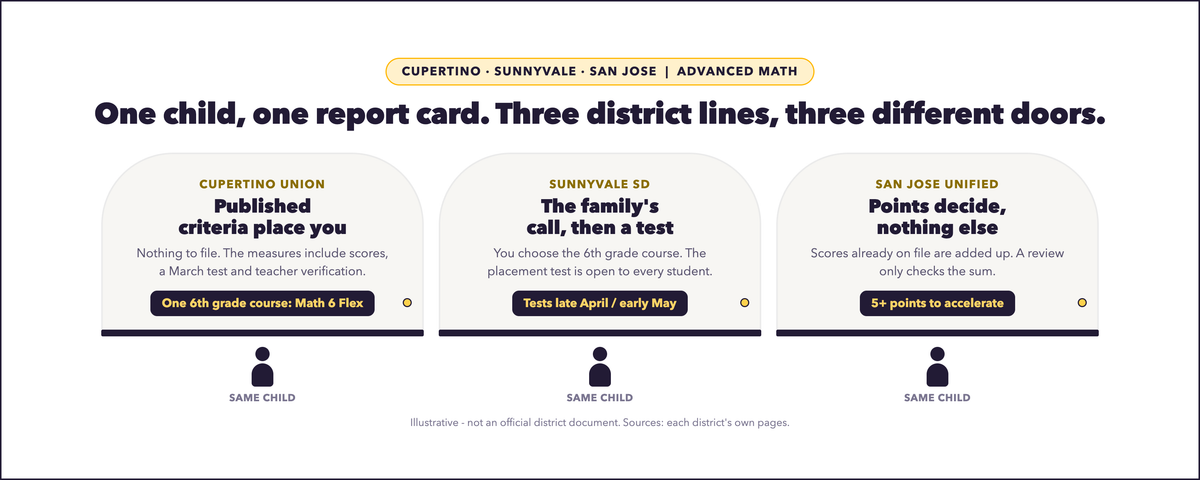
Three Bay Area districts, three different doors. In Cupertino Union, the district reads a list of measures it leaves open, runs its readiness tests in one posted March window, and places a child who meets the criteria. In the Sunnyvale School District (SESD), the family makes the call on the accelerated 6th grade course, and the placement assessment that unlocks the bigger jumps is open to every student, recommended or not. In San Jose Unified, placement is arithmetic: points from scores already on file, with 5 or more points placing a child into Accelerated Math 6.
Skip to the district you need: Cupertino Union · Sunnyvale School District · San Jose Unified
On the pages where each district lays out its placement rules, none publishes an application form for advanced math. What changes across the district line is what turns the handle - a scored test in Cupertino, a family decision plus an open test in Sunnyvale, a point total in San Jose.
Cupertino Union: published numbers, one March window
Every CUSD 6th grader takes the same course, Math 6 Flex, so acceleration is decided for grades 7 and 8. The district's page says that it uses "multiple assessment measures" and that the assessments "will include" NWEA adaptive diagnostics given several times a year, a standards-based assessment in Synergy in March, and first-semester grades. Teacher verification sits in every criteria table too, based on proficient in-class work. Read that list as open: these are the named measures, not a fixed count of them.
Seventh grade has three courses. Math 7 is the standard one. The page groups the other two as accelerated: Math 7+, which includes 8th grade standards, and Algebra 1, a high school level course.
The cut scores are printed. Math 7+ lists an NWEA RIT of 235 or higher, with 73.3% or higher on the 7th Grade Readiness Test. Algebra 1 in 7th grade lists an NWEA RIT of 250 or higher, with 83.3% or higher on the Algebra Readiness Test. Both percentages are scores on the readiness test itself, not percentile ranks. The child takes that test in 6th grade, for a 7th grade course the following year, and the same criteria read that year's first-semester grade. The posted spring test window is March 9-20, printed without a year, so treat it as the pattern and confirm the dates on the district page before the cycle. Our Cupertino placement page walks the whole ladder, including the second path into Algebra 1 in 8th grade.
Sunnyvale School District: the family's call, and a test anyone can take
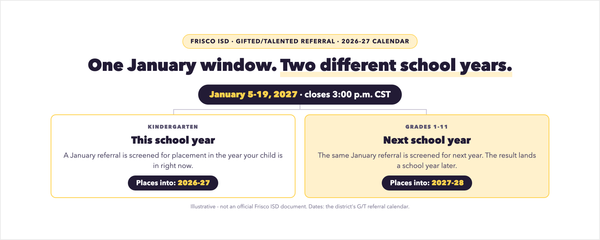
For an incoming 6th grader, Sunnyvale gives a course recommendation and then steps back. In its own words, "the final enrollment decision rests with the student and their family," and the accelerated Math 6/7 course carries no prerequisites. A recommendation you disagree with is not a decision.
The bigger jumps are gated. Moving into Math 7/8 or Algebra 1 means passing the district placement assessment or the matching Summer Bridge course, and an incoming 6th grader going straight to Math 7/8 has only the assessment, because no Summer Bridge runs for that jump. Summer Bridge needs a district recommendation. The assessment does not: the FAQ states it is "open to all students." Recommendations are aimed at mid-February, and the assessments run before the end of the school year, in late April or early May. No passing score is published anywhere. The only score numbers the FAQ prints are NWEA percentiles, as guidance about who tends to be ready to attempt the problems.
San Jose Unified: points decide, and the review checks the sum
San Jose Unified publishes a point system and follows it. For incoming 6th graders it scores three measures: the math CAASPP from the last two years, the grade 5 spring i-Ready Diagnostic, and the grade 5 winter progress report. The i-Ready bands are 3 points at the 90th percentile or above, 2 at the 80th or above, 1 at the 70th or above. 5 points or more places a child into Accelerated Math 6. A year later, four measures decide 7th grade: the CAASPP, the grade 6 spring i-Ready, the first-semester grade 6 math grade, and a point for having been in Accelerated Math 6. There, 5 points places a child in Accelerated Math 7, and 6 or more places them in Algebra 1.
Land exactly one point short, at 4, and a Challenge Assessment opens: 70% or higher places the child in the accelerated course anyway.
What a parent can do afterwards is narrow and stated in print. Administrators do not modify criteria and cannot open seats. You may ask to see the data, and you may ask the principal for a review if you think the points were added up wrong. The document then lists what is not considered at all, including a parent's request and private or independent assessments from outside the district.
The same four questions, three answers
| Cupertino Union (CUSD) | Sunnyvale School District (SESD) | San Jose Unified (SJUSD) | |
|---|---|---|---|
| What a parent files | Nothing. A child who meets the criteria "will be placed in the corresponding course." | Nothing for Math 6/7 - the family enrolls. For Math 7/8 or Algebra 1, the student passes the placement assessment, or the matching Summer Bridge course where one runs. | Nothing. Points are computed from data already on file. |
| What gets read | An open list: NWEA diagnostics through the year, a Synergy test in March, first-semester grades, teacher verification. | Fall and winter NWEA for the recommendation; the placement assessment itself for the jump. | For 6th grade: CAASPP from the last two years, the grade 5 spring i-Ready percentile, the grade 5 winter progress report. For 7th grade: CAASPP from the last two years, the grade 6 spring i-Ready percentile, the first-semester grade 6 math grade, any previous accelerated course. |
| When it is decided | Spring test window posted as March 9-20, with no year printed. | Recommendations aimed at mid-February; assessments in late April or early May. | Student information reviewed each spring for the following year. |
| What is published about changing it | No appeal process and no retest process on the page. | For Math 6/7, enrollment against the recommendation, which is the family's decision. | Principal review for a points error only; a Challenge Assessment at exactly 4 points. |
Every cell above comes from each district's own pages and documents, read live on 2026-09-18: the CUSD mathematics page; Sunnyvale's Middle School Math Pathways FAQ (its own footer reads "Updated 11/19/25") and the district pathways page that links it; and San Jose Unified's mathematics page plus its "Middle School Math Placement Criteria and Process 2026-2027."
What this means if your family moves
The same child, with the same report card, can land in a different math course on the other side of a district line. That is the one thing to carry out of this page.
Two of the three publish a route for a child arriving new. Here is what each district publishes, and what the third does not.
San Jose Unified. The route is in the criteria document. For a student who did not attend one of its schools the previous year, the district reviews the academic data it can get - prior-year grades and SBAC scores where available - and asks the student to take the i-Ready assessment in the summer. If those data points meet the criteria, the child is placed in an accelerated course.
Sunnyvale School District. Enrollment comes first, then the test. The FAQ addresses a family whose child is not currently in a Sunnyvale school this way: once enrollment is complete, contact your middle school principal to schedule a time to take the placement assessment.
Cupertino Union. No route is published for a child new to the district. We read the full mathematics page live on 2026-09-18 and scanned it word by word. A family moving in gets the same criteria and the same March window as everyone else, with no extra step published for them.
In Cupertino, what matters at a move is when you arrive, not what you file. A child who arrives before 6th grade faces no math placement decision in 6th grade at all: every 6th grader is enrolled in Math 6 Flex, the district's one 6th grade course. The 7th grade decision is made during that 6th grade year, and the NWEA diagnostics those criteria read are given several times through the year, so a child who is in the district for the year builds the record inside it. A child who arrives partway through 6th grade, or into 7th or 8th, has less of that year in the district before the next decision. The criteria are the same either way. What changes is how much of the record they read was built in the district.
A strong i-Ready percentile and a good CAASPP score are most of the decision in San Jose. Cupertino's published measures name neither one; its printed thresholds sit on the NWEA RIT and on a readiness test given in a posted March window. The decision itself also sits with a different party in each district. San Jose Unified holds it and follows its own arithmetic. Cupertino Union holds it for grades 7 and 8, and for 6th grade there is nothing to hold, because every 6th grader takes Math 6 Flex. Sunnyvale hands the incoming-6th-grade accelerated course to the family, which enrolls after hearing the district's recommendation. And in San Jose a teacher's recommendation is on the not-considered list, though the teacher's winter progress-report grade is worth a point; in Cupertino, teacher verification is a named measure in every criteria table.
So the useful question at a move is not whether your child is advanced. It is which evidence the new district actually reads, and when it reads it. Pull that district's own page before the window, not after: Cupertino Union's mathematics page, Sunnyvale's middle school math pathways page, and San Jose Unified's mathematics page.
Know where your child's math stands right now
A free Cuemath MathFit evaluation is a 55-minute, one-on-one session. It cannot move a district's decision - San Jose Unified puts private or independent assessments from outside the district on its not-considered list, and neither Cupertino's nor Sunnyvale's published pages offer any route for one. It is a reading of where your child's math reasoning stands now.
Book a Free EvaluationFor students in Grades K to 12.
FAQs
We are moving into San Jose Unified over the summer. Has my child missed the acceleration decision?
No. The district publishes a route for a student who did not attend one of its schools the previous year, and the summer i-Ready assessment is part of it. There is also a second chance inside that route: a child whose data lands one point short can still qualify for the Challenge Assessment, and that family is notified one week before the start of school.
Can an outside tutor's test or a private assessment change any of these placements?
In San Jose Unified, no, and the district says so in print: private or independent assessments from outside the district are on its not-considered list, and it does not accept outside coursework for middle school acceleration either. Cupertino's mathematics page says nothing about outside assessments at all, so there is nothing published to lean on. Sunnyvale's placement assessment is the district's own test.
What score does a child need on Sunnyvale's placement assessment?
It does not publish one. There is no passing score and no practice test. The only score numbers the FAQ prints are two NWEA percentiles, both as guidance about readiness: students at or above the 95th NWEA percentile typically have the foundation to attempt the problems, and students near the Math 6/7 recommendation threshold generally score between the 45th and 55th percentile.
My child is already in Sunnyvale's accelerated track. Do they have to test again every year?
No. Students already in an accelerated course who want to continue at the same pace advance automatically to the next course in the sequence. The assessment and the summer course are for moving into the track or for jumping further ahead inside it.
Can a child skip a math course in San Jose Unified?
No, with one exception the district names in its own criteria document: the Ramp Up to Algebra and Ramp Up to Geometry summer programs. Students cannot take concurrent math courses either. The pathway is meant to be walked in order, and those two summer programs are the only published shortcuts.
My child did not take the state test. Does that matter?
In San Jose Unified it costs real points, because CAASPP is a scored measure in every grade's table. The district answers this question directly and says those students may not earn enough points to be eligible for accelerated math. Cupertino and Sunnyvale do not score the state test in their published placement measures.
Which of these three districts is best for a strong math student?
That is not a question these pages can answer, and this one will not try. What the districts publish is a process, not a promise, and the three processes are built differently. The comparison above is of what each district publishes: what it reads, when, and who decides.