Cupertino (CUSD) Math Placement Test: The Tracks, the Scores, and the Second Path
Cupertino Union School District decides which math track your child lands in for grades 6 through 8, and the criteria are all published if you know where to look. We discuss the full picture: the math tracks, the NWEA scores and test dates, and the one rule that keeps a fast track open past grade 7.


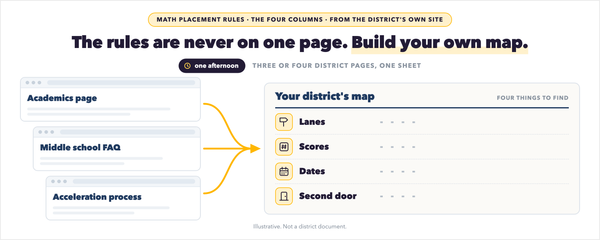
Your child is starting middle school in the Cupertino Union School District, and you want the complete journey: which tracks exist, what the accelerated ones require, and when it gets decided. CUSD's math placement test and criteria are published in the websites, scores included. However, the information is just spread across the district site, and old forum threads still quote retired numbers. Here is the current picture.
Note: Every CUSD number below comes from the district's own published pages, checked in August 2026.
The Math Tracks
CUSD is a K-8 district, so its math pathway splits in the middle school years.
- Grade 6 has one track. Sixth graders take Math 6 Flex, which covers the grade-6 standards plus part of the grade-7 standards, with personalized gap-filling.
- Grade 7 has three tracks: Math 7, Math 7+ (which includes grade-8 standards), and Algebra 1 (course code MA7AC). Algebra 1 in grade 7 is a high-school-level course, two grades ahead of the standard sequence.
- Grade 8 has three tracks: Math 8, Algebra 1 (MA8AC), and Geometry (MAAGC). The Algebra 1 and Geometry courses are high-school-level.
One rule worth knowing early: a high-school-level course has to end with a C- or better to count toward high school graduation. The fast track bank real high school credit, and the bank has a floor.
How CUSD Placement Is Decided
- No sign-up appears on the district's placement page, and no single test decides it alone. The district describes its placement decisions as resting on "multiple assessment measures," and its own list says what those "will include."
- The published measures include NWEA adaptive diagnostic scores from during the year, a standards-based placement assessment given in March, and first-semester course grades, plus teacher verification, which appears as an additional measure in all four criteria tables.
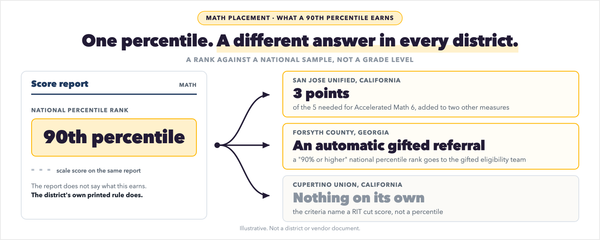
- NWEA is a computer-adaptive test many districts use to check a student's math skills several times a year. Its score is called a RIT score, a scale that goes up as skills grow rather than a percentage or a grade. That's the number that shows up as a hard cutoff in every criteria table below.
- Because the district's own wording is open ("will include," not "consists only of"), read every list in this post as the named measures, not a complete set. The posted window for the March assessment is March 9-20.
- If a child meets the bars, placement follows. The district's line: "If your child meets the criteria for an accelerated course, s/he will be placed in the corresponding course." No application step and no fee appear on the placement page.
If you searched for a 6th grade math placement test or a math placement test for middle school, this March assessment is the one CUSD runs. A grade 6 student takes it in March, and the result feeds the grade 7 track decision together with the year's NWEA scores and the first-semester grade.
Other districts run a similar cycle under a different name; one New Jersey student's path into an honors and accelerated math program followed the same shape: a state test score plus a percentile threshold, not one exam alone.
The Printed Numbers, Door by Door
- Math 7+ in grade 7 (accelerated). The published measures include an NWEA RIT score of 235 or higher, 73.3% or higher on the spring placement assessment, a first-semester grade of C+ or higher, and teacher verification.
- Algebra 1 in grade 7 (MA7AC, double acceleration). The published measures include an NWEA RIT score of 250 or higher, 83.3% or higher on the Algebra readiness test, a first-semester grade of B+ or higher, and teacher verification.
- Algebra 1 in grade 8 (MA8AC). The published measures include an NWEA RIT score of 240 or higher, the Algebra readiness test, a first-semester grade floor, and teacher verification. The test and grade bars depend on the grade 7 course. From Math 7+: 73.3% or higher on the readiness test and a first-semester grade of C or higher. From Math 7: 80% or higher and a first-semester grade of B+ or higher. The bars are higher from Math 7 because the jump is bigger.
- Geometry in grade 8 (MAAGC, the fastest track). The published measures include Algebra 1 completed with a C or higher, an NWEA RIT score of 260 or higher, 80% or higher on the Geometry readiness test, and teacher verification. One scope note: the completed Algebra course has to come from a CUSD school or a similar LEA (a public education agency). The page does not say outside programs qualify.
Cut scores can be revised year to year. Before a March cycle, check the district's mathematics page rather than this post or any forum thread.
Algebra 1 in Grade 8: A Second Path
A claim that keeps circulating in parent forums: miss Algebra 1 in grade 7 and the accelerated track is closed. The district's own pathway says otherwise. MA8AC is a second door. A student who is not in Algebra 1 in grade 7 can still reach Algebra 1 in grade 8, from Math 7 or from Math 7+, with the bars printed above.
The one track that truly depends on the grade 7 outcome is Geometry in grade 8, because it requires Algebra 1 already completed. A family aiming for that fastest rung needs the grade 6 cycle to land. A family aiming for Algebra 1 by grade 8 gets two chances at the door.
What that second door looks like once a student walks through it varies by student, but the shape is familiar: one Grade 8 student who landed in accelerated Common Core Algebra describes the same jump CUSD's MA8AC criteria are built around, tested skills catching up to a faster course.
One Stale Number to Retire
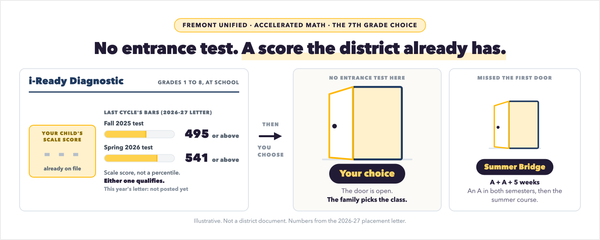
Older threads quote iReady 548 as the Algebra bar. That criterion is retired. The old measure for Algebra 1 in grade 7 was an iReady Diagnostic scale score of 548 or greater, and the iReady tables stayed posted into early 2025. The district then switched diagnostic vendors, and the current measure is an NWEA RIT score. A child prepped against the old threads is prepped against the wrong instrument. When a forum number and the district page disagree, the page wins.
The Calendar
Students return on August 13, 2026. One school, Murdock-Portal, runs a different calendar. From the fall, NWEA diagnostics run during the year and classwork starts to count: the criteria tables print first-semester grade floors, and the Geometry door needs Algebra 1 completed with a C or higher.
The readiness tests come in March. The posted window is March 9-20, and the exact March 2027 dates are not yet published, so treat the posted window as the pattern and confirm on the district page closer to spring. The practical line for a parent planning the year: the test sits in March, but the counting starts in the fall.
What This Track Costs
The fast track in this district is printed, free, and district-run.
For this research we audited what 49 US private schools publish for math.
- At least 12 publish an Algebra-1-in-grade-7 track, and the most common published landing for Algebra 1 across the 49 is grade 8.
- CUSD's no-tuition track lands Algebra 1 in grade 7, with the gate in print: which test, what score, which month.
- Speed is not what tuition buys here.
Three honest limits sit under that comparison.
- First, the private numbers count published curricula: 9 of the 49 schools publish almost nothing, and not published is not the same as not taught.
- Second, the test is free but preparation is not; time, attention, and often money are real costs.
- Third, a published criterion is not proof of what happens in class. If a family that went through the March cycle describes a process that differs from the page, that report is evidence too. The page is the promise, not the practice.
And the counter-pole, stated plainly: acceleration is an option, not a requirement. Math 7 and Math 8 are the district's standard path, and a child who stays on it is not behind. The pace belongs to the child. The map is for families who want to see the option. If first-semester grades are the piece that worries you most, since three of the four criteria tables above use a grade floor, these middle-school math tips from Cuemath tutors cover exactly that: keeping grades steady while a student is still building speed.
What to Do Next
- Read the district's mathematics page on cusdk8.org and put two dates on the family calendar: the first day of school and the March window.
- Keep placement separate from enrollment. Open Enrollment decides which school, and its application window closes November 30, 2026. Math placement decides which course. Different doors, different rules.
- If you were looking for a gifted program: CUSD does not run a standalone GATE identification or testing program. Math acceleration through the March placement process is the district's main formal advanced pathway.
- If a placement result surprises you, the district page publishes no appeal or retest process, so ask the school or the district's Educational Services department directly.
Want a Clear Read on Where Your Child Stands, Before March?
Start with a FREE Cuemath evaluation today.
Book a Free EvaluationFor students in Grades K to 12 worldwide.
Frequently Asked Questions
What is the CUSD math placement test?
The CUSD math placement test is a standards-based assessment the Cupertino Union School District gives every March to help decide a student's math course for the following year. It is one of several published measures, alongside NWEA diagnostic scores from during the year and first-semester grades. No single test decides placement on its own.
How does 6th grade math placement work in CUSD?
All CUSD sixth graders take one course, Math 6 Flex, so there is no separate track to test into in grade 6. The March placement assessment a sixth grader takes still matters, because that score, combined with the year's NWEA scores and the first-semester grade, feeds directly into the grade 7 track decision.
What NWEA RIT score does a CUSD student need for Algebra 1 in grade 7?
The published measures for Algebra 1 in grade 7 (MA7AC) include an NWEA RIT score of 250 or higher, 83.3% or higher on the Algebra readiness test, and a first-semester grade of B+ or higher, plus teacher verification. Math 7+, the less accelerated grade 7 track, needs a lower RIT score of 235 or higher.
Can a student still reach Algebra 1 in grade 8 if they miss it in grade 7?
Yes. MA8AC (Algebra 1 in grade 8) is a second door that does not require Algebra 1 in grade 7. A student coming from Math 7+ needs 73.3% or higher on the readiness test and a C or higher first-semester grade; a student coming from Math 7 needs 80% or higher and a B+ or higher, since the jump is bigger.
When is the CUSD math placement assessment given?
CUSD's posted window for the spring placement assessment is March 9-20. The exact dates for the following year's cycle are not published this far in advance, so the posted window is the pattern to expect, and it's worth confirming on the district's mathematics page closer to spring.
Does CUSD still use an iReady score of 548 for Algebra placement?
No, that measure is retired. CUSD used to require an iReady Diagnostic score of 548 or higher for Algebra 1 in grade 7, but the district switched diagnostic vendors, and the current measure is an NWEA RIT score of 250 or higher. Any forum post quoting the iReady 548 number is describing a criterion CUSD no longer uses.
Does Cupertino Union School District have a gifted or GATE program?
No, CUSD does not run a standalone GATE identification or testing program. The March math placement process is the district's main formal pathway for advanced math, rather than a separate gifted-and-talented track.
Is CUSD's Open Enrollment the same as math placement?
No, they are two separate processes. Open Enrollment is the district process that decides which CUSD school a student attends, and its application window for 2026-2027 closes November 30, 2026. Math placement is decided separately, by each school, using NWEA scores, the March assessment, and first-semester grades.