CogAT Test: What It Measures, When Your District Gives It, and What the Score Opens
Your child's school just announced CogAT testing. Here's what the test actually measures, how the testing calendar works district by district, and what a strong score can open, from gifted screening to math acceleration.


Your child's school just announced CogAT testing, and you want to know what it means and whether you have to do anything.
Short Answer: the CogAT is a reasoning test that many districts use as their gifted and talented test. The school gives it during a window the district sets, and there's no sign-up needed for the grades it screens automatically. What needs your attention is the calendar: which grades test, when the window falls, and whether a referral form is due before it opens.
What the CogAT Test Measures
CogAT stands for Cognitive Abilities Test. Riverside Insights, the company that publishes it, describes it as a test that measures verbal, quantitative, and nonverbal reasoning. It's an abilities test, not an achievement test: it's built to measure how a child reasons, not how much of this year's curriculum they've absorbed.
District decisions can key on specific score areas. Plano ISD, for example, uses a student's most recent CogAT Quantitative and Non-Verbal scores for a math placement decision (more on that below).
Two facts save parents a lot of confusion:
- You can't register your child for the CogAT yourself. Schools and districts buy and administer it, and there's no parent sign-up through the publisher.
- There's no national CogAT test date. Each district sets its own window and decides which grades take it.
When Districts Give the CogAT
Only your district's gifted or assessment page can answer this for your child. Our fact base covers 14 districts, and practice ranges from three testing windows a year to no CogAT at all. Here are the districts where we verified CogAT practice against official pages.
Frisco ISD, Texas
Frisco runs district-wide CogAT testing windows that feed gifted and talented screening in grades 1, 3, and 5. On the 2025-26 calendar:
- Grade 5: tested September 15-26, 2025
- Grade 3: tested October 20-31, 2025
- Grade 1: tested November 10-21, 2025
Even within one district, each grade gets its own window. The 2026-27 calendar hadn't been published when we last checked, and Frisco's own gifted-referral calendar PDF warns that dates are subject to change. Treat last year's windows as the pattern, and confirm on the live district site before you plan around them.
Fairfax County, Virginia
In Fairfax County Public Schools (FCPS), grade 2 is the universal testing year. For 2026-27:
- October 2026: covers all grade 2 students, plus grades 3-7 students with no score on file who aren't already found eligible for full-time services, plus select students requesting a one-time retake
- March 2027: a second window for certain students in grades 2-7 still without a score
- Referral window for full-time Advanced Academic Programs (AAP): August 24 to December 15, 2026, with no exceptions to the deadline
- Retake requests: due by September 30, 2026 (a student may retake one ability test once)
One caution: FCPS pages carry a banner that all dates are pending school board approval, so re-check before you plan around them. The current FCPS pages also describe the instrument only as a "nationally normed ability test," without naming it. The last cycle FCPS named its tests was 2024-25 (October CogAT, November NNAT — the Naglieri Nonverbal Ability Test, a different nonverbal reasoning test — and March CogAT again). So treat any specific CogAT claim about this fall's Fairfax window as unconfirmed until the district names it.
Fremont Unified, California
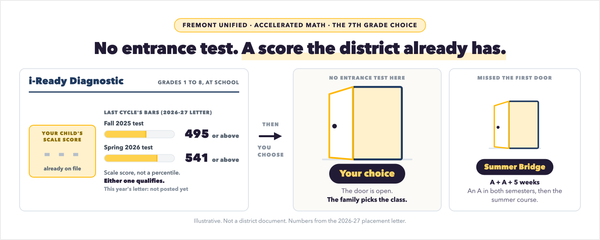
Fremont is the opposite case. The district cut CogAT testing funding in February 2020, and its 2025-26 update states plainly that there's no test for GATE (Gifted and Talented Education) eligibility this year. The 2026-27 process wasn't posted when we checked. GATE support runs through differentiated instruction in regular classrooms instead. If your district works like this, there's no CogAT window to wait for.
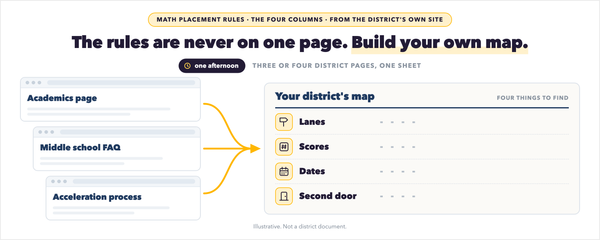
If your district isn't listed here, the same three questions still apply: which grades test automatically, when the window falls, and whether a referral form is due first. Some districts require a parent referral weeks before the window opens, and only your district's page can confirm whether yours does.
What CogAT Scores Open
CogAT scores do one kind of work: they open doors to programs. Which doors depends on the district. Two verified examples.
Gifted and talented screening. In Frisco, CogAT windows feed G/T screening for grades 1, 3, and 5. In Fairfax, one ability test score is required for AAP screening.
One Cuemath family saw this play out directly: a Grade 7 student who scored in the 97th percentile on the CogAT used that score for her school's gifted placement decision. In every district we verified, the score is a required input, not the whole file.
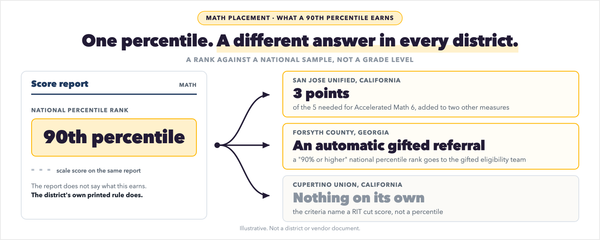
Math acceleration, sometimes with no application at all. Plano ISD's Math Rocks program has no application. Plano identifies students using multiple measures: the MAP math test (a widely used, nationally normed progress-monitoring assessment) and the student's most recent CogAT Quantitative and Non-Verbal scores. Selection reviews assessment history for grades 3, 4, and 5, and invitation letters go out by email to qualifying students' parents in early April. A score already on file can qualify a child for a spring invitation the parent never applied for.
Some districts run a separate placement process entirely. Cupertino Union School District, for example, decides its middle-school math track from its own published set of criteria, not the CogAT.
Two limits held in every district we verified: the score feeds a screening file or a multiple-measures review, and it never decides placement alone. And no test result can be promised, by anyone.
Make Math Fun with the New Cuemath App
Explore fun math games, worksheets, test prep, and daily practice — all designed for your child's grade and free to get started.
Try the Cuemath AppNo commitment, no pressure.
CogAT Practice Tests
A CogAT practice test has one honest use: familiarity. A young child who's never seen this style of question can lose time to the format itself, and one short run-through removes that surprise. That's a real benefit, and it's the whole benefit. The test is designed to measure reasoning rather than studied content, so long prep runs chase the wrong thing, and no practice product can promise a score. If you're weighing practice tests more broadly, here's what actually helps and what doesn't across math placement tests.
The higher-value work is logistics: knowing whether your child's grade tests automatically, and whether a referral is due before the window. Fairfax is the strictest example we verified. Referrals close December 15, 2026, no exceptions.
What to Do Next
Four things, this month:
- Open your district's gifted and talented page and look for the assessment or testing calendar. If nothing's posted yet, check again in early October.
- Find which grades test automatically. If your child's grade isn't on the list, find the referral or nomination form and its deadline. The deadline matters more than the test date.
- Put both dates on your family calendar: the testing window and the referral deadline.
- If your district gives no CogAT, ask what it uses instead. Fairfax has used more than one instrument. Fremont identifies without a test. Your district's answer decides your next step, and only the district can give it.
Curious How Your Child's Reasoning Really Stacks Up?
Start with a FREE Cuemath evaluation today.
Book a Free EvaluationFor students in Grades K to 12 worldwide.
FAQs
What does the CogAT test measure?
The CogAT measures verbal, quantitative, and nonverbal reasoning, not how much of the year's curriculum a child has learned. Riverside Insights, the company that publishes it, describes it as an abilities test built to show how a child reasons through new problems, not what they've memorized.
Can parents register their child for the CogAT?
No. Schools and districts buy and administer the CogAT directly, and there's no parent sign-up through the publisher. If your child's grade tests automatically, the school handles it during the district's testing window.
When is CogAT testing given each year?
There's no single national CogAT test date. Each district sets its own testing window and decides which grades take it, so the schedule can range from three windows a year in one district to no CogAT testing at all in another. Check your district's gifted and talented or assessment page for the exact dates.
Is a CogAT practice test worth doing?
A short practice test has one real benefit: familiarity with the question format, which can save a young child from losing time to an unfamiliar test style. Beyond that, heavy prep chases the wrong thing, since the CogAT is designed to measure reasoning rather than studied content.
What is considered a good CogAT score?
A good CogAT score depends on what your district uses it for. In Frisco ISD, CogAT results feed gifted and talented screening for grades 1, 3, and 5. In Plano ISD, a student's Quantitative and Non-Verbal scores factor into a math acceleration decision, with no separate application needed.
Does a high CogAT score guarantee gifted placement?
No. In every district we verified, the CogAT score feeds a screening file or a multiple-measures review, and it never decides placement alone. Districts like Fairfax County require the score plus other criteria before a student is found eligible for a gifted program.
What if my district doesn't require a referral for the CogAT?
Some districts, like Frisco and Fairfax, screen certain grades automatically with no referral needed. Others require a parent referral or nomination form weeks before the testing window opens, so the deadline for that form usually matters more than the test date itself.
What happens if my district doesn't give the CogAT at all?
Some districts don't use the CogAT. Fremont Unified in California cut CogAT funding in 2020 and identifies gifted students through differentiated instruction in regular classrooms instead. If your district doesn't test, ask its gifted program page what it uses in place of the CogAT.