Cuemath vs Kumon Australia: Which One Fits Your Child?
Comparing two of Australia's best-known maths programs? Here's what actually differs between a live 1-on-1 online tutor and an in-person worksheet centre, in plain terms and which one might suit your child better.

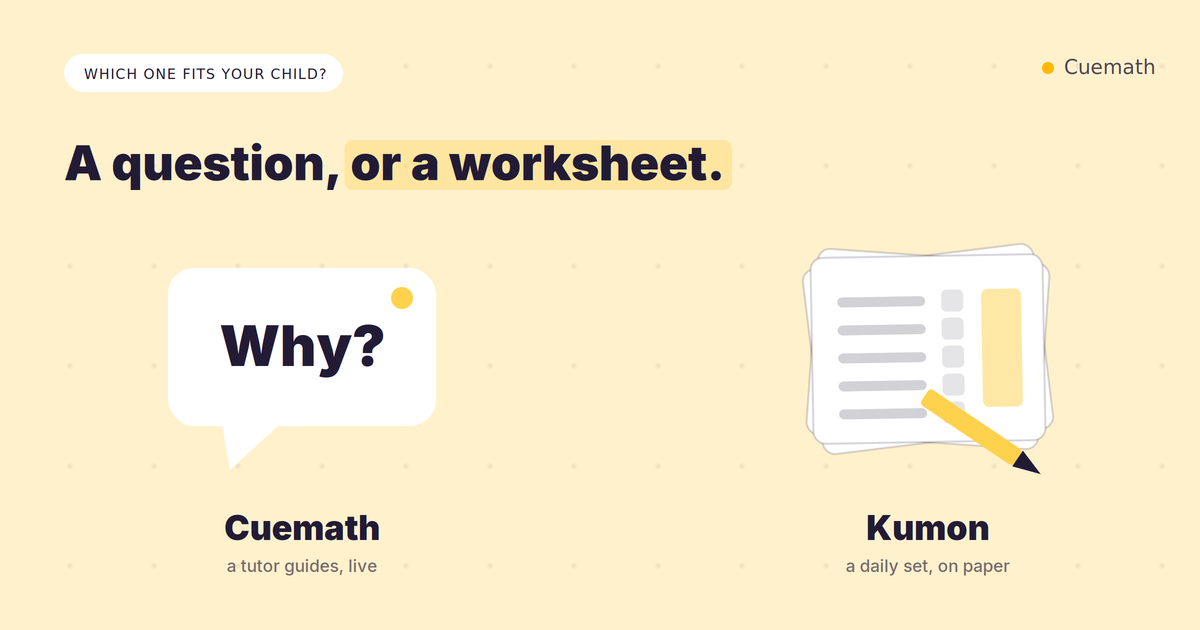
It's 4:45 pm on a Tuesday. You're deciding between two different afternoons: driving your child to a Kumon centre for worksheets, or logging into a live online class from the kitchen table. Both promise to make your child better at maths. But neither tells you which one is actually right for your child.
Cuemath is 1-on-1 live online tutoring built around the Australian curriculum. Kumon is in-person worksheet practice built around daily repetition. This guide compares what really matters: how each one teaches, what they align to, who works with your child, and what real Australian parents say.
- What Is Cuemath?
- What Is Kumon?
- Cuemath vs Kumon: The Quick Answer
- How Do Cuemath and Kumon Actually Teach Maths?
- Is Cuemath or Kumon Better Aligned to the Australian Curriculum?
- Which One Costs More — Cuemath or Kumon?
- Who Actually Teaches the Lessons?
- What Do Australian Parents Say About Each One?
- So, Which One Fits Your Child?
- Frequently Asked Questions
What Is Cuemath?
Cuemath is a 1-on-1 live online maths tutoring program, run entirely through its own interactive platform rather than a video call. Every child is paired with a dedicated tutor for every session (not a rotating roster), and the same tutor works with them long-term. Sessions run live, generally two to three times a week, 40–60 minutes each, and the tutor adjusts pace and content in real time based on how the child is doing that day.
For Australian families specifically, Cuemath's curriculum is mapped to the Australian Curriculum (ACARA) and individual state syllabi (NSW, VIC, QLD, WA, SA), with built-in support for NAPLAN preparation, Opportunity Class tests, and selective school entrance exams, alongside enrichment for competitions like AMC, ICAS, and Kangourou. Source: Cuemath Australia
What Is Kumon?
Kumon is a worksheet-based learning program. Children attend a physical Kumon centre, commonly twice a week, and work through a structured sequence of worksheets. Kumon calls this the "just-right" level: not too easy and not too hard. The stated goal is to build self-learning ability, so capable students can work ahead of their school grade. An instructor at the centre reviews each child's work, offers hints, and decides which worksheet set comes next, guiding students as they progress through the material.
Kumon in Australia covers ages roughly 3 and up. It starts with Pencil Skills and basic number recognition for the youngest children, and progresses through arithmetic, fractions, algebra, and calculus for older students. Kumon also offers a separate English/reading program alongside maths. Source: Kumon Australia.
Cuemath vs Kumon: The Quick Answer
| Cuemath | Kumon | |
|---|---|---|
| Format | Live, online, 1-on-1 | In-person, at a physical centre |
| Who teaches | Dedicated tutor, same each session | Centre instructor (guides, doesn't lead direct teaching) |
| Teaching style | Guided reasoning ("cue, don't tell") | Repetition through structured worksheets |
| Curriculum alignment | Australian Curriculum (ACARA) + state syllabi | Not tied to weekly school topics; own sequential levels |
| Subjects | Maths only | Maths, English/reading, and other programs |
| Best-fit age range | Kindergarten to Year 10 | From age 3 up, strongest for primary-age skill-building |
| Commute | None — sessions run from home | Requires travel to a centre, typically twice weekly |
Sources: Cuemath Australia, Kumon Australia
Not Sure Which One Actually Fits Your Child?
See the "cue, don't tell" approach in one live class — 100% free, no credit card needed, just one session to find out.
Book a Free ClassFor Students in Foundation to Year 10, Australia
How Do Cuemath and Kumon Actually Teach Maths?
Yes — the two programs teach maths very differently, and that is the biggest thing to weigh. Cuemath's tutors guide a child toward an answer by asking questions, so the child explains why a method works, not just how to do it. Kumon's model is built on repeated worksheet practice at a level that's carefully matched to the child, on the idea that repetition builds both speed and the habit of working independently.
Here's what that looks like for two different kids.
Child A gets stuck on a fractions question and doesn't know why her answer is wrong. In a Cuemath session, her tutor asks a few guiding questions until she spots her own mistake and can explain it back. Child B is quick with addition and subtraction but makes careless errors under time pressure. At Kumon, he works through a daily worksheet set slightly above his comfort level, building speed and accuracy through repetition.
Neither approach is "wrong" as they simply suit different goals:
- If the goal is understanding a new topic and building confidence: Live guided instruction (Cuemath's model) gives a child someone to ask "why" to, right when they're stuck.
- If the goal is calculation speed and independent work habits: Structured daily practice (Kumon's model) is built specifically for that.
Is Cuemath or Kumon Better Aligned to the Australian Curriculum?
Cuemath's curriculum is explicitly mapped to the Australian Curriculum (ACARA) and to individual state syllabi (NSW, VIC, QLD, WA, SA), with dedicated preparation tracks for NAPLAN, Opportunity Class, and selective school entrance tests. Source: Cuemath Australia
Kumon's worksheet sequence is its own independent, sequential system. Source: Kumon Australia
| Cuemath | Kumon | |
|---|---|---|
| Mapped to ACARA / state syllabi | Yes, explicitly | Not stated |
| NAPLAN-specific preparation | Yes | Not stated |
| Selective school / Opportunity Class prep | Yes | Not stated |
| Competition maths (AMC, ICAS, Kangourou) | Yes | Not stated |
| Works ahead of school grade level | Available via personalised pacing | Explicit program goal |
Sources: Cuemath Australia, Kumon Australia, ACARA, NAP — NAPLAN
Which One Costs More — Cuemath or Kumon?
Yes, here are the real published Australian rates for both.
Cuemath Australia — Basic plan (1-on-1 live classes, 2 per week)
| Year group | 3-Month | 6-Month | 12-Month |
|---|---|---|---|
| Foundation – Year 2 | $21/class | $19/class | $17/class |
| Year 3 – 5 | $21/class | $19/class | $17/class |
| Year 6 – 8 | $28/class | $25/class | $22.5/class |
| Year 9 – 10 | $35/class | $31.5/class | $28/class |
Source: Cuemath Australia pricing. A platform fee also applies per billing cycle (from $39 on the 3-month plan).
All plans include flexible scheduling, the ability to pause classes, and a refund policy for unused classes — no lock-in contract.
Kumon Australia
| Item | Cost |
|---|---|
| Monthly tuition | $160 per subject, per month |
| Enrolment fee | $100 one-time (non-refundable) |
Source: Kumon Australia. Pricing is standardised across Australia and GST-inclusive.
Who Actually Teaches the Lessons?
Yes, the person working with your child differs between the two.
Cuemath says it selects tutors from a small percentage of applicants and keeps them with the same child long-term, so the tutor learns that child's pace and gaps over time.
Kumon's centre instructors observe each child's progress, offer hints, and decide which worksheet comes next, guiding students through the material at the centre.
| Cuemath | Kumon | |
|---|---|---|
| Who's with your child | Dedicated 1-on-1 tutor | Centre instructor (shared across a room of students) |
| Continuity | Same tutor, long-term | Depends on centre staffing |
| Role | Actively teaches and explains | Observes, hints, assigns next worksheet |
Sources: Cuemath Australia, Kumon Australia
What Do Australian Parents Say About Each One?
Cuemath holds a 4.9-out-of-5 rating across 10,000+ Trustpilot reviews, with recurring themes around a child's confidence and reduced fear of maths.
So, Which One Fits Your Child?
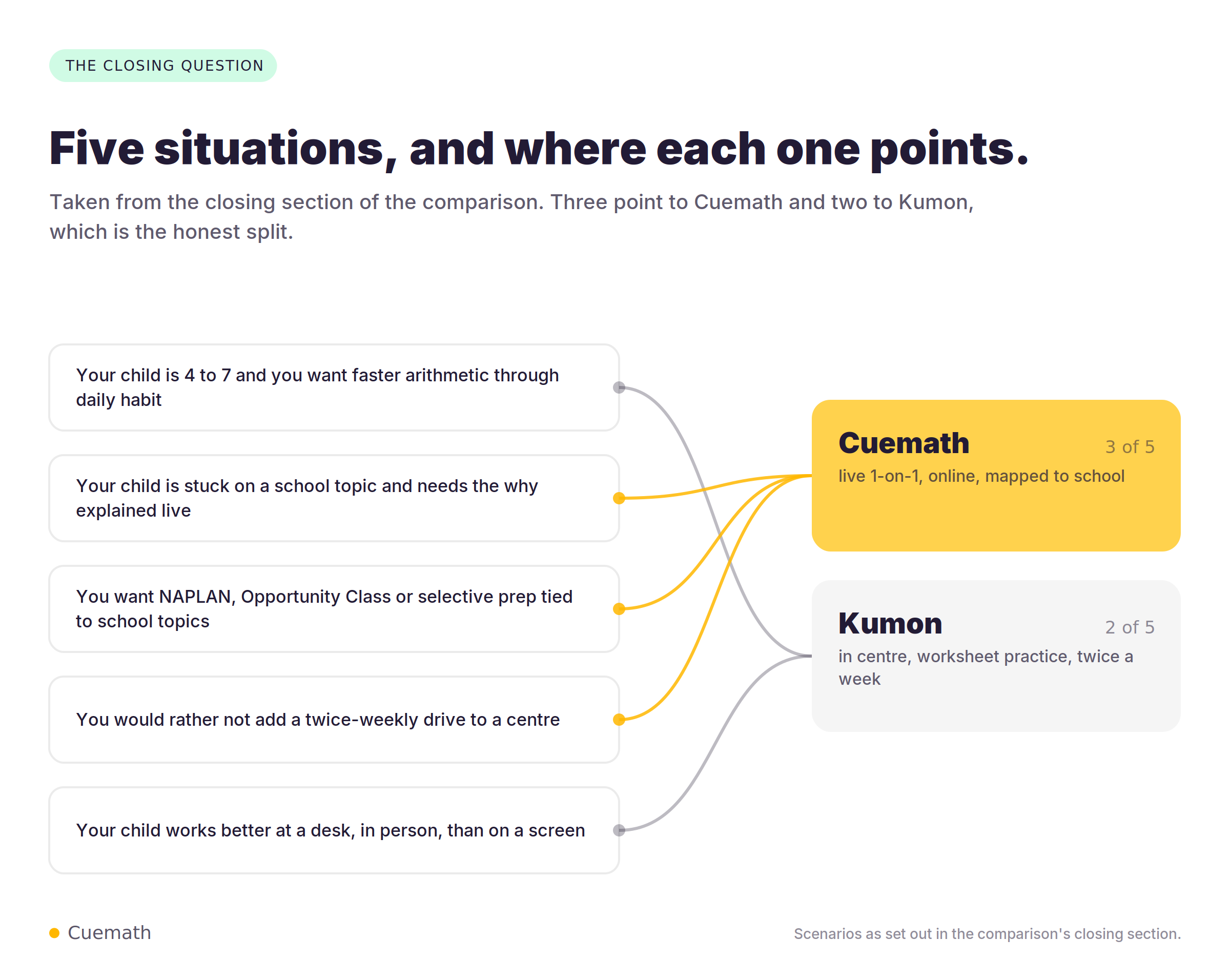
- Your child is 4–7, and you mainly want faster, more confident arithmetic through daily habit-building → Kumon's repetition model is explicitly designed for this.
- Your child is stuck on a school topic and needs someone to explain the "why," live → Cuemath's guided 1-on-1 model is built for this.
- You want NAPLAN, Opportunity Class, or selective school preparation tied to what your child's school is actually covering → Cuemath's ACARA/state-syllabus alignment is the more direct fit.
- You'd rather not add a twice-weekly commute to a centre, and want sessions to happen from home → Cuemath's online format removes that; Kumon requires it.
- Your child does better with in-person, at-a-desk structure than a screen → Kumon's centre format may suit that learning style better.
For a deeper look at how Cuemath, Kumon, and Mathnasium compare specifically for high schoolers, see our Cuemath vs Kumon vs Mathnasium comparison.
Find Out What's Actually Holding Your Child Back
Before you commit to either program, Cuemath's short assessment finds exactly where your child's understanding breaks down — not by year level, but by concept. 100% free, no credit card needed.
Book a Free ClassFor Students in Foundation to Year 10, Australia
Frequently Asked Questions
Is Cuemath better than Kumon?
Neither is universally "better" — it depends on what a child needs. Cuemath suits a child who needs live, 1-on-1 explanation and Australian-curriculum alignment; Kumon suits a child who needs structured daily repetition to build arithmetic speed and independent work habits, typically at a younger age. Source: Cuemath Australia · Source: Kumon Australia
What age does Kumon start in Australia?
Kumon in Australia starts around age 3 with its Pencil Skills program, then moves into structured maths and English worksheets as children get older. Source: Kumon Australia.
What age range does Cuemath cover?
Cuemath covers Kindergarten through Year 10 in Australia, with personalised pacing so a child can work at, ahead of, or behind their nominal school year as needed. Source: Cuemath Australia
Is Cuemath or Kumon better for NAPLAN preparation?
Cuemath states explicit alignment to the Australian Curriculum and NAPLAN preparation as part of its program; Kumon's official materials describe its own independent worksheet sequence rather than NAPLAN-specific content. Source: Cuemath Australia · Source: Kumon Australia
Does Kumon teach subjects other than maths?
Yes — Kumon Australia also offers an English/reading program (and, in some markets, Japanese), alongside its maths program. Cuemath is maths-only. Source: Kumon Australia
Is Cuemath online or in person?
Cuemath is 100% online, delivered live through its own platform rather than a general video-call tool, with the same dedicated tutor each session. Source: Cuemath Australia
Is Kumon in person or online in Australia?
Kumon in Australia is delivered in person at physical learning centres, generally attended twice a week. Source: Kumon Australia
How much does Cuemath cost compared to Kumon in Australia?
Cuemath's Basic plan starts at $21/class for Foundation to Year 5 (3-month plan, 2 classes a week), dropping to $17/class on a 12-month plan, plus a small platform fee. Kumon Australia charges a flat $160 per subject per month plus a one-time $100 enrolment fee. Source: Cuemath Australia pricing · Source: Kumon Australia
Sources
- Cuemath Australia — official site
- Kumon Australia — official site
- ACARA — Australian Curriculum, Assessment and Reporting Authority
- NAP — National Assessment Program (NAPLAN)
- Trustpilot — Cuemath reviews

I write because I like understanding things properly, and I've never been able to do that quietly.
Six years in, what still interests me most isn't the writing itself. It's the person on the other side. Who are they, what were they actually worried about when they opened this page, and did they leave with what they came for? Most content fails that last test. It answers the easy question instead of the one that was asked.
At Cuemath, I write for parents and students in India and around the world. That range is the part I enjoy. A parent in Bangalore and a parent in Canada are asking about the same child, but not always in the same words, and that difference matters.
So I research before I write. Not just search results. Forums, reviews, the long comment threads where somebody finally admits what they're really confused about. That's usually where the useful thing is hiding.
I also spend time on how people find this writing at all, since a growing number of them now ask an AI instead of typing into Google. But that only works if the writing is clear to begin with. There's no shortcut around that part.