
Before You Pick a Math Program: The Six Questions That Matter More Than the Brand
Six questions that tell you more about a math program than its brand name, all askable in one conversation. What each one surfaces, what a good answer sounds like, and why a non-answer is also an answer.

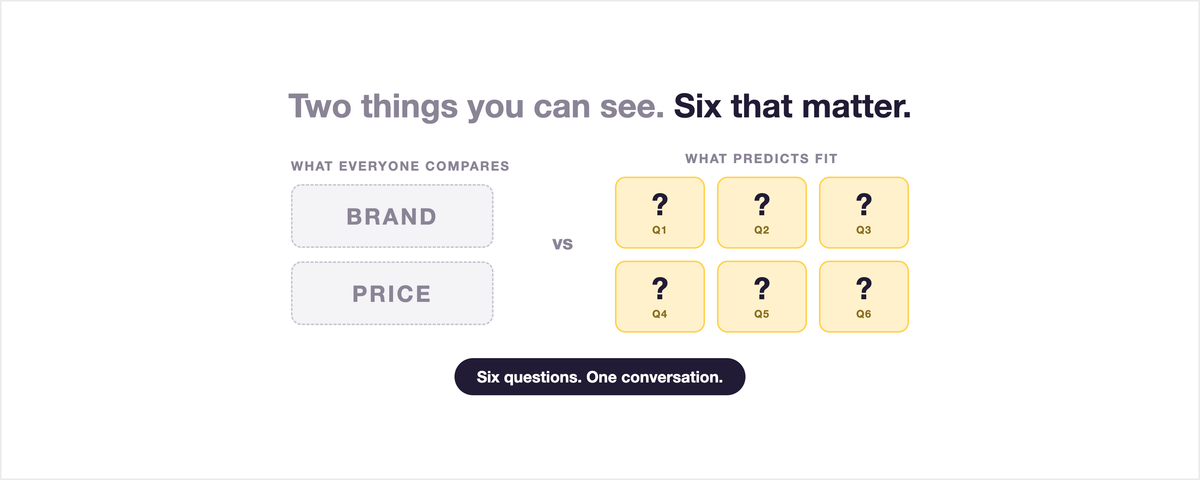
Brand and price are the two easiest things to compare, so that is what most program comparisons come down to. Whether a program will work for your child shows up in six other things. You can ask about all six in one conversation, before you sign anything. No math degree needed. Big class, small group, 1:1, online, in person - the questions work for all of them.
Here they are, in the order they usually come up.
- 1. How do they find out where your child actually is?
- 2. What comes after what your child is doing now?
- 3. Is the work actually hard enough - and who checks?
- 4. Will the same person teach your child next month? Next year?
- 5. What do you get to see of the work - and how often?
- 6. What happens if you want to leave?
- A program that can't answer is also an answer
- Where Cuemath fits
- FAQs
1. How do they find out where your child actually is?
A serious program starts with a real diagnosis before any teaching: what your child knows, what they don't, which concept they are stuck on. A program that places by grade level, or after a 10-minute chat, is teaching the grade, not your child.
Ask directly: how do you figure out where my child is now, and can I see what you find?
2. What comes after what your child is doing now?
Ask them to lay the path out: what follows your child's current level, what follows that, and what "finished" looks like. A program that can name the next step, and the one after it, has a real curriculum. "We have our own materials" with no order behind it means the book sets the pace, not the child.
3. Is the work actually hard enough - and who checks?
Too easy means practicing what your child already knows. Too hard means surviving, not learning. Both waste the year.
Ask two things: how is the difficulty set, and does it move up once my child gets things right? A good answer is specific - who looks at my child's work, and how often the level adjusts. "Our problems are challenging" is not an answer.
4. Will the same person teach your child next month? Next year?
Every teacher change restarts the diagnosis and restarts your child's settling in. Ask plainly: how often do teachers change, and are last year's students still with the same teacher this year? Hardly any brochure lists this. You can only find out by asking - and a good answer is concrete, like "most of last year's students still have the same teacher." "All our teachers are great" is not one.
5. What do you get to see of the work - and how often?
Not "Is there a parent chat group?" Can you see the problems your child did, the ones they got wrong, and what the teacher said about them? And how often - on a schedule, or only when you follow up?
A program that only calls you at renewal time and a program that shows you progress every week are not the same thing.
6. What happens if you want to leave?
Ask before you sign: if we stop halfway, what happens to the remaining money, and how much notice do you need? A good answer has numbers in it: what portion comes back, and how many days' notice. A program that states its exit rules plainly is keeping you with its classes, not its contract. If they ask for a year upfront, ask this one first.
A program that can't answer is also an answer
Any serious program can answer all six. Take the list into the first conversation and work down it in order: the answers tell you more than the brand name can, and a non-answer tells you just as much. If you don't have a shortlist yet, pick two or three programs of different shapes - a local center, an online 1:1 program, a group class - and ask all of them the same six. Math circles, which are not programs in this sense, are on our math circle page.
Where Cuemath fits
These six questions work on any program, including ours. If you want the first question answered before you talk to anyone - a clear read on what your child knows and where they are stuck - that is what a Cuemath MathFit evaluation is for: a free 55-minute session that maps exactly that. What happens in the session is documented plainly in what a MathFit evaluation is.
The other five you still ask every program, ours included.
Walk into the first conversation already holding the answer to question 1
A free Cuemath MathFit evaluation gives you exactly that, in writing, before you talk to any program.
Book a Free EvaluationFor students in Grades K to 12 worldwide.
FAQs
Can I really ask all six in one conversation without seeming difficult?
Yes. These are the questions a serious program answers every week, and asking them marks you as an engaged parent, not a hostile one. Frame it simply: "I'm trying to understand how the program works." Ask for specifics, write the answers down, and thank them - the tone stays friendly even when the questions are sharp.
We're already enrolled somewhere. Is it too late for these questions?
No - you are actually in a stronger position, because now you can check answers against evidence. At renewal time, you don't have to ask whether you will see your child's work; you know whether you did. Ask the same six questions, but answer them yourself first from your last few months there, then raise the gaps with the program.
Is a big, well-known brand safer?
A brand name tells you the format is consistent from one location to the next. It does not tell you where your child starts, what comes next for them, who teaches them, or how you leave. Consistency and fit are different things, and the six questions measure fit.
How often do tutoring programs change teachers?
There is no general number to give you: programs almost never publish this. For our own program, the answer is on record: the same coach in every session is the stated design goal - a goal, not a guarantee. The full set of teacher questions - applied to us - is in "Who Teaches Your Child."
What does a good answer to the diagnosis question look like?
It names specifics: where your child starts, which concepts are missing, and what you will be shown at the end.
Should we pay for a year upfront to get a discount?
Not before the exit question is answered in writing. Paying for months ahead earns its discount by making it harder to leave, so know what comes back if you stop - before the money moves. What a monthly fee should actually buy, question by question, is broken down in "What a Math Tutoring Fee Actually Buys."