
The coach who stays: what to ask any program about who teaches your child next year
In 1:1 tutoring, the person is the product. Five questions that show whether a program is built for the coach staying, and what happens if change comes anyway.

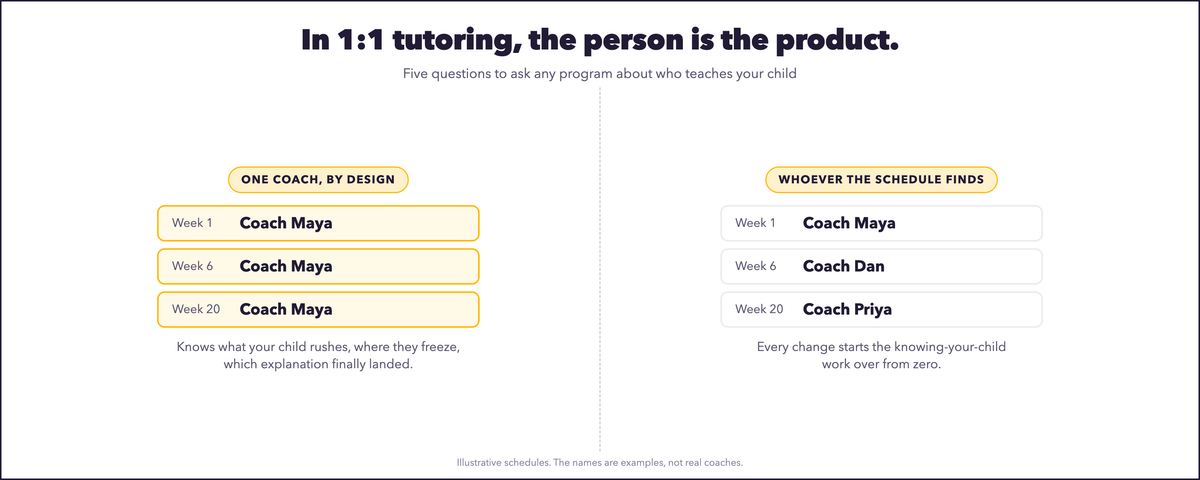
Most questions parents put to a math program get polished answers. Ask about curriculum, engagement, or results, and there is usually a page ready. One question rarely has a rehearsed answer, and in 1:1 tutoring it is the one that matters most: who exactly will teach my child next month, and who decides?
The reason is simple. In 1:1 help, the person is the product. The curriculum matters and the platform matters, but the thing you are actually paying for is an adult who knows your child: what they rush, where they freeze, which explanation finally landed. A group class or a worksheet program can absorb teacher turnover. A 1:1 program cannot, because when the person changes, that knowledge does not move by itself.
Below are five questions you can put to any provider before you commit. Under each: what a good answer sounds like, and what a vague one usually means. No provider is named in the questions, and none needs to be. They do the sorting.
- 1. Who exactly teaches my child, session to session?
- 2. If that person changes, who decides, and when do I hear?
- 3. Who holds the picture of my child across months, a person or a file?
- 4. When a teacher does change, what does the new one receive?
- 5. What does the teacher know about my child before session one?
- How to read the answers
- Our own answers
- Frequently Asked Questions
1. Who exactly teaches my child, session to session?
You are listening for one person, not a pool. A good answer says: your child works with one coach, here is how the match is made, and here is who that person is before you start. A vague answer, like "your child gets access to our team of expert tutors," usually means the schedule decides who shows up. A schedule does not know your child.
2. If that person changes, who decides, and when do I hear?
Every program loses teachers sometimes. The honest ones can describe the mechanics: who makes the call, whether you hear before the change or after it, and whether you and your child get any say in the replacement. If the answer is "that rarely happens," you have learned two things. It happens, and there is no process for it.
3. Who holds the picture of my child across months, a person or a file?
Months of tutoring build up a picture: what has been covered, what was hard, what finally worked. Ask where that picture lives. The good answer is both. A person who carries it in their head, and a record that would survive that person leaving. A file with no person is just notes. A person with no file is one resignation away from starting over.
4. When a teacher does change, what does the new one receive?
Ask what a handover actually contains: a conversation between the old teacher and the new one, a written profile, the session history, the learning plan. "The new tutor can see everything in the system" is half an answer, because reading a record is not the same as knowing a child. Ask what the new person is required to do before their first session with yours.
5. What does the teacher know about my child before session one?
This is the same question pointed at the start instead of the middle. A good answer lists concrete inputs: grade, what the school is teaching, an assessment, your goals, what your child finds hard. A vague answer means the first sessions are spent discovering things you could have told them on day one, on paid time.
How to read the answers
One pattern separates programs. Specific mechanics mean the program is designed for continuity. Reassurance means it is not. Be fair about the limit, though: no program can promise that one specific person will stay forever, because teachers are people with lives. A program that promises that is telling you what you want to hear. What you can reasonably ask for is a program where a child keeps one coach by design, and where the knowledge survives if change comes anyway.
Our own answers
This page sits on Cuemath's blog, so here are our answers to the same questions, kept factual.
Cuemath is a personalized 1:1 program. Classes are live 1:1, one coach and one child, two sessions per week, one hour each, on our own platform, Leap. On question one, our design goal is the line we use internally: "Your 1:1 coach, the same one in every session." That is a design goal stated honestly, not a promise that a specific person can never change. Nobody can promise that.
On questions three and four: classes, homework, and curriculum all run in one place. Leap is where coach and child meet, where classes happen, where homework is assigned, and where homework completion is tracked. The record of your child's work lives in one system, not in one person's head alone. The coach is the person who knows your child and acts for them inside the program. The platform is the record that would outlast a change.
On question two, who decides a change and when you hear, on question five, what your coach knows about your child before the first session, and on what a new coach must review: ask us directly, the same way you would ask anyone. This page is the standard we expect to be measured against.
A MathFit evaluation is a reasonable place to start that conversation: a free session that builds a picture of your child in writing before anyone teaches anything. You watch it happen.
Want to Put Us to the Test First?
Ask us the five questions on this page, starting with a free MathFit evaluation: a session that builds the picture of your child before anyone teaches anything.
Book a Free EvaluationFor Students in Grades K to 12 Worldwide
Frequently Asked Questions
Does my child get one Cuemath coach, or a rotating pool?
One coach. Cuemath is a personalized 1:1 program: live one-on-one classes, one coach and one child, two sessions a week, one hour each. The line we hold ourselves to internally is "Your 1:1 coach, the same one in every session." That is a design goal stated honestly, not a promise that a specific person can never change. Nobody can promise that.
Can any program promise the same teacher forever?
No. Teachers are people with lives. A program that promises forever is telling you what you want to hear. What you can reasonably ask for is a program where a child keeps one coach by design, and where the knowledge survives a change if it comes anyway.
If the coach changes, does my child start over?
The record should not. At Cuemath, classes, homework, and curriculum all run on one platform, Leap. Classes happen there, homework is assigned there, and completion is tracked there. The record of your child's work lives in one system, not in one person's head alone.
Is the person who runs the free evaluation the coach my child keeps?
No. The MathFit Specialist's job is the evaluation: building the picture of how your child thinks. Who coaches the ongoing program is a separate question, settled when you enroll.
What should I ask a program before committing?
The five questions on this page: who exactly teaches my child; who decides a change and when do I hear; who holds the picture of my child, a person or a file; what does a new teacher receive in a handover; and what does the teacher know about my child before session one. Specific mechanics are the good sign. Reassurance is the warning.
Why does teacher continuity matter more in 1:1 than in a group class?
In 1:1 help, the person is the product. A group class can absorb teacher turnover. A 1:1 program cannot, because when the person changes, the knowledge of your child does not move by itself.