What Is a Math Circle? Nine Programs, Fees, and Sign-Ups
A math circle is a weekly meeting where children work on math problems that school does not teach, led by mathematicians and math teachers. It is not tutoring, and it is not test prep.

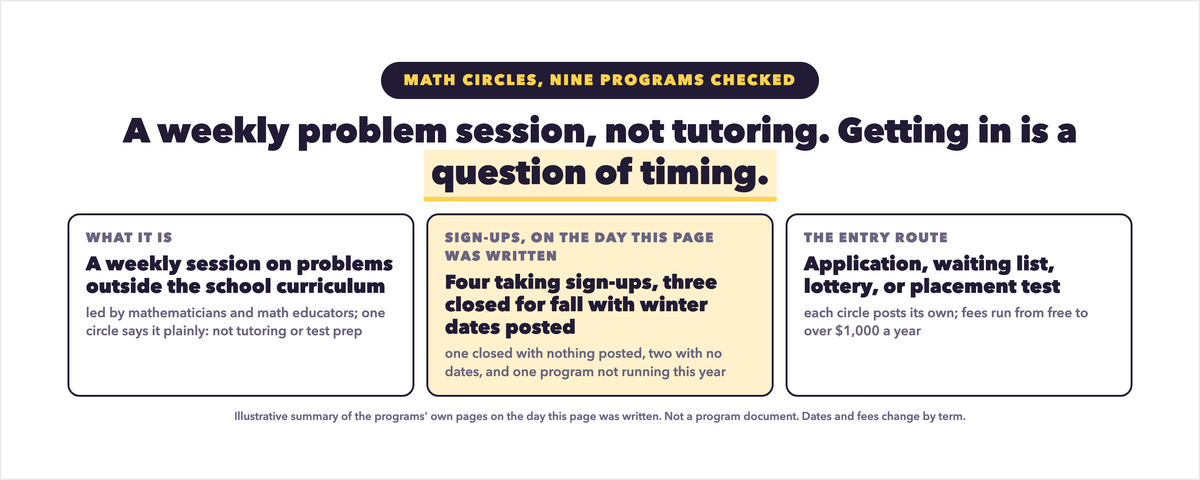
A math circle is a weekly meeting where children work on math problems that school does not teach, led by mathematicians and math teachers. It is not tutoring, and it is not test prep. New York Math Circle (NYMC) says so on its own page: "NYMC is not a place to get tutoring or test prep."
Your first step is the calendar, not the comparison. Counting Berkeley's three programs one by one, four were taking sign-ups: San Jose, New York, San Francisco Math Circle (SF Math Circle), and Berkeley's elementary program, whose waiting list is open all year. Three had closed fall and posted winter dates: Stanford, UCLA, and Chicago.
One had closed with nothing posted: Berkeley's Monday program, which it calls Math Taught the Right Way. Two print no dates: MIT's PRIMES Circle prints a timetable with no year, and the Global Math Circle prints none. One is not running this year: Berkeley's upper circle, BMC-Upper, for grades 5 to 12.
So find the circle near you in the table below, and join its mailing list if it keeps one (UCLA does not). Sign up early: Chicago fills spots first come, and Berkeley's elementary program admits by merit and space. If none of them is near you, the Math Circle Network's map at mathcircles.org lists circles by place.
What a math circle is, in the circles' own words
New York puts it this way: "Our classes explore mathematics you won't find in the regular curriculum." SF Math Circle says its focus is creative problem-solving "rather than building their skills in arithmetic or other traditional K-12 math."
Two things follow. A gap in school math is not what a circle is for: New York's page says it is not tutoring, and SF Math Circle's says its focus is not arithmetic. And most circles on this page group children by grade, as the table shows. New York places children by a test, and the Global Math Circle groups them by age and experience. UCLA tells parents: "Please apply for the age-appropriate level." It adds that most of its students are already 2 to 4 years ahead of their school grade.
The nine programs, plus the national map
Everything below comes from the programs' own pages, read on the day this page was written. Fees and dates change each quarter or semester, so check the linked page before you pay.
| Program | Grades | Where and when | Cost | How a child gets in | Sign-ups |
|---|---|---|---|---|---|
| Berkeley Math Circle: Elementary | 1 to 6, in three levels: grades 1 and 2, grades 3 and 4, grades 5 and 6 (see the FAQ on disagreements) | In person and online. Tuesdays and Wednesdays at 5, 6, and 7 p.m. Pacific | $360 continuing, $395 new (includes a $35 application fee), Fall 2026. Financial aid available | Waiting list first, then admission by merit and space | Waiting list open all year |
| Berkeley Math Circle: Math Taught the Right Way (the Monday program) | Grades 6 to 12 | UC Berkeley, Berkeley. Mondays 5 to 8 p.m., 15 meetings in Fall 2026. A one-hour proofs-only group meets 5 to 6 p.m. | $910 for Fall 2026. $303 for the proofs-only group | Application, selection on academic record, payment within 48 hours of acceptance | Fall 2026 closed. No next sign-up window posted |
| Berkeley Math Circle: BMC-Upper | Grades 5 to 12 | Not running in Fall 2026 or Spring 2027 | Not running | Not running | Not running. Its page says the university's fingerprinting rules for guest speakers "severely limited our ability" to run it |
| Stanford Math Circle | 1 to 12 | Online; grades 9 to 12 also in person. Tuesdays, Wednesdays, and Thursdays, late afternoon and evening Pacific | $500 a quarter online, $525 in person (Winter 2027) | Registration through Stanford Pre-Collegiate Studies (SPCS), announced to its mailing list. Its grade pages print no entry test | Fall 2026 closed. Winter 2027 classes run January 12 to March 18, 2027 |
| San Jose Math Circle | 7th and 8th grade, age 11 and up (see the FAQ on disagreements) | Santa Clara University. Thursdays 7 to 9 p.m., September to May | $580 a year, $290 for a sibling, on a tuition page dated 2023-24. Scholarships on request | Application. New students write an essay | Application open for 2026-27 |
| Olga Radko Math Circle at UCLA, which its pages call ORMC | K to 12, from BNP, UCLA's level for kindergarten and 1st grade, to Advanced. The Fall 2026 schedule starts at grade 2 | UCLA's Math Sciences building. Sundays, three quarters a year, nine meetings a quarter (see the FAQ on disagreements) | Free. Suggested donation $300 a student a quarter, "not a factor in enrollment decisions" | Apply every quarter while enrollment is open; a new account can only be made then. The youngest level takes an assessment test | Fall 2026 closed. Winter sessions start January 10, 2027. No mailing list, so mark the date yourself |
| New York Math Circle | Upper elementary through high school, by level | NYU's Courant Institute, 251 Mercer St., or on Zoom. Sundays, fall and spring | $875 a year in person. $500 fall in person, $375 fall Zoom, $600 full year Zoom. Fee reductions on a form | Registration plus a take-home placement test for new students. Contest classes need no test | 2026-27 registration open |
| Math Circles of Chicago | 3rd to 12th grade | Chicago schools, the University of Chicago, and Chicago State University, each a hub, the program's word for a site. Fall and winter | $150 for one child, $225 for two (Fall 2026). Half or waived by school or income. "Free for Most," in its words | Fall students re-enroll. New families register from December. Its FAQ describes a lottery (see the FAQ on disagreements) | Fall closed. Winter registration opens December 1 (see the FAQ on disagreements) |
| SF Math Circle at San Francisco State | 2nd to 5th grade | San Francisco State University, in person. One hour, once a week: Monday, Wednesday, or Saturday. 10-week terms | $300 a term. Payment plans. Scholarships up to 90% off through ActivityHero | Registration, no test. A child can join in the middle of a term | Fall 2026 registration open |
| MIT PRIMES Circle | High school, within commuting distance of Boston | Cambridge, near Boston, on the MIT campus. Two hours a week with a mentor, at least 5 to 7 hours a week in all, February to May | Free. $5 application fee, waivable | Application with letters of recommendation, due October 30. Decisions early December. Placement test in January. A student can take part once | Its timetable, with no year printed, has applications open from early October to October 30 |
| The Global Math Circle | All ages, grouped by age and experience | Online, on Zoom. 7 or fewer children per circle. One hour a week for 7 to 8 sessions | Not printed on its pages | Mailing list and class listing | No dates printed on its pages |
| MathCircles.org, the Math Circle Network | A directory, not a program | A map of circles across the US, kept by the circles' own leaders | None | Search the map for your city | Open the map on its site to find a circle near you. |
If your child is in...
- Grades 1 to 6, in the Bay Area: Berkeley's elementary program has three levels: grades 1 and 2, grades 3 and 4, and grades 5 and 6. Its waiting list is open all year, and it admits by merit and space. Stanford's online circle takes grades 1 to 12; join its mailing list for winter. SF Math Circle at San Francisco State takes 2nd to 5th grade, and its fall registration is open. The Monday program meets at UC Berkeley; the elementary page says its classes run online and in person.
- Grades 7 and 8, in the Bay Area: San Jose Math Circle meets on Thursdays, and its application is open. New students write an essay. Stanford also runs a grades 7 to 8 circle.
- High school: Stanford's grades 9 to 12 circle meets in person or online.
- Outside California: New York meets on Sundays, with a placement test for new students. Chicago's FAQ describes a lottery, and its winter registration opens December 1 or December 12; both dates are on its pages. Near Boston, MIT's PRIMES Circle takes high school students by application.
- Anywhere else: the MathCircles.org directory, or the Global Math Circle online.
How a child gets in
New York's take-home placement test needs a score of 7 out of 10 to qualify for a level. Berkeley's Monday program selects on "high academic qualifications and a timely and complete application." Readmission is not guaranteed. Chicago's winter registration is first come: "First come, first serve enrollment for winter math circles opens on December 1st."
What the pages say that is easy to miss
Chicago's FAQ still describes a lottery, with students in Chicago public schools taking spots first.
San Jose's FAQ and apply page take 7th and 8th graders. Ask before you plan on a high school spot (see the FAQ on disagreements).
The Stanford pages we could read list the winter class dates but not the registration dates, so join its mailing list.
Where Cuemath fits
A math circle is for a child who wants more math and has the school math in hand. The Cuemath evaluation is a check on school math, which several circles on this page expect a child to have already; it is not a way into any circle. Cuemath is live, one-on-one online math tutoring.
Know where the school math stands first
A free Cuemath MathFit evaluation, our skills-and-gaps check, is a live, one-on-one session that shows where your child is solid and where a gap sits, in your child's own work. No credit card, and the report is yours either way.
Book a Free EvaluationFor students in Grades K to 12 worldwide.
FAQs
Is a math circle a competition class?
Not by default. The circles above describe problem sessions outside the school curriculum. Contest training is a separate class where it exists.
Two pages do name contests as an aim. Berkeley's home page lists "preparing them for mathematical contests," and UCLA's FAQ calls math competitions its secondary goal. UCLA lists AMC 8 Training, for the American Mathematics Competitions (AMC), as one class among its levels, for grade 8 and younger. New York sells its AMC 8 and AMC 10 contest classes separately, at $1,025 a year. It also runs an online MATHCOUNTS class at $550.
The AMC 8, for grade 8 and below, is explained on our AMC 8 page. The school-run contests are on our MATHCOUNTS page and our Math Olympiad for Elementary and Middle Schools (MOEMS) page.
Does a math circle take a child who is behind in school math?
New York and Chicago expect a child who already has the school math; SF Math Circle does not. New York says its program "is designed for students who are already comfortable with standard school material." Chicago says "many (though not all) of the students are already taking math a year beyond the standard school curriculum for their grade level." SF Math Circle says "a student's math background is not a barrier to participation in Math Circle." Its activities do not teach arithmetic or other school skills. The six questions to ask any program before you pay are on our program page.
Can my child join in the middle of a session?
Yes at SF Math Circle, and in Chicago if space allows. SF Math Circle's activities differ week to week, so "students who join in the middle of the term won't be behind other students." Chicago keeps enrollment open "up until 2 days before the 4th session of the semester." New York expects a student who starts to come for the full semester. Its line "Students may join at any point in the cycle" is about its one-year middle school and two-year high school course cycles. UCLA and Stanford run by quarter, and Berkeley's Monday program and San Jose by application, so a missed sign-up window there waits for the next one.
What does free mean at UCLA and in Chicago?
At UCLA, free means no fee for admitted students: "ORMC is free to all students admitted into the program." The suggested donation is $300 a student a quarter, and the page says a donation "does not play a role in our enrollment decisions." In Chicago the Fall 2026 full fee is $150 for one child and $225 for two. Chicago waives the fee for a family whose child attends a school where 75% or more of children are lower income, or whose tax return shows income under $70,000. It halves the fee between 50% and 75%, or between $70,000 and $100,000.
My child is in 4th grade. Where can we start?
Five programs on this page name grades that include 4th grade. Berkeley's elementary Level II is grades 3 and 4. Stanford runs a grades 3 to 4 circle online. Chicago's Cheng-3/4 program is for 3rd and 4th graders. SF Math Circle's classes take 2nd to 5th grade. UCLA's Beginners 1 is grades 2 to 4, and a UCLA satellite circle, run by UCLA circle students, teaches grades 2 to 5 in the Torrance school district. New York's entry level targets upper elementary students, and the Global Math Circle takes all ages.
My child is in 2nd grade. Which circles take 2nd graders?
Four of the nine programs say so on their pages. Berkeley's elementary Level I is grades 1 and 2. Stanford's grades 1 and 2 circle runs online. SF Math Circle takes 2nd to 5th grade. UCLA's Beginners 1 is grades 2 to 4. Its youngest classes (BNP, for grades K to 1, though the entry page heads them "K-2") start every two years and admit by an assessment test. Chicago does not admit 2nd graders, and San Jose starts at 7th grade. New York's entry level targets upper elementary and middle school. The Global Math Circle says it is for "children of all ages" and prints no grade list.
How much time does a circle take each week?
From 50 minutes to three hours, plus homework. The Global Math Circle and SF Math Circle meet for one hour. Stanford's grades 1 and 2 classes run 50 minutes. UCLA's Fall 2026 schedule gives Beginners 1 50 minutes and its other levels two hours, while its FAQ calls its Beginners classes one hour. Berkeley's Monday program runs three hours, 5 to 8 p.m., and its proofs-only group one hour. Stanford's grades 5 to 6 page says "Homework is an essential part of the curriculum." New York's middle school homework is about 30 minutes a week, and its high school homework about 60. MIT's PRIMES Circle expects at least 5 to 7 hours a week in all.
Where do a program's own pages disagree?
Four programs print two answers to the same question: Chicago, Berkeley, San Jose, and UCLA.
- Chicago: its banner opens winter registration on December 1, but its text sends new families back on December 12. Its event listing ends winter registration on February 3, 2027; its text calls February 5 the final day to enroll for "winter 2026." Its circles page says the lottery has ended; its FAQ still describes one.
- Berkeley: the elementary page says grades 1 to 6, and also sends grade 6 to the Monday program. The home page says grades 1 to 5. The Monday program's closed fall sign-up window ended May 8 on its own page and May 6 on the home page.
- San Jose: its FAQ and apply page take 7th and 8th grade only. An older about page says it is "for middle school and high school students."
- UCLA: its FAQ says nine meetings a quarter. Its home page lists nine fall Sundays and eight each for winter and spring, and its entry page says eight a quarter.
Email the program before you plan on either reading.