
What a Math Tutoring Fee Actually Buys, Month to Month
Two programs can charge the same monthly fee and sell very different things. Six questions separate a path from a set of sessions, before you pay.

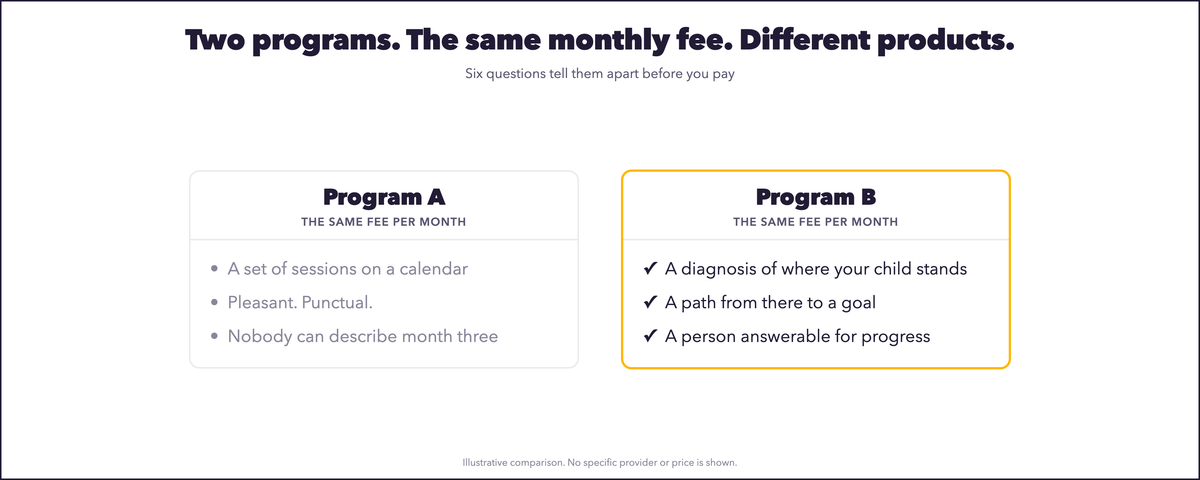
Math help is sold by the month, so most families compare programs by the monthly fee. But the fee alone tells you almost nothing. Two programs can charge the same amount and sell very different things. One is selling a diagnosis, a path, and a person accountable for movement along that path. The other is selling hours. You cannot tell them apart from the price page. You can tell them apart in one conversation, if you ask the right six questions.
This page is that conversation. For each question: what your monthly fee should be buying, what to ask, and what a weak answer sounds like.
- The fee is not buying hours
- 1. Is there a path, or just sessions?
- 2. Is the work at the right depth?
- 3. Did anyone diagnose before selling a plan?
- 4. Who is the teacher, and who do they answer to?
- 5. Will you see progress, or just hear about it?
- 6. Can you leave?
- One conversation
- What Cuemath states up front
- Frequently Asked Questions
The fee is not buying hours
A month of tutoring looks like a set of sessions on a calendar. But sessions are how the help is delivered. They are not the thing you are paying for. The thing you are paying for is movement: your child was here, and after some months of fees, your child is measurably there.
Movement needs three things behind it. Someone found out where your child actually stands. Someone built a path from that point to a goal. And someone is answerable for progress along that path. Hours without those three can be pleasant, punctual, and still go nowhere.
The six questions below check for those three things. A program that has them can answer all six on the spot.
1. Is there a path, or just sessions?
What the fee should buy: a real sequence your child is on. Not a promise of structure. An actual answer to what comes next and why.
Ask: "What will my child work on over the next three months, and why in that order?"
A weak answer sounds like: "We follow the school." "It depends on the day." "The tutor decides each session." A program can adjust a plan as your child moves. It cannot use adjustment as a substitute for having a plan. If nobody can describe month three, there is no path, and you would be paying for sessions.
2. Is the work at the right depth?
What the fee should buy: work that stretches your child. Not pages of the same kind of question, done faster.
Ask: "Show me the actual work a child at my child's level does here." Then look at it. You do not need to be a math person to spot repetition.
A weak answer: they will not show you the work. Or the work is one move repeated forty times. Volume is cheap. Depth is what you are paying for.
3. Did anyone diagnose before selling a plan?
What the fee should buy: a plan built on your child, not on your child's grade label.
Ask: "What did you find out about my child before proposing this plan? What exactly is missing?"
A weak answer: a raw score with no explanation. A grade label. Or a plan quoted before anyone spent real time with your child. If the plan existed before the child was assessed, the plan was never about the child.
4. Who is the teacher, and who do they answer to?
What the fee should buy: a specific person who knows your child, plus someone checking that person's work.
Ask: "Who will teach my child? What is their background? Who reviews their sessions? What happens if the match is not working?"
A weak answer: "one of our tutors." No name until after you pay. A new face every few weeks without anyone asking you. Nobody above the tutor whose job is to notice a bad month.
5. Will you see progress, or just hear about it?
What the fee should buy: proof you can look at. Your child's actual work, changing over time.
Ask: "What will I be shown each month? Will it be my child's own work, or a summary?"
A weak answer: reassurance. "She is doing great." Attendance tallies. Cheerful reports with no work attached. Progress you cannot inspect is a claim, not a result. A serious program expects you to check.
6. Can you leave?
What the fee should buy: nothing, on this one. An easy exit costs the program nothing if the teaching works.
Ask: "How do I stop? What is refundable? What am I committed to on the day I start?"
A weak answer: a long contract as a condition of starting. Vague refund terms. Pressure to prepay many months for a discount. A program that needs to lock you in is telling you how it expects you to feel a few months in.
One conversation
Run all six questions in a single conversation before you pay. A serious program answers quickly, because the answers already exist: the path is written down, the work is there to show, the diagnosis is a step they already run, the teacher has a name, the progress report is something they already produce, and the exit terms are in plain sight. A weak program stalls, generalizes, or steers you back to the fee.
That is also when the monthly fee finally becomes useful. Two fees are only comparable when they buy the same six things. Once you know what each fee is actually buying, the comparison is easy. Before that, you are comparing numbers attached to different products.
What Cuemath states up front
Stated plainly, and checkable in the same conversation:
- Classes are live one-on-one sessions between a tutor and a student, two sessions per week, one hour each.
- The curriculum is structured and covers grades K-12. Lessons are sequenced with clear learning arcs, defined objectives, and checkpoints, so the path your child is on is a set sequence, not a session-to-session drift.
- The curriculum is organized around learning goals: specific competencies tied to school success, test prep, and enrichment.
- Practice and assessments respond to how the student performs and adjust difficulty, so the work stays at the right depth for that child.
- Homework is assigned and completion is tracked.
For everything else on the list, ask us the same six questions you would ask anyone else. The conversation before you enroll exists for exactly that. It can start with the diagnosis itself: a MathFit evaluation is free, and you leave with the picture in writing.
Want the Diagnosis Before the Plan?
A MathFit evaluation is free, and you leave with the picture in writing: where your child stands, and what to fix first.
Book a Free EvaluationFor Students in Grades K to 12 Worldwide
Frequently Asked Questions
How much does 1:1 math tutoring cost per month?
Fees vary widely by format, region, and frequency, so a single number would mislead more than it helps. What this page can do is show you what any fee should be buying, and the same six questions do that whatever the number. Two fees are only comparable when they buy the same six things.
What should a monthly tutoring fee actually buy?
Movement, not hours. Behind the sessions there should be three things: someone found out where your child actually stands, someone built a path from that point to a goal, and someone is answerable for progress along it.
What is the fastest way to tell a serious program from a set of sessions?
One conversation, six questions: is there a path or just sessions; is the work at the right depth; did anyone diagnose before selling a plan; who is the teacher and who do they answer to; will you see progress or just hear about it; and can you leave. A serious program answers on the spot, because the answers already exist.
What are the warning signs?
Nobody can describe month three of the plan. The work is one move repeated forty times. The plan was quoted before anyone assessed your child. Progress comes as reassurance with no work attached. And a long lock-in is a condition of starting.
Which of the six does Cuemath state up front?
The ones our product documentation states: live 1:1 classes, two one-hour sessions per week; a structured K-12 curriculum with sequenced lessons, objectives, and checkpoints; learning goals tied to school success, test prep, and enrichment; practice that adjusts difficulty to the student; homework assigned and completion tracked. For everything else, ask us the same six questions you would ask anyone else.
Is there a free way to check where my child stands before paying anyone?
Yes. Cuemath's MathFit evaluation is a free 55-minute session where a MathFit Specialist reads how your child thinks, and you leave with the MathFit Report in writing. It is free in 2026, and what you leave with is yours whether or not you go any further with us.