Math with Confidence vs Dimensions Math for Kindergarten: What Each Lesson Asks of You
You are teaching kindergarten math at home and the lesson keeps stopping: a baby on the move, a toddler, or a child who answers off-script. Two programs parents weigh for this year, Kindergarten Math with Confidence and Dimensions Math K, print different lesson shapes.

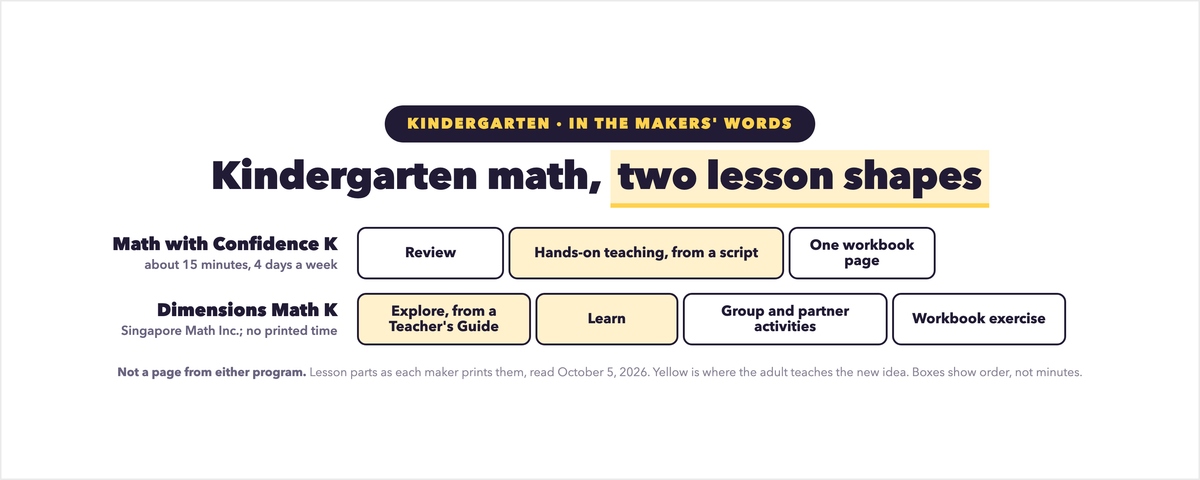
You are teaching kindergarten math at home and the lesson keeps stopping: a baby on the move, a toddler, or a child who answers off-script. Two programs parents weigh for this year, Kindergarten Math with Confidence and Dimensions Math K, print different lesson shapes. Dimensions Math is the PreK to grade 8 program from Singapore Math Inc., the publisher most parents mean when they say "Singapore Math." Math with Confidence K asks you to read a script for about 15 minutes, four days a week for 32 weeks, with household items on the table and one workbook page at the end. Dimensions Math K asks you to run a Teacher's Guide lesson plan with a textbook, a workbook, and kit pieces, and its maker prints no lesson time.
Neither maker says which lesson survives an interruption. In our read, the shape decides whether a stopped lesson can restart, and the shape is printed. Below are the printed differences, in the makers' words, and one way to test both at your own table. This page does not rank them.
How long a lesson is, and how many a week
Kindergarten Math with Confidence says its lessons "take about 15 minutes from start to finish." Each one has three parts: a short review activity, hands-on teaching of the new skill through talk and objects, and a workbook page, which in kindergarten means tracing a few numbers and practicing the new skill. The author writes that the kindergarten lessons "are written for 4 days per week for 32 weeks."
Dimensions Math K is two textbooks and two workbooks, KA and KB, for the two halves of the year. The maker's Grade K pacing guide spreads 14 chapters over a nine-month school year, Chapter 1 in Month 1 and Chapters 12 to 14 in Month 9, and marks which lessons are essential. None of the maker's pages we checked prints a number of minutes for a lesson. The maker's sample Teacher's Guide pages for Chapter 8 show what its lessons hold instead: an objective, a materials list, an Explore step, a Learn step, whole-group and small-group activities, an Extend activity, and the matching workbook exercise.
The script or the guide
Math with Confidence tells you what to say. The instructor's guide is "scripted and open-and-go," and the author says most families "just open the book and start reading the script to their child, without any preparation." A script carries a lesson on a day you have no energy to plan. It also has to be followed: when a child answers off-script, the book has no line for that answer, and you improvise. What the author's page offers for pacing is the checkpoint at the end of each unit, which asks you to decide whether to stay on the unit or move on.
Dimensions Math K gives you the moves, not the words. The Teacher's Guide holds "background information, detailed lesson plans, helpful suggestions, and activities," plus the answer keys. The instructions are written to the adult, not as lines to read aloud. In the Chapter 8 sample they read "Have students discuss what they see in the picture on page 29," "Provide each student or pair of students with 10 linking cubes," and "Partners take turns grabbing a handful of cubes and telling a story to their partner." The textbook's lesson pages are the pictures you talk through with the child. That is a classroom voice, and for Grade K it is the only guide the maker sells. The Grade K set comes with Teacher's Guides. The Home Instructor's Guides, written "specifically for teaching Dimensions Math in a one-on-one setting," run from 1A to 5B. The maker's video lesson subscription covers Grades 1 to 6, not K.
What is on the table
Math with Confidence uses what the house already has: counters, coins, a clock. The one specialized item is a set of pattern blocks, and the author includes a printable set in the Blackline Masters for families without them.
Dimensions Math K lists materials lesson by lesson, and the maker's Teacher's Guide listing says its manipulative kits, sold separately, "include all the essential manipulatives used in Teacher's Guides activities." The Chapter 8 sample pages call for two-color counters, linking cubes in two colors, number cards from the Blackline Masters, and a recording worksheet. More pieces on the table mean more for a crawler to reach. Each maker's list tells you how many.
Where each starts, and what each covers
Math with Confidence places by age: use the level that matches the child's age-based grade. The author says most children are ready at 5 or 6, that no preschool program is needed first, and that it helps if the child can count to 10 and hold a pencil. She calls the program "middle-of-the-road" in difficulty. Dimensions Math K has free placement tests for KA and KB on the maker's site. The maker built them to show whether a child has mastered that level, and its instruction is to watch how the child solves the problems and where they struggle, not just the score.
The coverage overlaps. Math with Confidence K lists writing numbers, counting to 100, beginning addition and subtraction, shapes, measurement, time, money, and more. The Dimensions Math K chapters run from matching and sorting through numbers to 5, 10, 20, and 100; shapes and solids; comparing height, length, weight, and capacity; comparing numbers within 10; number bonds; addition; subtraction; time; and money. The pacing guide adds two notes. Time and money are each "not included in Grade K Common Core" but could be taught if there is time. And "students who know number bonds to 10 without counting will be more successful in Grade 1." What the public school expects by June is on our kindergarten math expectations page.
Side by side
| Kindergarten Math with Confidence | Dimensions Math K | |
|---|---|---|
| Books | One instructor's guide, one student workbook | Textbooks KA and KB, Workbooks KA and KB, Teacher's Guides KA and KB; Tests K optional |
| One lesson | Review, hands-on teaching, one workbook page | Objective, materials, Explore, Learn, activities, Extend, workbook exercise |
| Printed time | About 15 minutes | Not printed; a nine-month pacing guide by chapter |
| Days a week | 4, for 32 weeks | Not printed |
| Written for | A parent reading a script to one child | A teacher with a group; Home Instructor's Guides start at Grade 1 |
| Materials | Household items plus pattern blocks | Lesson-by-lesson lists; manipulative kits sold separately |
| Entry | By age-based grade; readiness at 5 or 6 | By placement test (free, KA and KB) |
| Series runs to | Grade 6 | Grade 8 |
Every cell comes from the makers' own pages, read on the day this page was published. Prices are on those pages too: the author's page for Math with Confidence and the Singapore Math Inc. store for Dimensions Math.
Testing both at your table
Both makers post free sample lessons. The Math with Confidence page links a sample of the instructor's guide and of the workbook. Singapore Math Inc. posts sample pages for the K textbook, workbook, and Teacher's Guide.
Run one sample lesson from each with the baby in the room. Note where you stopped, whether you could pick up where you left off, and how many pieces were on the table when you stopped. That is the test the makers' pages cannot run for you. If your shortlist is wider than these two, the four checks that sort any spine are on our homeschool math curriculum page. Another page covers where Dimensions Math ends and what its maker says comes after Grade 8. It is the what comes next page.
Where Cuemath fits
We do not sell a homeschool curriculum, and the free evaluation below does not replace your main one.
Know where your kindergartner stands before you switch
A free Cuemath MathFit evaluation is a live, one-on-one session that shows where your child is solid and where a gap sits, so the program you pick starts in the right place.
Book a Free EvaluationFor students in Grades K to 12 worldwide.
FAQs
Is Math with Confidence scripted?
Yes. The author calls the instructor's guide "scripted and open-and-go," and says most families read the script to their child without preparation or pre-reading. Kindergarten has one instructor's guide and one student workbook, and the lessons are written for 4 days a week for 32 weeks.
How long is a Dimensions Math kindergarten lesson?
The maker does not print a time. Its Grade K pacing guide works in months, one to three chapters a month over a nine-month school year, and the lesson sample for Chapter 8 lists the parts of a lesson rather than minutes. If you want a number, time one sample lesson yourself.
Do I need the Teacher's Guide for Dimensions Math K?
Yes, the maker says so: "Textbooks, Workbooks, Teacher's Guides, and Home Instructor's Guides are necessary to successfully use this program." For Grade K, the guide on sale is the Teacher's Guide, hardcover and spiral-bound, with the answer keys for both the textbook and the workbook. The one-on-one Home Instructor's Guides begin at 1A.
Is Math with Confidence mastery or spiral?
Both, by the author's description. New material is taught one concept at a time for several weeks, which she calls a mastery approach, and core skills get daily review, which she calls a spiral approach to review.
Can I move from Math with Confidence to Dimensions Math in the middle of kindergarten?
Yes, and the placement tests tell you where to land. Singapore Math Inc. posts free tests for KA and KB. A child who passes the KA test takes the KB test next and starts in KB unless that test shows KB is mastered too; a child who does not pass KA starts in KA. The maker built the tests to find what a child has mastered, so watch the mistakes, not just the total.
What math should a kindergartner know by the end of the year?
The Common Core kindergarten standards name two critical areas (whole numbers with sets of objects, and describing shapes and space) and say more kindergarten time should go to number than to anything else. Both programs cover both areas. The full end-of-year list is on our kindergarten math expectations page.