AMC 10 Results 2026: When Scores Post and the AIME Cutoff
AMC 10 and 12 scores are finalized in mid-December, typically, and appear in the MAA competition portal. The AIME cutoff is a set score this year: 100 on the AMC 10, 85 on the AMC 12, so 100.5 is the lowest that qualifies. If a reported number looks wrong, the portal is the record.

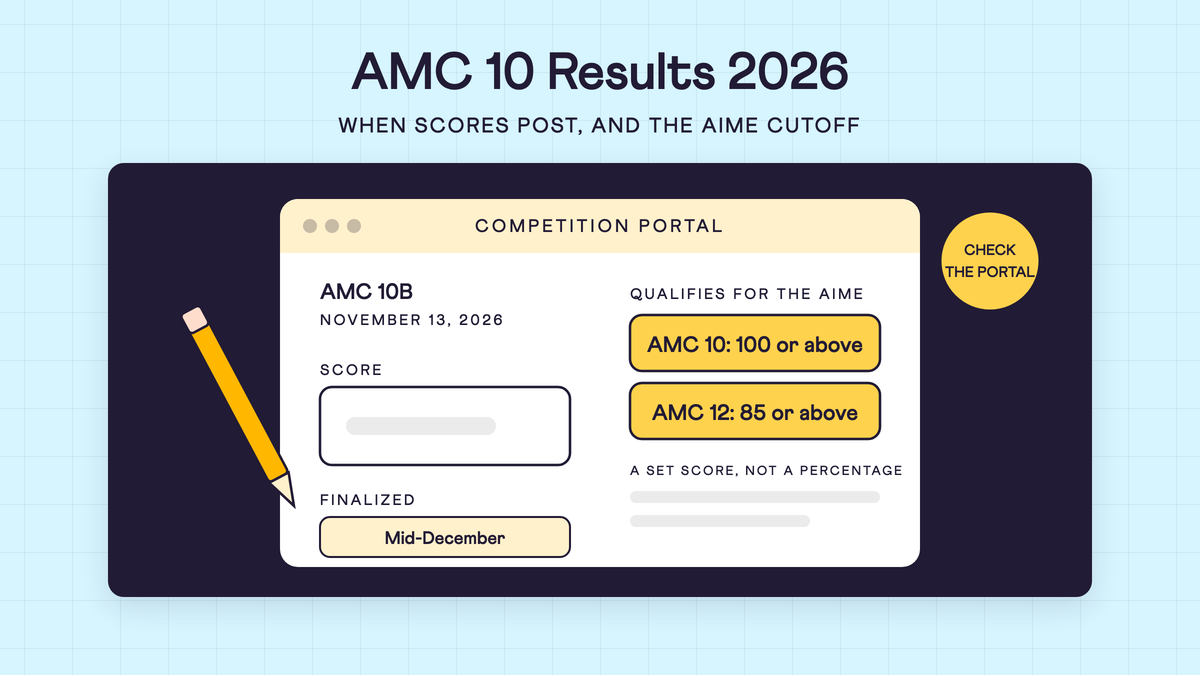
Your child took the AMC 10 or AMC 12 on November 5 or November 13, 2026. The MAA (the Mathematical Association of America, which runs the AMC) says of the scores, "Typically, this happens in mid-December for AMC 10 and 12": it emails the competition manager, the teacher or center that ran the test, and from that moment the family can log in to the MAA competition portal and see the finalized score. The AIME cutoff this year is a set number published before the test, 100 on the AMC 10 and 85 on the AMC 12, and because every score is a multiple of 1.5, the lowest qualifying scores are 100.5 and 85.5: just over 100 is right, and 99 misses. A number a teacher reads off an answer key before mid-December is not the finalized score, so the check is the portal entry, which the competition manager sees too; the MAA's AMC rules print no rescoring or appeal route. For a concern about cheating, the MAA's address is amcintegrity@maa.org.
When the scores come, and who sees them
The MAA's AMC rules and policies, updated August 21, 2026, say: "The MAA will notify competition managers via email when AMC scores are finalized. At that time, students will be able to view their scores in the competition portal." The date table in the same document has one line for it: "mid-December 2026 Scores finalized; AIME invitations sent to qualifying students". No day is printed, and none appears in the MAA pages we read this month.
The portal account is the one made at registration. The rules say "Minors who wish to participate in MAA Competitions must have a parent/guardian complete their registration", so the login is usually a parent's. The rules also say "Competition managers will also be able to view the scores of students to whom they administered exams." The teacher and your family read the same entry.
The AIME cutoff this year is a set score
The MAA's invitational competitions page says: "The thresholds for qualifying for AIME will be set numbers rather than based on percentages." The numbers: "Students who score 100 or above on AMC 10 and 85 or above on AMC 12 (and meet other eligibility requirements) will qualify to register for AIME." In the copies we read, the MAA has published no other cutoff for this year, no count of qualifiers and no 2026 average score.
How many right that takes. The AoPS wiki's AMC 10 page (a community-kept page; copy of October 25, 2025) gives the scoring: "Correct answers are worth 6 points, incorrect questions are worth 0 points, and unanswered questions are worth 1.5 points, to give a total score out of 150 points." So every score is a multiple of 1.5, and no one scores exactly 100: 99 misses the line and 100.5 makes it. On the AMC 10, 14 right with the other 11 left blank gives 100.5, the fewest right that can reach the line; 15 right needs at least 7 blanks (15 right and 10 wrong is 90); 17 right qualifies whatever happens on the rest. On the AMC 12 the lowest qualifying score is 85.5: 11 right with 13 blank reaches it, 14 right needs at least 1 blank, and 15 right qualifies with no blanks at all. Blanks decide it as much as the count of right answers.
Last year's floors sit next to this year's set scores in the table below. The November 2025 figures come from the AoPS wiki's historical results page, a community-kept page, not the MAA's (copy of September 22, 2026); it says the old threshold was adjusted "to allow a consistent number of students (usually 6000-7000) to qualify each year". Its note on the 2025 AMC 12A: "Problem 25 was voided for all participants, and everyone received 6 points for that question."
| Test | AIME floor, November 2025 (old rule) | Average score, November 2025 | Set qualifying score, November 2026 |
|---|---|---|---|
| AMC 10A | 105 | 57.13 | 100 |
| AMC 10B | 99 | 57.00 | 100 |
| AMC 12A | 96 | 64.44 | 85 |
| AMC 12B | 100.5 | 65.99 | 85 |
The MAA's "other eligibility requirements" are the AIME rules' grade, age, enrollment and attendance conditions, on our AIME 2027 page with the age-13 rule; the same rules add that AoPS also nominates "a small number of additional students" from its USA Mathematical Talent Search.
After a qualifying score
The invitation comes with the scores in mid-December, to the email on the portal account, and the 2027 AIME runs on February 5 and 6, 2027, at Pearson testing centers, on test center computers; its fee, registration close and rules are on our AIME 2027 page. For a younger child, the January AMC 8 is on our AMC 8 deadlines page, and what its score means is on our AMC 8 score page.
If the number looks wrong
Start with the portal. A number a teacher reads off an answer key before mid-December is unofficial; the finalized score is the one the MAA posts in the portal, and for a paper test it rests on the score sheets the manager uploads: "The CM must scan the participant score sheets and upload them to the competition portal." The manager "is responsible for ensuring that the scans are legible and all score sheets are recognized in the exam portal." If the portal's number and the teacher's differ, the portal is the record; ask the competition manager to look at the same entry. If your child has two portal accounts, the score may sit on the other one: the rules say to write to amchq@maa.org "to have the accounts merged".
Beyond that, the MAA's AMC rules print no rescoring, regrade or appeal route for an AMC score, and no fee for one. They say students "are participating voluntarily and are not entitled to any particular score, recognition, or process." For a score that is cancelled or disqualified, "the MAA will notify the competition manager about the decision", and the rules point to a separate Academic Integrity Policy, a document this page does not cover.
Where to write about a cheating concern
The MAA's AMC page names one address: "We encourage the community to report any threats to exam integrity through a dedicated email address, amcintegrity@maa.org, with staff assigned to follow up on these concerns." That is the route the MAA prints.
Where Cuemath fits
Cuemath is live, one-on-one online math tutoring for grades K through 12. Its free MathFit Evaluation is a skills-and-gaps check in one live session, in your child's own work. A finalized AMC score is one number; the evaluation shows which topics cost the points. It does not change the MAA's score, its set qualifying numbers or its dates.
See which topics cost the points
A free Cuemath MathFit Evaluation is a live, one-on-one session that shows where your child is solid and where a gap sits, in your child's own work. No credit card. You keep the report.
Book a Free EvaluationFor students in Grades K to 12 worldwide.
FAQs
When do AMC 10 and AMC 12 results come out?
Mid-December, typically, for a November test. The MAA emails the competition managers when the scores are finalized, and students see their own scores in the competition portal at the same time; the MAA's date table says the same, with no day printed. The competition manager, your child's teacher or the center that ran the test, sees the scores of the students they administered.
What is the AIME cutoff for the November 2026 AMC 10 and AMC 12?
100 on the AMC 10A or 10B and 85 on the AMC 12A or 12B, set before the test. Because scores move in steps of 1.5, the lowest scores that qualify are 100.5 and 85.5. A student at or above the line, who also meets the age, grade, enrollment and attendance rules, qualifies to register for the AIME. The MAA has published no other cutoff for this year.
Is the AIME qualifying score just over 100, about 15 correct?
Just over 100 is right: the line is 100 on the AMC 10, and the lowest score that reaches it is 100.5. The count of right answers alone does not settle it, because each right answer is worth 6, each blank 1.5 and each wrong answer 0 (the AoPS wiki's AMC 10 page, copy of October 25, 2025). Fourteen right with the other eleven blank gives 100.5; fifteen right needs at least seven blanks; seventeen right qualifies however the rest go. On the AMC 12 the line is 85 and the lowest qualifying score is 85.5.
What was the AIME cutoff in 2025?
Under the old rule, the floors for the November 2025 tests were 105 on the AMC 10A, 99 on the AMC 10B, 96 on the AMC 12A and 100.5 on the AMC 12B, as recorded on the AoPS wiki's historical results page (copy of September 22, 2026), a community-kept page, not the MAA's. Those numbers do not apply to the November 2026 tests, which use the set scores of 100 and 85.
How many students qualify for the AIME each year?
No count for this year is posted. Under the old rule, the AoPS page says, the threshold was adjusted "to allow a consistent number of students (usually 6000-7000) to qualify each year". With a set score, everyone at or above 100 or 85 qualifies, plus a small number of students AoPS nominates from its USA Mathematical Talent Search, and the MAA has not published how many that is for 2026.
The teacher reported a score that does not match what we expected. Can we double-check it?
Yes, in the portal. Log in to your child's MAA competition portal account; the finalized score there is the MAA's record and the same entry the competition manager sees, and a number read off an answer key before mid-December is unofficial. If the two differ, ask the competition manager to look at the portal entry. The MAA's AMC rules print no rescoring or appeal route and no fee for one, and say students are not entitled to a particular score or process.
Can college students take the AIME?
No. The MAA's AIME rules require a participant to be in grade 12 or below on the day they take the AIME, enrolled full-time in and physically attending a school in the U.S. or Canada that provides primary or secondary education, 19.5 or younger on the day of the qualifying AMC, and, for 2027, 13 or older on the AIME day. The qualifying score has to come from the AMC 10 or AMC 12 taken as a school student.