How to Skip a Grade: Who Decides and What Schools Weigh
There are two different requests, and a child who is ahead in math only is asking for the first. Subject acceleration moves a child up a grade in one subject, usually math, while the child stays with their class for everything else.

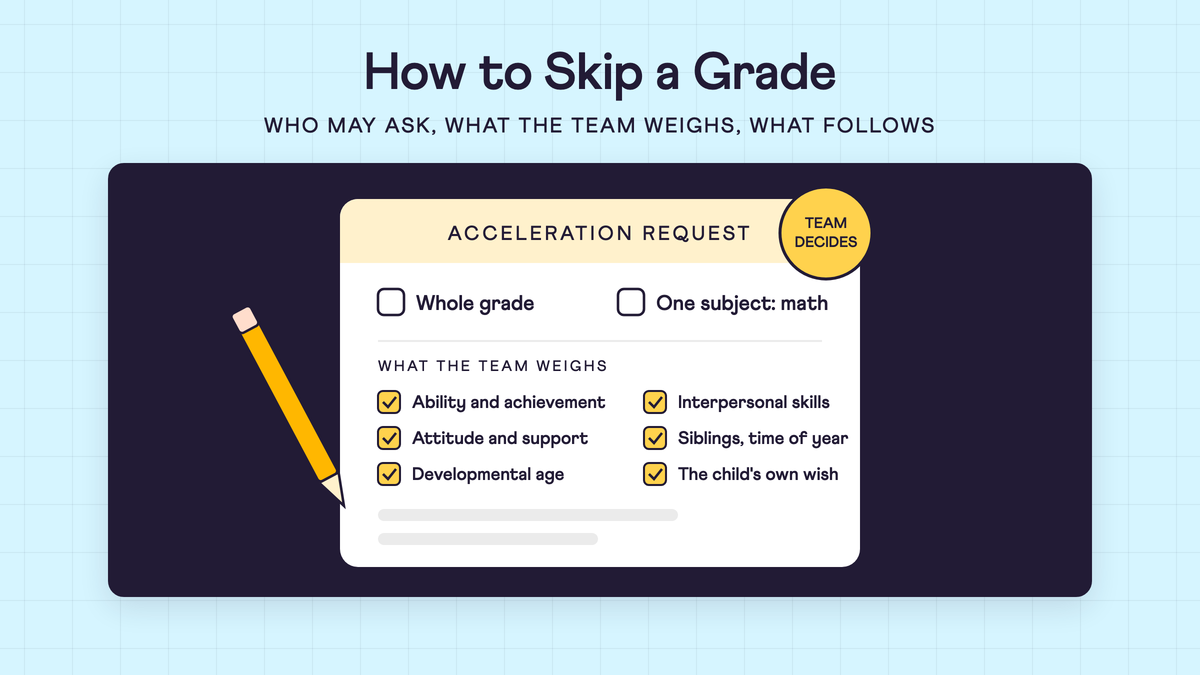
There are two different requests, and a child who is ahead in math only is asking for the first. Subject acceleration moves a child up a grade in one subject, usually math, while the child stays with their class for everything else. A whole-grade skip moves the child up a full grade, and the team weighs the whole child, not the math score. A parent may start either one: the request goes in writing to the principal or the gifted teacher, a team meets and works through a written tool, and the district decides on it. For a whole-grade skip, the tool these districts name is the Iowa Acceleration Scale (IAS), a University of Iowa form that guides a team "through a discussion of the academic and social characteristics of the student."
A yes brings a written plan and a trial period. In Niles, Ohio, a no comes in writing within 45 days, and Niles and Starmont, Iowa, print an appeal route. Every rule here is one US public district's own, and yours is the one that counts: ask the school office for a copy of the district's acceleration policy, which is what Ohio's education department tells its parents to do.
Whole grade, or one subject
Ohio's math example of subject acceleration is "A student completing third, fourth, and fifth grade math in two school years." Worthington Schools, Ohio, gives another: "A 5th grade student attends a 6th grade math class each day". Oak Grove School in Green Oaks, Illinois, files the two as separate requests.
In middle school, a move up the math track runs on the district's placement rule, not a grade skip: Fremont Unified's lane is on our Fremont accelerated math page, the 8th grade seat on our Algebra 1 in 8th grade page, and Cupertino, Sunnyvale and San Jose on our district placement page. The whole-grade skip rules of Cupertino, Evergreen, Plano, Round Rock and Frisco, with their numbers, are on our page on math class being too easy.
How to skip a grade: the request, the meeting, the decision
- Talk to the classroom teacher first. Oak Grove's page says, "Speaking with a child's classroom teachers first before exploring this option is encouraged." Worthington says of a child who says they are bored: "This statement in isolation is not a reason to refer a student for the acceleration process." What carries weight is what your child can do, so bring the work from home and ask whether the school can test above grade level.
- Put the request in writing, and name which request it is. In Pocatello-Chubbuck School District 25, Idaho, a parent, a teacher or an administrator may start a whole-grade request "by submitting a request to the building principal." In Johnston, Iowa, the request goes to the building's gifted (GT) teacher. Timing is each district's own: Oak Grove prefers spring or summer and Pocatello-Chubbuck asks for applications by March 1 for best consideration.
- The data. The school gives the tests; you do not need a score in hand to ask. Pocatello-Chubbuck's curriculum coordinator decides what extra testing is needed (the school psychologist gives the ability test), and a team works through the IAS form. Starmont lists what it may gather: achievement, ability and aptitude results, and interviews with the student, the teacher, the parent and school staff.
- The meeting. The classroom teacher does not carry this alone. Niles City Schools, Ohio, seats the current teacher, "a teacher at the grade level to which the student may be accelerated" and the parent, and its committee must weigh "the student's own thoughts". Pocatello-Chubbuck's team may include the principal, the current teacher, the receiving teacher, the counselor and the gifted facilitator, and it tells the parents its recommendation.
- The decision, and who holds it. The team scores the scale and recommends; the district answers. Johnston: "Final decision for acceleration rests with the school district." In Pocatello-Chubbuck the team recommends based on the IAS total and "final approval is granted/denied by the Elementary or Secondary Director." In Starmont the final authority is the building principal. Niles answers in writing within 45 days of the referral, with instructions for appeal, and accepts a written appeal to the superintendent within 30 days.
What the team weighs beyond the score
Pocatello-Chubbuck says the scale "considers the student's social, emotional, physical, academic, and intellectual development." Ohio approves only the IAS for whole-grade decisions in grades K-8; the other districts here chose it themselves. Johnston's meeting goes over, among other items:
- the reason for the request, siblings in the grade the child would enter, and the time of year;
- ability and achievement scores, and when and where the move happens;
- attendance, motivation and attitude;
- age, physical development, relationships, emotional development and behavior;
- the support of the student, the parent and the school, and preparation for the move.
Pocatello-Chubbuck prints five items, and if any one applies it does not recommend a skip: an ability score under 115 on a test the school psychologist gives, a child who "would be accelerated into the same grade as an older sibling" or "presently has a sibling in the same grade", a child who "indicates s/he does not want to be accelerated", and a skip over "a transition year (5th or 8th grade)" in that district's school layout.
After the decision
Ohio requires a Written Acceleration Plan for every child recommended; it "describes the transition plan and supports", and after the transition period, in Ohio's words, "an acceleration becomes a permanent placement." Starmont's policy, reviewed in 2012, says the plan carries "a timeline for transition" and that all acceleration runs "on a trial basis of four weeks/midterm." Johnston's gifted teachers talk with the parents "six weeks after the acceleration" about the plan. Niles names a staff member to monitor the child and lets a parent withdraw the child in writing during the transition.
Five questions for the first meeting
- Which policy covers this request, and may I have a copy?
- Who sits on the team, and who gives the final answer?
- Which tool and tests will you use, and when will my child take them?
- What will the plan say about the start date, the transition period, and who checks in and when?
- If the answer is no, what is the appeal, and when can we ask again?
Where Cuemath fits
The first thing to know, before the first talk, is whether the work at home really is a grade or two ahead. Cuemath is live, one-on-one online math tutoring for grades K through 12, and its free MathFit Evaluation, a skills-and-gaps check in one live session, shows how far ahead of grade level your child's math is and where the first gap sits, in your child's own work. It does not change the district's policy, the team's tool or the decision.
Know where your child really stands before you ask
A free Cuemath MathFit Evaluation is a live, one-on-one session that shows where your child is solid and where a gap sits, in your child's own work. No credit card, and the report is yours either way.
Book a Free EvaluationFor students in Grades K to 12 worldwide.
FAQs
My child is ahead in math only. Do I ask for a grade skip or for math one grade up?
Math one grade up, which districts call subject acceleration: the child moves ahead in math and stays with their class for the rest. Ohio's example is third, fourth and fifth grade math in two school years; Worthington's is a 5th grader in a 6th grade math class each day. A whole-grade skip is weighed on the whole child, and in middle school a move up the math track runs on the district's placement rule.
How do you skip a grade?
Ask the school in writing. A parent, a teacher or an administrator may refer a child to the principal or the gifted teacher; the school gathers test and classroom data; a team works through a tool such as the Iowa Acceleration Scale; the district gives the answer.
What are the requirements to skip a grade?
Each district sets its own. Pocatello-Chubbuck's bar is at least 46 points on the Iowa Acceleration Scale and an ability score of at least 115; those are that district's numbers, not a national rule. Johnston's meeting over the scale goes through scores, attendance, motivation, age, emotional development, siblings, time of year and the support of the child, the parent and the school.
My child is in 2nd grade with no test scores yet. What will the school use?
Its own tests. In Pocatello-Chubbuck the school psychologist gives the ability test and the curriculum coordinator decides what else is needed; Starmont lists achievement, ability and aptitude results and interviews with the student, the teacher and the parent. You do not need a score in hand to ask.
Can you skip a grade in elementary school?
Yes, where the district has a policy for it, and Ohio requires every public district to have one. Pocatello-Chubbuck lists a skip that lands in "a transition year (5th or 8th grade)" as a reason not to recommend one; other districts print their own limits.
Who decides whether my child skips a grade?
The district, by a team. The team scores the tool and recommends; a director, the principal or the district gives the final answer. The parent sits on the team in Johnston, Niles and Starmont; Pocatello-Chubbuck's team tells the parents its recommendation.
What are the pros and cons of skipping a grade?
Scores on one side; age, emotional development, relationships, attendance, the child's own wish and the support at home and school on the other. Those are the lists the districts print and the team weighs. Oak Grove calls a whole-grade move "a thorough process since it has implications on the remainder of a student's schooling career", and Worthington asks parents to weigh "Your child's ability to be a resilient learner in a class of older peers."
What if the school says no?
Ask for the reason in writing and the appeal route. Niles prints both; Starmont uses its student grievance policy; Johnston says the child "may be re-evaluated at a later date." Johnston also prints the other door: students and parents "may choose to remain at grade level with an enriched curriculum."