PSAT 8/9 Scores: What They Mean and What They Do Not Decide
Whether your 8th grader takes the PSAT 8/9 is the school's call. The score runs 240 to 1440 on the SAT's scale; read the grade benchmark and the percentile. By itself it decides nothing: not National Merit, not college, not placement. Scores usually come 2 to 4 weeks after the test.

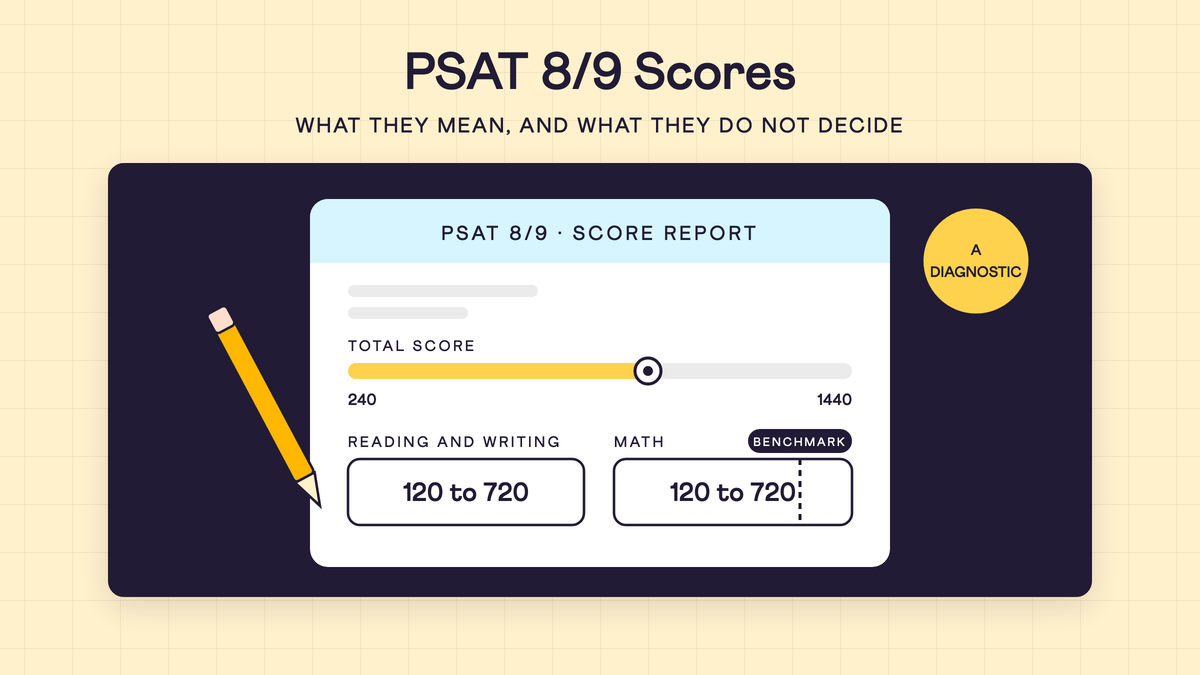
Whether your 8th grader takes the PSAT 8/9 is the school's call: it is an in-school test on a school day, about two and a quarter hours long, and the College Board's line to students is "Ask your principal or counselor which assessments your school offers". It is the first test in the College Board's SAT Suite, built for 8th and 9th graders, scored from 240 to 1440 (each section 120 to 720) on the SAT's own scale. Read two numbers on the report: the grade-level benchmark, the section score that means on track for the grade (8th grade: 390 in Reading and Writing, 430 in Math; 9th grade: 410 and 450), and the percentile, your child's rank among the last three years of same-grade testers. By itself the score decides nothing: it does not enter National Merit, the College Board sends it to schools (and in many cases districts and states), not colleges, and it tells schools not to use the benchmarks to assign tracks. Scores usually come 2 to 4 weeks after the test; the fall 2026 release dates (October 22, November 5 and November 12) have passed.
What the PSAT 8/9 is
One school-day test: 98 questions in 2 hours 14 minutes, Reading and Writing first, then Math, with a calculator allowed on all of Math. Each section has two modules, and the second "will either be more difficult or less difficult" depending on how the first goes. The Math section covers algebra, advanced math, problem-solving and data analysis, and geometry and trigonometry. Later tests on the same scale are the PSAT 10 and the PSAT/NMSQT (10th and 11th graders), then the SAT.
The College Board calls it "a diagnostic test that tells you about your strengths and opportunities for growth" and prints no good or bad score. What a tester gets is the score report and free practice: Tailored Practice built from the result at mypractice.collegeboard.org, plus Khan Academy, Bluebook practice tests and Schoolhouse.world peer tutoring.
What the score means
The report prints the total and the two section scores on the suite's common scale. A child with a Math 500 on the PSAT 8/9 "would be expected to also get a 500 on the SAT" taken that same day, so a 550 on next year's PSAT/NMSQT or PSAT 10 would be 50 points of growth. The SAT's own range is 400 to 1600; the Class of 2026 average is on our page on what a good SAT score is.
The benchmark. Each section has one for each grade, and "Students meeting or exceeding these benchmarks are considered on track to be college ready." The College Board asks families to compare the section scores with it and, where a section is under it, to work with the child's teacher on "classroom work that is focused on areas that need improvement". The full bands are on the College Board's benchmarks page:
| Grade | Section | Not yet approaching | Approaching | Meets or exceeds |
|---|---|---|---|---|
| 8th grade | Reading and Writing | 120 to 360 | 370 to 380 | 390 to 720 |
| 8th grade | Math | 120 to 400 | 410 to 420 | 430 to 720 |
| 9th grade | Reading and Writing | 120 to 380 | 390 to 400 | 410 to 720 |
| 9th grade | Math | 120 to 420 | 430 to 440 | 450 to 720 |
The percentile. The College Board's definition: "if a student's score is in the 70th percentile, 70% of a comparison group achieved scores at or below that student's score." The group is "the past 3 cohorts of students who took the PSAT 8/9 in 8th or 9th grade", worldwide, so it is not a national rank; the online report (age 13 and up) adds a country and a state percentile. A child testing outside those grades gets the nearest grade's rank ("a 7th grader is provided the 8th-grade percentile"); the College Board says the test is designed for 8th or 9th graders, and the pages we read do not say whether a younger child may take it, so ask the school. No public College Board page prints a percentile table or an average score; your child's report shows both. What a percentile is and is not is on our 90th percentile page.
The report also shows a range under each score, because "A student's ability is better represented by score ranges than points." Its Knowledge and Skills bars cover the eight content domains, and each bar shows mastery in that domain, not a score.
What the score does not decide
National Merit. The College Board's page says the PSAT/NMSQT "is the qualifying test for the National Merit" Scholarship Program, and the National Merit Scholarship Corporation's own page says "The PSAT 10 and PSAT 8/9 will not be considered for entry to the National Merit Scholarship Program." Students enter with the PSAT/NMSQT in 11th grade, the third year of high school.
College. The College Board's page on who sees the score lists schools, and in many cases districts and states; colleges are named only for SAT scores a student asks to send. Connections, the opt-in feature in the BigFuture School app that lets a student hear from colleges, is for 9th graders: "Connections is not available to 8th-grade PSAT 8/9 test takers."
Placement. The College Board prints no rule for what a school does with the score and tells schools: "Benchmarks shouldn't be used to assign academic tracks, to discourage students from pursuing college, or to keep students from participating in challenging courses." Another line says teachers "can also accelerate the progress of students who meet or exceed the benchmarks". We found no district page that writes the PSAT 8/9 into a math placement rule, so ask your school what, if anything, it uses the score for.
When PSAT 8/9 scores come out
The College Board's score release page says: "Scores are typically available online 2-4 weeks after the test administration." The day depends on when the school submits its answer sheets, in three fall batches. A school testing under a state program should "check with your state to confirm when scores will be available". A U.S. student age 13 or older who gave a mobile number at testing sees the score in the BigFuture School app, with a text alert sent from 6:00 p.m. ET on the release day; a younger child sees it through the school, which holds a PDF called Your Score Report for every tester.
| Window | Answer sheets submitted | Scores to students | School portal | Educator reports |
|---|---|---|---|---|
| Fall 2026 | By October 9, 2026 | October 22, 2026 | October 20 | October 28 |
| Fall 2026 | By October 23, 2026 | November 5, 2026 | November 3 | November 11 |
| Fall 2026 | By October 30, 2026 | November 12, 2026 | November 10 | November 18 |
| Spring 2027 | By March 12, 2027 | April 1, 2027 | March 30 | April 7 |
| Spring 2027 | By March 26, 2027 | April 15, 2027 | April 13 | April 21 |
| Spring 2027 | By April 9, 2027 | April 29, 2027 | April 27 | May 5 |
| Spring 2027 | By April 30, 2027 | May 13, 2027 | May 11 | May 19 |
The fall in-school window was October 1 to 30, 2026; the spring window is March 1 to April 30, 2027. If your child's score has not appeared by the last fall date, the causes the College Board names are these: the school tested under a state program with its own dates, or your child is under 13 or gave no mobile number at testing, so the score comes through the school rather than the app. Either way the school has the PDF report; a student under 13 "can talk to her school counselor to see her full score report", in the College Board's example, and so can you.
Where Cuemath fits
Cuemath is live, one-on-one online math tutoring for grades K through 12. Its free MathFit Evaluation is a skills-and-gaps check in one live session, in your child's own work. The PSAT 8/9 Math section covers four domains, algebra, advanced math, problem-solving and data analysis, and geometry and trigonometry, and the evaluation reads math one skill at a time. It does not change the College Board's scale or benchmark, or what your school does with the score; it is not PSAT prep, it does not predict a PSAT score, and it says nothing about the Reading and Writing section.
See what sits behind the Math score
A free Cuemath MathFit Evaluation is a live, one-on-one session that shows where your child is solid and where a gap sits, in your child's own work. No credit card. You keep the report.
Book a Free EvaluationFor students in Grades K to 12 worldwide.
FAQs
What is a good PSAT 8/9 score for an 8th grader?
There is no good-score line: the College Board calls the PSAT 8/9 a diagnostic test and says the score is "just information that you, your family, and your teachers can use to help plan your high school journey". The two printed markers are the 8th grade benchmarks, 390 in Reading and Writing and 430 in Math, and the percentile, which ranks your child among the last three years of 8th grade testers. A child at or above both benchmarks is on track for college readiness, in the College Board's words.
What is a good PSAT 8/9 score for a freshman (9th grader)?
The College Board prints no good or bad score for 9th graders either. Its markers are the 9th grade benchmarks, 410 in Reading and Writing and 450 in Math, and the percentile, which compares the score with 9th graders who took the PSAT 8/9 in the last three years, not with 8th graders.
What is the PSAT 8/9 score range, and what is it out of?
The PSAT 8/9 total runs from 240 to 1440, so the maximum score is 1440 and the lowest possible total is 240, not zero. Each of the two sections runs from 120 to 720. The PSAT 10 and PSAT/NMSQT run 320 to 1520 and the SAT 400 to 1600; the College Board says the ranges "reflect grade-level appropriateness within the common score scale".
What is the difference between the PSAT 8/9 and the PSAT 10?
Grade and range. The PSAT 8/9 is for 8th and 9th graders; the PSAT 10 "is typically taken by students in grades 10 and 11", scores 320 to 1520, and has higher benchmarks (10th grade: 430 in Reading and Writing, 480 in Math). Only the PSAT/NMSQT enters National Merit.
Does the PSAT 8/9 count for National Merit?
No. The College Board says the PSAT/NMSQT is the qualifying test for the National Merit Scholarship Program, and the National Merit Scholarship Corporation's page says the PSAT 10 and PSAT 8/9 "will not be considered for entry". The corporation also says students on the usual four-year path "must take the PSAT/NMSQT in their third year (grade 11, junior year)". The 8/9 report carries no Selection Index.
Does the PSAT 8/9 convert to an SAT score?
No conversion is needed. The suite uses one scale, and the College Board says a student with a Math 500 on the PSAT 8/9 "would be expected to also get a 500 on the SAT, PSAT/NMSQT, or PSAT 10 if they had taken any of those tests on that same day". Only the ranges differ by test: 240 to 1440 for the PSAT 8/9, 400 to 1600 for the SAT.
How long is the PSAT 8/9, and how many questions are on it?
The PSAT 8/9 runs 2 hours 14 minutes and has 98 questions: 54 Reading and Writing questions in 64 minutes and 44 Math questions in 70 minutes, each section in two timed modules. Each Math module is 35 minutes, about 1 minute 35 seconds a question, and a calculator is allowed throughout the Math section.
When do PSAT 8/9 scores come out, and do results take two weeks?
Scores usually arrive 2 to 4 weeks after the test, by the College Board's line, and the fall 2026 student dates were October 22, November 5 and November 12, set by when the school submitted the answer sheets; all three have passed. Two weeks is the short end, not a promise, and a state testing program may run on its own dates. If the score has not appeared, ask the school: it holds the PDF score report for every tester.