What Does 90th Percentile Mean for Math Placement?
Your child's math report says 90th percentile. Your child scored higher than about 90 of every 100 students in the test maker's national sample.

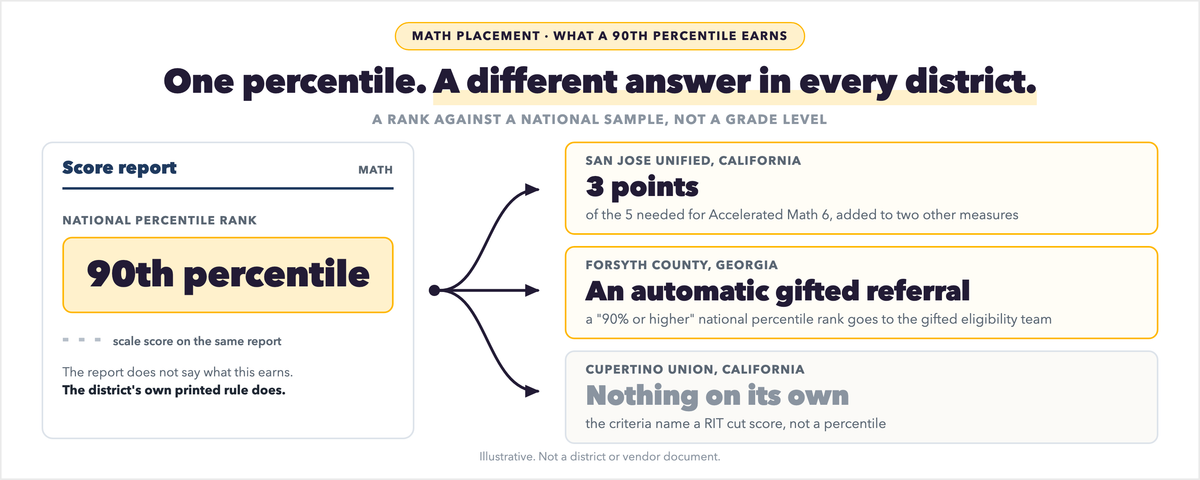
Your child's math report says 90th percentile. Your child scored higher than about 90 of every 100 students in the test maker's national sample. Those students are in the same grade and took the test at the same time of year. That sample is national, not your state and not your school. It is a rank, not a placement and not proof that your child is above grade level. What it gets your child depends on which district reads it. Open your district's math placement page and search for the word "percentile." If there is no such page, or no percentile on it, email the school. Ask the teacher or counselor which measures decide the placement, and by what date. In San Jose Unified it is worth 3 points out of the 5 a child needs for Accelerated Math 6. In Forsyth County Schools, in Georgia, it triggers an automatic gifted referral. In Cupertino Union it does nothing on its own.
What a percentile is, and what it is not
A percentile is a rank against a group of other students. Both diagnostic makers say so in their own words. Curriculum Associates, which makes i-Ready, reports its norms as percentile ranks that compare a student's score with nationally representative samples of students in the same grade taking the test at the same time of year. NWEA, which makes MAP Growth, builds its norms from anonymous data on more than 13 million US students. Knowing the top, middle, and bottom scores of that group is what lets a teacher see where your child sits.
Two details on the report decide what the rank means. The first is the norm group, the maker's reference sample: same grade, same season. A fall percentile compares your child with other fall test takers in that grade, so a fall 90th and a spring 90th are two different comparisons. The second is the norm year, the year the maker built that sample. NWEA's current norms are its 2025 set, drawn from 116 million scores of 13.8 million students between fall 2022 and spring 2024. NWEA refreshes its norms every few years. Curriculum Associates built new post-pandemic norms from more than 5 million students. It tells districts plainly that new norms can change which students clear a percentile rule for coursework. A child's score can stay the same while the percentile moves, because the group behind it moved.
So a percentile is not a percent correct, and it is not a fixed mark on a ruler. It is your child's position in a line of other children, on a given test, in a given season, under a given year's norms.
Why above grade level is a different reading
"Above grade level" answers a different question: not where does my child rank, but what does my child know. Curriculum Associates draws the line itself. A criterion-referenced score compares a student with a fixed bar, a predetermined standard, not with other children. A norm-referenced score ranks a student against other students. A percentile is the second kind.
i-Ready's placement level is the first kind. It is the label printed on the i-Ready report. The publisher builds those labels from ranges of the scale score, i-Ready's own score number on one scale that runs from kindergarten through grade 12. It sets a range for each grade, with more than 100 teachers involved in the work, and reads your child's score against those ranges. The report's five-level view runs from Mid or Above Grade Level down to Three or More Grade Levels Below, and the bands hold from fall through spring. The report shows the placement two ways: an absolute placement, the grade level the work matches, and a relative placement, how far that sits from your child's own grade.
A MAP report leads with the RIT score, the percentile, and a growth reading. A RIT is the score number MAP Growth prints, on a scale NWEA built to measure what students know regardless of grade level. Fairfax County tells families to look at all three together. NWEA answers the grade-level question itself in its family guide to MAP Growth: can MAP Growth tell you whether your child is working at grade level? "Yes, but please note that MAP Growth scores are just one data point that teachers use to determine how a student is performing." So "above grade level" on a MAP result is a judgment someone makes from the numbers. On an i-Ready report it is a printed placement level.
A 90th percentile says your child outscored most same-grade peers this season. A placement of Mid or Above Grade Level says the score cleared a fixed bar for the grade, and says nothing about how many other children cleared it too.
What districts do with the same number
A district runs the number through its own printed rule, and the rules differ more than most parents expect.
| District | Test it names | What a 90th percentile does |
|---|---|---|
| San Jose Unified (California) | i-Ready Diagnostic, grade 5 spring | Earns 3 points. The 80th earns 2 and the 70th earns 1. Points are added to a CAASPP score, California's state test, and the winter progress report. 5 or more points place the child in Accelerated Math 6. A child with exactly 4 is offered a challenge assessment, a second test for a child who falls just short |
| Forsyth County Schools (Georgia) | i-Ready Diagnostic, grades K to 8 | A "90% or higher national percentile rank" triggers an automatic referral to the Gifted Eligibility Team for gifted testing. An "85 - 89% national percentile rank" may be referred through each school's "equitable process," the school's own process for borderline scores |
| Plano ISD (Texas) | MAP math, compared with district and national percentiles, plus CogAT, the Cognitive Abilities Test | Feeds the district's own identification for Math Rocks, Plano's program for mathematically gifted students in grades 4 to 8. There is no application, and the Math Rocks page prints no percentile cut |
| Sunnyvale School District (California) | NWEA benchmark, the district's name for the MAP tests it gives | Math 6/7 is the district's own name for a course covering all of Math 6 and half of Math 7. A 90th sits above the 45th to 55th percentile band the district's FAQ page calls near the recommendation threshold for it. A 90th also sits below the 95th percentile, the FAQ's guide to who typically has the foundation to attempt the optional placement assessment. That assessment is open to any student |
| Cupertino Union (California) | NWEA MAP, read as a RIT score | Nothing on its own. The criteria name a RIT of 235 or higher for Math 7+, the district's own name for a 7th grade course that includes 8th grade standards. For Algebra 1 in 7th grade they name a RIT of 250 or higher. Each sits next to a readiness test, a semester grade, and teacher verification |
Read the San Jose row as arithmetic. A 90th percentile is worth 3 of the 5 points a child needs, so a 90th percentile alone does not place anyone. A child one point short is offered a challenge assessment. And the review is calculation-only. The district's document says administrators do not modify the criteria. A parent who believes the points were added wrong may ask the principal for a review. The list of what is not considered includes private or independent assessments from outside the district. San Jose also changed the test under the rule for 2026-2027: the measure that used to be the NWEA score is now the i-Ready Diagnostic, on the same 90th, 80th, and 70th bands.
Forsyth's rule is the opposite shape. The percentile is the trigger, and the trigger is automatic: a "90% or higher national percentile rank" in reading or math sends the child to the next Gifted Eligibility Team meeting. One caution: as of September 30, 2026, the district's advanced academics page still labels those criteria for the 2025-2026 school year while posting 2026-2027 testing windows, so ask the school which year's rule applies.
Reading the number on your child's report
- Find the norm year and the season on the report. An i-Ready percentile is a same-grade, same-season rank; a MAP percentile comes from NWEA's 2025 norms. Compare a percentile only with another percentile from the same test, season, and norm year.
- Find the placement phrase, if the report has one. On i-Ready, read the absolute and relative placements together. On MAP, read the RIT and the growth line, and the MAP page explains both.
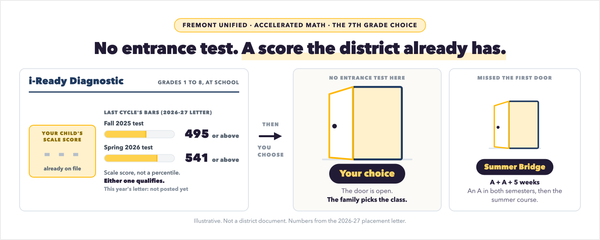
- Open your district's math placement page and search it for the word "percentile." If the word is there, the page will say what the percentile earns: points, a referral, a recommendation, or a seat. If it is not there, the district reads something else, often the score itself. Cupertino Union does that with the RIT, and Fremont Unified, another California district, reads the i-Ready scale score itself. The i-Ready vs MAP page covers both scores.
- If the rule uses points, do the sum yourself with every measure on the table, not the diagnostic alone. Placement windows close on a date the district prints: San Jose Unified's criteria read a spring test, and Cupertino Union posts a spring test window of March 9 to 20. Ask the school for your district's date in the same email. The district comparison page shows three of these rules worked through.
Where Cuemath fits
We do not run either test, and we cannot change a district's rule. What a percentile leaves out is which specific skills sit behind the rank, and a free Cuemath MathFit evaluation is a live, one-on-one reading of exactly that.
A rank tells you where your child stands in line. See the skills behind it.
A free Cuemath MathFit evaluation is a live, one-on-one session that shows where your child is solid and where a gap sits, whichever percentile the report shows.
Book a Free EvaluationFor students in Grades K to 12 worldwide.
FAQs
What does 90th percentile mean on a math test?
Your child scored higher than about 90 of every 100 students in the test maker's national sample, students in the same grade, tested at the same time of year. It is a rank against that group, under the norms the maker is using this year. It is not a percent of questions answered correctly, and it does not name a grade level.
Is the 90th percentile above grade level?
Not by itself. A percentile ranks your child against other students. "Above grade level" is a criterion reading. On an i-Ready report it comes from fixed scale score ranges the publisher set for each grade. The report's five-level view runs from Mid or Above Grade Level to Three or More Grade Levels Below. A child can hold a high percentile and a placement of Early On Grade Level in the same report, because the two answer different questions.
Why did my child's percentile change when the score barely moved?
Because the group behind the percentile changed. NWEA replaced its norms in 2025, and it refreshes them every few years. Curriculum Associates built new post-pandemic norms and says they can change which students clear a percentile rule. A fall and a spring percentile also compare your child with different groups. The score is your child's result; the percentile is that result placed in a line.
What percentile do you need for accelerated math?
There is no national answer, because each district writes its own rule. In Sunnyvale the 95th percentile is guidance on who might attempt an optional placement assessment that any student can take. In Cupertino Union no percentile appears in the criteria; the district reads a RIT score of 235 or higher for Math 7+. Search your district's placement page for the word "percentile."
Does a 90th percentile on i-Ready mean the same as a 90th percentile on MAP?
No. Each maker ranks your child against its own national sample, built in its own year, and neither publishes a table that converts one score into the other.
Can a private test's percentile be used for placement?
In San Jose Unified, no. The district's criteria document lists private or independent assessments from outside the district among the things it does not consider. Its review process only checks the arithmetic of the points. Other districts write their own lists, so check the placement page before paying for an outside test.
Is a high percentile the same as a gifted referral?
Only where the district says so. Plano ISD compares MAP math results with district and national percentiles alongside CogAT scores to identify students for Math Rocks, with no application. Many districts run gifted identification on a separate test with its own percentile, which the gifted testing by district page covers.