Where Does Your Child Stand When the School Posts No Class Rank?
Many US schools post no class rank and set their own honor roll cutoff. Here are the five signals a school does give, and the two to ask for first.

The report card shows A's and B's. The school posts no class rank. A parent new to US schools can read this as "the school gives no information." The school does give five signals.
Three are test results measured against a measure set outside the school. They are the national percentile on the district's diagnostic test, the level on the state test, and the College Board's PSAT (Preliminary SAT) and AP (Advanced Placement) scores. One is a decision the school has already made: the math course your child is placed in. The fifth is set by each school: the honor roll cutoff and class rank. The cutoff can move from year to year.
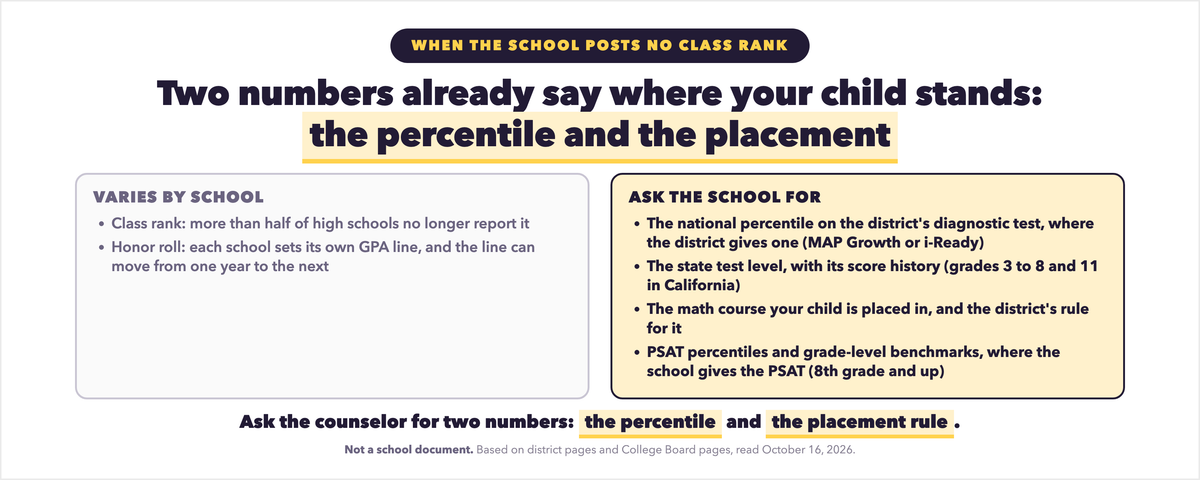
The first step is two questions for the counselor or the classroom teacher. What is my child's national percentile on the district's diagnostic test? What rule places students in next year's math course? Those two answer your question: the percentile ranks your child against children nationwide, and the placement is the school's own reading of your child. The other three each answer a narrower question.
- The percentile on the district's diagnostic test (kindergarten through 12th grade)
- The level on the state test (3rd through 8th grade and 11th)
- The course your child is placed in (middle and high school)
- The College Board tests (8th grade and up)
- Honor roll and class rank (set by each school)
- The five signals, side by side
- What to ask the counselor
- Where Cuemath fits
- FAQs
The percentile on the district's diagnostic test (kindergarten through 12th grade)
Many districts give a computer-adaptive math test during the year: the test adjusts the difficulty of the next question to the child's answers. Two common ones are MAP Growth (MAP stands for Measures of Academic Progress), from NWEA, and i-Ready, from Curriculum Associates. Each report carries a score and a national percentile. The percentile is the comparison that honor roll and class rank lists never give you: your child against students in the same grade who took the test in the same term, across the country. NWEA's current norms (the national comparison group) come from 13.8 million students. Curriculum Associates also compares each child with a national sample of students in the same grade, tested at the same time of year.
Ask for the percentile, not only the score. Some districts print what they treat as strong in their rules. San Jose Unified gives placement points from the 70th percentile up on its diagnostic and the most points at the 90th, and Forsyth County Schools in Georgia, under its criteria for the 2025-2026 school year, refers a child at the 90th national percentile or higher on i-Ready, in reading or math, for gifted testing. The i-Ready report adds a placement level, from Mid or Above Grade Level down to Three or More Grade Levels Below, which measures the child against the grade's standard rather than against other children. How districts use these numbers is on our diagnostic scores page and our percentile page.
The level on the state test (3rd through 8th grade and 11th)
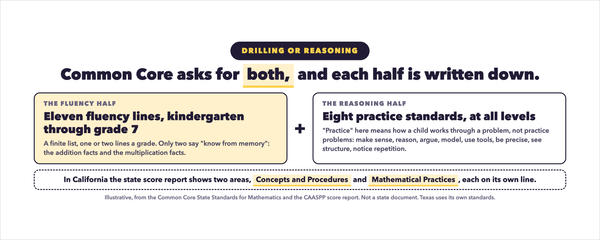
In California the state math test is the CAASPP, the California Assessment of Student Performance and Progress, given in grades 3 through 8 and 11. The report gives one of four levels (Advanced, Proficient, Developing, or Minimal), plus a score history across grades. The level measures your child against the grade's standard, not against other children, and the report warns that the standard rises each year, so holding a level may take a higher score. The state's sample report also prints the school average and the state average beside your child's score.
Evergreen School District in San Jose places a child in its accelerated math pathway automatically when three things are true. The child exceeds the 5th- and 6th-grade standards on the CAASPP, passes a 6th-grade placement exam, and keeps satisfactory grades. What other districts do with the score is on our CAASPP score page.
The course your child is placed in (middle and high school)
This is the ranking the school has already made, and it is on your child's schedule. In middle school, it is the math course. San Jose Unified's 8th graders take Math 8, Algebra 1, or Geometry. By default, each child moves to the course that follows last year's, and a published point system (points added up across several measures, with a total that places the child) decides who moves ahead faster. In high school it is the course level, such as regular, college-preparatory, honors, or AP.
A letter grade means little without its course. Many districts publish the rule that places a child in next year's math course. Our placement rules page shows how to find yours and read it.
The College Board tests (8th grade and up)
The PSAT 8/9, PSAT 10, and PSAT/NMSQT (the Preliminary SAT/National Merit Scholarship Qualifying Test) each report a Math section score, a Reading and Writing section score, a percentile against students who took the same test, and a grade-level benchmark. The math benchmarks are 430 in 8th grade, 450 in 9th, 480 in 10th, 510 in 11th, and 530 on the SAT. A score at or above the benchmark is on track for college and career readiness by the College Board's measure. The College Board adds that benchmarks are not for assigning tracks or keeping students out of harder courses. AP exams, taken at the end of an AP course, are scored 1 to 5; many colleges grant credit or placement for a 3 or above, each by its own rule. If your child does the AP Calculus homework but goes blank on its tests, our AP Calc exam page has the exam's format and one home check.
Honor roll and class rank (set by each school)
Honor roll is a list of students whose GPA (grade point average) clears a cutoff the school sets, and the cutoff can move. One Fremont middle school set its Honor Roll Award at a 3.85 to 4.0 GPA for the 2023-2024 school year. For 2025-2026, the same award was set at 3.0 to 4.0. Honor roll says your child cleared that school's cutoff for that grading period, not how far above it your child is.
Class rank is the number many parents from outside the US expect, and often the one that is missing. Citing a report from NACAC (the National Association for College Admission Counseling), the College Board says more than half of all high schools no longer report student rankings. Most public high schools still rank, and some let the student choose whether to report the rank to colleges.
The five signals, side by side
| Signal | Grades | Compares your child with | Where you find it |
|---|---|---|---|
| Diagnostic test percentile (MAP Growth, i-Ready) | K through 12 | Same grade, same term, nationwide | The family report; ask the teacher for the percentile |
| State test level (CAASPP in California) | 3 through 8 and 11 | The grade's standard; score history across grades; school and state averages | The Student Score Report, through the district |
| Course placement | Middle and high school | The district's published rule | The schedule; the district's placement page |
| PSAT and AP scores | PSAT: grades 8 through 11; AP: high school | Students who took the same test; grade-level benchmarks | The College Board score report |
| Honor roll and class rank | Set by the school | The school's own cutoff; classmates, if the school ranks | The school handbook or awards page; the counselor |
What to ask the counselor
What is my child's national percentile on the district's diagnostic test, and from which term? What rule decides next year's math course, and where is it published? Does the school compute a class rank, and does it tell families? What is the honor roll cutoff this year?
Where Cuemath fits
These numbers say where your child stands. They say less about which skills sit behind the number.
See what sits behind the percentile
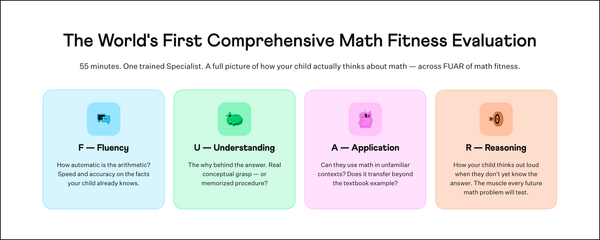
A free Cuemath MathFit evaluation, our skills-and-gaps check, is a live, one-on-one session that shows where your child is solid and where a gap sits, in your child's own words and work. No credit card, and the report is yours either way.
Book a Free EvaluationFor students in Grades K to 12 worldwide.
FAQs
What is honor roll?
A list of students whose GPA clears a cutoff the school sets for that grading period. Look for the cutoff in the student handbook or on the school's awards page; it can change from year to year. Ask the school for its cutoff, and ask which grading periods count.
Do high schools still rank students?
Many do, and many no longer report it. Ask the counselor two separate questions: does the school compute a rank, and does it report that rank?
What is a good PSAT score for an 8th grader or a sophomore (10th grader)?
A good score is one at or above the grade-level benchmark printed on the report. The math benchmark is 430 in 8th grade, 450 in 9th, 480 in 10th, and 510 in 11th; the Reading and Writing benchmark is 390, 410, 430, and 460 for the same grades. A section score at or above the benchmark is on track for college and career readiness by the College Board's measure. The report also gives a percentile against students who took the same test, which is the comparison with other children.
What does a percentile mean on a MAP or i-Ready report?
The share of students in the same grade, tested in the same term across the country, who scored at or below your child. A 72nd percentile means about 72 of every 100 such students scored at or below your child. The percentile can change when the test maker updates its norms, so compare percentiles only when both come from the same set of norms (the national comparison group).
Does the state test compare my child with other children?
Not through the level. The level measures how well your child's work meets the grade's standard. The 2025-26 sample report also prints the school average and the state average beside your child's score; that is a rough comparison, not a percentile. The state releases the report through the district's parent or student portal; ask the school how it reaches you.
Is an A in a regular class the same as an A in an honors class?
Often not. The College Board describes class rank as usually weighing both the difficulty of the courses taken (AP, honors, college-preparatory, or regular) and the grade earned. Many districts place students in math courses by published rules, so the course your child is in already tells you where they stand. Read the grade with the course level next to it.