AP Calc Exam Format: Why a Child Who Gets It in Class Still Goes Blank
Your child follows AP (Advanced Placement) Calculus in class and finishes the homework. Then the test comes back with blank spaces.

Your child follows AP (Advanced Placement) Calculus in class and finishes the homework. Then the test comes back with blank spaces. Before you call it nerves, run one check this week. Open the College Board's past free-response questions on AP Central, the College Board's site for teachers, where the past questions live. Pick one question from a recent year. Take it from the no-calculator part (Section II, Part B), and from a unit the class has already finished. Print it, set a timer for 15 minutes, and put the textbook away. Your child works it with no notes and no help.
The result sorts two different problems. If the work stops at the first line, the method is not yet your child's own; the homework was carrying it. Run the check twice, on two days, before you decide. If the work keeps going and the timer ends first, the clock is the problem. Both can be fixed, but not with the same fix.
Fifteen minutes is the exam's own pace: Section II, Part B gives four questions in 60 minutes.
What the exam is, in the College Board's words
The AP Calculus AB exam is a hybrid digital exam, part on screen in Bluebook, the College Board's testing app, and part on paper. It runs 3 hours 10 minutes. The format is the same for AB and BC; BC covers more content. In the College Board's words, AB equals "a first-semester college calculus course," and BC equals "a first-semester college calculus course and the subsequent single-variable calculus course." The format below is the one the College Board updated for the May 2027 exams; the course content has not changed.
| Section and part | Questions | Time | Calculator | Share of score |
|---|---|---|---|---|
| Section I: multiple choice (total) | 42 | 1 hour 40 minutes | Parts A and B below | 50% |
| Section I, Part A | 29 | 62 minutes | Not permitted | 35% |
| Section I, Part B | 13 | 38 minutes | Graphing calculator required for some questions | 15% |
| Section II: free response (total) | 6 | 1 hour 30 minutes | Parts A and B below | 50% |
| Section II, Part A | 2 | 30 minutes | Graphing calculator required | 16.7% |
| Section II, Part B | 4 | 60 minutes | Not permitted | 33.3% |
The 2027 AB and BC exams are on Monday, May 10, 2027. Scores come on a scale of 1 to 5.
At least two free-response questions put the mathematics in a real-world context. The AB-or-BC choice and the full 2027 schedule each have their own page.
Why the homework and the test are not the same thing
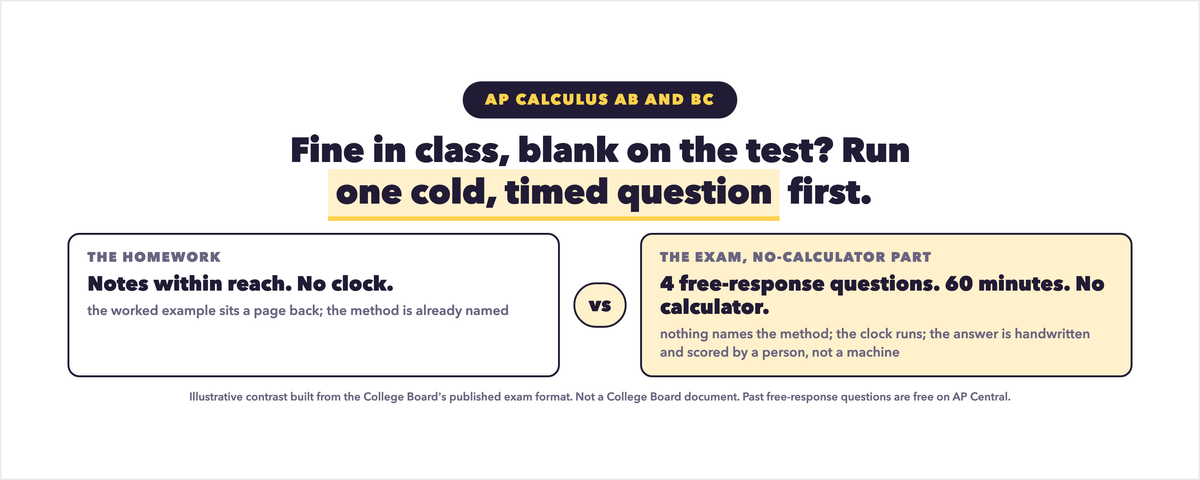
A homework set names the method. The worked example sits a page earlier, the book is open, and there is no clock. The exam does none of that. A question may arrive as a table of values or a sentence about a water tank, with no hint of which unit it comes from. Sixty of the 90 free-response minutes run with no calculator.
Your child handwrites the answer, and a person reads it, so the reasoning on the page counts, not only the final number. A child who can run a procedure once it is named can still stall when the question does not name it. That is a gap in the understanding the exam tests, and the homework does not show it.
The free practice that matches the exam
Four things on the College Board's own sites match the exam's shape.
- Past free-response questions. AP Central says it posts the three most recent years of released materials. On the day this page was written, the AP Calculus AB page listed 2026, 2025, 2024, and 2023. Every year has its scoring guideline, the point-by-point answer key the College Board publishes.
- Test previews in Bluebook. Download the Bluebook app and log in with your child's College Board account to see the digital multiple-choice format.
- The sample free-response booklet. It shows how the handwritten answers are laid out on the hybrid exam.
- AP Classroom. AP Classroom is the class site a student joins through the teacher's class section. Depending on the course, it may hold class assignments and practice that get students used to the Bluebook app.
The College Board's course page lays out the AB course in eight units, which is one possible order, and lists the share of the exam each unit carries. A teacher may organize the content differently, so match the past questions to what the class has covered.
Three checks before you call it nerves
1. Score the cold question. When the 15 minutes end, read the scoring guideline together. Three outcomes are possible: the work never started, the work started and went wrong, or the work was right but time ran out. You do not need to know calculus for this. The scoring guideline lists the points, and you only count which of your child's lines earned one.
2. Sort the last class test's misses. Take the returned test and put every lost point in one of three piles: a concept your child cannot explain, a known method that failed on an unfamiliar setup, or arithmetic and notation slips under time pressure. The biggest pile points at the problem. The College Board's skill list for the course includes justifying reasoning and using correct notation, so the third pile is not a small one.
3. Teach one idea back. Pick one unit the class has finished and have your child explain its main idea aloud, without notes, to someone who does not know calculus. Where the explanation stops is the place to look first. A shy child explains badly even when the mathematics holds, so judge the steps, not the delivery.
These checks find gaps in the mathematics, not test anxiety.
What to do with each result
If the work keeps going and the timer ends first, the problem is pace. The method is there, and it needs to run inside the time. Repeat the cold, timed question with a new past question each time, so your child never practices on an answer they remember. Add the College Board's test previews in Bluebook, which show the digital part of the exam in its own format.
If the work stops at the first line, the problem is the content. More timed practice will not help, because there is no method yet to speed up. Go back to that unit; the College Board's course page names the eight units. Have your child teach that unit's idea back without notes. Then take the sorted pile of missed questions to the teacher, so the teacher sees which kind of point is being lost.
The home check cannot recreate the exam room. If the cold question runs clean at home and the blank still happens in the room, read the signs on our math anxiety page and tell the teacher what you saw.
Where Cuemath fits
Cuemath is live, one-on-one online math tutoring for grades K to 12. An evaluation can spend 55 minutes on your child's own work and show where the gap is, if there is one.
Find where the work stops
A free Cuemath MathFit evaluation, our skills-and-gaps check, is a live, one-on-one session that shows where your child is solid and where a gap sits, in your child's own work. No credit card, and the report is yours either way.
Book a Free EvaluationFor students in Grades K to 12 worldwide.
FAQs
How long is the AP Calc exam?
The exam runs 3 hours 10 minutes for both AB and BC: 1 hour 40 minutes of multiple choice and 1 hour 30 minutes of free response. In 2027 both exams are given on Monday, May 10, 2027, in Session 1, which the College Board says is "typically the morning." Schools in the lower 48 states, Hawaii, and Washington, D.C., start AP exams at 8 a.m. and 12 p.m. local time. The school's AP coordinator tells students when and where to report.
What if it is nerves after all?
The home check cannot show that. What it can show is whether the mathematics holds when nobody helps. The signs of math anxiety are on our math anxiety page. Tell the teacher what you saw at home.
Which calculator is allowed?
A graphing calculator is allowed, and only in the calculator parts: Part B of the multiple choice and Part A of the free response. Desmos, the on-screen calculator built into Bluebook, is available only in those parts, and the web or app version used in class is not allowed on exam day. Your child may also bring up to two approved handheld calculators; the Texas Instruments TI-84 Plus and TI-84 Plus CE are on the approved list. The adult running the exam room checks every calculator before the exam, and students cannot share calculators.
Is the exam on paper or on a computer?
Both. The multiple-choice questions and the free-response prompts are in the Bluebook app, and your child handwrites the free-response answers in paper booklets. Your child must remember their College Board account login on exam day, because a password saved on the device does not work.
Who scores the free-response answers?
College professors and experienced AP teachers score them, at the June scoring session the College Board calls the AP Reading, held in the first two weeks of the month. The multiple-choice section is scored by computer. The College Board combines the two section scores into one total and converts it to the 1-to-5 scale, so that "a 3 this year reflects the same level of achievement as a 3 last year." The arithmetic behind the total is on our scoring page.
What do we do with each result?
If time ran out with the work still going, practice pace: a new past question each time, under the timer, plus the Bluebook test previews. If the work stopped at the first line, go back to that unit, have your child teach it back, and take the sorted misses to the teacher. Either way, open the College Board's sample free-response booklet before exam day; it shows the answer booklet's layout, so the paper part feels familiar.
Did the AP Calc exam change for 2027?
Yes. The College Board updated the number of multiple-choice questions and the timing of the AB and BC exams, effective from the May 2027 exams, and says the course content has not changed. The numbers on this page follow the updated format. A practice set printed before the change may show a different question count and time.
What AP score counts as passing?
Many U.S. colleges give credit or placement for a 3 or higher. The scale is 1 to 5, and "many U.S. colleges grant credit and/or advanced placement" for scores of 3 and above; each college makes its own decision. What a 3 is worth is the job of our page on a 3, and a child who wants another attempt can read our retake page.