What Comes After Beast Academy, Kumon, or Singapore Math?
Where each program actually ends, what its maker says comes next, and the one check that tells you where your child stands at that point.

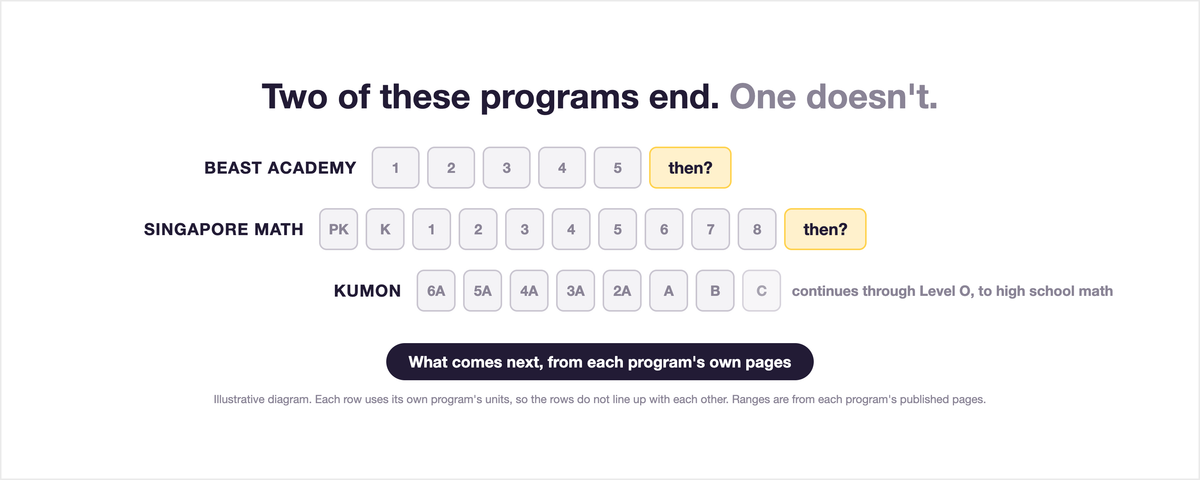
Each of these programs answers the "what next" question on its own pages, and the answers are more specific than most parents expect. Beast Academy ends at Level 5, and its maker, Art of Problem Solving, names the exact next course: Prealgebra. Singapore Math's publisher stops at Grade 8 and says students move on to Geometry and Algebra 2. Kumon never ends at a grade at all - its worksheets run to high school math, so "after Kumon" is a decision you make, not a grade the program runs out of.
After Beast Academy: the maker names the next course
Beast Academy is Art of Problem Solving's elementary program: a full math curriculum for ages 6 to 13, in five levels of four units each (1A through 5D). Progression inside it is mechanical. In the company's words: "Once a student completes unit D of a level, they are ready to move on to unit A of the next level."
Level 5 is the last one, and AoPS keeps a page in its school handbook titled "After Beast Academy." Under its "What Comes Next?" heading, it answers directly: "A student who has completed the Beast Academy series through Level 5D has the mathematical background necessary for Math 6: Prealgebra (Part 1)." That course runs in two tracks, Honors and Scholars. A family that wants to stay in the AoPS chain does not have to leave it to find the next course.
One thing the level names hide: Beast Academy prints age ranges, not grades. Level 5 is listed for ages 10 to 13, a three-year spread. Two children can both finish Beast Academy and stand in very different places against their school's math.
After Singapore Math: Grade 8, then Geometry and Algebra 2
"Singapore Math" here means the books from Singapore Math Inc., whose two core programs are Dimensions Math (PreK through Grade 8) and Primary Mathematics. Its own FAQ asks, "What math do kids transition to in high school after doing Singapore math through Grade 8?" and answers: "Singapore math programs do not continue beyond Grade 8. Students may move onto Geometry and Algebra 2. We don't have specific recommendations for programs beyond Grade 8."
Geometry and Algebra 2, not Algebra 1, because the publisher states that Dimensions Math 7 and 8 together already "provide a comprehensive Pre-Algebra and Algebra 1 sequence with additional Geometry topics." A child who genuinely finishes Grade 8 of this series has covered Algebra 1 ground.
The mid-series moves are published too: after finishing any Grade 5 program, start Dimensions Math 6; after a solid Grade 6, start Dimensions Math 7.
After Kumon: there is no final grade, so the question changes
Kumon has no final grade. The math program runs 20 worksheet levels, 6A through O, plus four electives, from counting up to high school material. Its printed goal is "to enable learners to master high school level mathematics through self-learning," and enrollment runs from age three through high school.
So families do not finish Kumon the way a child finishes Beast Academy Level 5 or Dimensions Math 8. They decide it has done its job.
Translating a Kumon level into a school-grade position needs a measure from outside the program, because Kumon's site publishes no level-to-grade table. Placement is ability-based by design: a child studies "regardless of age or school grade," and the starting level "is often lower than the level of material they are studying at school." What the Common Core asks a child to do fluently at each grade, and the eight practices it asks for beside them, are on our page on drilling or reasoning.
The full map: thirteen programs
The same two questions - where does it end, and what does its maker say next - have printed answers across the market. Five programs end before high school:
| Program | Printed range | Where it ends | What its maker says comes next |
|---|---|---|---|
| Beast Academy | Ages 6-13, Levels 1-5 | Level 5D | AoPS Math 6: Prealgebra (Part 1), Honors or Scholars track |
| Singapore Math (Dimensions Math) | PreK through Grade 8 | Dimensions Math 8 | Geometry and Algebra 2; no specific program named |
| Synthesis Tutor | Ages 5-11 | The standard K-5 curriculum (its page says it "goes much further") | Nothing named |
| Beestar Math | Grades 1-8 | Grade 8, with Algebra I add-ons | Its separate high school site: SAT and ACT preparation for grades 9-12 |
| ALOHA Mind Math | Ages 3-12 | Mind Math Senior, ages 7-12 | Nothing named |
The other eight programs print ranges that run through grade 12. For these, there is no handoff to plan - the exit is whenever you decide:
| Program | Printed range | Last printed level |
|---|---|---|
| Kumon Math | Age 3 through high school, Levels 6A through O | Level O; its printed goal is mastery of high school math |
| Russian School of Mathematics (RSM) | Grades K-12, "one continuous curriculum" | Calculus AB/BC and Statistics |
| Think Academy | PreK through high school | Precalculus and AP Calculus AB & BC |
| Mathnasium | Grades K-12 | High school math (no level-to-grade mapping printed) |
| IXL Math | Pre-K through Calculus | Calculus |
| WuKong Math | Grades 1-12, a 10-level course | Not printed per level; competition courses run alongside |
| Brighterly | Grades K to 12 | "Statistics and Calculus from Grade 9 onwards" |
| Sylvan Learning | Kindergarten through 12th grade | 12th-grade math |
Thirteen programs, two shapes. Every claim in these tables comes from the programs' own published pages, checked most recently on the day this page was last updated. Where a program's site blocks direct visits, an archived copy of its own page was used.
The step none of these pages can do for you
Notice what all three programs do at the entry door: none of them seats a child by grade. Kumon starts every child with a free placement test. Singapore Math Inc. offers free placement tests for its elementary levels, and says plainly that they exist to find gaps, not to be scored. Beast Academy points new families to a placement test to pick a starting level, and it moves children up by completed units.
The exit door is where you are on your own. Each program measures your child for its own placement, inside its own materials. What you do not get at the exit is an outside read: what stuck, what has gaps, and how that maps to the grade your school will place them in. Singapore Math's publisher says so itself: no recommendations beyond Grade 8. If you are weighing candidates for the next step, the six questions in Before You Pick a Math Program tell you more than any brand name. A math circle is another next step for a child who wants problems, not another level; nine are on our math circle page.
The other half is knowing where your child actually is. A free Cuemath MathFit evaluation is a live session with a Cuemath tutor that maps what your child knows for their grade: how they reason, where they are fluent, and where the gaps are. What happens in it, minute by minute, is laid out in What Is a MathFit Evaluation?
Find out where your child actually stands
A free Cuemath MathFit evaluation maps it before you pick what comes next.
Book a Free EvaluationFor students in Grades K to 12 worldwide.
FAQs
Is Beast Academy Level 5 the same as 5th grade?
No. Beast Academy prints age ranges, not grade labels: Level 5 is listed for ages 10 to 13. A child's level depends on which units they have completed, and for new students the maker recommends choosing a placement test by age, not grade.
What does AoPS say comes after Beast Academy?
Math 6: Prealgebra (Part 1), in an Honors or a Scholars track. The statement sits on AoPS's own "After Beast Academy" handbook page. On the same page, AoPS adds that its Prealgebra instructors are used to students new to online courses and even to typing, and that its Prealgebra classes are shorter and less aggressively paced than its later classes.
Does Kumon end at a certain grade?
No. Kumon enrolls children from age three through high school, and its stated aim is mastery of high school math through self-learning. The worksheet sequence is built around elements needed for high school calculus, such as calculations using the four operations, equations, factorization, and functions and graphs. There is no grade at which the program hands a child off to something else.
Is Dimensions Math 8 the same as Algebra 1?
Not exactly. The publisher says Dimensions Math 7 and 8 together cover a Pre-Algebra and Algebra 1 sequence with some geometry, and that Dimensions Math 8 expects more prior work with linear equations than a traditional Algebra 1 text. If your child did a different pre-algebra course first, the publisher's own advice is to compare it against the Dimensions Math 7 scope and start at 7 if there are gaps, because many foundational topics are not repeated in 8.
Are there placement tests for Dimensions Math 6-8?
No. Singapore Math Inc. says it does not currently offer placement tests for Grades 6-8. Its published start rules stand in for them: begin Dimensions Math 6 after successfully completing any Grade 5 program, and Dimensions Math 7 after a solid Grade 6. Free placement tests exist for the elementary levels.
Which math programs end before high school?
Five of the thirteen programs on this page do: Beast Academy (Level 5, listed for ages 10 to 13), Singapore Math's Dimensions Math (Grade 8), Beestar's math program (Grade 8), Synthesis Tutor (the standard K-5 curriculum, for ages 5 to 11), and ALOHA Mind Math (its senior program runs to age 12). The other eight - Kumon, RSM, Think Academy, Mathnasium, IXL, WuKong, Brighterly, and Sylvan - print ranges that run through grade 12. Check which unit your program prints before mapping it to your school year: three of the five end on a grade, two end on an age.
What comes after RSM (Russian School of Mathematics)?
Nothing, until the end of high school. RSM describes its program as "one continuous curriculum, from K-12," and its high school program runs through Algebra, Geometry, Trigonometry, Pre-Calculus, Calculus AB/BC, and Statistics. Leaving before grade 12 is a family's decision, not a point the program marks.
My child finished Beast Academy in 4th grade. Do they start middle school math early?
That is your school's call, not the program's. AoPS's readiness statement is about its own next course: a child who completes Level 5D is ready for its Prealgebra. Whether your school seats a 4th or 5th grader in a middle school math course depends on that school's own placement process, which is separate from anything Beast Academy prints.