Math with Confidence 2nd Grade: What the Sample Pages Show, Start to Finish
The author, Kate Snow, posts two free samples on her Second Grade Math with Confidence page: a 71-page Instructor Guide sample and a 27-page Student Workbook sample. Between them they hold all of Week 3, one lesson each from ten later weeks up to Week 31, the matching workbook pages, the scope and s

The author, Kate Snow, posts two free samples on her Second Grade Math with Confidence page: a 71-page Instructor Guide sample and a 27-page Student Workbook sample. Between them they hold all of Week 3, one lesson each from ten later weeks up to Week 31, the matching workbook pages, the scope and sequence, and the materials list. That covers the beginning, middle, and end of the year. Download both files, then run Lesson 3.1 with your child before you decide.
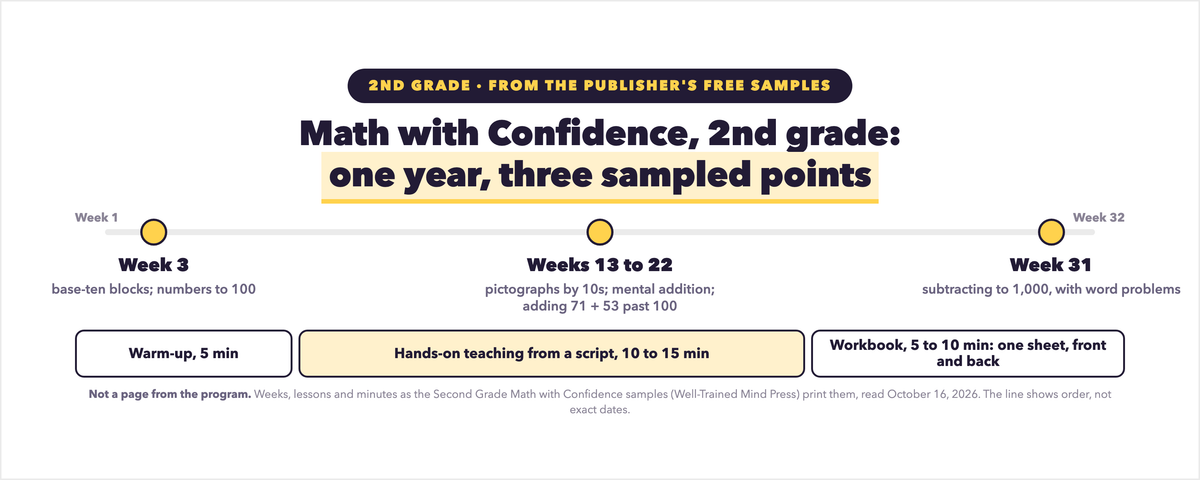
A Grade 2 lesson is scripted and runs 20 to 30 minutes in three parts: a warm-up, hands-on teaching, and the workbook. Your child does two workbook pages a day, the front and back of one sheet: the front practices the new skill, the back reviews earlier ones. The year runs 32 weeks in 14 units, with 4 required lessons and 1 optional enrichment lesson (a picture book and a real-life math activity) each week.
The start: Week 3, base-ten blocks and numbers to 100
Week 3 reviews the numbers to 100 with base-ten blocks (units, rods, flats, and large cubes that stand for ones, tens, hundreds, and thousands). In Lesson 3.1, you name the blocks, and then your child lines up 10 units to confirm they match 1 rod. Workbook page 3.1A asks her to match sets of blocks to numbers; 3.1B has her color leaves by the addition facts that make 9 and 10. By 3.4B she is reading a bar graph of a swim class.
Unit 1 (Weeks 1 to 3) reviews first-grade skills: addition and subtraction facts to 10, numbers to 100, place value, and simple mental math. The guide's Week 1 overview says that if your child remembers this material well, make these quick review lessons. Each unit ends with a Checkpoint, a short check that helps you decide whether to move on or practice more. The Unit 1 Checkpoint sets one bar before Unit 2: the child can find the answers to most addition facts with sums to 10 "in less than 3 seconds." The rest of Unit 1 does not need to be mastered yet. Comparing numbers, the number line, and place value keep coming back in the warm-ups and review pages.
The middle: Weeks 13, 14, and 22
Lesson 13.2 teaches pictographs and bar graphs that count in steps of 10. On workbook page 13.2A, each soccer ball stands for 10 minutes, and the child counts by 10s to fill in a chart. Lesson 14.1 teaches adding a one-digit number to a two-digit number. For 37 + 4, the child splits 37 into 30 and 7 and uses the fact 7 + 4. The lesson ends with Roll and Add, a dice game of 5 rounds. In each round, both players roll the die, write the number beside that round's printed number on page 14.1A (29, 38, 47, 56, then 79), and add the two; the greater sum wins a point. Lesson 22.3 is written addition with sums over 100: the child models 71 + 53 on the Place-Value Chart (a printed chart with a place for ones, tens, hundreds, and thousands) and trades 10 rods for 1 flat, then does the other 3 problems in the top row of page 22.3A.
The end: Week 31, subtraction to 1000
Lesson 31.4 opens by counting by 2s from 992 to 1000, then turns to a playset price chart: tire swing $235, slide $258, spiral slide $467, climbing net $226, swing $73. The four word problems on page 31.4A include how much more a spiral slide costs than a regular slide and what is left of $300 after buying a climbing net. Page 31.4B asks the child to write the time, match pairs that equal 1000, and circle the quadrilaterals. Week 31 sits in Unit 14, the last unit in the scope and sequence: adding and subtracting to 1000, including subtracting across a zero (a 0 in the number you subtract from). Week 32 is review.
One lesson's shape, in the guide's words
The guide prints the minutes for each part: the warm-up (counting, memory work, and review), 5 minutes; hands-on activities, 10 to 15 minutes; workbook pages, 5 to 10 minutes. Of that time, 15 to 20 minutes is parent-led teaching. The guide says most second graders can do the workbook pages on their own, though many need a parent to read the directions.
If a lesson runs past 30 minutes or your child gets restless, the guide says to stop and pick up the next day, or to do the hands-on part and the workbook page at two different times of day. If your child picks up math quickly, you can condense lessons and skip some warm-ups and review pages, checking now and then that the skills are still there.
Is a 6-year-old ready for it?
The author says most children are ready at age 7. Your child is ready if she can:
- count to 100 by 1s, 2s, 5s, and 10s
- read, write, and compare 2-digit numbers
- know what the tens place and ones place mean in 2-digit numbers
- write simple addition and subtraction equations and solve simple word problems with single-digit numbers
- know most addition facts up to 9 + 9
- know most subtraction facts from numbers up to 10
- know the names and values of coins and identify combinations of a few coins
The book reviews all seven in its first few units, so it's fine if your child needs a refresher on a few. Seven is the age the author gives as typical. What she tells parents to check is the skill list: her placement article puts the list under the words "Your child is ready if she can."
On her Grade 2 page, the author answered a parent whose daughter found the first grade book too easy: look at what the child is "actually able to do," not at her sense of difficulty. If she knows most of the skills in the first grade book, moving up to the second grade book could work; if not, condense lessons and go through the first grade book at a quicker pace. The guide adds the other side: a child who is continually frustrated or crying during math may find the book too challenging "no matter how old" the child is, and First Grade Math with Confidence may be the wiser choice. Lesson 3.1 is your test. If it feels like easy review to your child, Grade 2 is the right level.
What you need on hand
Most lessons need only the Math Kit the guide lists: base-ten blocks, 50 counters, coins, play money, a clock with hands, a ruler in inches and centimeters, two decks of cards, two dice, paper, pencils, page protectors, and a dry-erase marker. Some lessons also use household items like stuffed animals, small toys, or crayons. The blackline masters, printable pages in the Instructor Guide, include paper base-ten blocks for families without real ones. The weekly enrichment lesson, with a picture book and a real-life activity, is optional.
If you are comparing more than one program, the four checks we use to compare any main math curriculum are on our homeschool math curriculum page. The kindergarten level of this series is set beside Dimensions Math K on another page. That is our kindergarten comparison page.
Where Cuemath fits
Cuemath is live, one-on-one online math tutoring. We do not sell a homeschool curriculum, and the free evaluation below does not replace the program you pick.
Know where your child stands before you pick a level
A free Cuemath MathFit evaluation, our skills-and-gaps check, is a live, one-on-one session that shows where your child is solid and where a gap sits, in your child's own work. No credit card, and the report is yours either way.
Book a Free EvaluationFor students in Grades K to 12 worldwide.
FAQs
Does Math with Confidence have a placement test?
No. The author publishes a readiness list for each grade in her placement article, and the Grade 2 book ends each unit with a Checkpoint. The Checkpoints help you decide whether your child knows the facts well enough to move on; if your child is not fluent with the addition facts up to 9 + 9 or the subtraction facts up to 10, the author says to spend a little extra time on them in the early units.
Can a 6-year-old start Second Grade Math with Confidence?
It can work, if she has the skills. The author gives 7 as the typical age for Grade 2 (and 6 for Grade 1), then the skill list, and the list decides. When a parent asked about a 6-year-old who found the first grade book too easy, the author said to look at what she can actually do: if she knows most of the skills in the first grade book, moving up could be a great solution; if not, condense lessons and go through the first grade book at a quicker pace.
Can we do two lessons a day or skip Unit 1 if my child moves fast?
The guide sample sets no number of lessons per day. In the author's reply about the 6-year-old on the first grade book, her suggestions for going faster include "do a couple lessons per day." What the guide does say is that for a child who picks up math quickly, you can condense lessons and skip some warm-ups and review pages, with a check now and then that the skills are still there. For Unit 1, the Week 1 overview says that if your child remembers this material well, make these quick review lessons, and the Unit 1 Checkpoint tells you when to move on to Unit 2.
Which parts of a lesson can my child do alone?
The workbook pages, mostly. The hands-on part is parent-led teaching. Most second graders can do the workbook pages on their own, though many need a parent to read the directions. If writing is hard for your child, the guide says to "feel free to have your child complete part or all of the worksheets orally." It also asks you to check the workbook pages as soon as your child finishes them.
Is the Grade 2 book sold as a PDF?
Yes, but only at Well-Trained Mind Press. Print copies are sold at Amazon, Well-Trained Mind Press, and other homeschool booksellers. The digital Student Workbook comes in a standard and a printer-friendly version.
Where are the free samples, and what is in them?
Both are on the author's Second Grade Math with Confidence page: the Instructor Guide sample and the Student Workbook sample. The Instructor Guide sample is 71 pages and holds, in her words, "the full introduction, scope and sequence, and materials list, plus a variety of lessons from across the year." The Student Workbook sample is 27 full-color pages.