National Test Finds Just 37% of Year 10 Students Digitally Proficient
Australian students' digital literacy has fallen to its lowest level since national testing began — even as students use AI and screens more than ever before. Here's what the new report found, and what experts say is really going on.

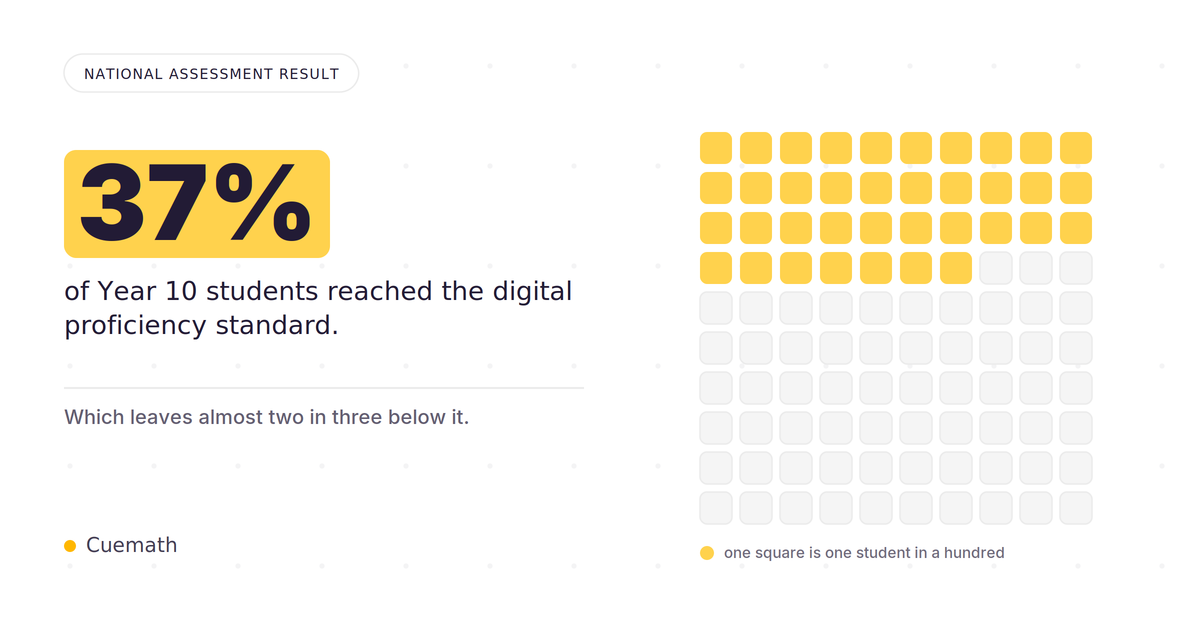
Most Year 10 students in Australia cannot use technology as well as they should be able to. That comes from a national test released on 27 May 2026. It is called NAP-ICT. Only 37% of Year 10 students met the standard. For Year 6, it was 50%. Both are the worst results since the test began in 2005.
Scores have been falling for a long time. Year 10 is down almost 30 points since 2008. Year 6 has slipped from 55% in 2022. That drop has happened while students got school laptops, then tablets, and now AI. More than 60% of Year 10 students use AI to write something each month.
What Did the Test Find?
About 10,000 students sat the test last year, answering questions on things like creating presentations, searching for information, and online safety.
- Only 37% of Year 10 students hit the proficiency bar — down almost 30 percentage points since 2008
- Only 50% of Year 6 students hit the bar — down from 55% in 2022
- Students struggled most with harder tasks: analysing data, building presentations, and designing simple step-by-step processes (algorithms)
- Indigenous students, students in remote areas, and students from low-income households scored well below their peers
Why Are Scores Falling When Kids Use Tech So Much?
ACARA’s boss says using a device isn’t the same as understanding it.
- “Kids are using devices more and more, but that’s not translating into them having the proficiency skills that they need,” ACARA CEO Stephen Gniel said
- Professor Therese Keane of La Trobe University says many students have only “superficial” tech knowledge, despite being “digital natives”
- In many classrooms, she said, laptops are just used for note-taking and iPads for browsing — not real problem-solving
- A shortage of specialist computing teachers is part of the problem, she said
What Role Did AI Play?
The test itself didn’t measure AI skills — but a separate survey asked students how they use it.
- 1 in 4 Year 10 students said they use AI frequently for schoolwork
- More than 60% of Year 10 students, and almost a third of Year 6 students, use AI to write content at least once a month
- ACARA says the next test, due in 2028, will likely include AI for the first time
- Education Minister Jason Clare has asked the Australian Education Research Organisation (AERO) to dig into why scores keep falling
What Happens Next
This isn’t the last word on the issue.
- Education Minister Clare has tasked AERO with investigating the two-decade decline
- Education ministers are due to discuss AI in schools more broadly at a meeting later this year
- The next NAP-ICT test, in 2028, is expected to include AI skills for the first time
Sources:
School students have grown up online but test shows digital literacy at new low, ABC News (27 May 2026)
Australian Curriculum, Assessment and Reporting Authority (ACARA)
National Assessment Program (NAP)
National Assessment Program – ICT Literacy 2025 Public Report, ACER Research Repository

I write because I like understanding things properly, and I've never been able to do that quietly.
Six years in, what still interests me most isn't the writing itself. It's the person on the other side. Who are they, what were they actually worried about when they opened this page, and did they leave with what they came for? Most content fails that last test. It answers the easy question instead of the one that was asked.
At Cuemath, I write for parents and students in India and around the world. That range is the part I enjoy. A parent in Bangalore and a parent in Canada are asking about the same child, but not always in the same words, and that difference matters.
So I research before I write. Not just search results. Forums, reviews, the long comment threads where somebody finally admits what they're really confused about. That's usually where the useful thing is hiding.
I also spend time on how people find this writing at all, since a growing number of them now ask an AI instead of typing into Google. But that only works if the writing is clear to begin with. There's no shortcut around that part.