7th Grade Math Word Problems: Why They Ask for Reasoning Now
7th grade math word problems: why they ask for reasoning now, what the state test scores, Fremont's CC2 course and book, and a five-step routine for homework.

The long questions are not one teacher's style. California's math standards ask for them by name in 7th grade: "Solve multi-step real-life and mathematical problems", check that the answer makes sense, and build an equation "by reasoning about the quantities." The habits the standards want in every grade include "Construct viable arguments and critique the reasoning of others." The state test has performance tasks that ask students to use the math in context, and the state's sample score report has a line for how well a child could "explain the reasoning for the solution".
In Fremont Unified, the grade-level 7th grade course is Common Core 2 (CC2) and 8th grade is CC3; the district's printed book for grades 6 to 8 is Reveal Math (McGraw Hill, ALEKS). Does this way of teaching help or confuse? No page can see your child's class. The standards document gives its own reason for asking: it wants "a balanced combination of procedure and understanding", because "Students who lack understanding of a topic may rely on procedures too heavily." So a child who knows the steps but cannot say why may have a thinner grasp than it looked. The routine below finds where it breaks, one problem a night, out loud.
What the 7th grade standard asks for
The California Common Core standards for grade 7 ask students to solve multi-step ratio and percent problems, with examples such as tax, markups and markdowns and percent increase and decrease; to solve multi-step problems with fractions, decimals and negative numbers and "assess the reasonableness of answers" with an estimate; and to write a simple equation for a word problem, then compare the equation's solution with the plain-arithmetic solution and name the order of the steps in each. On top of the grade's content sit eight habits for every grade. The first is "Make sense of problems and persevere in solving them." The third is "Construct viable arguments and critique the reasoning of others", under which students "justify their conclusions, communicate them to others, and respond to the arguments of others." That is the explain your reasoning box. Every habit, with every fluency line by grade, is on our drilling or reasoning page.
What the state test scores
Fremont Unified's page on the state test says the Smarter Balanced exams have "both a computer adaptive component and performance tasks", and the test's maker says performance tasks require critical thinking and problem solving "to apply their learning in context". The state's sample 2025-26 score report prints two areas for math: Concepts and Procedures, and Mathematical Practices, the second asking how well the child could "apply strategies to solve complex problems and explain the reasoning for the solution". One caution: Fremont's own page says current student reports show only the overall level, not the separate areas. Open your child's report in Aeries, the district's online parent portal. If it prints the two areas, read the second; if it prints only the level, Fremont's page is why.
Fremont's courses and book
The district's Secondary Math Pathways chart, posted as a 2024-2025 update, shows the grade-level lane as CC1 in 6th grade, CC2 (or CC2 w/ Support) in 7th, and CC3 (or CC3 w/ Support) in 8th. The accelerated lane is Accelerated CC2/CC3 in 7th and Accelerated CC3/Algebra 1 in 8th. "Initial Secondary Math Placement is made at the end of 6th grade", the district's math page says, and students and parents choose courses each year. The district's curriculum dashboard lists the grades 6 to 8 math adoption as Reveal Math (McGraw Hill, ALEKS), approved May 8, 2024.
If your child is in the accelerated class, the district's placement letter says those classes "move very quickly through content with limited time for reteaching", and that "Students who do not take accelerated math are NOT behind their peers". Faster is the difference the letter names. How a child gets into that lane is on our Fremont accelerated math page.
When your child knows the concept but not the long question
One problem a night, out loud. Your child talks; you ask. You do not need to solve it, and a parent who finds the problem hard can still run this.
- Read the question twice. Your child says, in one sentence, what it asks for and what it gives. If the words are the wall, the reading is the work: restate it in plain words before any math.
- Name the concept: a percent problem, or an equation with one unknown. If your child cannot name it, the concept is thinner than it looked in class, and an earlier skill may be missing; our page on a child behind in math is for finding which one.
- Do the steps, and say why each one is allowed.
- Check with an estimate before the exact answer: about how big should it be?
- Write the answer as a sentence, with its unit.
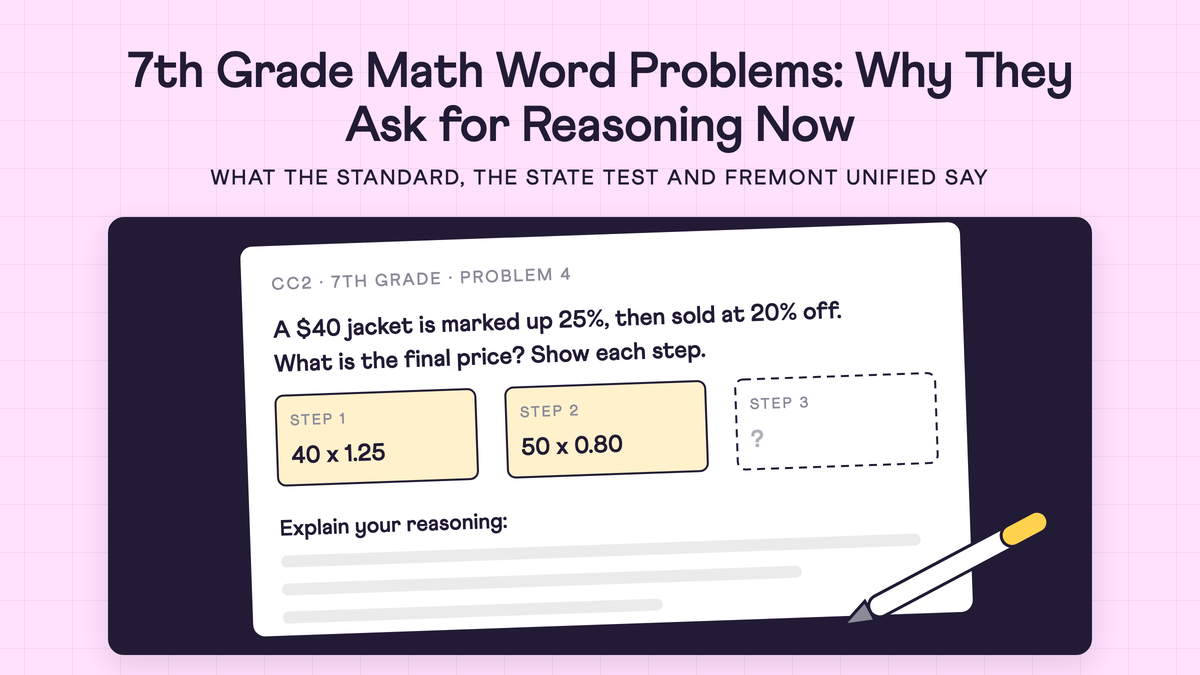
Here is the shape of a good answer, on a problem of our own. A $40 jacket is marked up 25 percent, then sold at 20 percent off. What is the final price? Step 1: it asks for a price after two changes. Step 2: a percent problem. Step 3: 25 percent of 40 is 10, so the marked-up price is 50; 20 percent of 50 is 10, so the sale price is 40. Step 4: it should land near 40, and it does. Step 5: the final price is $40, the same as the start, because 20 percent of a bigger number is more than 25 percent of a smaller one was. If your child can do step 3 but not say the because in step 5, the explaining is the work: ask why at every step until the reason comes without a prompt.
Three questions for the teacher
- On the last test, where did my child lose points: the concept, the steps, or the explanation? Can I see one scored example?
- Which course is my child in, CC2 or Accelerated CC2/CC3, and which unit is the class on now?
- When a student has the concept but not the explaining, what does the class do, and what should we do at home?
Where Cuemath fits
Cuemath is live, one-on-one online math tutoring for grades K through 12. Its free MathFit Evaluation, a skills-and-gaps check in a live one-on-one session, shows whether the gap is the concept or the explaining of it. It does not change the questions the class asks, or the Fremont course your child is in.
Find where the long question breaks
A free Cuemath MathFit Evaluation is a live, one-on-one session that shows where your child is solid and where a gap sits, in your child's own work. No credit card, and the report is yours either way.
Book a Free EvaluationFor students in Grades K to 12 worldwide.
FAQs
Why is middle school math so hard now?
Because the standard asks for more than the answer. The grade 7 lines ask for multi-step problems, a check that the answer makes sense, and an equation built by reasoning about the quantities; the habits for every grade ask students to justify their conclusions and explain them to others. A question that asks for the steps and the reason is the standard's question, not one teacher's.
Does the way it is taught help or confuse?
No page can see your child's class; the third teacher question above is how you find out. What the standards document says is why it asks: it wants procedure and understanding together, because students who lack understanding "may rely on procedures too heavily". The routine above shows you, in one problem, whether your child has the understanding or only the steps.
What are CC2 and CC3 in Fremont Unified?
Common Core 2 and Common Core 3, the names of the grade-level 7th and 8th grade math courses on the district's pathways chart; each also has a 'w/ Support' form. The accelerated lane is Accelerated CC2/CC3 in 7th and Accelerated CC3/Algebra 1 in 8th. CC3 also appears as a 9th grade course on the chart.
What math book does Fremont Unified use in middle school?
Reveal Math (McGraw Hill, ALEKS) is the district's printed adoption for grades 6 to 8, listed on its curriculum dashboard with an approval date of May 8, 2024. The dashboard says nothing about how a given class uses it; ask the teacher.
Is the accelerated class why the questions are hard?
The accelerated class is faster, not a different kind of question: the district's letter says it covers "three years of math content in only two years of school" and moves "with limited time for reteaching". The multi-step and explain lines above are grade 7 lines, and the letter says students who do not take accelerated math "are NOT behind their peers".
I find some of these problems hard myself. Can I still help?
Yes, by asking, not solving. The routine needs a parent who asks what the problem wants, which concept it is, why that step is allowed, and about how big the answer should be. The answers are your child's. The standard's third habit wants students to explain their reasoning to others; you are the other.