What Happens at a Free Cuemath Math Event? Insights from 200+ Workshops
What if you could step into a room where math wasn't about speed or test scores, but about curiosity, logic, and pure hands-on fun? Across US and rest of the world, Cuemath is hosting free math events designed to change how children learn math.

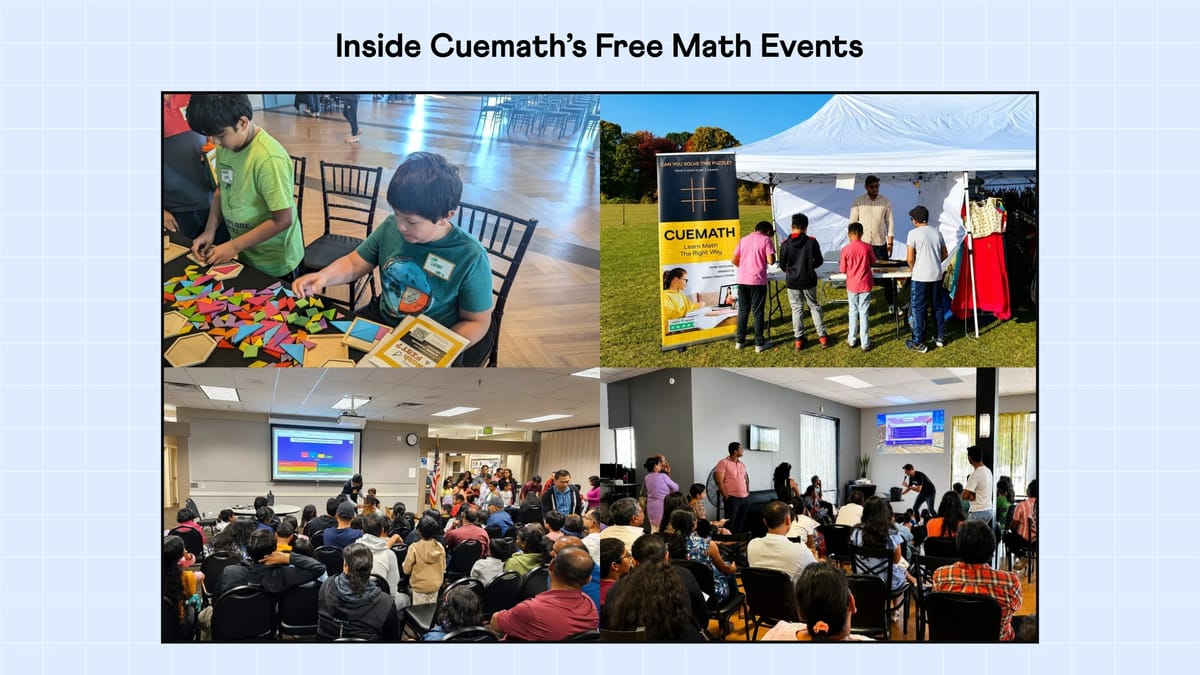
Cuemath is taking over local communities. Across US and rest of the world, Cuemath is hosting free math events designed to change how children learn math.
Built to bridge the gap between traditional learning and true problem-solving, these math events invite families to participate in logic games, real-world simulations, and interactive challenges together. Rather than testing speed or rote memory, the events highlight what it truly means to be "MathFit": building fluency, understanding, application, and reasoning.
In this blog, we will read how Cuemath math events work, and how parents are leaving with a brand-new perspective on their child’s potential.
- Cuemath Math Events at a Glance
- What Happens in a Cuemath Math Event?
- Welcome & Progress Compass
- Four Hands-On Activity Stations
- Math Personality Profile & Take-Homes
- Cuemath Events Evaluate Skills Behind Every Formula and Concept
- Exploring Math Tutoring? How This Event Helps Your Search
- Where Events Happen & How to Join
- How to Find a Free Math Event Near You
- FAQs
Cuemath Math Events at a Glance
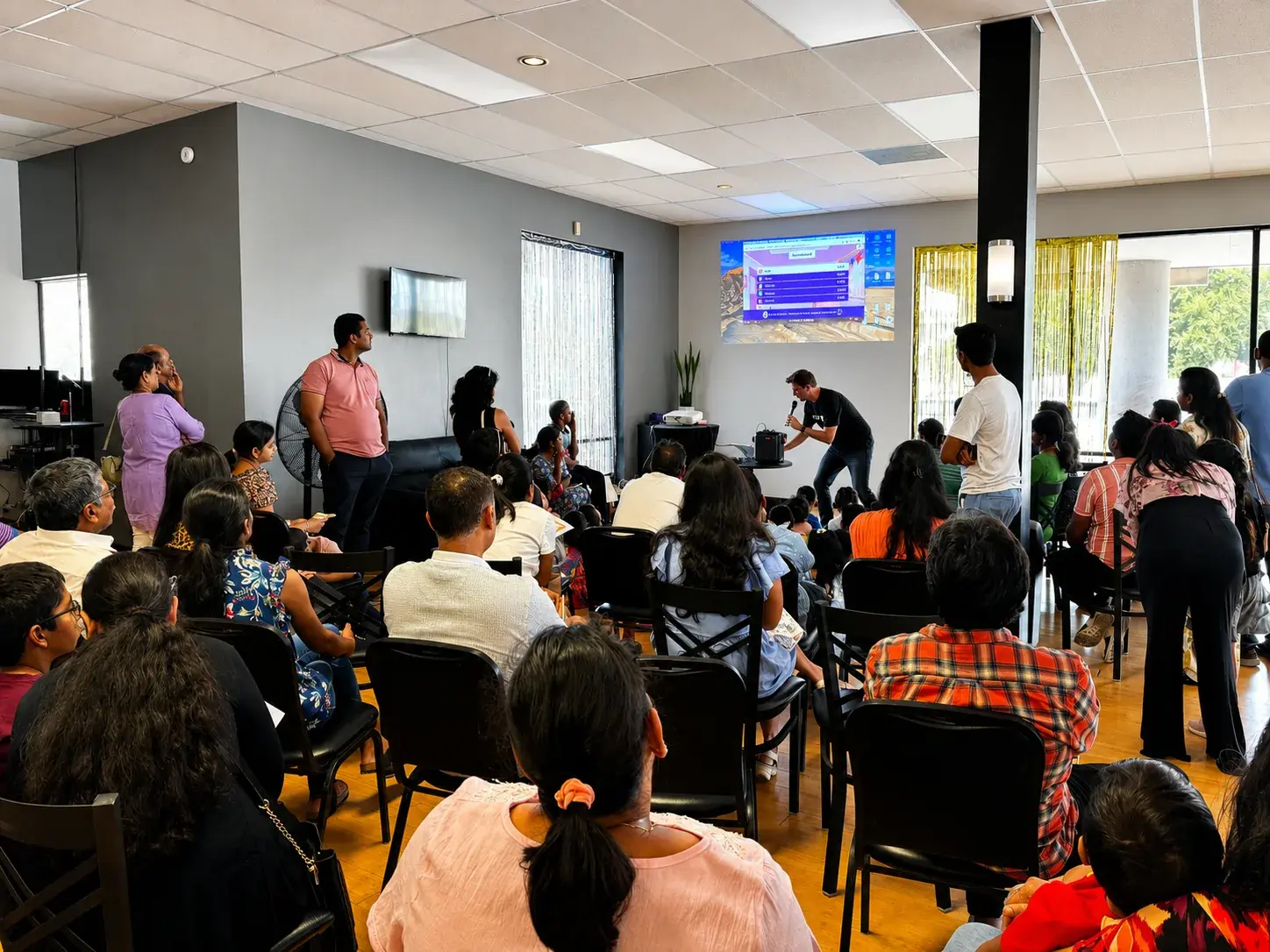
- 100% Free: Free registration, zero entry fees, and no required purchases at the venue.
- Open to Everyone: Built for kids in elementary and early middle school. You do not need to be an existing Cuemath student to attend.
- Zero Competition: Kids are not timed, ranked, or compared to one another. There are no public scores or pass/fail grades.
What Happens in a Cuemath Math Event?
Your child gets a progress card at the door, works through four activity tables at their own pace, and gets a stamp at each one.
Welcome & Progress Compass
At check-in, every child receives their own progress tracking card (their "compass"). This serves as their personal guide for the afternoon as they explore four distinct activity stations at their own pace.
Four Hands-On Activity Stations
At each table, children engage with physical, interactive math challenges:
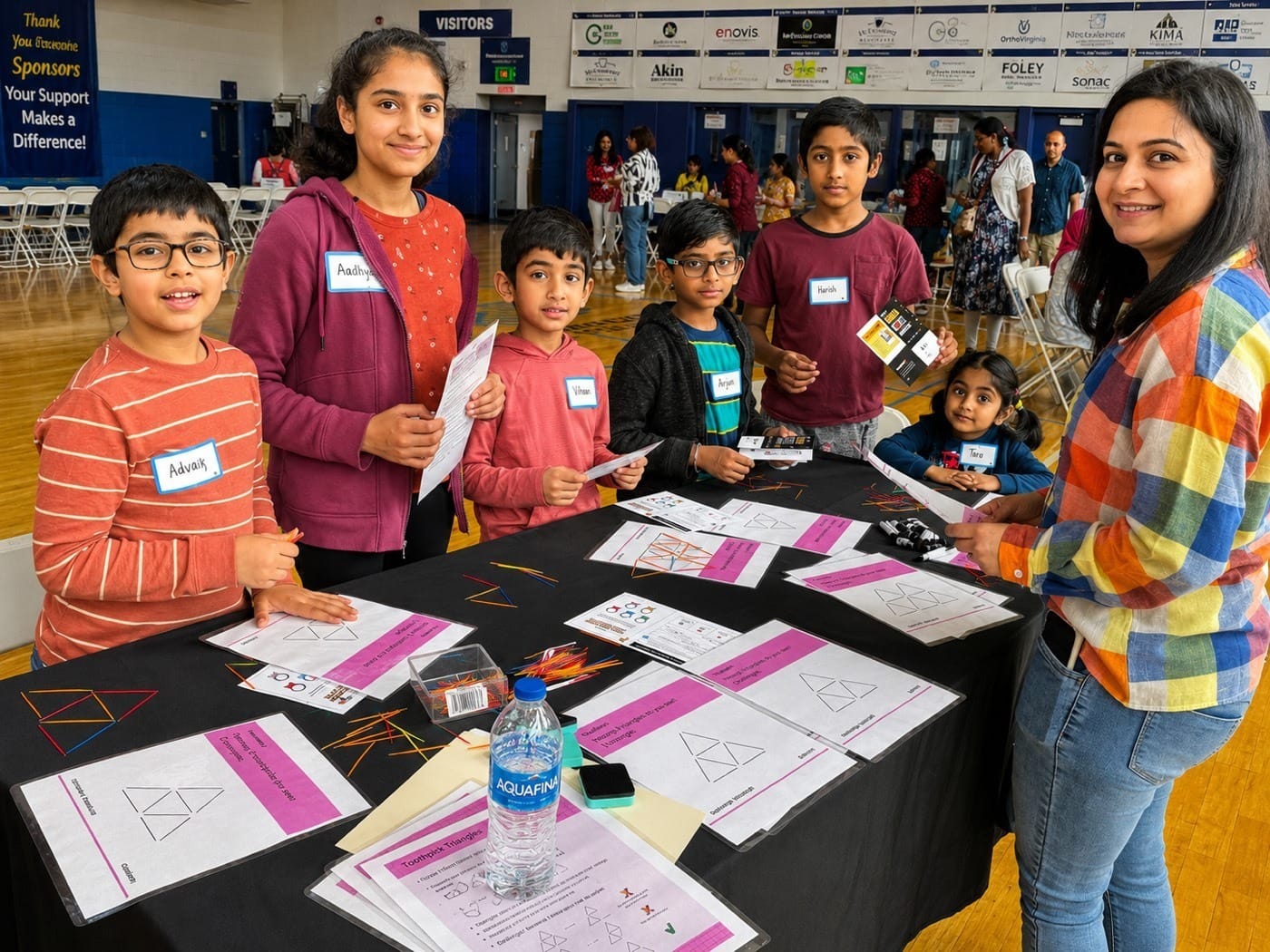
- Spatial Reasoning & Geometry: Assembling Tangram tiles and wooden shapes to build complex figures.
- Logic & Pattern Games: Solving cup-stacking patterns, toothpick geometry puzzles, and hidden logic riddles.
- Number Fluency: Speed-free number challenges that encourage mental math, estimation, and strategy.
- Real-World Problem Solving: Deciphering stories and physical puzzles by talking through reasoning out loud.
Each table is hosted by a trained MathFit Master, often local parents, teachers, and math enthusiasts from your own community. Their role is to guide and encourage with strategic hints without handing over the answer, ensuring no child gets stuck or feels marked wrong.
Free Math Events are Happening in 50+ Cities!
Join us at the next free Cuemath math event near you. Watch your child build, puzzle, and think out loud with zero test pressure.
Find an Event Near YouZero Registration Fee, Free Goodie Bags and Kits
Math Personality Profile & Take-Homes
Every finished station earns a stamp on the child's progress compass. Once all stations are complete, children scan a code to discover their Math Personality Profile (naming how they think, such as Number Ninja or Code Captain).
Every child leaves with:
- Their stamped progress compass and all physical creations built during the session.
- Their personalized Math Personality Profile card.
- An official event pin, goodie bag, and free access to the Cuemath app.
Cuemath Events Evaluate Skills Behind Every Formula and Concept
Every activity at a Cuemath event is specifically designed to evaluate 4 core skills:
Fluency
Solving problems with accuracy, efficiency, and flexibility.
Example
Naming triangles, quadrilaterals, and circles on sight, without counting sides.
Understanding
Moving beyond 'how' to 'why'.
Example
Knowing a square is a kind of rectangle, and why.
Application
Using math across different problems and contexts.
Example
Using the same area logic for a rectangle, a triangle, and a parallelogram.
Reasoning
Training the brain to think logically and explain the choice.
Example
Proving two different shapes can share the same area.
International curriculum frameworks like Common Core, NAEP, and TIMSS build their benchmarks around these four specific skills because they represent how the human brain actually processes mathematical concepts. While school curriculum and topics change grade by grade, these are basic skills to master math at any grade level.
Exploring Math Tutoring? How This Event Helps Your Search
If you are currently evaluating math tutoring options for your child, you should definitely attend any Cuemath event near you (you get all of this for free):
- Get to Know About Cuemath in Person: Before signing up free evaluation online, you get to see Cuemath’s teaching philosophy in action. You will watch how mentors guide children rather than forcing rote memorization.
- You Understand Your Child's Abilities: School report cards only show right or wrong answers. At Cuemath events, you actually see first-hand how your child likes to learn and solve problems.
- See How Your Child Enjoys Learning Math: Many children push back against tutoring because it feels like extra homework. Because this event feels like a carnival of games and spatial puzzles, it reframes math into something fun and fear-free, making your child open to learning.
- Get a Baseline for 1:1 Tutoring: The four core skills measured at the event map directly to Cuemath’s 1-on-1 online tutoring curriculum. The Math Personality Profile your child takes home gives you a starting point if you decide to pursue regular 1:1 tutoring later.
"Cuemath has shaped my child's love for learning since age 3, with creative concepts and a kid-friendly website. The teacher tailors lessons to my child's needs. Great experience!"
 |
★★★★★
Varna Priyadarshini, US
|
"The Cuemath curriculum matches their school in the USA. My kids love finishing goals and getting badges, and the teacher uses the platform's tools to explain concepts visually. It feels like she is sitting right next to them."
 |
★★★★★
Harini, US
|
"As a parent, I feel valued and supported by Mrs. Puduru Sandeepa. She involves me, always communicates clearly, and creates a caring environment that improves my daughter's understanding."
 |
★★★★★
Eliza, US
|
Where Events Happen & How to Join
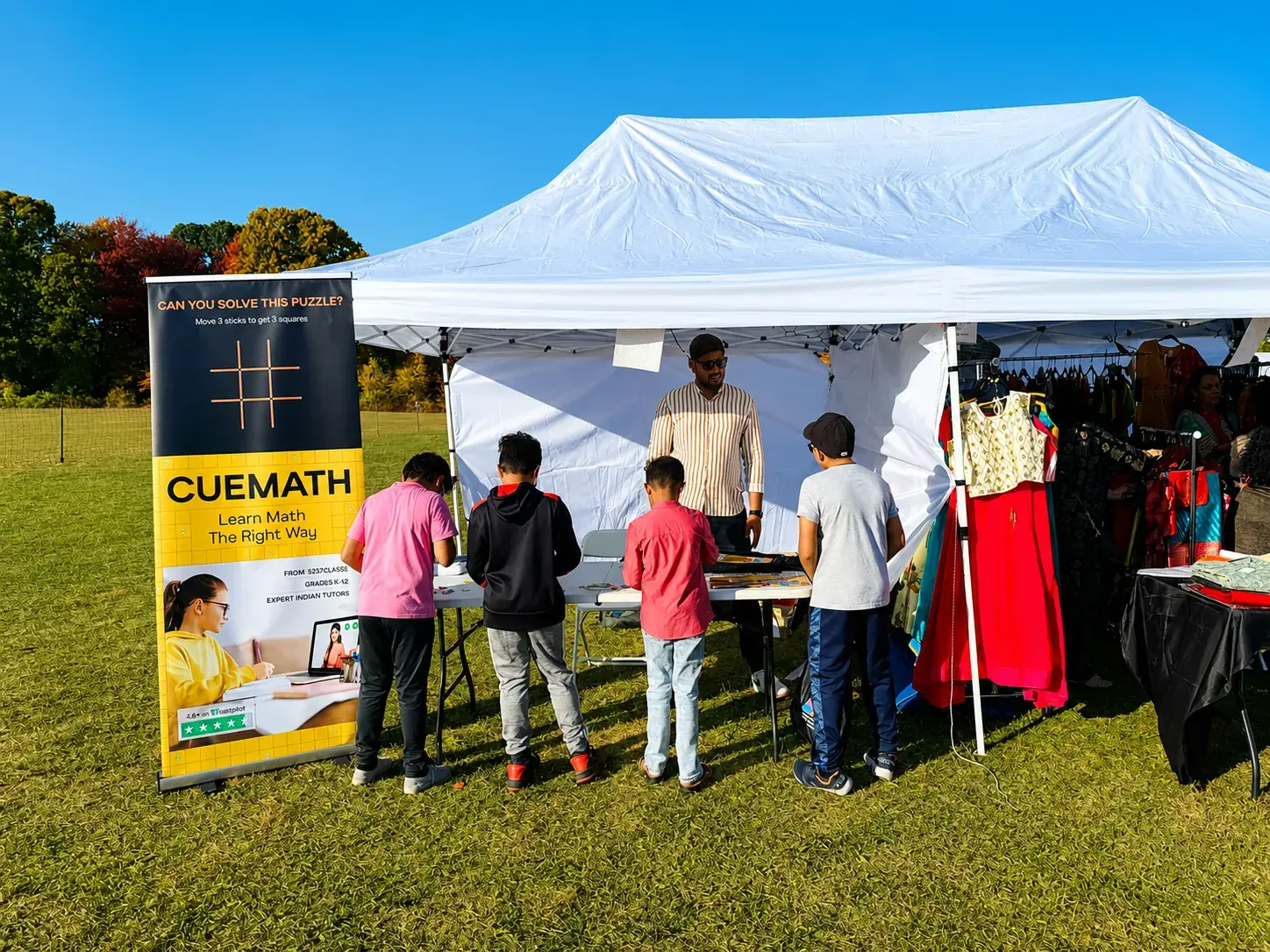
Cuemath has organized more than 200 free math events in 50+ US cities, including Fremont, Plano, Edison, Austin, Redmond, Schaumburg, Rockville, and Naperville, as well as globally, including the recent ones in Abu Dhabi.
Cuemath math events take place on weekends at local libraries, community centers, and neighborhood schools.
How to Find a Free Math Event Near You
- Visit the official Cuemath Events Page.
- Select your region to view upcoming weekend dates and local venues.
- Reserve your child's free spot and preferred arrival slot.
Pro Tip: Register early. Venues have capacity limits, and the first 50 registered attendees at every event are guaranteed full activity kits and physical materials.
Free Math Events are Happening in 50+ Cities!
Join us at the next free Cuemath math event near you. Watch your child build, puzzle, and think out loud with zero test pressure.
Find an Event Near YouZero Registration Fee, Free Goodie Bags and Kits
Frequently Asked Questions (FAQs)
Are Cuemath math events really free?
Yes. Registration for a Cuemath math event is free, there is nothing to buy at the venue, and no purchase is required to take part in the activities or to receive the math personality card.
Do I need to be a Cuemath customer to attend a math event?
No. Anyone can register. You do not need an account, a subscription, or any prior contact with Cuemath, and attending does not enroll you in anything.
What ages are Cuemath math events for?
Cuemath math events are built for children in grades K to 5. Younger siblings are usually in the room with the family, but the four activities are designed for K to 5.
How long does a Cuemath math event take?
About 90 minutes per child. Events are listed with a wider arrival window, so check your slot and arrive on time rather than at the start of the window.
What does my child take home from a math event?
Their stamped progress card, everything they made during the activities, a math personality card naming how they think about math, a pin, a goodie bag, and free access to the Cuemath app.
Is a math event a competition?
No. There are no scores, no winners, and no rankings. A child collects a stamp for finishing each activity, and that is the only scoreboard in the room.
Who runs the math events?
Cuemath's events team organizes each one, sometimes with a local math association or a school and its PTA. Each activity table is run by a MathFit enthusiast from the same community as the families attending, a parent or student who loves math and is trained on that activity.
Does Cuemath hold math events outside the US?
Yes. Most events are in the US, across more than 50 cities, and Cuemath also runs them internationally. The September 2026 calendar includes three MathFit Challenges in Abu Dhabi in the United Arab Emirates.
How do I find a math event near me?
Check the Cuemath Events Page and select your region. Dates are posted as venues get confirmed rather than on a fixed schedule, so checking the page is the only reliable way to see what is coming up.

I grew up a science kid. Math was not my best subject. Class moved fast, I was too shy to ask for help, and I somehow ended up more curious about how people learn than about the subjects themselves.
That's what pulled me into education, not to teach, but to understand how colleges and tutoring programs actually work and what students genuinely need from them.
My love for writing did the rest. I had too many observations and nowhere to put them, so I started writing, and haven't stopped. Over the last five years I've written about edtech, student life, and college programs. For the past year, my focus has been math tutoring specifically.
I work at Cuemath now, so factor that in. I research by going where parents actually talk: forums, reviews, and direct conversations with students and families. I'm writing for the kid who's too scared to raise their hand in class. I was that kid.