
The 1:1 IAR Test Prep Guide to Reasoning & Real-World Math
The IAR test assesses reasoning and real-world problem-solving skills, which is why free prep courses and practice tests alone do not help a struggling child. In this blog, we discuss what the Illinois math test actually measures, and how only 1:1 IAR tutoring can change that.

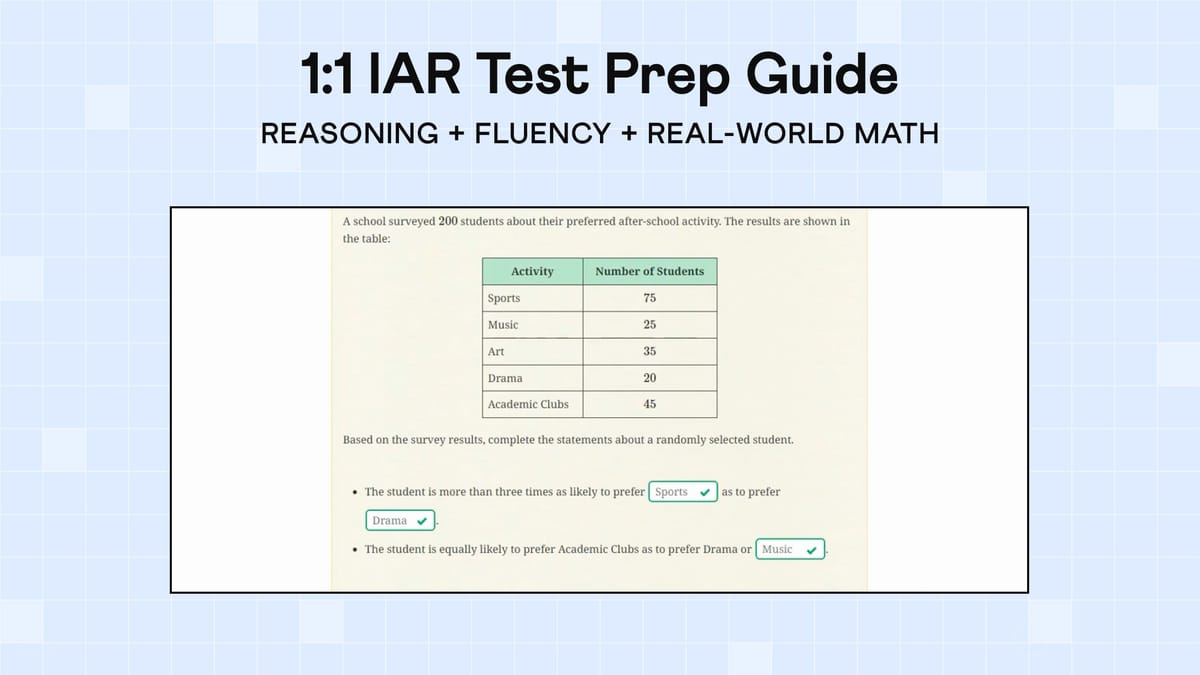
- The IAR (Illinois Assessment of Readiness) tests math for every Illinois public school student in grades 3 through 8, each spring.
- Even after Illinois lowered the proficiency bar in 2025, only 38% of students statewide reached it in math. A struggling child is with the majority, not the exception.
- The hardest parts of the test are not calculations. They are reasoning tasks and real-world, multi-step problems that ask a student to explain and justify their thinking.
- Free practice tests are useful for showing format and exposing gaps. They do not, on their own, teach a struggling student the concept underneath the gap.
- For a child who is behind, what works is fixing the concept first, then practicing the reasoning and real-world problems on top of it.
- Cuemath's 1-on-1 tutors teach Illinois students concept-first, on a curriculum built from the same Common Core standards the IAR tests.
There's a common notion that Illinois kids take the IAR test lightly, since it does not affect their school grades. Schools and teachers do not always correct that, so students miss what the test is really assessing: the math reasoning they will lean on in high school, college, and their careers.
The IAR checks three math skills:
- Conceptual Understanding and Fluency (if you are aware of math concepts)
- Reasoning
- Applying concepts on a real-world problem
A child who understands middle school math deeply handles all three. A child who does not will not get there by solving free IAR practice tests online. The questions start to look familiar, but a worksheet cannot explain a concept your child never understood, and it cannot sit with them and build the reasoning step by step. A 1-on-1 tutor can. This guide, reviewed by Cuemath's expert tutors, shows how.
Even With Lower IAR Benchmarks, Less Than 40% of Illinois Students are Proficient in Math
In August 2025, Illinois lowered the bar for what counts as "proficient" on the IAR test. Even after lowering the bar, the results were hard to read.
- Only 38% of students statewide reached proficiency in math.
- In Chicago Public Schools, it was 26.2%.
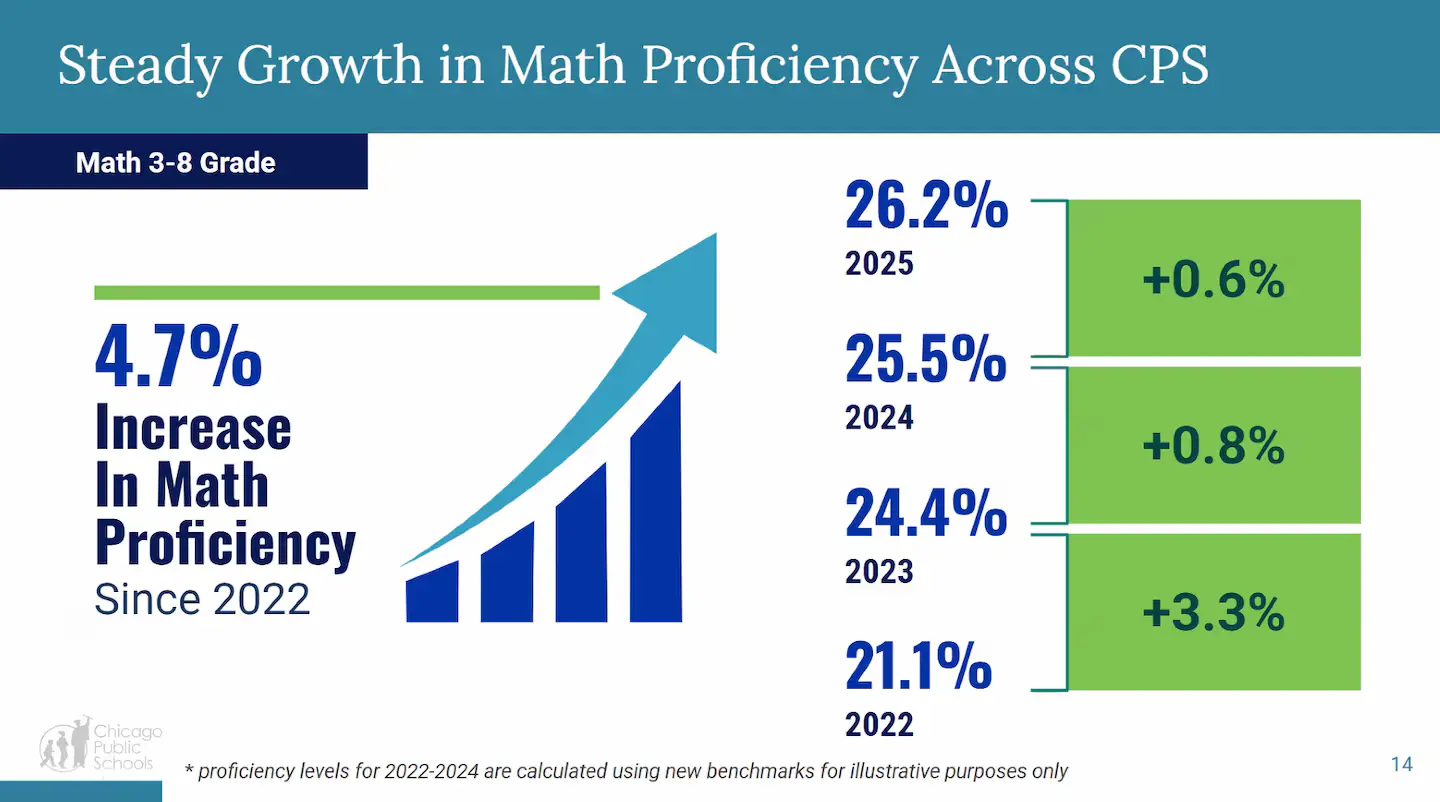
The key takeaway is clear: most Illinois kids are not proficient in math, even by the gentler standard.
Districts like Chicago Public Schools will respond with their own plans, more support, new programs, revised pacing. That helps at the system level. It does much less for the individual child sitting in a class of 30.
- A teacher with 30 students cannot stop and readjust to each child's pace while the rest move on.
- They need an expert math tutor to meet them one-on-one, and work on fixing the conceptual gaps.
And this is bigger than one spring test. The IAR measures reasoning, problem-solving, and the real-world application of math, the same skills that decide whether a student lands an accelerated math track in high school, scores well on the SAT, and gets into the college they are aiming for. The IAR is just the first place those gaps show up.
The IAR Tests Math Skills Struggling Students Often Miss in Class
Here is what each skill is, and the harder question underneath it: can a classroom or a free prep course actually build that skill in your child?
| Skill | What the IAR checks | Can a classroom or free prep course build it? |
|---|---|---|
| Conceptual understanding | Whether a student knows the concept and can solve an IAR test problem accurately. | Mostly, yes. This is what most class time and practice worksheets already target. |
| Reasoning | Whether a student can explain why an answer works, justify a step, or find the flaw in someone else's reasoning. | Rarely. Reasoning is built by someone asking "why" and responding to each child's specific thinking. |
| Real-world application | Whether a student can take an unfamiliar, multi-step real-world problem, and decide which concept to use. | Rarely. Application has to be coached on new problems, with feedback on the child's actual approach, not an answer key. |
Reasoning and real-world application are built by doing, getting a specific step wrong, and a tutor who can figure out exactly where the problem is and ask the question that fixes it. A teacher with 30 students cannot do that for each child, every day. Free prep courses and practice tests are even further from it.
So here is the honest conclusion:
- A student who has real conceptual gaps, or who has seen a low IAR benchmark and cannot seem to catch up in class, will not close that gap with more worksheets.
- The skills the IAR actually measures, reasoning and real-world application, can only be built one mind at a time.
- That child needs 1:1 IAR test prep: an expert who finds the exact concept that broke, rebuilds it, and then coaches the reasoning and application the test is really testing.
The Best IAR Test Prep: 1:1 Tutoring Tailored to Your Child
So what does choosing Cuemath actually change for your child? The prep is not a worksheet pack and not a recorded video. It is one expert tutor and one child, working through the exact gaps the IAR will expose, and every class moves at your child's pace.
Here is how that compares to a school classroom and to free practice, on the things that actually matter.
1. Finding the problem
- In school: the teacher teaches the whole grade and cannot stop to find what your child is missing.
- Free practice tests: show the score and the wrong answers, but not the reason behind them.
- Cuemath: your child takes a short evaluation first, so the tutor knows exactly what to work on from day one.
2. The attention
- In school: one teacher for about thirty students.
- Free practice tests: no live help, or a video that plays the same for everyone.
- Cuemath: one tutor and one child for the full class, moving at your child's pace.
3. How your child learns
- In school: the teacher shows the steps to the whole class at one speed.
- Free practice tests: your child solves the same kind of question over and over, alone.
- Cuemath: in the live class, the tutor explains why the math works, solves problems with your child, then lets them try on their own.
4. When your child gets stuck
- In school: with thirty kids, the teacher often cannot catch the mistake or re-explain.
- Free practice tests: only mark the answer right or wrong; no one explains what went wrong.
- Cuemath: the tutor catches it on the spot, explains the concept again, and works through it together until it is clear.
5. The relationship
- In school: a new teacher each year, and a shy child may never raise their hand.
- Free practice tests: there is no real person to get comfortable with.
- Cuemath: your child has the same tutor, so they get comfortable enough to ask questions and admit what they do not understand.
And at just $20 a class, you get all of this: a real 1:1 tutor who prepares your child for the IAR, and once the test is done, the same tutor builds a learning plan for whatever your child works toward next.
Start Your Child's IAR Prep With One Free Evaluation
The evaluation is free and starts by finding the exact gaps that cost students points on the IAR.
Free evaluation + skills check
Because the IAR is a state test, the proof worth looking at is other state-test results. Cuemath students have reached the top performance level on the NJSLA in New Jersey, the 99th percentile on NJSLA math, and the Masters grade level on the STAAR in Texas. Different state tests, same approach: build the understanding first, and the score follows.
And the IAR is not the only test this approach helps with. Cuemath runs the same concept-first, 1:1 prep for the MAP test, for summer SAT prep down the road, and for other state tests like Arizona's AASA.
Sample IAR-style Math Questions, Explained by a Tutor
Below are three questions in the style of the IAR, written by Cuemath tutors. They are pitched at the middle of the grade 3 to 8 band. Read them less as "can my child get the answer" and more as "can my child explain their thinking." That second thing is what the IAR actually scores, and it is what a tutor is trained to listen for.
The point of these is not the worksheet. It is the conversation that happens while your child works through them. When a tutor sits with a child on question 2 and asks "what happens if Maria's numbers are both one-half?", that is the moment the concept clicks. A printed answer key cannot ask that question back.
See What Real IAR Prep Looks Like
In one free evaluation, watch a tutor build the reasoning and real-world skills the IAR actually tests, the kind no worksheet can teach. See it before you pay anything.
Frequently Asked Questions
What is the IAR practice test?
The IAR practice test is a set of sample questions in the format of the Illinois Assessment of Readiness, used to prepare students in grades 3 through 8. Official practice items come from the Illinois portal run by Pearson, and because the IAR uses the same item bank as the former PARCC exam, released PARCC items work as IAR practice too. Practice tests are most useful for learning the test format and finding gaps, not for teaching new concepts.
How do I prepare my child for the IAR math test?
Prepare your child for the IAR math test by fixing the underlying concept first, then practicing. Start by identifying the exact idea your child does not understand, rebuild it until they can explain it in their own words, then practice reasoning and real-world problems before doing full practice tests near test day. For a struggling student, a 1-on-1 tutor makes this far easier than working through worksheets alone.
Are free IAR practice tests enough to improve a child's score?
Free IAR practice tests are usually not enough on their own to improve a struggling child's score. They are good for showing the test format and revealing which topics are weak, but they do not teach the concept a child is missing. A student who does not understand a concept will keep missing those questions no matter how many practice tests they complete.
What kind of math is on the IAR test?
The IAR math test checks three skills: knowing the math, reasoning, and real-world application. The first is whether a student can carry out a procedure and get the right answer. The other two ask students to explain their thinking and solve unfamiliar, multi-step real-world problems, and these are where most struggling students lose points.
How is the IAR math test scored?
The IAR math test is reported as a performance level that shows whether a student met the state's standards for their grade, along with a math score on the Quantile scale. Worth knowing: in 2025 Illinois lowered the benchmark for proficiency, so a "proficient" result reflects an easier bar than in past years. The report also shows whether a child is stronger in procedures or in reasoning.
Is the IAR test hard?
The IAR test is challenging because it goes beyond calculation. The reasoning and real-world problems require students to explain their thinking in writing and work through multi-step problems with no obvious formula, which is harder than the procedure questions most students practice. A child who understands the concepts deeply tends to find it manageable; a child who has only memorized procedures tends to struggle.
When is the IAR test in 2026?
The IAR test is given in spring 2026, with most Illinois districts testing somewhere between March and May. The Illinois State Board of Education sets the overall testing window, and each district picks its own dates inside it. Check with your child's school for the exact dates, since they vary by district.
What is a good IAR score?
A good IAR score is one that meets or exceeds the state's proficiency benchmark for the child's grade. Worth knowing: Illinois lowered that benchmark in 2025, so the bar for "proficient" is easier than it used to be. Beyond the overall result, the report shows whether your child is stronger in procedures or in reasoning, which tells you what to work on.
Can a 1-on-1 tutor help with IAR test prep?
A 1-on-1 tutor can help with IAR test prep, especially for a struggling student, because a tutor can find the exact concept a child is missing and rebuild it before practicing questions. This is something a practice test cannot do. Cuemath offers live 1-on-1 online math tutoring for grades K through 12, with a teaching method that focuses on the reasoning and real-world skills the IAR tests.
Does Cuemath offer IAR practice and test prep?
Cuemath offers IAR test prep through its 1-on-1 online math tutoring, including practice with the reasoning and real-world problem types the IAR uses. Rather than only assigning practice tests, Cuemath tutors find where a student's understanding breaks down and rebuild the concept first. Every student starts with a free evaluation and a MathFit Evaluation that identifies their specific gaps.
Is Cuemath aligned with the Illinois Learning Standards?
Cuemath's curriculum is aligned with the Illinois Learning Standards for Mathematics. Those standards are Illinois's version of the Common Core State Standards, which Cuemath's curriculum is built on, and the IAR is built on the same standards. This means the math a Cuemath student covers maps to what the IAR tests.
How long does it take to prepare for the IAR math test?
How long it takes to prepare for the IAR depends on how far behind a student is and what the gaps are. A student who understands the concepts may need only a few weeks of format practice before the test. A struggling student who has underlying concept gaps usually needs longer, because rebuilding understanding takes more time than reviewing format, and that work is best started well before the spring testing window.
Sources
- Illinois State Board of Education — IAR overview (what the IAR is, grades and subjects tested)
- Illinois Learning Standards for Mathematics (ISBE) — the standards the IAR tests against
- Illinois assessment practice items portal (Pearson) — official IAR practice items and tools
- Illinois Report Card — how IAR results feed school ratings
- Chalkbeat Chicago — 2025 IAR results under new, lower cut scores (38% proficient in math statewide; 26.2% in CPS)
- Chalkbeat Chicago — Illinois approves statewide numeracy plan (June 2026)

I grew up a science kid. Math was not my best subject. Class moved fast, I was too shy to ask for help, and I somehow ended up more curious about how people learn than about the subjects themselves.
That's what pulled me into education, not to teach, but to understand how colleges and tutoring programs actually work and what students genuinely need from them.
My love for writing did the rest. I had too many observations and nowhere to put them, so I started writing, and haven't stopped. Over the last five years I've written about edtech, student life, and college programs. For the past year, my focus has been math tutoring specifically.
I work at Cuemath now, so factor that in. I research by going where parents actually talk: forums, reviews, and direct conversations with students and families. I'm writing for the kid who's too scared to raise their hand in class. I was that kid.