The ISEE by level: Primary, Lower, Middle, Upper - what changes at each one
The ISEE changes shape by level, and the level follows the grade your child is applying to, not the grade they are in now. What each level actually asks, from a one-hour Primary sitting to the 161-question Upper Level.

Ask what is on the ISEE test and you will get an answer that may describe someone else's child. The test changes shape by level, and the level does not follow the grade your child is in now. The official rule, from the test's own page: a student's testing level is determined by the grade to which the student is applying.
The application around the test, the deadlines, the five pieces of the file, and which grades have seats, is on our private school admissions page.
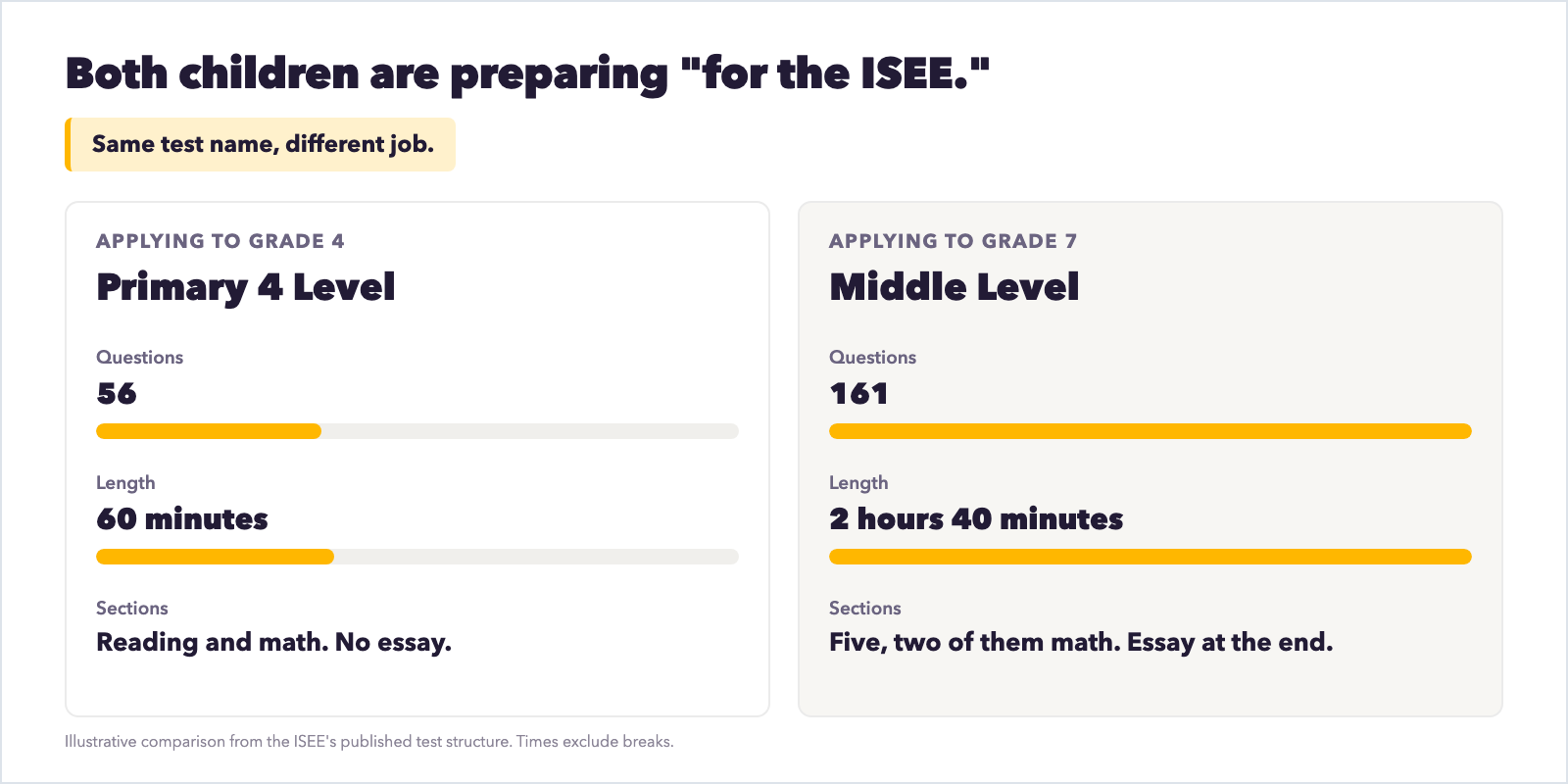
A third grader applying for grade 4 sits a one-hour test with no essay. A sixth grader applying for grade 7 sits 161 questions over two hours and forty minutes, essay included. Both are "the ISEE." So the useful preparation question is not what is on the ISEE. It is what your child's level asks.
- The rule that sets everything else
- Primary Levels 2, 3, and 4: applying to grades 2 to 4
- Lower Level: applying to grades 5 and 6
- Middle and Upper Levels: applying to grades 7 to 12
- A grade 4 applicant next to a grade 7 applicant
- Seasons, retakes, and booking
- ISEE scores: what the official pages say
- If you are still choosing between tests
- What to do next
- Where Cuemath fits
- Frequently asked questions
The rule that sets everything else
The ISEE is an admissions test for independent schools. Its publisher says over 1,200 schools accept it, for students applying to grades 2 through 12. It comes in levels: Primary Levels 2, 3, and 4 for children applying to grades 2, 3, and 4. Lower Level for applicants to grades 5 and 6. Middle Level for grades 7 and 8. Upper Level for grades 9 through 12.
The level is set by the grade applied to, never the grade your child sits in today. Applying for entry next school year means the test runs a grade ahead of the current classroom: a sixth grader applying for grade 7 takes the Middle Level, alongside applicants to grade 8. Check the level against your application grade before anything else, because the sections, the length, and the pace all depend on it.
| Level | Applying to | Questions | Length | Essay |
|---|---|---|---|---|
| Primary 2, 3, 4 | Grades 2 to 4 | 48 to 56 | 53 to 60 min | No essay |
| Lower | Grades 5 and 6 | 128 | 2 hr 20 min | 30-min essay, unscored |
| Middle | Grades 7 and 8 | 161 | 2 hr 40 min | 30-min essay, unscored |
| Upper | Grades 9 to 12 | 161 | 2 hr 40 min | 30-min essay, unscored |
Times exclude breaks. Question totals and times are the ISEE's published figures.
Primary Levels 2, 3, and 4: applying to grades 2 to 4
The Primary levels are short, built around reading and mathematics. There is no essay. The paper-testing section of the page says it plainly: there is no writing sample for the Primary levels.
- Primary 2, applying to grade 2: a short listening section called Auditory Comprehension (6 questions, 7 minutes), then Reading (18 questions, 20 minutes) and Mathematics (24 questions, 26 minutes). 48 questions, 53 minutes, plus a break.
- Primary 3, applying to grade 3: Reading (24 questions, 28 minutes) and Mathematics (24 questions, 26 minutes). 48 questions, 54 minutes, plus a break.
- Primary 4, applying to grade 4: Reading (28 questions, 30 minutes) and Mathematics (28 questions, 30 minutes). 56 questions, 60 minutes, plus a break.
Only Primary 2 has the listening section. On paper, Primary children mark answers straight in the test booklet, no separate answer sheet.
Notice the pace: at every Primary level, the math section gives roughly a minute per question. For a seven-year-old, the working skill is a steady rhythm and the stamina to sit a full hour, not advanced content.
Lower Level: applying to grades 5 and 6
The shape changes here. The Lower Level has five parts: Verbal Reasoning (34 questions, 20 minutes), Quantitative Reasoning (38 questions, 35 minutes), Reading Comprehension (25 questions, 25 minutes), Mathematics Achievement (30 questions, 30 minutes), and a 30-minute essay. The official table marks the essay unscored. Total: 128 questions, 2 hours 20 minutes, plus two breaks.
Two of the four scored sections are quantitative, and together Quantitative Reasoning and Mathematics Achievement hold 68 of the 128 questions. A child applying to grade 5 or 6 meets, for the first time, a test where math is split in two, one section named for reasoning and one for achievement, and where an essay ends the day.
Middle and Upper Levels: applying to grades 7 to 12
The page groups these two, and its own line settles the split: Middle Level applies to grades 7 and 8, Upper Level applies to grades 9 through 12, and the Upper Level is also used as a high school entrance exam. Both levels follow the same test structure.
The five parts stay and grow: Verbal Reasoning (40 questions, 20 minutes), Quantitative Reasoning (37 questions, 35 minutes), Reading Comprehension (36 questions, 35 minutes), Mathematics Achievement (47 questions, 40 minutes), and the 30-minute essay, still unscored. Total: 161 questions, 2 hours 40 minutes, plus two breaks.
The quantitative load rises to 84 questions across the two math sections. And the clock tightens: Verbal Reasoning runs 40 questions in 20 minutes, thirty seconds each.
A grade 4 applicant next to a grade 7 applicant
Put the two side by side and "preparing for the ISEE" stops being one sentence.
The grade 4 applicant sits Primary 4: 56 questions, one hour, reading and math, no essay, no separate reasoning sections.
The grade 7 applicant sits the Middle Level: 161 questions, nearly three times as many, across five sections, in a sitting well over twice as long, with two quantitative sections and an essay at the end.
Same test name, different job. The younger child's day is short, and mostly about staying settled and keeping pace. The older child's day is a stamina and pacing exercise before it is anything else. A preparation plan copied from one to the other fits neither.
Seasons, retakes, and booking
Families book through an online parent account that manages testing dates, accommodations, and score reports, for one child or several.
A student may take the ISEE once per testing season. There are three: Fall, Winter, and Spring/Summer, so up to three sittings in a school year. The page's own example: a child who tests in September has used the Fall season and waits at least until December, the Winter season, to test again. The planning consequence is simple. A fall first sitting leaves the Winter season open for a retake; whether a winter score lands before your deadlines depends on your dates, so count the seasons against them.
The test runs online and on paper, and availability varies by location. Both formats carry the same number of questions and the same timing, so where the choice exists, pick on comfort. The essay is typed online and handwritten on paper, which matters if your child's handwriting is slow.
ISEE scores: what the official pages say
Two scoring facts sit on the official page. The essay is unscored, so at the Lower, Middle, and Upper Levels the scores rest on the four multiple-choice sections. And students are scored only on correct answers. The page says there is no advantage to leaving a question blank, so an unanswered question is simply a point not attempted.
The score scale is explained on its own page. Scaled scores, stanines and percentiles are covered in our guide to reading an SSAT or ISEE score report, built from the organizer's own score-report pages. When you want to know how a given school reads ISEE scores, ask that school's admissions office directly. That answer is theirs to give, and it is more useful than any general chart.
If you are still choosing between tests
This page assumes the ISEE is already on your list. If you are still deciding between the SSAT and the ISEE, we wrote that choice up separately, built on the 49-school requirements file we keep. Read it first if your list is unsettled.
What to do next
- Write down the grade your child is applying to. That names the level. The current grade does not.
- Read that level's section list, not a general ISEE description. A Primary child prepares for reading and math at a steady pace, plus the short listening section for a grade 2 applicant. A Lower, Middle, or Upper child prepares for five sections, two of them quantitative, and a long sitting.
- Count the seasons backward from your earliest application deadline. One sitting per season, up to three a school year. A fall sitting usually leaves a retake window; check your own deadlines against the seasons.
- Book through the parent account and put the date on the family calendar.
The level rule does the sorting for you. Name the application grade, and the test's shape, length, and pace all follow from it.
Where Cuemath fits
We do not run a dedicated ISEE prep track, and this page is not an ad for one.
What we do teach is the conceptual reasoning both quantitative sections are built on, rather than speed drills and memorized tricks. If you are weighing a formal prep company and want to know where your child's math reasoning stands before you commit, a free Cuemath evaluation gives you that starting point.
Before you commit to a prep company, find out where your child actually stands.
Book a Free EvaluationFor students in Grades K to 12 worldwide.
Frequently asked questions
Which ISEE level should my child take?
The level is set by the grade your child is applying to, not the grade they are in now. Primary Levels 2, 3, and 4 are for applicants to grades 2, 3, and 4. Lower Level covers grades 5 and 6, Middle Level grades 7 and 8, and Upper Level grades 9 through 12. A sixth grader applying for grade 7 takes the Middle Level.
What is on the Middle Level ISEE?
Five parts: Verbal Reasoning (40 questions, 20 minutes), Quantitative Reasoning (37 questions, 35 minutes), Reading Comprehension (36 questions, 35 minutes), Mathematics Achievement (47 questions, 40 minutes), and a 30-minute unscored essay. Total: 161 questions, 2 hours 40 minutes, plus two breaks. The Upper Level, for applicants to grades 9 through 12, follows the same structure and is also used as a high school entrance exam.
Does the ISEE have an essay?
The Primary levels have no essay. There is no writing sample for applicants to grades 2 to 4. The Lower, Middle, and Upper Levels each include a 30-minute essay. The essay is unscored, so the scores rest on the four multiple-choice sections.
How long is the ISEE?
It depends on the level. The Primary levels run 53 to 60 minutes plus a break. The Lower Level is 128 questions over 2 hours 20 minutes. The Middle and Upper Levels are 161 questions over 2 hours 40 minutes. Lower, Middle, and Upper sittings include two breaks.
Is there a penalty for wrong answers on the ISEE?
No. Students are scored only on correct answers, and there is no advantage to leaving a question blank. An unanswered question is simply a point not attempted.
How many times can a child take the ISEE?
Once per testing season. There are three seasons, Fall, Winter, and Spring/Summer, so up to three sittings in a school year. A child who tests in September has used the Fall season and waits at least until December, the Winter season, to test again.
Should my child take the ISEE online or on paper?
Both formats carry the same number of questions and the same timing, so where the choice exists, pick on comfort. Availability varies by location. One difference: the essay is typed online and handwritten on paper, which matters if your child's handwriting is slow.
What is a good ISEE score?
There is no published answer. The organizer's own score-report pages explain the scale (scaled scores, stanines and percentiles), and our guide to reading an SSAT or ISEE score report walks through what each number means. What actually matters is how the schools on your list read scores, and that varies school by school. Ask each admissions office directly what range they typically admit. That answer is theirs to give, and it is worth more than any general chart.