Kumon Reviews 2026: Who It's For and Who Should Skip It?
Kumon is a worksheet-based math and reading program for building arithmetic fluency through daily repetition. It works well for K–5 students who need a structured math practice. It's a harder sell if your child needs a tutor to explain concepts and is already frustrated with math.


Most parents assume that Kumon is a tutoring program and look for Kumon reviews accordingly. It isn't. No math tutor takes the classes, makes a learning plan, and rebuilds concepts.
Students are given custom worksheets that they solve on their own. Kumon has instructors who are there to help with doubts and grade completed work. If a child doesn't understand a concept, the Kumon approach is to redo the worksheet until they hit the required accuracy rate. That is the model by design.
Kumon is also a franchise. There are 3,000+ centers across North America, each independently owned and operated. The worksheets come from Kumon's central system. Everything else (how engaged the instructor is, whether graders are qualified or high school students, what the cancellation terms look like) varies by location. Two Kumon centers in the same city can feel like completely different programs. That's why Kumon reviews are all over the place.
So instead of a single thumbs up or thumbs down, this blog goes through what parents on Trustpilot, Kumon website, and Reddit actually say, what Kumon costs, which students it's genuinely built for, and the questions worth asking before you commit.
How Did We Review Kumon?
Besides Kumon's official website and their public testimonials page, we reviewed:
- Reddit threads across r/Kumon, r/ABCDesis, r/homeschool, r/Parenting, and r/mathteachers. It has over 100 posts and comment threads going back to 2021 (but to keep things honest, we referred to recent threads only).
- Trustpilot: Kumon's Trustpilot page had 12 reviews with a 2.2/5 average as of 2026. That is not enough data to conclude from, and we have noted it as a limitation rather than a signal.
- Parent community forums and Facebook groups where families discuss after-school math programs.
- Accounts from current and former Kumon students, including former Kumon center employees, who described how grading and instruction actually work inside a center.
We also reviewed Kumon's pricing, enrollment process, and curriculum scope across multiple US locations.
Is Kumon Worth It? Quick Answer
- Is in K–5 and still counts on their fingers, hasn't nailed times tables yet, or needs more repetition to get the basics to stick
- Can push through repetitive or boring work without giving up — they might not love it, but they'll do it
- Has a parent who can sit with them for 30 minutes of worksheet practice most days at home
- Is behind and needs someone to explain the concept, not just repeat practice until it clicks
- Finds repetition demotivating — they already find math frustrating or tends to give up when things don't come quickly
- Needs tutoring that reinforces what their teacher is covering right now — Kumon doesn't align with US school curricula
- Is in middle school or high school and needs help with algebra, pre-algebra, or test prep
- Needs to understand why math works, not just get faster at it
What is Kumon?
Kumon is an after-school math and reading program. Students attend the center twice per week, pick up worksheets, and complete 30 minutes of additional practice at home every day. Students solve problems on their own, advance when they hit the required accuracy rate, and redo worksheets when they don't.
Since 2024, Kumon has launched Kumon Connect, a tablet-based digital version of the same program for students who cannot attend a physical center.
How Does Kumon Work?
Kumon follows its own internal curriculum sequence, not the US Common Core standards. A 4th grader struggling with fraction concepts and word problems at school may be placed at a lower Kumon level and spend months on arithmetic drills that have no connection to what their teacher is covering that week. If you are looking for tutoring that reinforces your child's school curriculum, Kumon is not designed to do that.
Is Kumon a Good Option for Your Child?
This is the section most Kumon review articles skip. It is the most important one.
Kumon is not tutoring in the way most parents understand that word. The goal is arithmetic speed and calculation fluency built through high-repetition practice. If that is what your child needs right now, Kumon can work. If that is not what your child needs, the reviews will not match your experience.
How Kumon fits by grade:
| Grade band | Kumon fit | What to know |
|---|---|---|
| K–2 | Strong fit | The juniors section offers more 1:1 attention; building arithmetic facts through daily repetition at this age has clear evidence behind it |
| Grades 3–5 | Good fit if at or near grade level | Works for solidifying arithmetic before pre-algebra; breaks down when students hit concepts they have not yet been taught in school |
| Grades 6–8 | Mixed | Useful for arithmetic drill and pre-algebra fluency; struggles with algebra and new concepts that require explanation |
| Grades 9–12 | Not recommended | Self-instruction model does not scale to abstract high school concepts; no SAT, ACT, or AP prep offered |
Beyond grade level, Kumon works best for students who:
- Are self-motivated and can work independently for 30 minutes on worksheets without losing focus or needing encouragement
- Have a parent at home who can supervise the daily worksheet routine. This is not optional. The model depends on consistent home practice
- Are working toward arithmetic fluency: addition, subtraction, multiplication, division, fractions, and foundational algebra, not conceptual depth
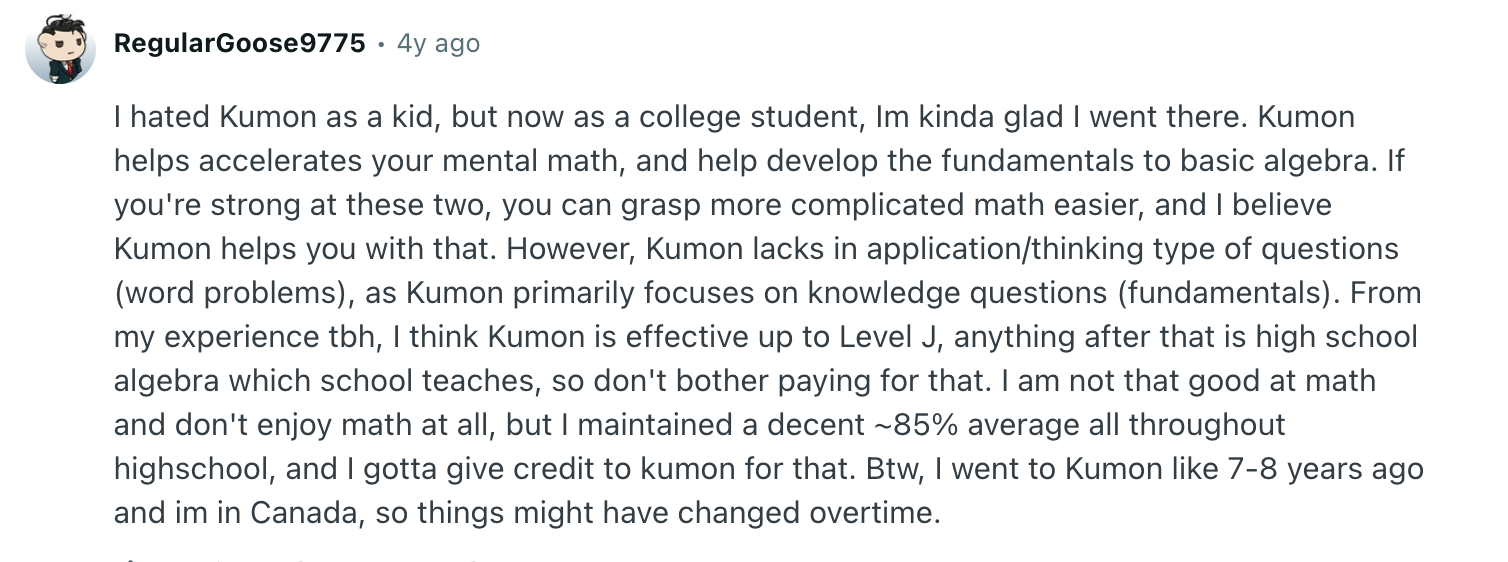
A former Kumon student, now in college, reflected on Reddit:
"I hated Kumon as a kid, but now as a college student, I'm kinda glad I went there. Kumon helps accelerate your mental math and helps develop the fundamentals of basic algebra. If you're strong at these two, you can grasp more complicated math more easily."
Kumon is not the right fit for students who:
- Are significantly behind and need someone to explain concepts they do not yet understand
- Have not been introduced to a concept and need instruction before they can practice it
- Are advanced learners who need deeper problem-solving, mathematical reasoning, or creative applications
- Need tutoring that reinforces what they are learning in school right now. Kumon runs on its own internal sequence and does not follow Common Core or your child's classroom curriculum
Kumon Reviews from Parents: What the Ratings Actually Show?
Most parents searching for Kumon reviews from parents online find one of three things:
- Kumon's curated testimonials page
- Trustpilot rating with too few reviews to be meaningful
- Reddit threads where families share unfiltered experiences.
Here is what each actually tells you.
Kumon's Official Testimonials
Kumon has a dedicated page on reviews and student testimonials. Each of the review links to several YouTube videos of Kumon students from 5-10 years ago.
Recently, there have been no reviews or videos of students on the website.
Trustpilot: Not Enough Data to Use
Kumon's Trustpilot page had 12 reviews with a 2.2/5 average as of 2026. For a program serving millions of students across thousands of centers, 12 reviews are not a meaningful sample. We have not used this number as a signal in either direction.
Reddit: Where the Real Picture Comes From
Reddit is where Kumon reviews from parents become genuinely useful.
What parents say Kumon does well:
"I hated it at first but finished the math program and am almost done with the reading. I got a 34 on the ACT in 10th grade mostly because of Kumon." (r/ABCDesis)
"It taught me to believe in my abilities and that given time and patience, I can find a solution to every problem." (r/ABCDesis)
"Repetition makes it easier to remember the basic principles." (Parent, Kumon testimonials)
"I maintained a decent ~85% average all throughout high school, and I gotta give credit to Kumon for that." (r/ABCDesis)
What parents say does not work:
"Kumon doesn't teach. If your kid doesn't get it, they just repeat the same worksheet." (r/Parenting)
"There is no real tutoring. The tutors only grade and keep kids on task. The workbooks are meant to be self-instructing." (Former Kumon instructor, r/homeschool)
"My question is, is it worth $200 a month to watch my kids write on an iPad?" (r/Kumon, April 2025, on Kumon Connect)
"The only thing I got out of Kumon was trauma." (r/ABCDesis)
The split is not random. It maps almost exactly onto the student profile in the section above.
Kumon Franchise Reviews: Center Quality Varies by Location
One parent on Reddit described a center with rigid rules, two-year contracts, and an instructor who accused a student of cheating for solving multiplication problems by recognizing that the questions were reversed. A former Kumon employee at a different center described an approach where instructors waited until a student's third attempt before stepping in — and noted that "any center that does in fact never interact with their students is straight-up a bad Kumon center." (r/ABCDesis)
The gap between a well-run and a poorly-run Kumon franchise is significant. The graders at many centers are high school students, not credentialed instructors. One former student who later worked at Kumon described the grading dynamics: "The people correcting the worksheets were in high school themselves, so mistakes and sloppiness were commonplace." (r/ABCDesis)
What this means before you enroll:
Visit the center before committing. Sit in during an active session. Ask the instructor about their background and how they handle it when a student does not understand a concept. Ask about the cancellation and refund policy before signing anything — some centers require 30 days' notice and do not refund unused sessions.
If there are multiple Kumon centers in your area, visiting more than one is worth the time.
Kumon Tutoring Reviews: The Teaching Model Explained
The word "tutoring" in "Kumon tutoring reviews" can mislead parents searching for live, instruction-based help.
Kumon is not tutoring in the conventional sense.
A typical session looks like this: your child arrives at the center, picks up their packet of worksheets, and sits at a long table alongside other students who are each working on their own packets. They work in near-silence for 20 to 30 minutes. When they finish, they hand in the completed sheets. A grader marks the answers and returns the packet. If there are mistakes, the child corrects them before leaving. The interaction between instructor and student is minimal — closer to a supervised study hall than a tutoring session.
This is by design, not a shortcut. The Kumon Method's theory is that self-directed learning builds resilience, discipline, and independent problem-solving habits. Those are real skills. Many students who went through Kumon credit it for the study habits and mental math speed they carry into adulthood.
The practical implication: if your child encounters a concept they do not understand, there is no tutor to explain it.
As one parent and former Kumon employee described on Reddit: "How do you expect a 9-year-old to teach themselves advanced math concepts they have never heard of before? Kumon isn't a tutoring center, as some people believe. Anybody hardly ever sat down with you and explained things to you." (r/ABCDesis)
Kumon tutoring reviews that describe "no real teaching" are not describing a broken center. They are describing how the program is designed to work.
Kumon vs. Cuemath vs. Mathnasium
Here is how the three most commonly compared programs differ for US parents. Kumon and Mathnasium both focus on math fundamentals, but their teaching models are different. Cuemath is the only one of the three that provides live 1:1 instruction from a dedicated tutor.
Cuemath is one of the programs in this comparison. The same evaluation criteria apply to all three.
| Kumon | Cuemath | Mathnasium | |
|---|---|---|---|
| Format | Self-paced worksheets | Live 1:1 online tutoring | In-person or online, instructor-led |
| Grades served | PreK–12 | K–12 | K–12 |
| Teaching model | Self-instruction; instructor grades, not teaches | Expert tutor leads every session | Instructor guides students; small group or 1:1 |
| Same instructor | No fixed instructor | Yes — same tutor every class | Varies by center |
| Subjects | Math + Reading | Math only | Math only |
| In-person option | Yes (centers + Kumon Connect online) | No — fully online | Yes (centers + online option) |
| Cost | $140–200/subject/month | From $25/class (K–7); $32/class (Gr. 8–12) | $150–250/month |
| Startup fees | $600–700 (registration + materials + deposit) | None | Free placement assessment |
| Free trial | Free placement assessment | Free class + free MathFit Evaluation | Free assessment |
| Trustpilot | 2.2/5 (12 reviews — insufficient data) | 4.9/5 (9,667 reviews) | ~4.0/5 |
| Best for | Arithmetic fluency, self-motivated students ages 4–8 | Concept-first 1:1 tutoring for K–12 | Closing foundational math gaps in-person |
The clearest distinction between Kumon and Cuemath: Kumon builds worksheet discipline. Cuemath builds mathematical thinking. The difference shows up when a student encounters a problem they have never seen before.
Your Child Deserves a Tutor Who Can Actually Explain It
If your child needs more than a worksheet, try a live 1:1 Cuemath class for free. Same tutor, every class. No commitment.
Book a Free ClassGrades K–12 · Free MathFit Evaluation included
Achievements of Cuemath Students
Suggested reading
Kumon for Middle Schoolers: Is It Worth It?
One former student on Reddit summed it up this way: "Kumon is effective up to Level J. Anything after that is high school algebra, which school teaches, so don't bother paying for that." (r/ABCDesis) Level J maps roughly to late 7th or early 8th grade material. That is a reasonable ceiling to plan around.
For a middle schooler who needs to drill foundational arithmetic, Kumon can work.
For a middle schooler who needs algebra concepts explained: A live 1:1 tutoring program is a better fit.
Kumon for High School Students: Is It Worth It?
Probably not, and this comes up consistently in Kumon reviews from parents of older students.
Kumon's curriculum technically covers through calculus. But the self-instruction model becomes increasingly strained as concepts get more abstract. High school math — Algebra 2, Precalculus, AP Calculus, Statistics — requires explanation, not more worksheet repetition. A student who does not understand what a function is will not learn it by redoing worksheets until they hit an accuracy threshold.
The practical limitations for high schoolers:
- Kumon does not offer SAT, ACT, or AP exam prep
- The worksheet format does not cover the reasoning and multi-step application questions that dominate standardized tests
- High school math requires a tutor who can identify and explain a conceptual gap in real time
For high schoolers, a live 1:1 tutoring program that aligns with their school curriculum and covers test prep is a better match. Cuemath's high school program covers the full curriculum from Algebra through AP Calculus, with SAT Math prep included in 6-month and 12-month plans — all in live sessions with the same assigned tutor every class.
Your Child Deserves a Tutor Who Can Actually Explain It
If your child needs more than a worksheet, try a live 1:1 Cuemath class for free. Same tutor, every class. No commitment.
Book a Free ClassGrades K–12 · Free MathFit Evaluation included
Is Kumon Worth the Cost in 2026?
Kumon costs $140–$200 per subject per month at most US centers. There are also upfront costs most parents do not expect: a $50 registration fee, $30 for materials, and many centers charge a security deposit equal to one month's tuition. The first-month cost for one subject often totals $200–$280 before a single session is attended.
One of the most frequently cited Kumon reviews from Reddit came from a former seven-year Kumon employee: "Are the center worksheets better than the $8 workbooks? Yes. Are they $200/month better? Definitely not."
The value question comes back to the student profile. If your child is the right fit — young, self-motivated, needs arithmetic fluency — the cost can be justified by the outcomes. If your child needs instruction and is not getting it, you are paying $200/month for a worksheet program.
One more note on cost: cancellation terms vary by center, but many require 30 days' notice and do not refund unused sessions. One parent on Trustpilot described being required to pay another full month before cancellation was processed. Read the enrollment agreement before signing.
Looking for a Program That Explains the Why, Not Just the What?
Try a live 1:1 Cuemath class for free. Your child gets a dedicated tutor, a free evaluation, and no long-term commitment.
Book a Free ClassGrades K–12 · 200,000+ students · 4.9/5 on Trustpilot
Frequently Asked Questions
What are some popular Kumon reviews from parents?
Kumon reviews from parents are consistently split by student type. Parents of self-motivated young children who need arithmetic fluency generally report good results and better study habits. Parents of students who needed concept instruction or were significantly behind report little progress and frequent frustration.
Is Kumon tutoring effective for struggling students?
Kumon tutoring is generally not effective for students who are significantly struggling with concepts they do not yet understand. The model relies on self-instruction: if a student does not understand a concept, the Kumon approach is to redo the worksheet until they get it right — there is no tutor who steps in to explain the gap. Students who need actual instruction are better served by a live 1:1 tutoring program where a qualified tutor can identify and explain the specific sticking point.
How much does Kumon cost per month?
Kumon costs $140 to $200 per subject per month at most US centers, with California and major metro areas often running $200 to $250 per month for one subject. For two subjects, the monthly total is typically $280 to $400. Upfront fees add to the first-month cost: a $50 registration fee, $30 for materials, and many centers charge a security deposit equal to one month's tuition. The effective first-month cost for one subject often runs $200 to $280 before any sessions are attended.
What is the Kumon Method and how does it work?
The Kumon Method is a self-paced, worksheet-based learning system developed by Toru Kumon in 1954. Students work through a structured sequence of math and reading worksheets independently. Instructors at the center grade completed work rather than providing direct teaching. Students redo worksheets until they hit a target accuracy rate before advancing to the next level. Sessions happen twice per week at the center, with 30 minutes of daily worksheet practice required at home. The goal is mastery through repetition at the student's own pace.
Is Kumon good for elementary school students?
Kumon can work well for elementary students in the K to 3 range if the child is self-motivated and the parent can consistently supervise daily worksheets. The juniors section (ages 4 to 7) offers slightly more 1:1 instructor attention and is designed for very early learners. For elementary students who need concept instruction rather than drill practice, or who find repetitive worksheets demotivating, the program is less effective, and dropout rates are notably higher.
Is Kumon worth it for high school students?
Kumon is generally not the best fit for high school students. High school math requires concept explanation for topics like Algebra 2, Precalculus, AP Calculus, and Statistics. Kumon does not offer SAT, ACT, or AP exam prep. For high school math support, a live 1:1 tutoring program that covers the full curriculum and includes test prep is a stronger match.
What are some popular Kumon tutoring reviews?
The most common Kumon tutoring review is that there is no math tutoring (instructors grade worksheets, not teach). Sometimes, Kumon's method of repetition demotivates students who are not drill-motivated, significant quality differences across franchise locations, strict cancellation policies, and high upfront costs.
How does Kumon compare to Cuemath for elementary and middle school students?
Kumon is self-paced and worksheet-based. Kumon is effective for building arithmetic fluency through repetition, but without instruction or concept explanation.
Cuemath offers live 1:1 online math tutoring classes with a dedicated tutor who explains concepts, adjusts in real time to the student's pace, and covers the full US math curriculum aligned to Common Core. For students who need math tutoring that focuses on concepts first, then builds problem-solving and critical thinking skills, Cuemath is a better option.
Does Kumon provide test preparation for any grade?
No, Kumon does not offer tutoring programs for test prep. Kumon's math program builds foundational arithmetic skills. It does not focus on problem-solving, analytical thinking, or practical skills needed to crack US tests.
What are the things parents should check before deciding on a Kumon franchise center?
Before enrolling, visit the Kumon center during an active session. Watch how instructors interact with students who are confused or making mistakes. Ask the instructor about their educational background and whether graders are qualified instructors or high school students.
Ask about the Kumon cancellation policy specifically, whether there is a notice period and whether unused sessions are refunded.
Does Kumon offer a free trial class?
No, Kumon has no free trial classes. Most Kumon centers offer a free placement assessment that evaluates your child's current level and determines where in the worksheet sequence they will start. However, parents can check with their local Kumon centre if they are willing to provide a free demo of the class.
Sources
- r/ABCDesis — “For those of you who did Kumon, was it even worth it?” (Reddit, August 2021)
- Kumon official reviews and testimonials page
- My Engineering Buddy — “Kumon Review: Pricing, Features & Alternatives”
- Brighterly — “Kumon Reviews: Is It Worth It in 2026?”
- r/mathteachers, r/homeschool, r/Kumon — parent and student discussions on Kumon (Reddit, 2021–2026)