Australia Is 16th in the World in Maths! (PISA 2025 Results Out)
Australia remains a "strong performer" in the world's biggest school assessment, PISA 2025 results confirm — even as maths and reading scores keep sliding. Here's the full breakdown, including the parts of the story that got less attention.

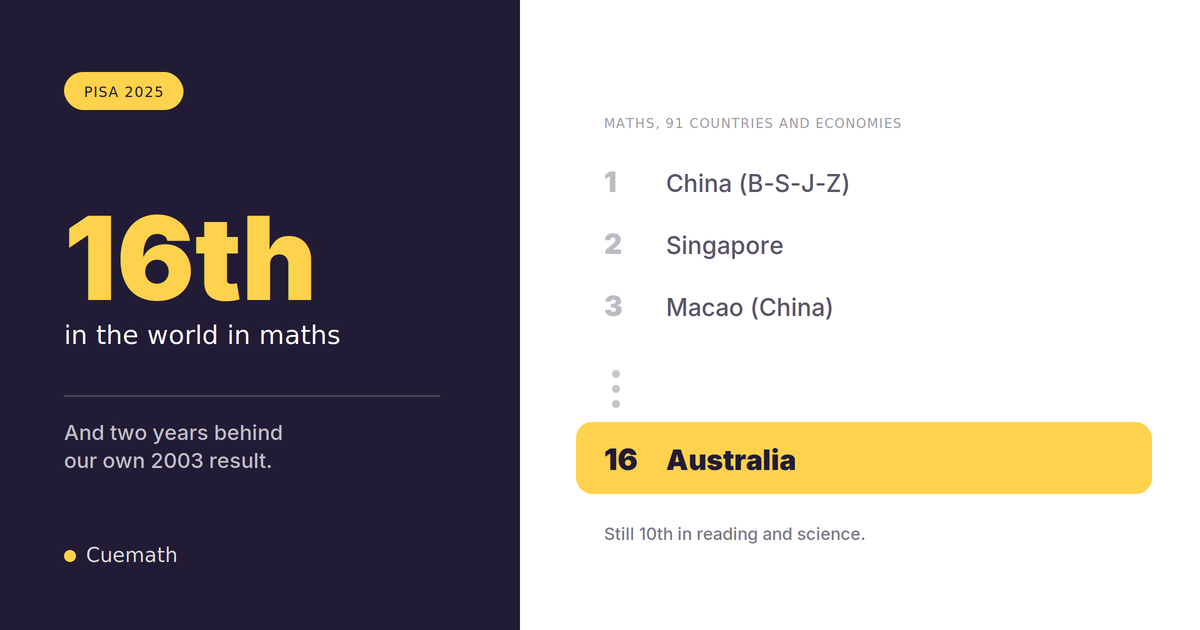
Australia’s students remain a “strong performer” in the world’s biggest school assessment, even as maths and reading scores keep sliding, the newest PISA 2025 results show. Released on 8 September 2026, the assessment tested more than 760,000 15-year-olds across 91 countries, including 14,658 Australian students from 766 schools.
Australia ranked in the top 20 globally in every subject tested — but maths scores have now dropped 46 points since 2003, the steepest long-term decline of any subject. The results matter because they shape the school reforms already underway across the country.
Coverage: 91 countries and economies participated.
Source: OECD PISA 2025 (Volume I) and ACER.
The Rankings, at a Glance
Australia finished well above the OECD average in every subject, according to ACER, the body that runs PISA in Australia. Two things stand out once you look past the overall “strong performer” line.
- Maths is Australia’s weakest subject by rank — 16th, against 10th in both science and reading
- The UK climbed several places this round — 3 in reading, 4 in maths, 7 in science — which Education Minister Jason Clare pointed to as an example worth learning from
- The countries ahead of Australia across the board: Singapore, several regions of China, Macao, Chinese Taipei, Japan, Korea, and Estonia
What Are Experts Saying About the Results?
Reactions ranged from cautious optimism to real concern.
- ACER research director Dr Jonas Bertling said Australia can be “quite content” with the overall result, while calling the long-term maths and reading declines a genuine challenge
- Deputy principal Dr Greg Ashman said Australia’s maths trend “probably reflects the poverty of our mathematics curriculum”
- Education Minister Jason Clare pointed to screen time, saying the data shows “the more kids are online, the more their results decline”
- Teachers’ union president Correna Haythorpe said the results reveal an “unacceptably large gap” between advantaged and disadvantaged students
The Good News Nobody’s Talking About
A few results are easy to miss under the bigger headline numbers.
- First Nations students improved by 16 points in science since 2022
- 30% of low-income students were classified as “resilient” — performing among the highest achievers despite disadvantage
- Australia scored well above average in “Learning in the Digital World,” with 38% of students rated high achievers in that domain
What This Means for Maths at Home
Maths had the steepest decline and the lowest proficiency rate of any subject tested. PISA doesn’t test school curriculum directly — it tests whether a 15-year-old can apply maths to a real problem, which is exactly where step-by-step understanding matters more than speed.
Programs like Cuemath’s 1-on-1 online maths tutoring, aligned to the Australian Curriculum, are built around that same idea — reasoning through a problem, not just getting to the answer faster.
Looking Ahead
This isn’t the full picture yet.
- A second report, covering school and student characteristics in more depth, is due 1 December 2026
- The government’s maths curriculum reform advice is still expected within weeks, separate from this release
- Education ministers are due to discuss the results, including screen time in schools, at a meeting later this year
Sources:
Australia a ‘strong performer’ in PISA 2025 despite plunging maths and reading results, EducationHQ (9 September 2026)
Programme for International Student Assessment (PISA), Australian Council for Educational Research (ACER)

I write because I like understanding things properly, and I've never been able to do that quietly.
Six years in, what still interests me most isn't the writing itself. It's the person on the other side. Who are they, what were they actually worried about when they opened this page, and did they leave with what they came for? Most content fails that last test. It answers the easy question instead of the one that was asked.
At Cuemath, I write for parents and students in India and around the world. That range is the part I enjoy. A parent in Bangalore and a parent in Canada are asking about the same child, but not always in the same words, and that difference matters.
So I research before I write. Not just search results. Forums, reviews, the long comment threads where somebody finally admits what they're really confused about. That's usually where the useful thing is hiding.
I also spend time on how people find this writing at all, since a growing number of them now ask an AI instead of typing into Google. But that only works if the writing is clear to begin with. There's no shortcut around that part.