Probability in Real Life
Learn about real-life applications of probability. Statistics and Probability with applications. Examples of probability in real life.

School math + test prep + skills AI can't match, at $0 cost.
Everything your child needs from Grade K to 12, curriculum mastery, test prep, and enrichment math, is now in one free app.
Simple log in with email, nothing else
Introduction
On tossing a coin, the outcome will be either ahead or a tail, the result is easily predictable. But what if you toss two coins at the same time? The result can be a combination of head and tail. In the latter case, the correct answer can not be obtained, so only one can predict the possibility of a result. This prediction is known as Probability. Probability is widely used in all sectors in daily life like sports, weather reports, blood samples, predicting the sex of the baby in the womb, congenital disabilities, statistics, and many. In this topic, we will learn in detail about probability.
What is probability?
The likelihood of the occurrence of any event can be called Probability.
Application of probability
Some of the applications of probability are predicting the outcome when you:
- Flipping a coin.
- Choosing a card from the deck.
- Throwing a dice.
- Pulling a green candy from a bag of red candies.
- Winning a lottery 1 in many millions.
Probability in Mathematics
Al-Khalil, a middle eastern mathematician, wrote the Book of Cryptographic Messages, which demonstrates the first use of permutation and combination to list all the Arabic words with or without vowels. This was the earliest form of probability and statistics.
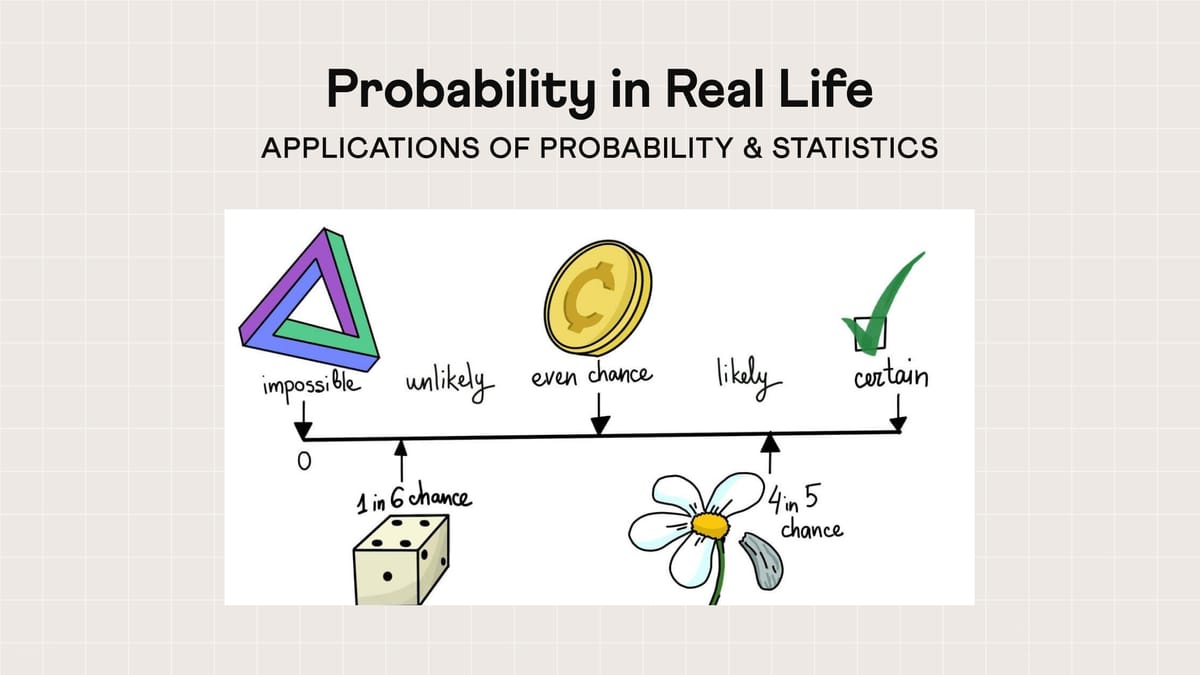
Probability is a branch of mathematics relating to the numerical illustration of how likely an event is to occur. The likelihood of any event to occur is a number between 0 and 1, where 0 indicates the impossibility of the event and 1 indicates certainty.
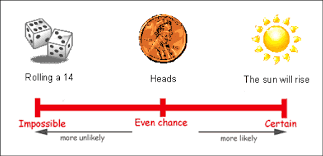
Probability theory is widely used in the area of studies such as statistics, finance, gambling artificial intelligence, machine learning, computer science, game theory, and philosophy.
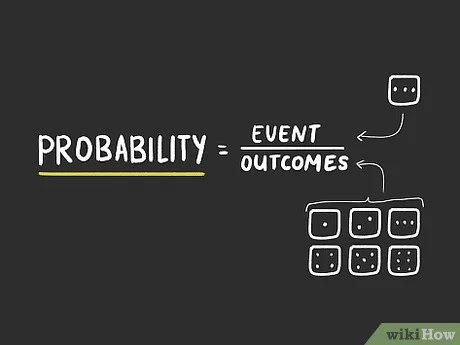
Formula to calculate the probability
Examples of Real Life probability
Weather Planning:
A probability forecast is an assessment of how likely an event can occur in terms of percentage and record the risks associated with weather. Meteorologists around the world use different instruments and tools to predict weather changes. They collect the weather forecast database from around the world to estimate the temperature changes and probable weather conditions for a particular hour, day, week, and month.
Sports Strategies:
In sports, analyses are conducted with the help of probability to understand the strengths and weaknesses of a particular team or player. Analysts use probability and odds to foretell outcomes regarding the team’s performance and members in the sport.
Coaches use probability as a tool to determine in what areas their team is strong enough and in which all areas they have to work to attain victory. Trainers even use probability to gauge the capacity of a particular player in his team and when to allow him to play and against whom.
Insurance:
insurance companies use the theory of probability or theoretical probability for framing a policy or completing at a premium rate. The theory of probability is a statistical method used to predict the possibility of future outcomes.
In Games:
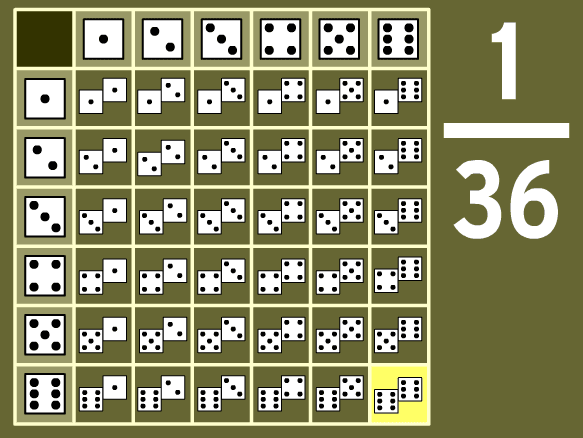
Blackjack, poker, gambling, all sports, board games, video games use probability to know how likely a team or person has chances to win.
Game Theory:
It is the study of mathematical representation of strategic relations among analytical outcomes. It has applications in social science, logic, system science, and computer science. In 1944, John Von Neumann published a paper, "Theory of Games and Economic Behaviour". He proved Brouwer’s fixed point theorem on continuous mapping into compact convex sets, the standard game theory method.
Application of probability in Game theory:
1.Economics and business: Economists use game theory as a tool to analyze economic competition and phenomena such as bargaining, voting theory, auction, mechanism design. Executives, investors, and managers in the business world use the game theory strategy for investments, launching of new products, or entering a new business. Game theory models force each player to consider the action made by their competitor and plan the next strategy.
2. In politics: Diplomats and politicians use game theory to analyze any situation of conflict between individuals, companies, states, and political parties. It is also used in war strategies, political voting, and political affairs.
3. In philosophy: Philosophers use game theory in various aspects of philosophy.
4. In biology: It is applied to the analysis of the abnormal natural phenomenon in biology.
Summary
FAQs
What is the definition of probability?
Probability in mathematics can be defined as the number of possible outcomes in an event.
How to calculate probability?
Probability= number of favourable outcomes/ number of possible outcomes
How is probability used in everyday life?
- Weather forecasting
- Calculation of batting average in cricket.
- How likely one can win a lottery ticket.
- Playing cards
- Voting strategy in politics
- Rolling a dice.
- Pulling black socks from a drawer of white socks.
- Buying or selling Insurance.
What are the 3 types of probability?
- Theoretical probability
- Experimental probability
- Axiomatic probability
What are the 5 rules of probability?
- Rule 1: For any event, 'A' the probability of any outcome lies between 0 and 1, where 0 is the event which never occurs, and 1 is the event will certainly occur
0 ≤ P(A) ≤ 1
- Rule 2: The sum of probabilities of all possible outcomes is 1.
if S is sample space in the model then P(S) = 1
- Rule 3: If A and B are two mutually exclusive events then
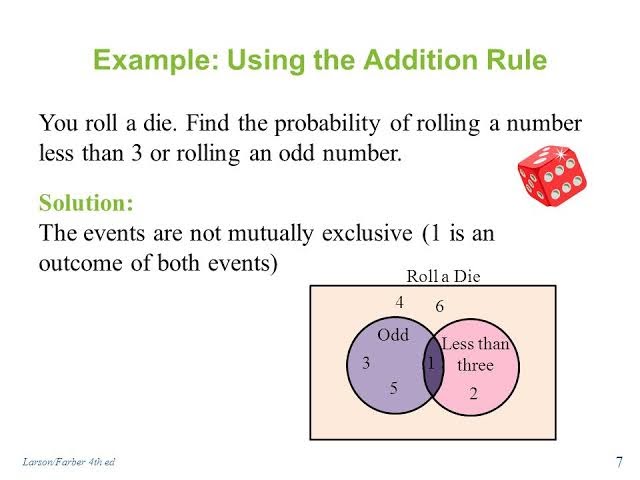
P (A or B) = P (A∪ B) = P (A) + P (B).
This is the addition rule for disjoint events.
- Rule 4: The complement of any event A is the event that consists of all the outcomes that are not in A.
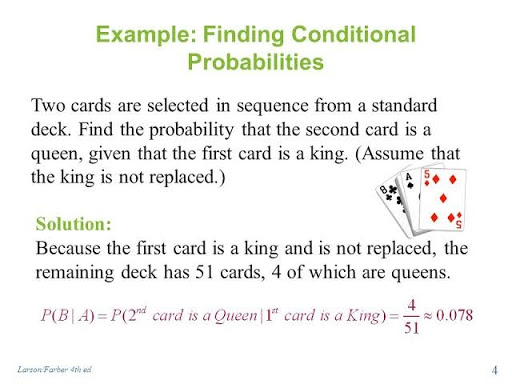
- Rule 5: If both A and B are independent, then the conditional probability that event B occurs given that event A has already occurred.
P ( A and B) = P (A) P (B | A).This is called the General rule of multiplication.