


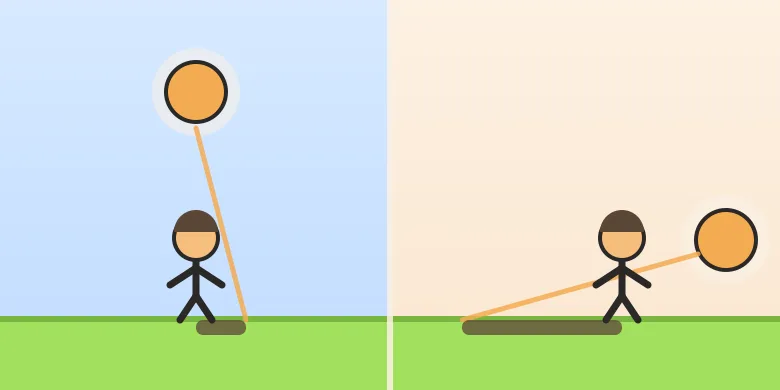
The Shadow Clock
Your shadow is never the same twice. Can you read it like a clock?
Concept
A shadow's length tells you how close it is to the middle of the day; its direction tells you which side of midday you're on. Together, they can tell the time — without a clock.
The Experience
Kid starts by moving the sun across the sky and watching a shadow respond in real time: long when the sun is low, almost gone when it's directly overhead, then swinging to the opposite side once the sun passes over — with the two ends of the sky simply labeled "the sun comes up" and "the sun goes down."
After learning to measure shadow length in blocks, the kid predicts what the shadow will look like by lunchtime, then measures it at six different times across the day, building their own row of numbers.
Looking at that row, the kid finds the shortest shadow of the day and notices the shape the numbers make — long, shrinking, shortest at midday, then growing long again: a valley.
The twist that earns the word "clock": the kid discovers that the early-morning shadow and the evening shadow are both exactly the same length — 8 blocks — so length alone can't say which is which. Only direction can break the tie.
With that, the kid orders three same-length shadows from earliest to latest using direction alone, then is shown a brand-new shadow and asked to name the time of day it belongs to — and the reverse: given a time, pick the matching shadow.
The exploration closes on the same kid from the very first screen, now at a different time of day, their shadow shrunk down to almost nothing under the overhead sun.
What Math Does The Kid Do?
- Reads a changing measurement (shadow length) in response to a changing input (sun position).
- Measures length using a repeated unit (counting blocks).
- Collects and records six data points across a day and looks for a pattern in them.
- Recognizes that two different measurements can share the same value (both 8 blocks) while representing different real situations.
- Uses a second variable (direction) to resolve an ambiguity that one variable (length) alone can't.
Why This Matters
You can look at a shadow and estimate roughly what time it is — not by memorizing a rule, but because you know both its length and its direction carry real information.
Frequently asked questions
The Shadow Clock is tagged for Grades K-3.
No — The Shadow Clock plays directly in the browser, right on this page. No login, no download.
Spot the hidden structure repeating inside something that looks random.
No — The Shadow Clock is free to play, no sign-up needed.