5 Best Math Apps for Kids in 2026 (Free & Paid, by Age)
Five math apps compared by age, 2026 price and what each one does well. Includes the best free math apps, the best mental math options, and a three-question way to pick the right one for your child.

The best math apps for kids help your child practice a little every day, understand why each step works, and build skills that show up in class and on tests. The best apps for kids to learn math also adjust to your child's level, so practice is never too easy or too hard.
We compared the apps parents search for most and narrowed them to five, then wrote down what each does well, what it costs in 2026, and where it stops being useful.
- What Is the Best Math App for Kids?
- Best Math Apps for Kids at a Glance
- How Did We Choose These Math Apps?
- 5 Best Apps for Kids to Learn Math in 2026
- 1. Cuemath
- 2. SplashLearn
- 3. Prodigy Math
- 4. Khan Academy Kids
- 5. IXL
- Which Math App Fits Which Problem?
- Best Free Math Apps for Kids
- Best Mental Math Apps for Kids
- How to Choose the Best Math App for Your Child
- Frequently Asked Questions
What Is the Best Math App for Kids?
Cuemath is the best math app for most kids from kindergarten to grade 12. It combines visual lessons, daily adaptive practice, test prep and puzzles in one app, and its "cue, don't tell" approach guides children with questions and hints instead of handing over answers. A live 1:1 tutor is optional.
Parents rate Cuemath 4.9+ on Trustpilot. Here is what you get inside the app.
| Section | What your child does | Why it helps |
|---|---|---|
| School Math | Works through grade-level lessons where every concept is explained visually, at the difficulty level you set | Improves classwork and grades, with practice built toward mastery |
| Test Prep | Takes timed mock tests and practice tests with guided hints, then reviews detailed step-by-step solutions | Builds test-day confidence before the real exam |
| Enrichment | Explores real-life math, logic puzzles and math games | Builds reasoning and judgment beyond the school curriculum |
Best Math Apps for Kids at a Glance
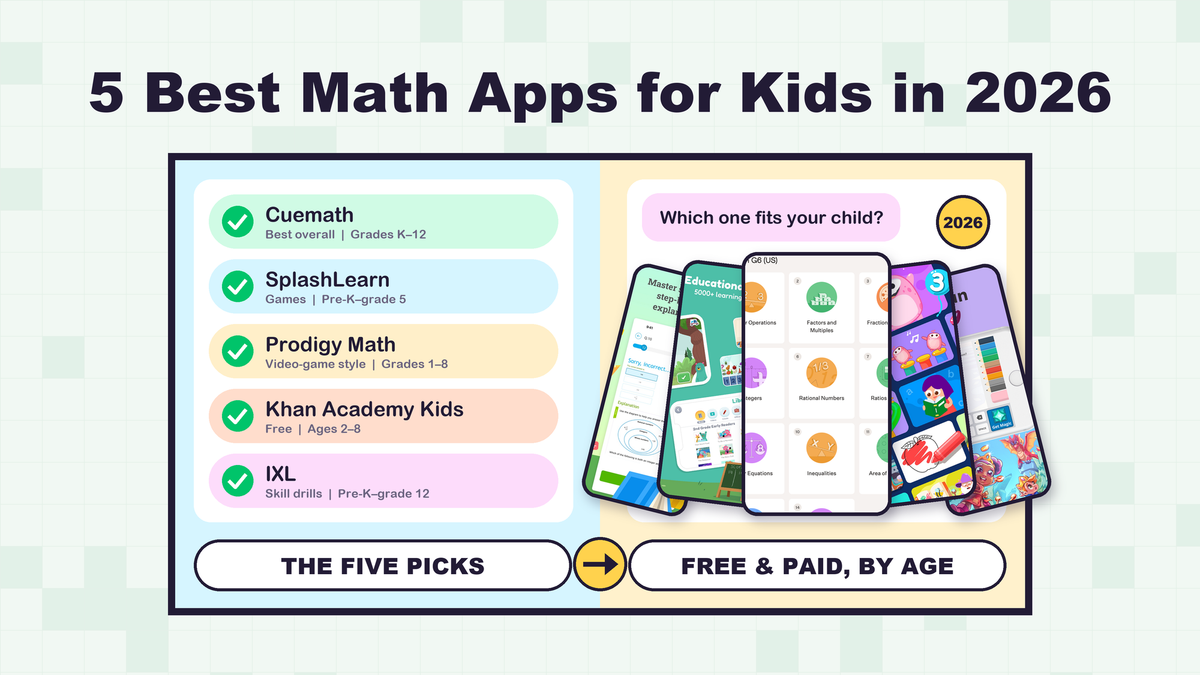
Here is how the five apps compare on what they do best, which grades they cover, and what they cost.
| App | Best for | Ages / grades | Price (checked Nov 2026) |
|---|---|---|---|
| Cuemath | Best overall: daily practice, test prep, optional live tutor | Grades K–12 | Live tutoring from $15/class on a 12-month plan (source) |
| SplashLearn | Game-based practice in elementary school | Pre-K–grade 5 | 7-day free trial, then from $7.49/month billed yearly (source) |
| Prodigy Math | Kids who love video games | Grades 1–8 | Free math; memberships from $9.95/month (source) |
| Khan Academy Kids | Free early learning | Ages 2–8 | Free (source) |
| IXL | Skill-by-skill practice and diagnostics | Pre-K–grade 12 | From $9.95/month (source) |
Source: each company's official website or App Store listing, checked November 11, 2026. Prices change, so confirm on the app's plan screen before you subscribe.
How Did We Choose These Math Apps?
We started with the apps that appear most often when parents search for math apps, then kept the five that best passed three tests:
- Builds real skills. The app teaches and practices math instead of handing over answers.
- Grows with your child. It adapts to your child's level or covers several grades.
- States ages and prices clearly. You can see who it is for and what is free before you download.
Every pick below gets a "Best for" line and a "Good to know" line, because every app has a limit. The comparison is based on each company's published features, ages and pricing.
See How Cuemath Teaches the Why
Start the Cuemath app free and let your child try a lesson, a daily practice set and a puzzle. Add a live 1:1 tutor only if you want one.
Try the Cuemath App Free100% free to start · No credit card · About 15 minutes a day · Grades K–12
5 Best Apps for Kids to Learn Math in 2026
Each app follows the same format so you can compare quickly: what it is, the features that are important, quick facts, and who it suits.
1. Cuemath: Best Overall Math App for Kids
Cuemath is a K–12 math app built around short daily practice, with an optional live 1:1 tutor when your child needs more than practice. Parents rate Cuemath 4.9 on Trustpilot across more than 12,000 reviews. See the Cuemath app and its plans and pricing.
What stands out:
- Cue, don't tell. The app asks probing questions, shows visual hints and gives small nudges, so your child works out each step. Every topic comes in several difficulty levels.
- Practice that adapts every day. Each day's set is built from what your child has and hasn't mastered, using spaced repetition and interleaving. It runs timed or untimed, and streaks and daily goals keep the habit going.
- School math, test prep and puzzles in one app. Beyond grade-level lessons, there is prep for Math Kangaroo, AMC, CogAT and SSAT built from real past papers, plus logic puzzles, math games and hands-on explorations.
- A live tutor when you want one. Coach Mode adds a live 1:1 coach who adjusts the plan, guides your child when stuck and holds regular parent-teacher meetings.
Best for: kids who need to understand the math, not just repeat it.
Good to know: the app teaches through questions and hints, so a child who needs a person to explain a concept in their own words gets the most from the optional live 1:1 coach.
2. SplashLearn: Best for Game-Based Practice
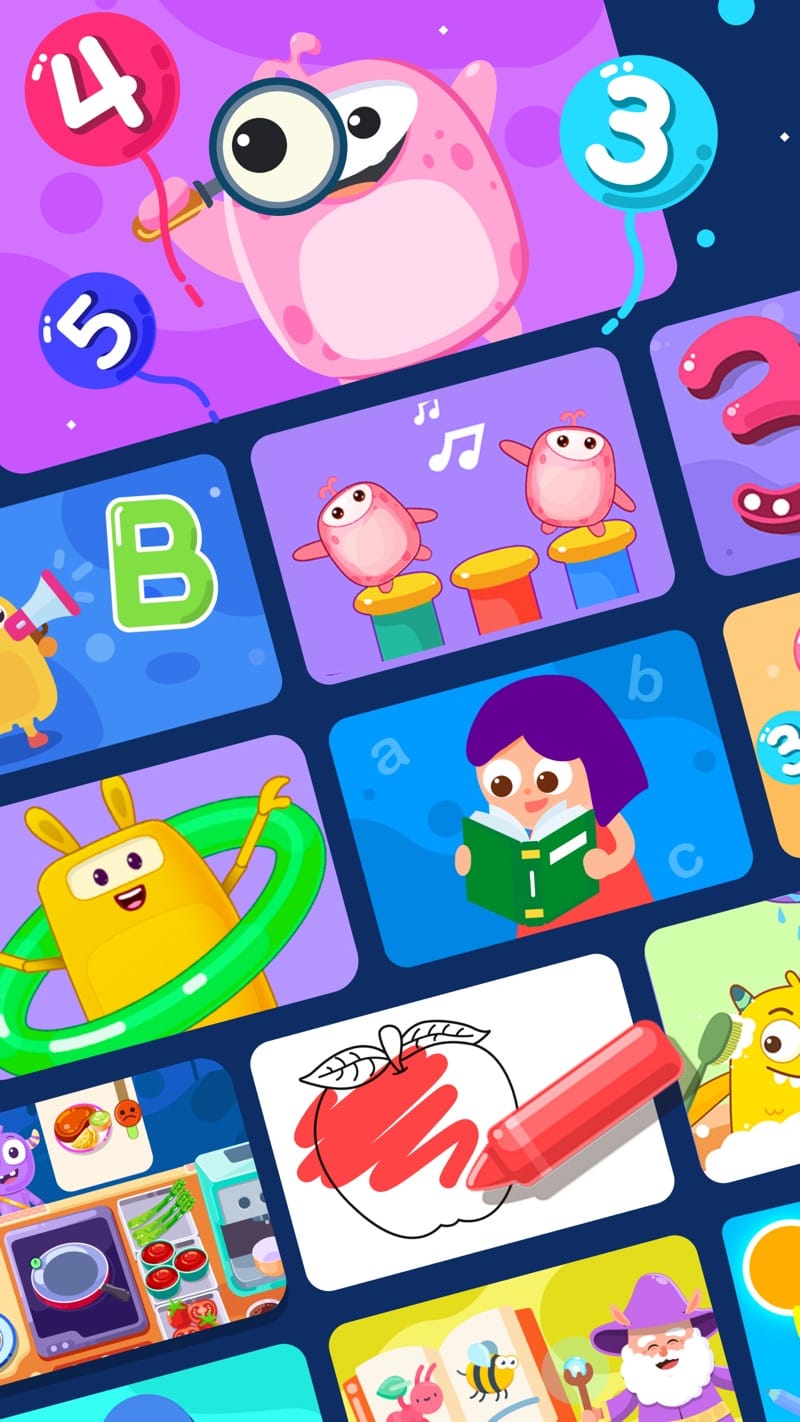
SplashLearn is a math and English program for preschool to grade 5, aligned with Common Core and state standards.
What stands out:
- A big game library. More than 2,000 math games and activities, plus printable worksheets for offline practice.
- Live classes on premium plans. Family plans include live math and English classes with certified teachers.
- Free homework practice. Anything a teacher assigns in SplashLearn is free to use at home.
Best for: elementary kids who like short, colorful games.
Good to know: content stops at grade 5, so plan a switch before middle school.
3. Prodigy Math: Best for Kids Who Love Video Games
Prodigy Math turns practice into a fantasy game where kids explore new worlds, collect pets and unlock powers by answering math questions.
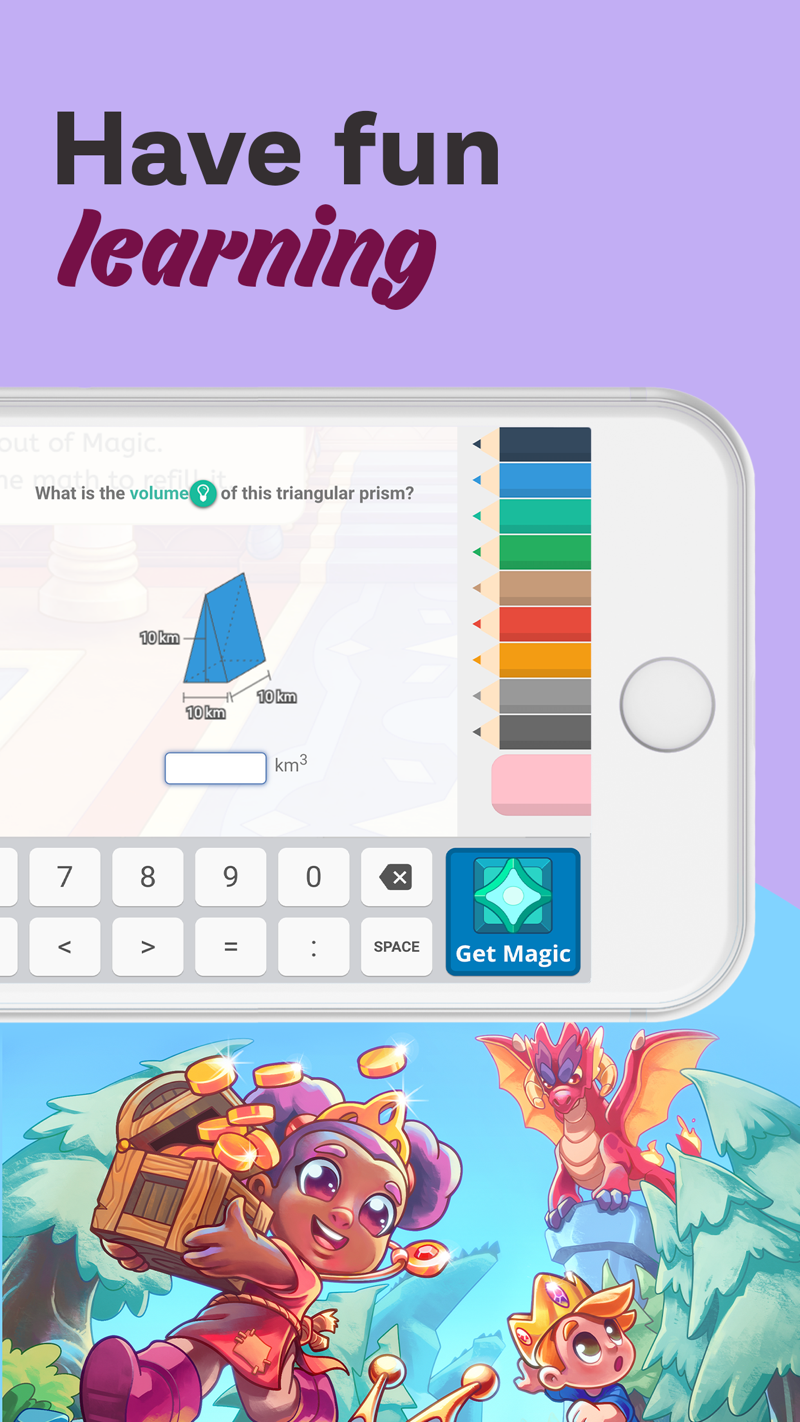
What stands out:
- The math is free. All educational content, including questions, in-game videos and math manipulatives, costs nothing.
- A large, standards-aligned question bank. More than 45,000 math questions aligned with state standards for grades 1–8.
- Adjusts to your child. Its algorithm adapts as your child progresses, and parents get progress reports.
Best for: reluctant kids who will practice for a quest but not a worksheet.
Good to know: memberships unlock Science, extra game areas and rewards. Decide your answer before your child asks for the upgrade.
4. Khan Academy Kids: Best Free App for Early Learners
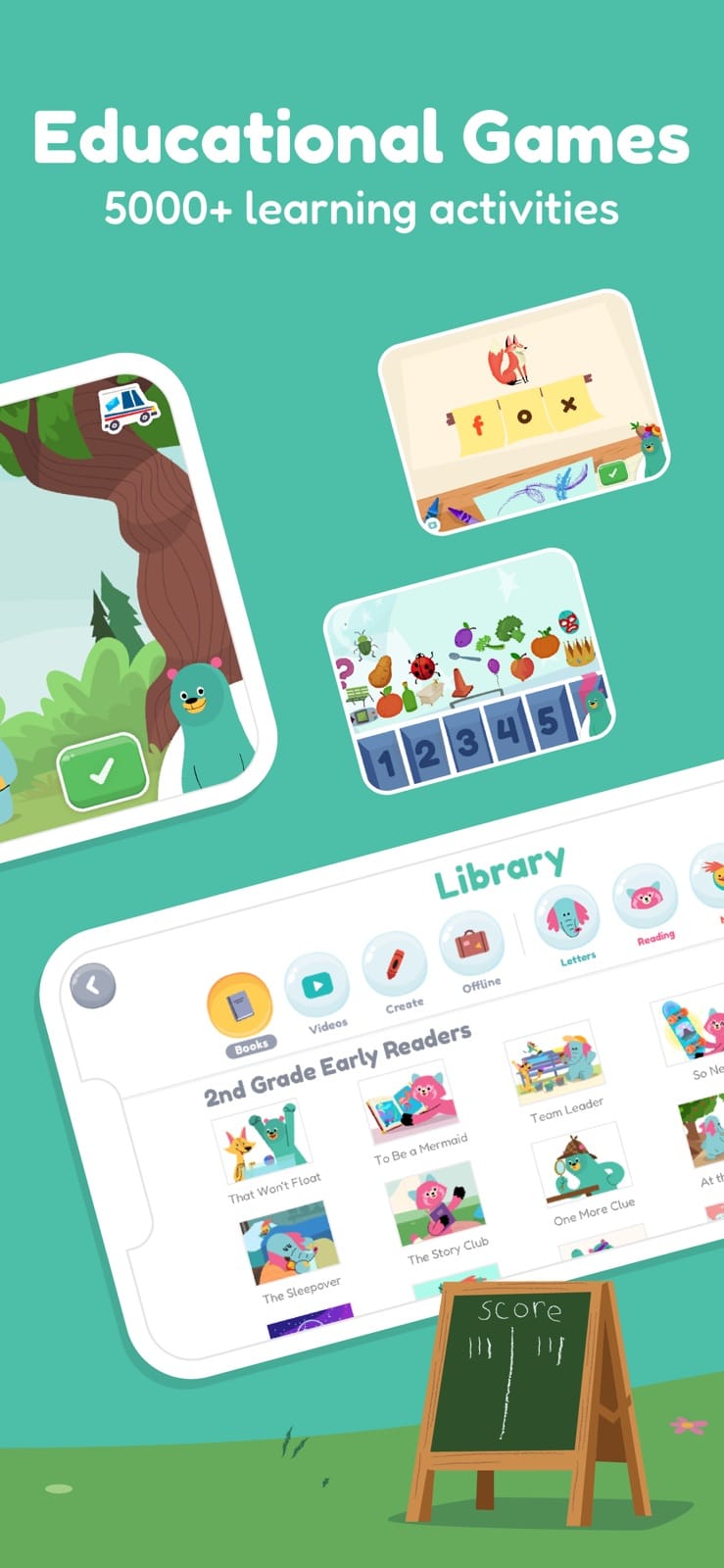
Khan Academy Kids is a nonprofit app covering early math, reading and social-emotional skills for ages 2–8.
What stands out:
- Completely free for families. No ads, no subscriptions and no in-app purchases across 4,000+ activities, videos and books.
- Built with education experts. Created with the Stanford Graduate School of Education and aligned with Head Start and Common Core.
- Works offline. Activities run without an internet connection.
Best for: preschool to grade 2.
Good to know: math is one subject among several, so math-focused or older kids will outgrow it.
5. IXL: Best for Skill-by-Skill Practice
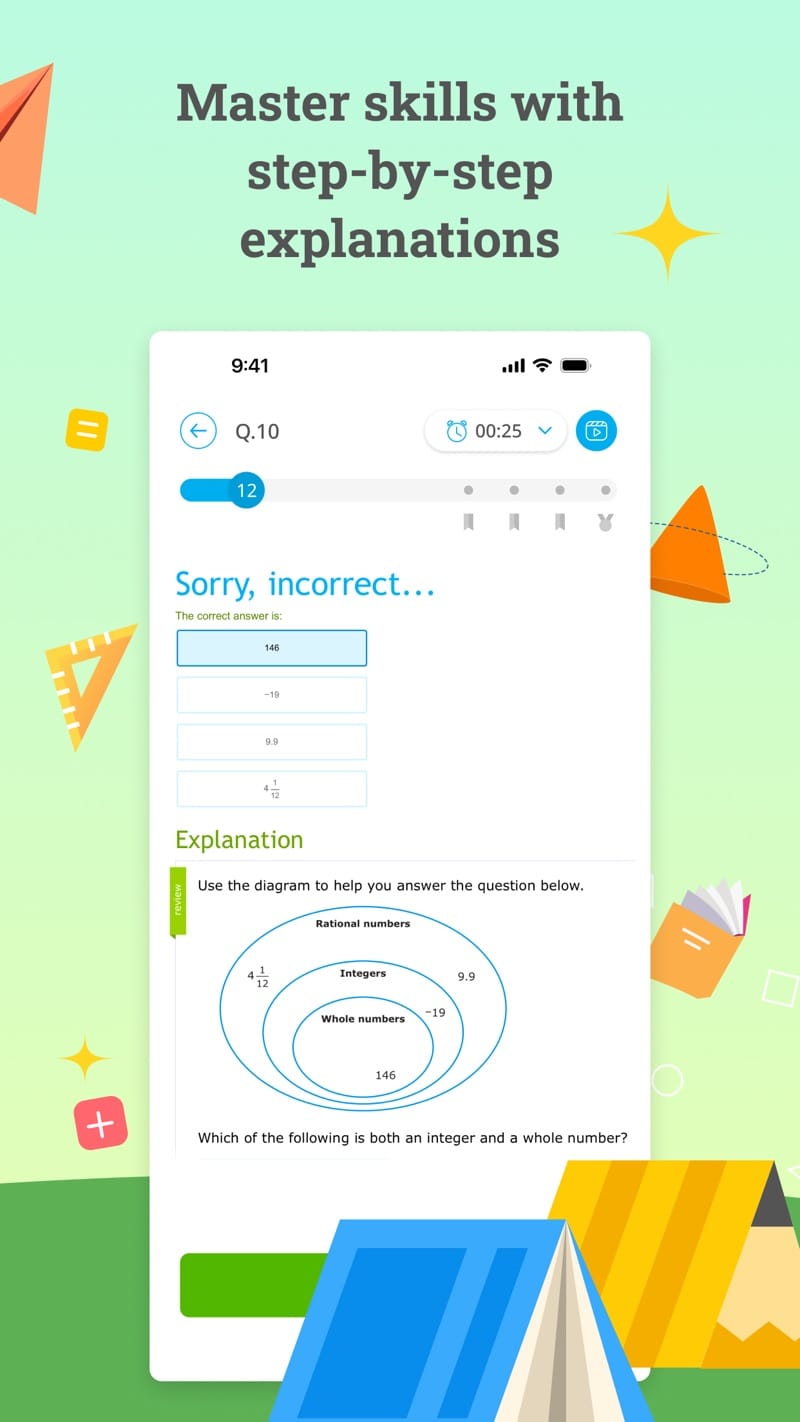
IXL is a subscription practice platform covering math from pre-K through grade 12, with a diagnostic that finds the skills your child should practice next.
What stands out:
- A diagnostic that points to gaps. Your child answers a series of questions, and IXL recommends the specific skills to practice.
- Very wide grade coverage. One account covers pre-K through high school math.
- Parent analytics. You can see which skills your child has practiced and where they are stuck.
Best for: kids who need steady, structured practice that follows the school curriculum.
Good to know: IXL is practice-first. It shows an explanation when your child misses a question, but it does not ask what your child was thinking.
Want a Tutor Alongside the App?
Book a free evaluation: a short assessment that finds exactly which concepts your child is missing, then a tutor-led plan to close them.
Schedule a Free Evaluation100% free · No payment · No commitment · Same tutor every session
Which Math App Fits Which Problem?
Pick by the problem you are trying to solve, not by the longest feature list.
| If your child... | Start with | Why |
|---|---|---|
| Copies steps but can't explain them | Cuemath | Asks questions and gives hints instead of showing answers, with an optional live tutor |
| Won't touch a worksheet but will play a game | Prodigy Math (grades 1–8) or SplashLearn (up to grade 5) | Practice is wrapped in a game, so effort comes from the child |
| Is 2–8 and you want zero cost | Khan Academy Kids | Free, no ads, works offline |
| Needs drills on exactly the skills school is teaching | IXL | Skill-by-skill practice plus a diagnostic |
| Is slow at facts like 7 × 8 | Cuemath (timed practice) or XtraMath | Both build recall, and Cuemath adds concepts |
| Is heading into AMC, Math Kangaroo, CogAT or SSAT | Cuemath | Prep built from real past papers |
Best Free Math Apps for Kids
The best free math apps for kids fall into two kinds: fully free apps that never charge, and freemium apps where the core learning is free and extras cost money. Three of the five picks have a free option that is useful on its own:
| App | What's free | What's paid |
|---|---|---|
| Cuemath | full K–12 library, daily practice and learning plan; sparks refill every few hours | live 1:1 coaching |
| Khan Academy Kids | Everything | Nothing |
| Prodigy Math | All math questions, in-game videos and manipulatives | Science, extra game areas and rewards |
Source: Cuemath app page; Khan Academy Kids pricing; Prodigy memberships. Checked November 11, 2026.
Best Mental Math Apps for Kids
Mental math apps build speed and accuracy with basic facts, so your child isn't counting on fingers in the middle of a word problem. The best ones add speed only after the concept makes sense.
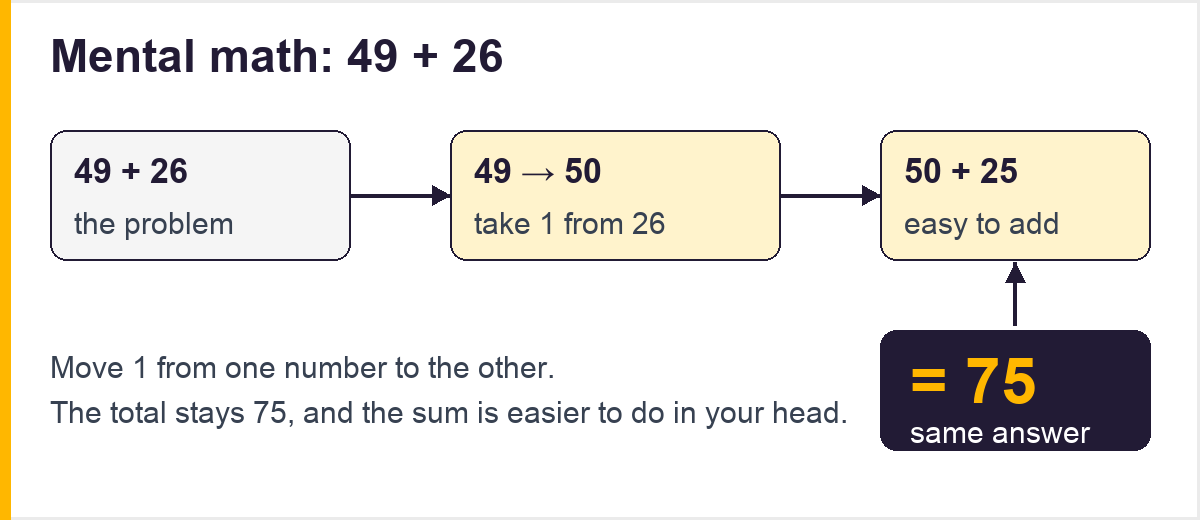
Cuemath is our top pick here. Its app trains fluency, meaning speed and accuracy, as one of four MathFit skills alongside understanding, application and reasoning, and daily practice can switch to timed mode. It provides mental math drills and speed-based challenges in short daily sessions. Add math puzzles for kids to keep practice varied.
XtraMath is a simple free add-on for fact drills. The nonprofit program is built around about 10 minutes a day, and it says plainly that it builds recall rather than teaching concepts.
For a deeper guide to building speed with facts, read math facts practice.
How to Choose the Best Math App for Your Child?
Answer three questions in order, and the right app is usually clear.
- How old is your child? For ages 2–8, a play-based app with audio guidance like Khan Academy Kids works well. From kindergarten up, Cuemath and SplashLearn add structured, grade-level practice.
- What is the goal? Daily practice and real understanding point to Cuemath, motivation points to Prodigy Math, and school-skill drills point to IXL.
- What is your budget? Start with a free option, and upgrade only once your child uses it every day.
Start Your Child's Daily Math Habit
Download the Cuemath app and begin with a free learning plan for your child's grade. Upgrade only when you see it working.
Try the Cuemath App FreeChild-safe and ad-free · No credit card · Grades K–12
Frequently Asked Questions
What are the best math apps for kids?
The best math apps for kids in 2026 are Cuemath, SplashLearn, Prodigy Math, Khan Academy Kids and IXL. Cuemath is the strongest all-round pick for grades K–12, with daily adaptive practice and an optional live tutor. The others suit specific needs: games, early learning or skill drills.
What is the best math app for a 5-year-old?
Cuemath for structured kindergarten math, or Khan Academy Kids for free play-based learning. Cuemath covers kindergarten with visual lessons and optional live 1:1 classes. Khan Academy Kids is free for ages 2–8, with no ads or in-app purchases.
Is Khan Academy Kids really free?
Yes, Khan Academy Kids is completely free for families. The app has no ads, no subscriptions and no in-app purchases across 4,000+ activities. Only schools and districts pay, $5 per student for web reporting, assessments and training.
Is Prodigy Math really free?
Yes, the math is free. Prodigy says all of its educational content for grades 1–8, including questions, in-game videos and math manipulatives, costs nothing. Paid memberships add Science content, extra game areas and rewards.
What are the best free math apps for kids?
Khan Academy Kids (ages 2–8), the free Cuemath app (grades K–12) and the free math in Prodigy (grades 1–8). Khan Academy Kids is the only one with nothing to buy.
Which math app is best for middle school?
Cuemath for grade-level math and test prep, and IXL for skill-by-skill practice. Cuemath covers middle school math plus prep for AMC and Math Kangaroo, with an optional live tutor. For algebra puzzles, Kahoot! Algebra 2 by DragonBox teaches algebra to ages 12–17.
How much time should kids spend on a math app each day?
Most math apps are built for short daily sessions. Cuemath's app is designed around about 15 minutes a day, and XtraMath around 10 minutes. Stopping while your child is still succeeding makes it easier to come back tomorrow.
Can a math app replace a math tutor?
For practice, often; for confusion, rarely. Apps give repetition and instant feedback, but they can't ask what a child was thinking. Cuemath combines both: a daily practice app plus live 1:1 classes with the same tutor every session, and the evaluation that starts it is free. See also our guide to the best online math tutoring platforms.
Sources
- SplashLearn homepage: pre-K–grade 5, Common Core, 2,000+ math games
- SplashLearn blog: plans from $7.49/month billed yearly
- SplashLearn support: plans and features, 7-day trial
- Prodigy Math: grades 1–8, free educational content
- Prodigy memberships: what paid plans add and what they cost
- Khan Academy Kids pricing: free for families, no ads, ages 2–8
- Khan Academy Kids App Store listing: Stanford GSE, Head Start, offline use
- IXL family membership: pre-K–12 coverage and starting price
- XtraMath: nonprofit, about 10 minutes a day
- Cuemath App: cue-don't-tell, adaptive daily practice, Self Mode ($0), Self Mode Infinite ($15/month), Coach Mode ($200 + $15/month)
- Cuemath Pricing & Plans: tutoring from $15/class, 4.9 across 12K+ reviews

I write because I like understanding things properly, and I've never been able to do that quietly.
Six years in, what still interests me most isn't the writing itself. It's the person on the other side. Who are they, what were they actually worried about when they opened this page, and did they leave with what they came for? Most content fails that last test. It answers the easy question instead of the one that was asked.
At Cuemath, I write for parents and students in India and around the world. That range is the part I enjoy. A parent in Bangalore and a parent in Canada are asking about the same child, but not always in the same words, and that difference matters.
So I research before I write. Not just search results. Forums, reviews, the long comment threads where somebody finally admits what they're really confused about. That's usually where the useful thing is hiding.
I also spend time on how people find this writing at all, since a growing number of them now ask an AI instead of typing into Google. But that only works if the writing is clear to begin with. There's no shortcut around that part.