How to Use a Hundreds Chart to Teach Addition, Subtraction, and Patterns
A hundreds chart looks like a list of numbers, but two simple moves turn it into a tool for adding, subtracting, and spotting patterns. This blog walks through each one with worked examples, the mistakes kids make, puzzles, games, and a 20-question worksheet with answers.

What if a simple chart filled with numbers could turn math lessons into an exciting adventure? Meet the hundreds chart: a colorful and versatile math tool that helps children explore numbers, discover patterns, and build essential math skills through hands-on learning!
The trick is two moves: across the chart changes the ones, and down the chart changes the tens. This blog shows parents of kids in kindergarten through 2nd grade how to use those two moves for adding, subtracting, and spotting patterns.
From adding numbers by hopping forward to subtracting by moving backward, a hundreds chart makes mathematical operations easier to understand and visualize. Children can follow number sequences, spot skip-counting patterns, recognize odd and even numbers, and uncover the fascinating relationships between numbers. It's like a little math treasure map where every square holds a new discovery!
The best part? Learning with a hundreds chart doesn't have to feel like work. With fun games, interactive activities, colorful markers, and simple challenges, children can turn everyday math practice into an engaging experience. Whether you're a teacher looking for creative classroom ideas or a parent supporting learning at home, this simple yet powerful tool can make addition, subtraction, and number patterns more meaningful, enjoyable, and memorable.
- A hundreds chart is a 10×10 grid of the numbers 1 to 100, with 10 numbers in each row.
- Moving right adds 1 and moving left takes away 1. Moving down adds 10 and moving up takes away 10.
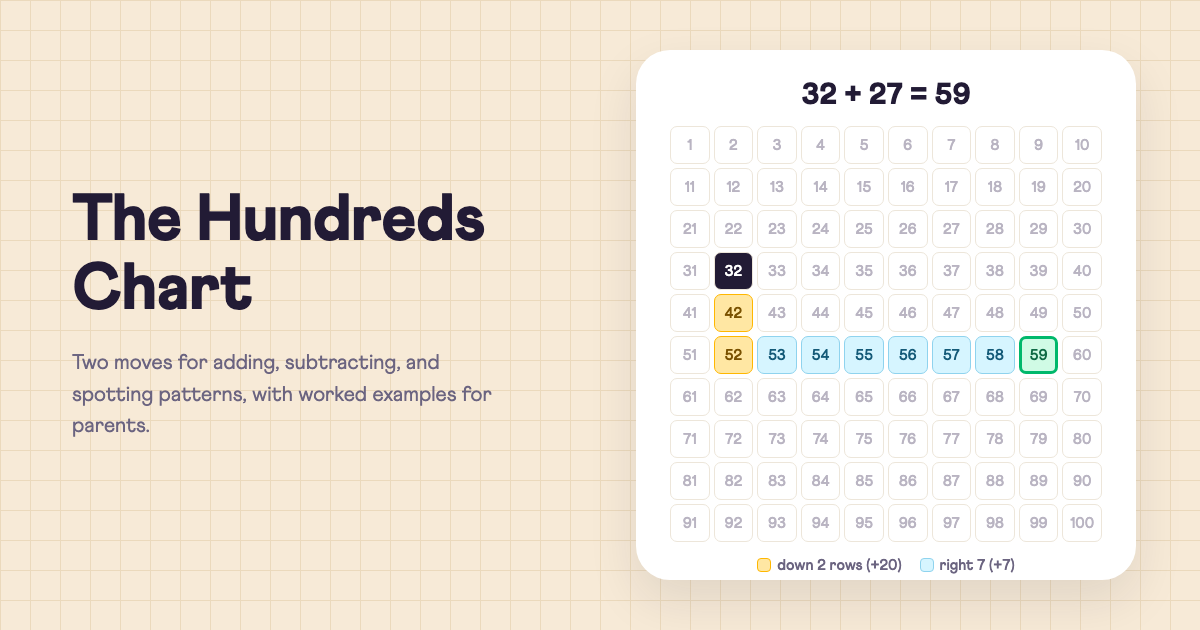
- To add a two-digit number, move down for the tens and right for the ones. 32 + 27 is down 2, right 7: 59.
- To subtract, move up for the tens and left for the ones. 75 − 42 is up 4, left 2: 33.
- Each column ends in the same digit and each row starts with the same tens digit. That is place value you can see.
- The most common mistake is the end of a row. After 50 comes 51, at the start of the next row.
What Is a Hundreds Chart (100 Chart)?
A hundreds chart (also called a 100 chart or 100s chart) is a grid of the numbers 1 to 100, laid out in 10 rows of 10. The first row runs 1 to 10, the second 11 to 20, and so on down to 91 to 100. Teachers use it from kindergarten onward for counting, adding, subtracting, and skip counting.
Here it is. Tap any number to see what's 1 more, 1 less, 10 more, and 10 less.
| 1 | 2 | 3 | 4 | 5 | 6 | 7 | 8 | 9 | 10 |
| 11 | 12 | 13 | 14 | 15 | 16 | 17 | 18 | 19 | 20 |
| 21 | 22 | 23 | 24 | 25 | 26 | 27 | 28 | 29 | 30 |
| 31 | 32 | 33 | 34 | 35 | 36 | 37 | 38 | 39 | 40 |
| 41 | 42 | 43 | 44 | 45 | 46 | 47 | 48 | 49 | 50 |
| 51 | 52 | 53 | 54 | 55 | 56 | 57 | 58 | 59 | 60 |
| 61 | 62 | 63 | 64 | 65 | 66 | 67 | 68 | 69 | 70 |
| 71 | 72 | 73 | 74 | 75 | 76 | 77 | 78 | 79 | 80 |
| 81 | 82 | 83 | 84 | 85 | 86 | 87 | 88 | 89 | 90 |
| 91 | 92 | 93 | 94 | 95 | 96 | 97 | 98 | 99 | 100 |
Tap a number to see 1 more, 1 less, 10 more, and 10 less.
Hundreds chart, 120 chart, or 0–99 chart? You'll see three versions, and they all work the same way.
| Chart | Numbers | Where you'll see it |
|---|---|---|
| Hundreds chart | 1 to 100 | The most common one, from kindergarten (count to 100) |
| 120 chart | 1 to 120 | 1st grade, because the standard asks kids to count to 120 |
| 0–99 chart | 0 to 99 | Some classrooms. Each row shares one tens digit (20 to 29), so the place value pattern is even cleaner |
The Two Moves That Do Most of the Work
Almost everything you do on a hundreds chart comes down to two moves: across changes the ones, and down or up changes the tens. Each row holds exactly 10 numbers, so dropping one row lands you exactly 10 further on.
Get from 45 to 72 in as few moves as you can. Each arrow is one move.
| 1 | 2 | 3 | 4 | 5 | 6 | 7 | 8 | 9 | 10 |
| 11 | 12 | 13 | 14 | 15 | 16 | 17 | 18 | 19 | 20 |
| 21 | 22 | 23 | 24 | 25 | 26 | 27 | 28 | 29 | 30 |
| 31 | 32 | 33 | 34 | 35 | 36 | 37 | 38 | 39 | 40 |
| 41 | 42 | 43 | 44 | 45 | 46 | 47 | 48 | 49 | 50 |
| 51 | 52 | 53 | 54 | 55 | 56 | 57 | 58 | 59 | 60 |
| 61 | 62 | 63 | 64 | 65 | 66 | 67 | 68 | 69 | 70 |
| 71 | 72 | 73 | 74 | 75 | 76 | 77 | 78 | 79 | 80 |
| 81 | 82 | 83 | 84 | 85 | 86 | 87 | 88 | 89 | 90 |
| 91 | 92 | 93 | 94 | 95 | 96 | 97 | 98 | 99 | 100 |
Here is the math hiding in the game: from 45, down two rows is 65, which is 45 + 20. Up three rows is 15, which is 45 − 30. Your child never has to count the 20 or the 30 one at a time. This is exactly what the 1st grade standard asks for: find 10 more or 10 less than a number "without having to count."
If your child is still unsure what the tens digit in 45 stands for, spend five minutes on expanded form first (45 = 40 + 5). The chart makes much more sense once "4 tens and 5 ones" is clear.
How to Add on a Hundreds Chart
To add on a hundreds chart:
- Start on the first number
- Move down one row for every ten in the second number
- Move right one square for every one.
- The square you land on is the answer.
Pick a problem below (or type your own) and tap Next step. Each step lights up on the chart, so your child sees exactly where the tens and ones go.
- 1Put a finger (or a coin) on the first number.
- 2Split the second number into tens and ones.
- 3Move down one row for each ten.
- 4Move right one square for each one.
- 5Read the number you landed on.
| 1 | 2 | 3 | 4 | 5 | 6 | 7 | 8 | 9 | 10 |
| 11 | 12 | 13 | 14 | 15 | 16 | 17 | 18 | 19 | 20 |
| 21 | 22 | 23 | 24 | 25 | 26 | 27 | 28 | 29 | 30 |
| 31 | 32 | 33 | 34 | 35 | 36 | 37 | 38 | 39 | 40 |
| 41 | 42 | 43 | 44 | 45 | 46 | 47 | 48 | 49 | 50 |
| 51 | 52 | 53 | 54 | 55 | 56 | 57 | 58 | 59 | 60 |
| 61 | 62 | 63 | 64 | 65 | 66 | 67 | 68 | 69 | 70 |
| 71 | 72 | 73 | 74 | 75 | 76 | 77 | 78 | 79 | 80 |
| 81 | 82 | 83 | 84 | 85 | 86 | 87 | 88 | 89 | 90 |
| 91 | 92 | 93 | 94 | 95 | 96 | 97 | 98 | 99 | 100 |
Here are the same four kinds of problems side by side. Tap Play to move on any card to watch the path one square at a time:
Start on 23. Move right 5 squares. 23 + 5 = 28.
Start on 34. Move down 2 rows: 44, 54. 34 + 20 = 54.
Down 2 rows to 52, then right 7 squares. 32 + 27 = 59.
Down 1 row to 59. Right 3: 60 ends the row, so the count jumps to 61 and 62 on the next row. 49 + 13 = 62.
That jump from 60 to 61 is where kids get stuck most often. It's the chart version of regrouping: ten ones fill a row and become one more ten.
A shortcut for adding 9: to add 9, move down 1 and left 1, because adding 10 and taking away 1 is the same as adding 9. 38 + 9: down to 48, left to 47. 38 + 9 = 47. This is a good one to show a child who already knows the basic moves.
Try It Yourself: addition. Type your answer, tap Check, then reveal the steps.
Reveal the answer
Reveal the answer
Reveal the answer
Reveal the answer
How to Subtract on a Hundreds Chart
To subtract on a hundreds chart:
- Start on the first number
- Move up one row for every ten you take away
- Move left one square for every one.
- The square you land on is the answer.
Pick a problem below (or type your own) and tap Next step to watch the counter move up and left.
- 1Start on the bigger number.
- 2Split the number you're taking away into tens and ones.
- 3Move up one row for each ten.
- 4Move left one square for each one.
- 5Read the number you landed on.
| 1 | 2 | 3 | 4 | 5 | 6 | 7 | 8 | 9 | 10 |
| 11 | 12 | 13 | 14 | 15 | 16 | 17 | 18 | 19 | 20 |
| 21 | 22 | 23 | 24 | 25 | 26 | 27 | 28 | 29 | 30 |
| 31 | 32 | 33 | 34 | 35 | 36 | 37 | 38 | 39 | 40 |
| 41 | 42 | 43 | 44 | 45 | 46 | 47 | 48 | 49 | 50 |
| 51 | 52 | 53 | 54 | 55 | 56 | 57 | 58 | 59 | 60 |
| 61 | 62 | 63 | 64 | 65 | 66 | 67 | 68 | 69 | 70 |
| 71 | 72 | 73 | 74 | 75 | 76 | 77 | 78 | 79 | 80 |
| 81 | 82 | 83 | 84 | 85 | 86 | 87 | 88 | 89 | 90 |
| 91 | 92 | 93 | 94 | 95 | 96 | 97 | 98 | 99 | 100 |
And the four kinds of subtraction side by side. Tap Play to watch each move:
Start on 47. Move left 4 squares. 47 − 4 = 43.
Start on 86. Move up 3 rows: 76, 66, 56. 86 − 30 = 56.
Up 4 rows to 35, then left 2 squares. 75 − 42 = 33.
Up 1 row to 52. Left 5: after 51 the count jumps to 50 at the end of the row above. 62 − 15 = 47.
A second way: count up. For problems like 58 − 35, some kids find it easier to start on the smaller number and count how far it is to the bigger one. From 35, down 2 rows is 55 (that's 20), then right 3 is 58 (that's 3). The distance is 23, so 58 − 35 = 23. This uses the link between adding and subtracting, which the Common Core asks kids to use in 1st and 2nd grade. If your child likes jumps, it works the same way on a number line. The chart just folds that line into rows of ten.
Try It Yourself: subtraction. Type your answer, tap Check, then reveal the steps.
Reveal the answer
Reveal the answer
Reveal the answer
Reveal the answer
Free, with no pressure to join. Your child gets a 1:1 session with a math specialist, and you keep the evaluation report and a personalized learning plan, whether or not you sign up.
Hundreds Chart Patterns to Find Together
A hundreds chart is full of patterns because each row repeats the ones digits 1 to 0, and each column keeps the same ones digit all the way down. Coloring in a skip-counting sequence turns each one into a picture your child can see.
| Color in… | Picture | What you see | Why it happens |
|---|---|---|---|
| Counting by 10s | The whole last column | Every row ends on the next ten | |
| Counting by 5s | Two straight columns (the 5s and the 10s) | Numbers that end in 5 or 0 | |
| Counting by 2s | Five stripes, every other column | Even numbers end in 0, 2, 4, 6, or 8 | |
| Counting by 9s | A diagonal going down to the left | Each step is down 1 row (+10), left 1 (−1) | |
| Counting by 11s | A diagonal going down to the right | Each step is down 1 row (+10), right 1 (+1) | |
| Counting by 3s | Diagonal stripes going down to the left | Every third square lands one column over each time |
Want to know why the 2s, 5s, and 10s land in straight columns? It comes down to the last digit, and this short Cuemath video shows the rule your child can use on any number:
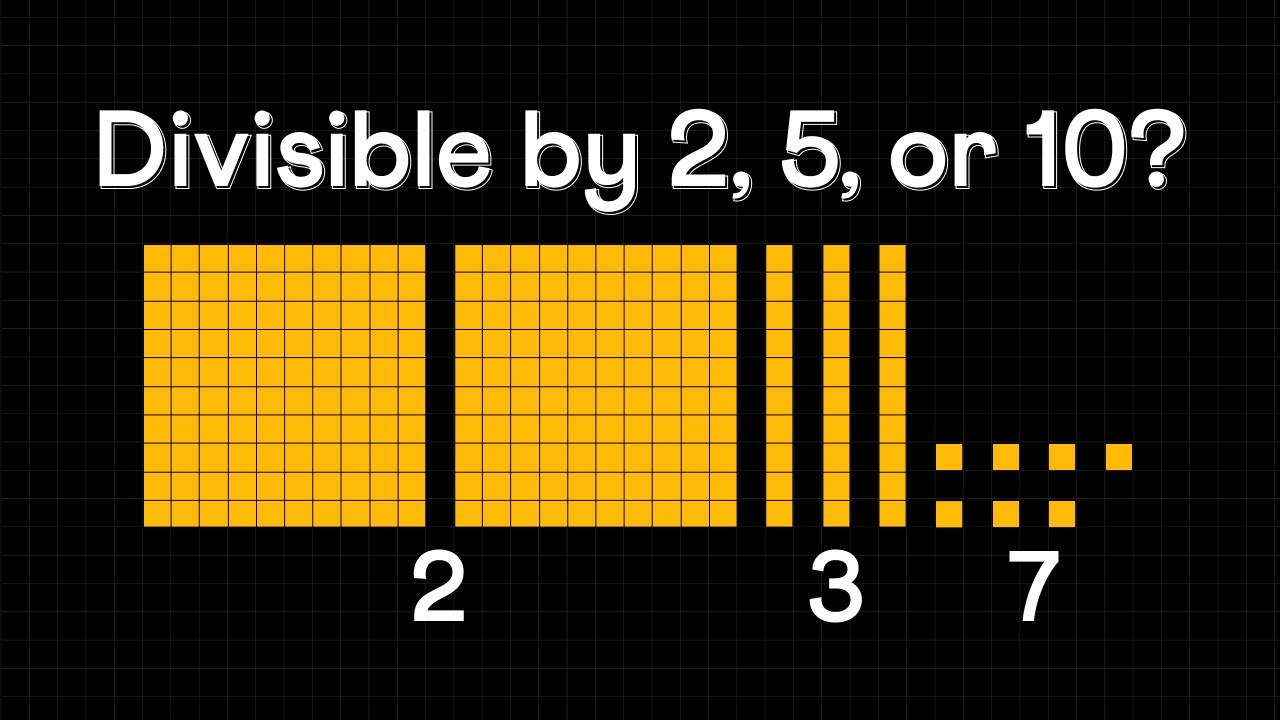
The odd and even pattern. Color every other square starting at 2, and your child sees even numbers in five neat columns, with the odd numbers in between. That gives them a way to check any number up to 100: look at the last digit. 2nd graders learn to tell whether a group has an odd or even number of objects by pairing them or counting by 2s, and the chart shows both.
The 9s trick. On the 9s diagonal, the tens digit goes up by 1 and the ones digit goes down by 1 each time: 18, 27, 36, 45. The two digits in each of those numbers also add up to 9. Kids love finding that one.

Skip counting on the chart is the same pattern idea that sits behind making a ten, and later, multiplication facts.
Try It Yourself: patterns.
Reveal the answer
Reveal the answer
Reveal the answer
Hundreds Chart Puzzles and Games
Hundreds chart puzzles give your child a piece of the chart with numbers missing, and they fill in the blanks using the two moves. They take a few minutes, need no printer, and show you right away whether the moves have clicked.
Bonus challenge: add every number on the chart. What is 1 + 2 + 3 + … + 100? Counting one by one takes ages. Instead, pair the numbers from the two ends: 1 + 100, 2 + 99, 3 + 98. Every pair makes 101, and there are 50 pairs, so the total is 50 × 101 = 5,050. A famous story says a young mathematician named Gauss spotted this trick at school.
These three games need only a hundreds chart (printed from anywhere or drawn as a 10×10 grid), a die or two, and a few coins. For screen time on the same skills, our tested lists of free 1st grade math games and 2nd grade math games need no login.
More Number Games, Five Minutes a Day
The free Cuemath App gives your child a short daily workout on counting, tens and ones, and adding, plus math games and puzzles that adjust to their level.
Get the Free App100% free · No credit card needed · A few minutes a day
4 Mistakes Kids Make on a Hundreds Chart
Most hundreds chart mistakes come from four habits, and each one has a quick fix you can show in under a minute.
Looks like: For 34 + 20, your child counts 20 single squares and loses track around 47.
Fix: Ask "How many tens are in 20?" Then hop down 2 rows. Say "44, 54" out loud.
Looks like: For 34 + 5, your child touches 34 and says "one," then lands on 38.
Fix: Count the jumps, not the squares. The finger moves first, then you say "one."
Looks like: For 48 + 4, your child gets to 50, hits the edge, and stops, or goes down instead of to the next row.
Fix: The chart works like reading a book: when a row ends, go to the start of the next line. After 50 comes 51.
Looks like: Your child moves up to add 10, because "up" sounds like "more."
Fix: On this chart, numbers get bigger as you go down. Trace your finger from 1 to 100 together so they see it. Some classrooms use a "bottom-up" chart with 1 at the bottom so that up means more. If your child's class does, practice on the same version at home.
How Kids Use the Hundreds Chart in K, 1st, and 2nd Grade
Kids use the hundreds chart differently each year: kindergartners count on it, 1st graders add and subtract tens on it, and 2nd graders use it as a check while they move to mental math.
| Grade | What your child does on the chart | Common Core |
|---|---|---|
| Kindergarten | Counts to 100 by ones and by tens, and starts counting from any number, not just 1. These are early topics in Cuemath's kindergarten math curriculum. | K.CC.A.1, K.CC.A.2 |
| 1st grade | Counts to 120 (often on a 120 chart), finds 10 more and 10 less without counting, adds a two-digit number and a one-digit number or a multiple of 10, and subtracts multiples of 10. See the full 1st grade math curriculum. | 1.NBT.A.1, 1.NBT.C.4, 1.NBT.C.5, 1.NBT.C.6 |
| 2nd grade | Adds and subtracts within 100, skip counts by 5s and 10s, sorts odd and even numbers, and checks 2nd grade math done in their head against the chart. | 2.NBT.A.2, 2.NBT.B.5, 2.OA.C.3 |
| 3rd grade (bonus) | Colors multiples to spot multiplication patterns, like all the 4s or all the 6s. | — |
When your child can do 34 + 20 or 75 − 42 in their head and only looks at the chart to check, it has done its job. Most kids get there during 2nd grade. After that, the chart is for patterns and puzzles, and word problems like our 2nd grade math problems take over from daily chart practice. Younger kids can keep going with our kindergarten math problems and 1st grade math problems, all with answers.
MAP Growth, which many districts give three times a year starting in kindergarten, includes counting and place value questions, and Cuemath's free MAP test prep curriculum practices them by grade.
How a Cuemath Tutor Uses the Hundreds Chart
A Cuemath tutor uses the hundreds chart to find out whether a child really understands tens and ones, not just whether they can get the right answer. In a one-on-one class, the tutor watches how the child moves, because a correct answer reached by counting 20 single squares means something different from one reached by two hops.
Two ways a child can solve 34 + 20 on the chart:
Starts on 34 and counts 20 single squares: 35, 36, 37 … 54. The answer is right, but the child didn't use tens.
Starts on 34 and hops down 2 rows: 44, 54. Same answer, and it shows the child understands tens.
Both get 54. A tutor looks for the second way. Here is how they check:
If a child counts by ones to add 20, the tutor goes back to "how many tens?" before giving more addition problems.
A child who says "I went down 3 rows, so it's 30 more" understands place value. A child who says "I just counted" needs more time on tens and ones.
Once the moves are solid, the tutor covers the chart and asks for 10 more, 10 less, and two-digit sums from memory. That shows whether the idea has moved into the child's head.
Here is what a one-on-one Cuemath class looks like for kids in kindergarten to 2nd grade:

Hundreds Chart Worksheet
This 20-question hundreds chart worksheet covers every move in this blog: adding and taking away ones and tens, crossing the end of a row, and skip counting. Your child types an answer in each box and taps "Check my answers" to see their score.
| Score | What it means | What to do next |
|---|---|---|
| 18–20 | The moves have clicked | Try the 3×3 puzzle and the 9s pattern |
| 12–17 | Tens are solid, ones or row ends slip | Practice row-end problems like 48 + 7 and 62 − 15 |
| 0–11 | Still counting square by square | Go back to the two moves and play Race to 100 |
Find out exactly where your child is with place value
Before the first class, your child takes a short evaluation with a Cuemath tutor that shows where their understanding breaks down, by concept, not just by grade level. For 1st graders, it follows the same topics as Cuemath’s 1st grade math classes.
Free, with no pressure to join. Your child gets a 1:1 session with a math specialist, and you keep the evaluation report and a personalized learning plan, whether or not you sign up.
FAQs
What is a hundreds chart?
A hundreds chart is a 10×10 grid that shows the numbers 1 to 100 in order, 10 numbers per row. Kids use it to count, add, subtract, and find number patterns, usually from kindergarten through 2nd grade.
How do you use a hundreds chart for addition?
To add on a hundreds chart, start on the first number, move down one row for each ten in the second number, then right one square for each one. For 32 + 27, go down 2 rows to 52, then right 7 squares to 59.
How do you use a hundreds chart for subtraction?
To subtract on a hundreds chart, start on the bigger number, move up one row for each ten you take away, then left one square for each one. For 75 − 42, go up 4 rows to 35, then left 2 squares to 33.
What patterns can you find on a hundreds chart?
The hundreds chart has patterns in every row, column, and skip-counting sequence. Each column ends in the same digit, each row shares a tens digit, counting by 5s fills two columns, counting by 2s makes five stripes of even numbers, and counting by 9s makes a diagonal.
What grade uses a hundreds chart?
Kids use a hundreds chart from kindergarten to 2nd grade, and sometimes in 3rd grade for multiplication patterns. Kindergartners count to 100 on it, 1st graders find 10 more and 10 less, and 2nd graders add and subtract within 100.
What is the difference between a hundreds chart and a number chart?
A hundreds chart is one kind of number chart: the one that shows exactly 1 to 100 in 10 rows of 10. "Number chart" can mean any chart of numbers in order, such as a 120 chart, a 0–99 chart, or a chart to 1,000.
Should a hundreds chart start at 0 or 1?
Both work, and the most common hundreds chart starts at 1 and ends at 100. A 0–99 chart puts every number with the same tens digit in one row (20 to 29), which some teachers prefer for place value. Use whichever version your child's class uses.
What is a 120 chart?
A 120 chart is a hundreds chart with two extra rows, running from 1 to 120. Many 1st grade classrooms use it because the Common Core asks 1st graders to count to 120, starting at any number below 120.
When should my child stop using a hundreds chart?
Your child can stop relying on the hundreds chart when they can find 10 more, 10 less, and two-digit sums like 34 + 20 in their head, and only use the chart to check. Most kids reach that point during 2nd grade.
Is a hundreds chart the same as a number line?
No, a hundreds chart and a number line show the same numbers in a different shape. A number line puts the numbers in one long row, while a hundreds chart cuts that row into rows of 10 and stacks them, so jumping 10 is one step down instead of ten steps along.
Sources
- Common Core State Standards: Kindergarten, Counting & Cardinality (K.CC.A.1, K.CC.A.2)
- Common Core State Standards: Grade 1, Number & Operations in Base Ten (1.NBT.A.1, 1.NBT.B.2, 1.NBT.C.4–6)
- Common Core State Standards: Grade 2, Number & Operations in Base Ten (2.NBT.A.2, 2.NBT.B.5)
- Common Core State Standards: Grade 2, Operations & Algebraic Thinking (2.OA.C.3)
- Cuemath reviews on Trustpilot

I was never the kid who loved math. I was much more interested in books, stories, and writing, and, somewhere along the way, I became even more curious about people. Why do we learn differently? Why does something make sense to one child but not another? And what makes a student feel confident enough to keep trying?
That curiosity led me to study Applied Psychology, where I learned more about how children think, learn, and make sense of the world around them.
My love for writing did the rest. What started as something I simply enjoyed became a career. Over the past five years, I've worked as a freelance writer across edtech, SaaS, B2B, travel, lifestyle, and healthcare, learning how to write for very different audiences without losing the human side of the story.
Today, I'm an SEO Content Writer & Editor at Cuemath, where I get to bring many of these interests together. Working in education, and especially around math, has made me even more curious about what happens behind the screen or textbook: what parents worry about, what students struggle with, and what actually helps them learn.
That's also how I like to research. I don't just look at search results and call it a day. I go where parents and students actually talk: forums, reviews, communities, and conversations with real families. Because sometimes the most useful insight isn't hiding in a keyword; it's in a parent's question, a student's frustration, or a small detail someone shares about their learning experience.
I write because I'm curious. I research because I want to understand. And I love turning what I learn into content that feels genuinely useful to the people reading it.