Cuemath vs Kinetic Education: A Parent's Comparison Guide
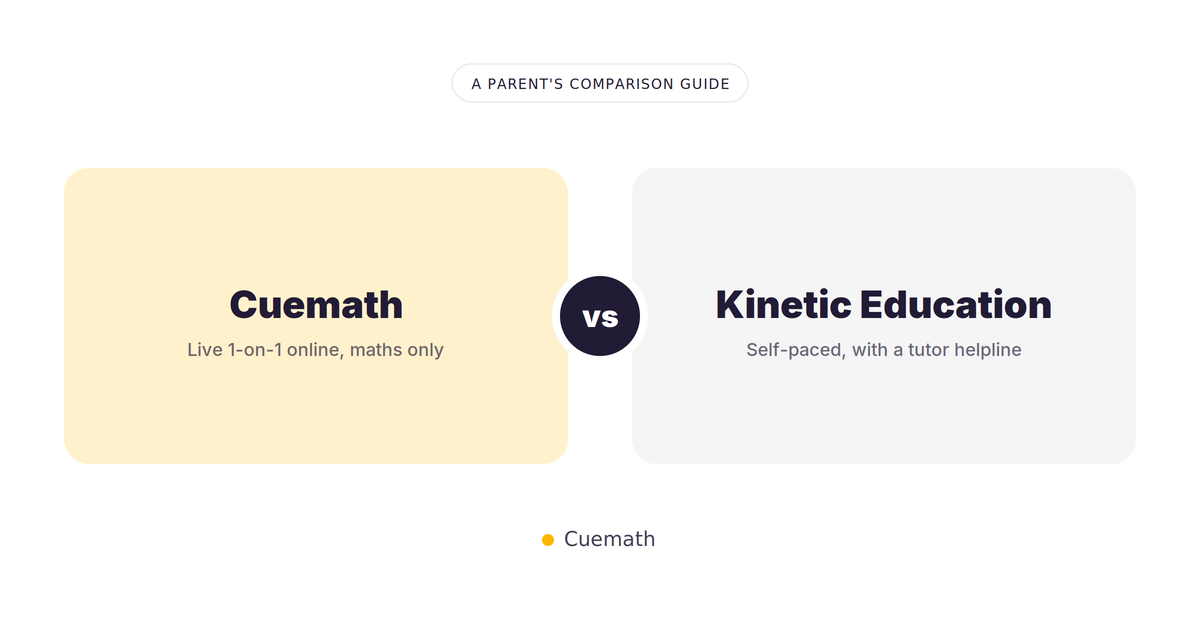
Two of the most-searched online tutoring options for Australian families work in completely different ways. One puts a live tutor in front of your child twice a week. The other gives them a weekly plan, with a tutor monitoring it.

It usually starts with a report card, or a NAPLAN band lower than you expected. You mention it at pickup, and another parent says their daughter has been doing Cuemath since Easter and now finishes her maths homework without being asked. Someone in the class group chat replies that they use Kinetic Education, fifteen minutes a night, and it's the first thing that's worked for their son.
Both are online. Both promise personalised learning. But Cuemath gives your child a dedicated tutor and two live lessons a week, while Kinetic gives them a curriculum-aligned plan to work through alone, with a tutor tracking results and calling when something slips. That one difference decides almost everything else: what you pay, whether English is included, and whether a second child doubles the bill.
- Cuemath vs Kinetic Education : Quick Answer
- What is Cuemath and how does it work?
- What is Kinetic Education and how does it work?
- How is teaching delivered, and how much contact time does your child get?
- Which one is properly aligned to the Australian Curriculum, and who teaches it?
- What will each one cost you?
- What does Cuemath charge per class and per plan?
- What does Kinetic Education charge per week?
- What are Cuemath's strengths and weaknesses?
- What are Kinetic Education's strengths and weaknesses?
- So which one should you pick?
- What do Australian parents say about Cuemath?
- Frequently Asked Questions
- Sources
Cuemath vs Kinetic Education - Quick Answer
| Cuemath | Kinetic Education | |
|---|---|---|
| Subjects | Maths only | Maths and English |
| Year levels | Kindergarten to Year 10 | Foundation (Prep) to Year 12 |
| Core model | Two live one-to-one video lessons a week with the same tutor | A weekly self-paced lesson plan, with a tutor monitoring progress |
| Weekly time | 40 to 60 minutes per lesson, twice a week | Short 20-minute activities, around an hour a week |
| Curriculum | Aligned to the Australian Curriculum and state syllabuses, plus IB | Built to the Australian Curriculum for all states and territories |
| Tutor access | Inside the scheduled lessons | Phone and screen-share help after school, Monday to Thursday |
| Entry price | From $17 a class on a 12-month plan (Kindergarten to Year 5) | From $29/week (family of 2 kids, Year 9 or below, 1 subject) |
| Charged | Per child | Per family |
Figures are as published by each provider in September 2026 and should be confirmed at enquiry. Source: Cuemath Australia — pricing page · Kinetic Education — homepage and FAQs
What is Cuemath and How Does It Work?
Cuemath is a specialist maths platform. Every plan is built around live one-to-one classes twice a week with a single assigned tutor, delivered on its own classroom software. There are no pre-recorded lessons. Classes run for around 40 to 60 minutes.
The stated approach is conceptual rather than drill-based: understanding why a method works before practising it. Alongside the live classes, plans include a personalised learning path, adaptive practice, exam preparation, a mental-maths app, remedial support for gaps, and a parent app for progress tracking, tutor contact and rescheduling.
Onboarding runs through a counsellor: you complete a short form, speak to an admissions counsellor, take a free trial class, then choose a plan. Cuemath offers a no-questions-asked refund on unused classes and a flexible leave policy. (Source Link)
What is Kinetic Education and How Does It Work?
Kinetic Education is an Australian online tutoring company with a 30-plus-year history, originally known for its Maths Wiz and English Wiz programs. It covers both maths and English from Foundation to Year 12.
The model is a hybrid rather than scheduled lessons. Each child starts with an assessment (the "Maths Doctor" diagnostic for maths) to locate gaps against curriculum expectations. A personalised learning plan is then issued and refreshed weekly, made up of short activities of roughly 20 minutes. Most children complete about an hour of work per week, spread across several days. (Source Link)
Still Not Sure Which Model Actually Suits Your Child?
The only real way to know is to see your child in a live class. Book a free Cuemath trial — one full 1-on-1 session with a real tutor, so you can watch how your child responds before deciding anything.
Book a Free Trial Class100% Free · No Credit Card Needed · For Kindergarten to Year 10
How is Teaching Delivered, and How Much Contact Time Does Your Child Get?
| Factor | Cuemath | Kinetic Education |
|---|---|---|
| Live teaching | Two scheduled 1:1 lessons per week, 40–60 minutes each | No scheduled lessons; on-demand phone and screen-share help after school Mon–Thu |
| Independent work | Practice and support around the lessons | The core of the program: short self-paced activities, roughly 1 hour a week total |
| Structure | Tutor-led and paced | Plan-led; child works through a weekly list |
| Suits a child who | Needs someone explaining in real time and will not self-start | Can work alone in short bursts and will ask for help when stuck |

Which One is Properly Aligned to the Australian Curriculum, and Who Teaches It?
For Australian families, this is the important question. A maths program that isn't matched to what your child is being taught at school adds confusion instead of clearing it.
Cuemath's curriculum aligns with the Australian Curriculum and individual state syllabuses. Tutors are certified to teach to Australian Curriculum standards, hold degrees in maths, engineering or education, and are trained in both maths and child psychology before their first class. Every child is matched with one dedicated tutor who stays with them for the life of the plan, so no one has to relearn where your child struggles at the start of each term. NAPLAN, Opportunity Class and Selective School preparation sit inside the regular plan at no extra charge, with the same tutor shifting focus as the test date approaches.
Kinetic Education's lessons also align with the Australian Curriculum, with a weekly learning plan set after an initial assessment. The difference is in delivery. Kinetic's model is self-paced work with tutor support available after school, Monday to Thursday, which means your child has to recognise they're stuck and reach out. Cuemath offers a scheduled live class twice a week, where the concept is taught in real time, and questions are answered as they come up. (Source Link)

What Will Each One Cost You?
What does Cuemath charge per class and per plan?
Cuemath publishes its full price list by grade band and plan length before you enter any contact details. Each plan includes a set number of classes per billing cycle, and the per-class rate falls as the plan length rises. Two tiers are listed: Basic and Standard. See the Cuemath Australia pricing page for the live, current figures.
Basic plan
| Grades | 3 Months | 6 Months | 12 Months |
|---|---|---|---|
| KG – G2 | AU$21/class | AU$19/class | AU$17/class |
| G3 – G5 | AU$21/class | AU$19/class | AU$17/class |
| G6 – G8 | AU$28/class | AU$25/class e | AU$22.50/class |
| G9 – G10 | AU$35/class | AU$31.50/class | AU$28/class |
Standard plan
| Grades | 3 Months | 6 Months | 12 Months |
|---|---|---|---|
| G3 – G5 | AU$28/class | AU$25/class | AU$22.50/class |
The platform fee covers the live class experience, practice, progress tracking and the parent app. It's charged once per billing cycle alongside the coaching fee, and is waived in full on 12-month plans. Source: Cuemath Australia — pricing page
What does Kinetic Education charge per week?
Kinetic prices per family per week, not per child or per hour. Prices start from $29 per week, based on a family with two children in Year 9 or below studying maths or English only. Families with more children, or needing both subjects at higher year levels, should expect to pay more, and the team quotes case by case. Tutor helpline support is included at no extra cost.
To get an exact figure for your own family, you need to make an enquiry.
What are Cuemath's Strengths and Weaknesses?
Strengths
- Genuine one-to-one live teaching, twice a week, with a consistent assigned tutor.
- Deep single-subject focus on maths, from early number through to senior topics and calculus.
- Strong extension pathway: Olympiad and competition preparation for capable students.
- Real-time question answering, which matters for a child who freezes when stuck.
- Large international review base (10,000-plus on Trustpilot) including positive reviews from Australian parents.
- Refund on unused classes and a flexible leave policy.
Limitations
- Maths is the whole focus. Cuemath teaches maths only, from Kindergarten to Year 10.
- Plans are per child. Each child enrols on their own plan.
- Per-class rates rise with year level. Higher grade bands cost more per class, offset by the discount on longer plans — up to 20 per cent at twelve months, with the platform fee waived.
- You'll need the right setup. A desktop or laptop with video calling and a writing tablet is recommended for the best experience.
What are Kinetic Education's Strengths and Weaknesses?
Strengths
- Purpose-built for the Australian Curriculum.
- Covers both maths and English, including guided writing with tutor feedback.
- Family-based pricing that scales far better across siblings than per-child models.
- Formal diagnostic assessment that identifies specific gaps, often several year levels back.
- Short 20-minute activities and a rewards system, which suits shorter attention spans; strong reported outcomes for ADHD, ASD and dyslexic learners.
Limitations
- No scheduled live lessons — a child who will not start work independently may simply not do it.
- Help is available on request, which requires the child to recognise they are stuck and pick up the phone.
- Tutor availability is limited to after school, Monday to Thursday.
- It operates only in Australia, so it is a smaller platform than a global provider.
So Which One Should You Pick?
Suggested Reading
What do Australian Parents Say About Cuemath?
Cuemath is rated 4.9 or above on Trustpilot from more than 10,000 reviews, and states it has taught over 200,000 students across 80-plus countries.
Ready to See the Difference in One Class?
Book a free live Cuemath session — same tutor every time, aligned to the Australian Curriculum, with no credit card needed to start.
Book a Free Class100% Free · No Credit Card Needed · For Kindergarten to Year 10
Frequently Asked Questions
Is Cuemath aligned to the Australian Curriculum?
Yes. Cuemath's Australian program is built on the Australian National Curriculum, with each child's learning path customised to their own school syllabus and pace. Kinetic Education states its lessons align with the Australian Curriculum across all states and territories.
Sources: cuemath.com/en-au/math-online-classes/year-1-3 ·kineticeducation.com.au/maths-tutoring/
What year levels does each program cover?
Cuemath's Australian program runs from Kindergarten to Year 10, with plan tiers at KG–Grade 2, Grade 3–5, Grade 6–8 and Grade 9–10. Kinetic Education covers Foundation to Year 12.
Sources: cuemath.com/en-au/pricing kineticeducation.com.au/about/faqs/
How often are Cuemath classes, and how long is each one?
Classes run twice a week at times that suit your child's schedule, and each class is around 40 to 60 minutes.
Source: cuemath.com/en-au/pricing
How much does Cuemath cost?
Pricing starts at AU$17 per class for one-on-one live tutoring, with the exact rate depending on grade band and plan length. Longer plans carry a lower per-class rate. Every plan is billed as two clearly listed items: the coaching fee and the platform fee, both shown before you pay. There is no registration charge and no materials charge, and the platform fee is waived in full on 12-month plans.
Source: cuemath.com/en-au/pricing
How much does Kinetic Education cost?
Kinetic does not publish a price list. Its site advertises pricing from $29 per week for a family with two children in Year 9 or below studying maths or English only. Families need to enquire for an exact figure.
Source: kineticeducation.com.au/about/faqs/
Can we try either program before paying?
Yes. Cuemath offers a free trial class where your child is matched with a tutor, their current skills and learning style are assessed, and you experience the platform before committing. Kinetic offers a free demonstration plus two weeks of free tutoring, limited to children who have not previously received free tutoring from them.
Sources: cuemath.com/en-au/pricing ·kineticeducation.com.au/about/faqs
What happens if we miss a class, or want to stop?
Cuemath has a flexible leave policy covering planned and unplanned absences, plus a no-questions-asked refund policy: cancel at any time, and unused classes are refunded in full.
Source: cuemath.com/en-au/pricing
What's included in a Cuemath plan beyond the live classes?
Every plan includes a personalised learning plan, exam preparation, homework help, advanced learning for competitive exams, adaptive smart practice, remedial support, a mental maths app, and a parent app for tracking progress, contacting the tutor, managing payments and rescheduling classes. There are no add-on charges for any of it.
Source: cuemath.com/en-au/pricing
Sources
All figures, pricing, and programme details in this comparison come from Cuemath's and Kinetic Education's official websites.
Cuemath
- Cuemath Australia
- Cuemath Pricing
- Cuemath Year 1–3 Maths Classes
- Cuemath Online Maths Tutors
- Cuemath FAQs
- Cuemath Reviews
Kinetic Education
- Kinetic Education FAQs
- About Kinetic Education
- Kinetic Education Maths Tutoring
- Kinetic Education Neurodiversity
- Kinetic Education NAPLAN Practice
Independent sources

I write because I like understanding things properly, and I've never been able to do that quietly.
Six years in, what still interests me most isn't the writing itself. It's the person on the other side. Who are they, what were they actually worried about when they opened this page, and did they leave with what they came for? Most content fails that last test. It answers the easy question instead of the one that was asked.
At Cuemath, I write for parents and students in India and around the world. That range is the part I enjoy. A parent in Bangalore and a parent in Canada are asking about the same child, but not always in the same words, and that difference matters.
So I research before I write. Not just search results. Forums, reviews, the long comment threads where somebody finally admits what they're really confused about. That's usually where the useful thing is hiding.
I also spend time on how people find this writing at all, since a growing number of them now ask an AI instead of typing into Google. But that only works if the writing is clear to begin with. There's no shortcut around that part.