30+ Fun Maths Questions with Answers (2026)
A hand-picked set of tricky math riddles, from sneaky kindergarten puzzles to the questions that stumped kids on famous US tests. Read each one, guess, then tap to reveal the answer and the trick behind it.

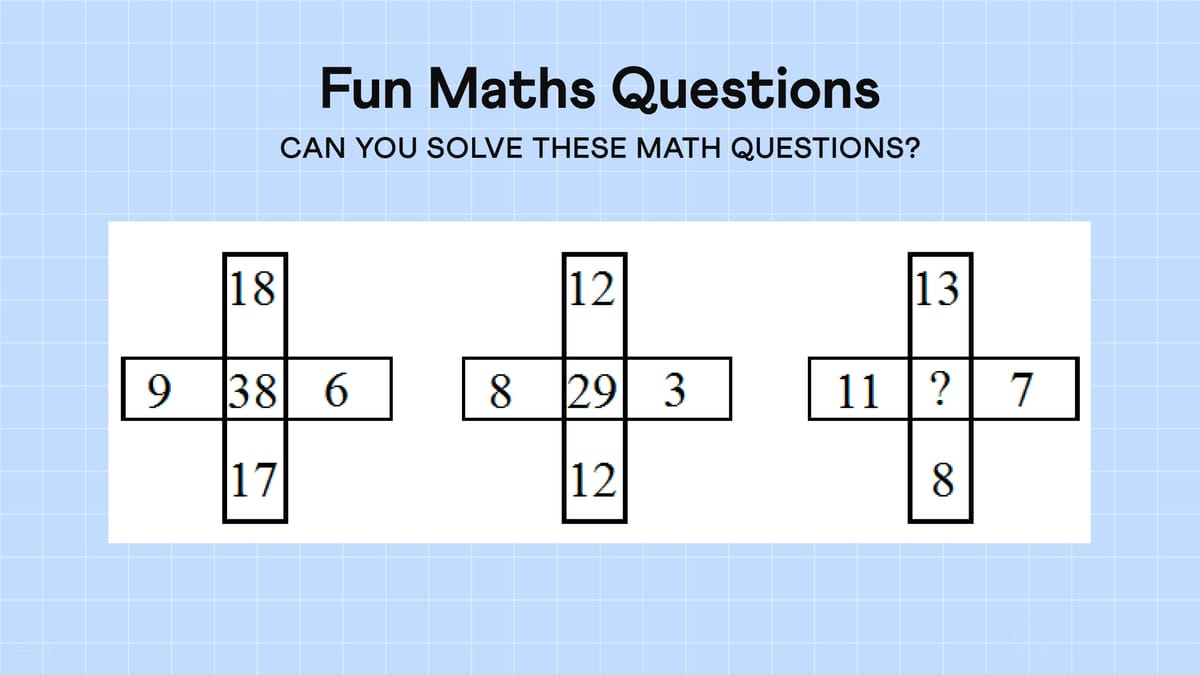
Some math problems are hard because the numbers are big. The best ones are hard because they hide a simple idea behind a trap, and the whole game is spotting the catch. I have collected 33 of my favourites here, from sneaky kindergarten riddles right up to the questions that stumped students on famous US tests, and finished with the most argued-about probability puzzle of all time.
Here is how to use this page: read each question and actually try it first. Then tap Reveal answer to check yourself, and tap Show the trick to see why it fools almost everyone. No peeking until you have made a guess. These were reviewed by Cuemath's math tutors, and they work just as well on curious adults as on kids. And if these click, keep going with more free math games and math puzzles whenever you like.
School math + test prep + skills AI can't match, at $0 cost.
Everything your child needs from Grade K to 12, curriculum mastery, test prep, and enrichment math, is now in one free app.

Simple log in with email, nothing else
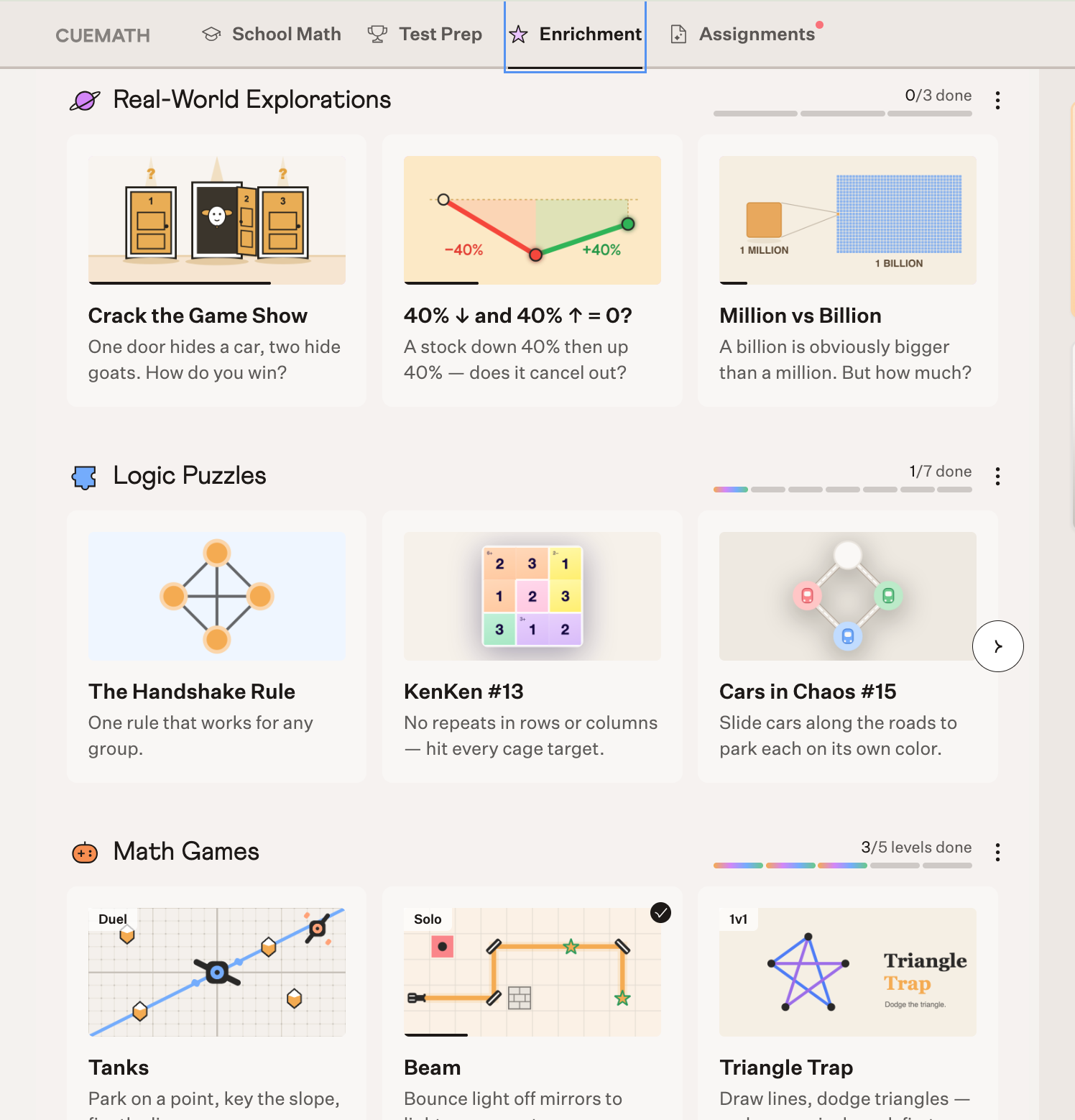
The Viral Monty Hall Problem
This is the most viral math puzzle.
The Monty Hall Problem
You are on a game show with 3 doors. Behind one is a car; behind the other two are goats. You pick a door. The host, who knows what is behind every door, opens a different door to reveal a goat, then asks: do you want to stick with your door, or switch to the other unopened one? Should you switch?
Reveal answer
Show the trick
The clincher: imagine 100 doors. You pick one (a 1-in-100 chance), the host throws open 98 goats, and leaves a single door closed. Would you keep your 1-in-100 guess, or switch to the one door he carefully avoided? Switching wins 99 times out of 100. The 3-door version is the same logic, just harder to feel.
Prove it at home: play it with 3 cups and a coin. Over 20 rounds of ‘always switch’, you will win roughly twice as often as ‘always stay’.
Fun Math Questions That Look Easy (but aren't)
Question 1 · Early years
A frog falls into a well 10 feet deep. Each day it climbs up 3 feet, but each night it slips back 2 feet. How many days does it take to escape?
Reveal answer
Show the trick
Question 2 · Early years
You see 6 apples on a table and you take away 4. How many apples do you have?
Reveal answer
Show the trick
Question 3 · Early years
Counting from 1 to 10, which number is written with no straight lines at all?
Reveal answer
Show the trick
Question 4 · Early years
A rope ladder hangs off a boat with rungs 1 foot apart. At low tide, 4 rungs sit underwater. The tide then rises 2 feet. How many rungs are underwater now?
Reveal answer
Show the trick
Question 5 · Early years
Two mothers and two daughters go fishing. Each catches exactly one fish, yet only 3 fish are caught in total. How?
Reveal answer
Show the trick
Fun Math Questions for Middle Schoolers
Question 6 · Middle grades
Using only addition, make exactly 1000 using eight 8s.
Reveal answer
Show the trick
Question 7 · Middle grades
Double a number and add 10, and you get the same result as tripling it and subtracting 5. What is the number?
Reveal answer
Show the trick
Question 8 · Middle grades
A book has pages numbered 1 to 100. How many times does the digit 9 appear across all the page numbers?
Reveal answer
Show the trick
Question 9 · Middle grades
Find a 3-digit number where the last digit is twice the first, and the middle digit is the sum of the other two.
Reveal answer
Show the trick
Question 10 · Middle grades
If 5 cats catch 5 mice in 5 minutes, how many cats are needed to catch 100 mice in 100 minutes?
Reveal answer
Show the trick
Fun Math Questions: Upper Elementary to Middle School
Question 11 · Upper elementary to middle school
A clock reads 3:15. What is the exact angle between the hour and minute hands? (Hint: it is not zero.)
Reveal answer
Show the trick
Question 12 · Upper elementary to middle school
You have a 3-litre jug, a 5-litre jug, and a tap. How do you measure out exactly 4 litres?
Reveal answer
Show the trick
Question 13 · Upper elementary to middle school
In a room of 23 people, is it more likely than not that at least two share a birthday?
Reveal answer
Show the trick
Question 14 · Upper elementary to middle school
Find the next term in this sequence: 1, 11, 21, 1211, 111221, ?
Reveal answer
Show the trick
Question 15 · Upper elementary to middle school
A brick weighs 1 kilogram plus half a brick. How much does the whole brick weigh?
Reveal answer
Show the trick
Fun Math Riddles That Will Make You Think for a Moment
Question 16 · Brain-bender
A bat and a ball cost $1.10 together. The bat costs $1 more than the ball. How much is the ball?
Reveal answer
Show the trick
Question 17 · Brain-bender
Three switches outside a room each might control one bulb inside, which you cannot see from the door. You may flip switches as much as you like, but you can enter the room only once. How do you find the right switch?
Reveal answer
Show the trick
Question 18 · Brain-bender
A train leaves Station A at 60 mph toward Station B, 120 miles away. At the same instant a bird leaves B at 90 mph, flies to the train, turns back to B, then back to the train, over and over until the train arrives. How far does the bird fly in total?
Reveal answer
Show the trick
Question 19 · Brain-bender
You have 9 identical-looking coins; one is slightly heavier. Using a balance scale only twice, how do you find the heavy coin?
Reveal answer
Show the trick
Question 20 · Brain-bender
Find the smallest number that leaves remainder 1 when divided by 2, remainder 2 by 3, remainder 3 by 4, remainder 4 by 5, and remainder 5 by 6.
Reveal answer
Show the trick
Viral & Fun Math Question From US Tests
These next twelve are not made up. They appeared on real standardized tests, and several are famous precisely because so many students fell for the trap. Wording is close to the originals; treat a couple as lightly paraphrased.
Test question 1 · NAEP
An army bus holds 36 soldiers. If 1,128 soldiers must be bused to a training site, how many buses are needed?
Reveal answer
Show the trick
Test question 2 · NAEP
Which is closest to 12/13 + 7/8? Your choices are 1, 2, 19, or 21.
Reveal answer
Show the trick
Test question 3 · 1982 SAT (the one that broke)
Circle A has 1/3 the radius of circle B. Circle A rolls all the way around circle B, back to its start. How many times does circle A revolve in total?
Reveal answer
Show the trick
Test question 4 · Smarter Balanced
A recipe needs 3/4 cup of sugar. You want to make half the recipe. Which of these are true? (a) you need 3/8 cup, (b) you need 1½ cups, (c) 3/4 ÷ 2, (d) 3/4 × 2.
Reveal answer
Show the trick
Test question 5 · STAAR
Ana has a ribbon 5/6 metre long. She cuts off 2/6 metre, then cuts the remaining piece into 3 equal parts. How long is each part?
Reveal answer
Show the trick
Test question 6 · MCAS
Eight people at a party each shake hands with everyone else exactly once. How many handshakes happen in total?
Reveal answer
Show the trick
Test question 7 · MCAS
The sum of three consecutive even integers is 78. What is the largest of them?
Reveal answer
Show the trick
Test question 8 · New York State
A square and an equilateral triangle have the same perimeter. The square has a side of 6. What is the side length of the triangle?
Reveal answer
Show the trick
Test question 9 · Remainder in context
A baker packs cookies 8 to a box and has 75 cookies. How many boxes can she completely fill, and how many cookies are left over?
Reveal answer
Show the trick
Test question 10 · Order of operations
Evaluate: 6 ÷ 2 × (1 + 2).
Reveal answer
Show the trick
Test question 11 · Averages
A student's average across 4 tests is 85. What must she score on a 5th test to raise her average to 87?
Reveal answer
Show the trick
Test question 12 · Percentages
A $50 jacket is 20% off. Then you take an extra 10% off the sale price. What is the final price?
Reveal answer
Show the trick
Frequently Asked Questions
How can you tell if someone understands math or has just memorised the steps?
Give them a question they have never seen before. Memorised steps only work on familiar formats, so they hold up on homework and fall apart on a puzzle like the ones above. Understanding travels: it works on an unfamiliar question, with the numbers changed, in a different order. That is why a check that separates the two tells you more than a score does. See which topics fall into which column.
What makes a math riddle tricky instead of just hard?
A tricky math riddle hides a simple idea behind misleading wording or an obvious-looking trap, so the real challenge is noticing the catch rather than doing heavy calculation. The bat-and-ball and the army-bus problems are classic examples where the ‘obvious’ answer is the wrong one.
What age or grade are these math riddles for?
These math riddles span early kindergarten through middle school. The warm-ups suit ages 5 to 8, the middle sets fit grades 3 to 6, and the brain-benders and the Monty Hall problem work for grade 6 and up, including adults. For practice matched to a specific grade, our free math worksheets and math games are organised by level. If your child needs more than practice, compare the best online math tutoring platforms.
Is the Monty Hall problem really solvable by kids?
Yes. The probability behind the Monty Hall problem is advanced, but the ‘100 doors’ version makes the answer click for most middle schoolers, and playing it with cups and a coin proves the 2-out-of-3 result by hand.
Are these questions really from US tests?
Several are. The army-bus problem and the fraction-estimate question are released NAEP items, the rotating-coin question is the famous 1982 SAT problem that had to be rescored, and others mirror released STAAR, MCAS, and Smarter Balanced questions.
Sources
- The Nation's Report Card (NAEP) — official home of the NAEP assessments the army-bus and fraction-estimate items come from.
- NAEP Questions Tool — searchable bank of released NAEP items and student performance data.
- Coin rotation paradox — explains the math behind the 1982 SAT question and the rescoring of the test.
- Monty Hall problem — the 2/3 switching result and the story of the 1990 controversy.
- Birthday problem — why 23 people is enough to make a shared birthday more likely than not.

I was never the kid who loved math. I was much more interested in books, stories, and writing—and, somewhere along the way, I became even more curious about people. Why do we learn differently? Why does something make sense to one child but not another? And what makes a student feel confident enough to keep trying?
That curiosity led me to study Applied Psychology, where I learned more about how children think, learn, and make sense of the world around them.
My love for writing did the rest. What started as something I simply enjoyed became a career. Over the past five years, I've worked as a freelance writer across edtech, SaaS, B2B, travel, lifestyle, and healthcare, learning how to write for very different audiences without losing the human side of the story.
Today, I'm an SEO Content Writer & Editor at Cuemath, where I get to bring many of these interests together. Working in education—and especially around math—has made me even more curious about what happens behind the screen or textbook: what parents worry about, what students struggle with, and what actually helps them learn.
That's also how I like to research. I don't just look at search results and call it a day. I go where parents and students actually talk—forums, reviews, communities, and conversations with real families. Because sometimes the most useful insight isn't hiding in a keyword; it's in a parent's question, a student's frustration, or a small detail someone shares about their learning experience.
I write because I'm curious. I research because I want to understand. And I love turning what I learn into content that feels genuinely useful to the people reading it.