Is Cuemath Good for High School? Inside 5 Student Journeys
Here are five different Cuemath high school journeys, from a first perfect algebra test to a perfect AP Calculus BC score, and what actually happened in their classes.

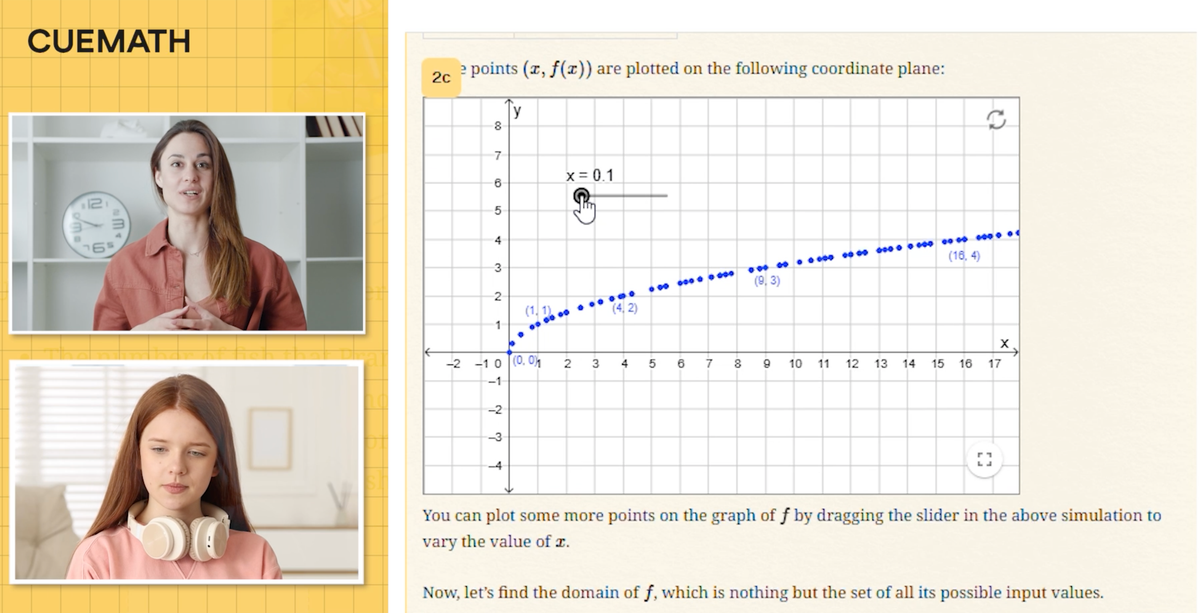
Last reviewed: July 2026. Math content in this blog has been reviewed by Cuemath's team of expert tutors.
Yes, Cuemath is good for high school, and it works for very different high schoolers.
Some are behind, anxious about math, or quietly dreading the next test, and they want to stop slipping and feel okay in class again. Some already do well but know there are cracks under the grades, and want to get genuinely solid before those cracks reach the SAT or an AP exam.
Others are already strong and want to get ahead, reach AP Calculus, and stand out for selective colleges, from the UC system to STEM programs at schools like Georgia Tech and MIT. What all of them want is the same thing: someone who can teach to their exact pace and their exact goal, one-on-one.
Cuemath is not one tutor; it is an online, personalized 1:1 program, and behind every student is a handpicked math tutor, a curriculum, and a practice platform working together. It pulls together the three things that actually decide a high school math outcome in the US: strong school grades, AP prep like Precalculus and Calculus, and SAT or ACT prep. Not ad-hoc homework help the night before a test. A plan.
- Is 1-on-1 Math Tutoring Better Than Group Classes or a Private Tutor?
- How Does Cuemath Work for High School Students?
- How Cuemath Builds Real Conceptual Understanding in High School Math
- Can Cuemath Help a High Schooler Get Ahead and Reach AP Calculus?
- Is Cuemath the Right Fit for Your High Schooler?
- Frequently Asked Questions
Is 1-on-1 Math Tutoring Better Than Group Classes or a Private Tutor?
Yes, for most high schoolers 1-on-1 math tutoring beats both group classes and a typical private tutor, because every minute is built around one student's gaps and pace.
Let's look at the data first:
These are teens who did not get a concept in school, never got it fixed, and slowly decided they were “just bad at math.” The reason it keeps happening? Students do not get personalized 1:1 tutoring. Every high schooler ends up needing one of two things a classroom cannot give one student at a time:
- Conceptual understanding on demand: a tutor who notices the gap and fixes it before it compounds into the next course.
- A pace that fits the student: a tutor who works toward that teen's own goals instead of following a one-size-fits-all curriculum.
This is what Cuemath believes in, a personalized math program for each high-schooler's goals.
How Does Cuemath Work for High School Students?
Cuemath works by starting every high school student with a free assessment, then building a personalized 1:1 plan around the exact gaps and goals it finds.
Here is what that plan actually looks like from the student's side, piece by piece.
The plan starts with what the student is stuck on, before day one
Before the first free evaluation, the teen names a goal, then takes a short evaluation built by Cuemath's curriculum experts that checks four things: fluency, understanding, application, and reasoning. That evaluation is a real, concept-driven lesson, not a sales demo.
One expert tutor, and the student keeps them
Only the top 1% of applicants become Cuemath tutors: a decade-plus of experience on average, many holding master's degrees or PhDs, and certified to prep students for the SAT. Trained on US Common Core and on how teens actually learn, matched to your teen's grade, and there to stay.
Just the student and the tutor, so the lesson hits only what they don't know
A class of 30 has to teach to the middle. One-on-one, the tutor teaches to your teen alone: when Sai joined mid-year, his tutor skipped re-teaching AP Precalculus and drilled the weak concepts instead; Zorain was fast but on autopilot, so his tutor used that speed to throw harder puzzles at him. See how Cuemath breaks down each idea in its math concept explanations.
A teen can finally say "I don't get this" with no class listening
Sessions are just the student and the tutor, about an hour, three times a week, on a shared whiteboard where the teen works problems out loud. The tutor asks instead of tells, so mistakes get caught and fixed in the session, not handed back on a graded paper a week too late.
A personalized pathway, built on the spot
The tutor takes just two things, the course the teen is in right now and the college goal, and builds a personalized pathway instantly, mapped term by term to milestones like reaching AP Calculus by junior year and sitting the SAT by junior spring. Most tutoring services never do this; Cuemath draws the map first, then teaches to it.
From here, the plan bends toward what each student actually needs. Here is what that looked like for five of them.
See Where the Cracks Actually Are
The free evaluation includes a skills-and-gaps evaluation that pinpoints the exact concept holding your teen back, before you commit to anything.
Book a Free EvaluationFor High Schoolers in Grades 8 to 12
How Cuemath Builds Real Conceptual Understanding in High School Math
Cuemath builds conceptual understanding by having tutors teach the reasoning behind each step, not just the procedure, so students can apply a concept to problems they have never seen. Here is what that looked like for real high schoolers:
- Zorain could calculate quickly, but he rushed through problems without understanding the reasoning, and he was not that interested in math.
- His Cuemath tutor, Aparna, used his speed, solved math puzzles, and let him pick chapters that interested him. He started asking questions and thought deeper as much as he chased the answer.
- A year later, Zorain scored a perfect 100% on his school's Common Core Algebra assessment. in a course he was taking a full year ahead of schedule.
- Saahith was already strong in math. He was confused, whether to play it safe with AP Calculus AB, or take the harder course like AP Calculus BC.
- Saahith's tutor Ranjita, instead of choosing a normal way, motivated him to choose AP Calculus BC.
- She built a customized learning plan, same topics as school, but more depth, plus years of past AP exam papers for practice.
- The outcome? He scored a perfect 5 on AP Calculus BC and a 1480 on the SAT, with 770 in Math.
Can Cuemath Help a High Schooler Get Ahead and Reach AP Calculus?
Yes. Cuemath helps high schoolers get ahead by moving them through the course sequence toward AP Calculus while keeping their foundations solid, so speed never comes at the cost of understanding. These students did exactly that:
Sreya, Grade 11: a four-year climb to a perfect BC score and a 1570 SAT.
- Sreya joined Cuemath in 2022 at the Algebra 2 level.
- She studied Algebra 2, then Precalculus, then Calculus BC, then prepared for SAT. She took Calculus BC a full year ahead of the standard sequence, which meant any hidden gap would surface under timed pressure.
- Her Cuemath tutor challenged her with harder SAT problems and full-length mock exams for both BC and the SAT.
- The outcome? Sreya scored a perfect 5 on AP Calculus BC in Grade 11, and a 1570 on the SAT, with 790 in Math.
Sai Tanish, Grade 9: the youngest in a class two grades ahead.
- Sai was the youngest student in his AP Precalculus class, and he had just switched schools mid-year.
- His Cuemath tutor, Nitya, did not reteach everything. She targeted the hardest topics, analytic trigonometry, polar graphs, and vectors, with systematic explanations and steady practice.
- He scored a perfect 5 out of 5 on AP Precalculus, as the youngest in his class.
Riddhi Pendru, Grade 10: staying a year ahead while juggling multiple APs.
- Riddhi was taking AP Precalculus a year early while taking several other AP courses at once. There was no room for gaps.
- Her Cuemath tutor, Nitya, devoted one focused hour a week to focus deeply on trigonometry, functions, and rational functions concepts.
- The outcome? Riddhi scored a 4 out of 5 on AP Precalculus, in the well qualified range that earns college credit at many universities, without letting her other APs slip.
💡 How did Cuemath help them?
Cuemath's high school tutoring is about systematic acceleration. Cuemath tutors help prepare the conceptual foundation first, then focus on the high school course across months, so there is time to actually understand it.
Cuemath aligns with the school's curriculum standards, but we are not rigid. If a student's school has no AP Calculus BC, or does not have room in the honors track, Cuemath tutors help build a customized pathway anyway.
Is Cuemath the Right Fit for Your High Schooler?
Cuemath is the right fit for almost every high schooler who wants to genuinely get better at math, and a poor fit for just one thing: last-minute, one-off homework help.
Put simply, Cuemath is made for every kind of high school student, whether your teen is catching up, keeping up, or racing ahead. The only thing it is not is a quick-answer service for the night before a test.
See the fit for yourself in one free evaluation.
Book a free evaluationFrequently Asked Questions
Is Cuemath good for high school?
Yes, Cuemath is good for high school. Cuemath offers 1:1 online tutoring for different high school courses, which includes everything from AP prep, and SAT or ACT prep.
Does Cuemath cover high school math like Algebra 2, Precalculus, and Calculus?
Cuemath covers the full range of high school math, including Algebra 1 and 2, Geometry, Precalculus, and AP Calculus AB and BC. The curriculum is aligned to US Common Core and state standards, so it supports school coursework while it builds toward advanced courses. Cuemath students have earned perfect AP scores in both Precalculus and Calculus BC.
Does Cuemath help with SAT and AP exam prep?
Yes, Cuemath offers free SAT prep and AP exam prep with regular high school tutoring. Students just need to ask for a SAT math tutor or a tutor certified to prepare for AP exams during signup. Our SAT practice material contains mock tests and practice sheets that help practice time management and problem-solving skills. The tutor helps with concepts in regular classes.
Is Cuemath worth it for high school students?
Cuemath is worth it for high school students who want a planned, one-on-one path rather than occasional homework help. The value is a consistent tutor who finds and fixes the exact concept gap, then builds toward AP and SAT goals over months. Cuemath is not a quick-fix or homework help high school program.
How does Cuemath work for high school students?
Cuemath works by starting every high school student with a free skills-and-gaps evaluation that pinpoints where understanding breaks down. The student then keeps one dedicated tutor for 1:1 classes, 55 to 60 minutes, twice a week, on a shared whiteboard. The plan is personalized to the student's pace and college goals.
Are Cuemath's high school math tutors qualified?
Cuemath's high school math tutors come from the top 1% of applicants and are trained in both advanced math and how teenagers learn. Each student keeps the same dedicated tutor over time, so the tutor learns their exact gaps and trims every lesson to what that student actually needs. Cuemath students have earned perfect AP Calculus BC and AP Precalculus scores working this way.
Can Cuemath help a high schooler get ahead and accelerate?
Yes, Cuemath helps high schoolers accelerate without cramming. Cuemath prepares the foundation before a hard course begins, then spreads the work across months so mastery stays intact. Cuemath students have taken AP Precalculus and AP Calculus BC a full year ahead of the standard sequence and still scored perfect 5s.
Does Cuemath give homework help for high school?
Cuemath supports homework and current coursework as part of a personalized plan, not as ad-hoc, one-off help. Because the curriculum is aligned to Common Core and state standards, classwork tends to improve alongside the plan. Cuemath is built as an ongoing program rather than a homework hotline.
What grades does Cuemath teach?
Cuemath teaches Grades K through 12, including the full high school range from Grade 8 through Grade 12. For high schoolers, that spans Algebra through AP Calculus, plus SAT and ACT Math prep. Every student gets a plan matched to their grade, pace, and goals.
Sources
- Nation's Report Card / NAGB, 2025 — 12th-grade math proficiency — backs the “22% proficient, 45% below basic” claim
- CNN, Sept 2025 — record-low 12th-grade math scores — backs the national decline context
- College Board — AP Calculus & Digital SAT — backs AP Calculus BC / Precalculus / SAT scoring context
- Roediger & Karpicke, 2006, Psychological Science — Test-Enhanced Learning — backs the retrieval-practice test-prep mechanism
- CRPE, 2025 — A Crisis in Math — backs the national context on high school math

I grew up a science kid. Math was not my best subject. Class moved fast, I was too shy to ask for help, and I somehow ended up more curious about how people learn than about the subjects themselves.
That's what pulled me into education, not to teach, but to understand how colleges and tutoring programs actually work and what students genuinely need from them.
My love for writing did the rest. I had too many observations and nowhere to put them, so I started writing, and haven't stopped. Over the last five years I've written about edtech, student life, and college programs. For the past year, my focus has been math tutoring specifically.
I work at Cuemath now, so factor that in. I research by going where parents actually talk: forums, reviews, and direct conversations with students and families. This blog was written with AI assistance and the math content was reviewed by Cuemath's team of expert tutors. Last reviewed: July 2026. I'm writing for the kid who's too scared to raise their hand in class. I was that kid.