What Is the GMAS Test? A Simple 2026 Guide for Parents
Learn what the GMAS test is, who takes it, what subjects it covers, how scores work, and how parents can help their children prepare. This simple 2026 guide covers the GMAS basics you need to know.

The Georgia Milestones Assessment System (GMAS) is Georgia’s statewide assessment program that measures how well students have learned the knowledge and skills outlined in the state-adopted content standards in our schools. It provides a clear picture of student knowledge and skills across different subject areas.
GMAS assessments are available for grades K-12 and can include English language arts, mathematics, science, and social studies, depending on the grade level and course of the student. The assessments are designed to measure students’ knowledge and academic skills.
Students, parents, teachers, and schools can all gain useful information from the GMAS results. The results can help teachers to see what areas students are excelling in and where further learning support may be helpful.
Understanding what GMAS is can help ease the testing process for students and families. In this blog, we will discuss GMAS, what it includes, who takes the assessments, how the results are reported, and how students can prepare.
- What Is the GMAS Test?
- What Does GMAS Measure?
- Who Takes the GMAS Test?
- GMAS Subjects: What Each Test Covers
- GMAS End-of-Course Tests in High School
- When Are GMAS Tests Given?
- How Is the GMAS Test Scored?
- GMAS Results: When and How Parents Get Them
- How to Prepare for the GMAS Test
- Frequently Asked Questions
- Sources
What Is the GMAS Test?
GMAS measures your child against Georgia's standards, not against other students. A proficient score means your child has learned what the standards expect for that grade, no matter how the rest of the class scored.
GMAS stands for the Georgia Milestones Assessment System. It is Georgia’s statewide testing program used to measure how well public school students have learned the academic standards for their grade level or course.
Milestones works as one connected system from grade 3 through high school:
- One set of levels: Every GMAS test reports the same four achievement levels, from Beginning Learner to Distinguished Learner.
- One kind of report: Your child gets the same score report format each year, so you can compare one spring's results with the next.
- One goal: Checking whether your child is ready for the next grade, the next course, and later, college or a career.
The GMAS system covers assessments from elementary school through high school and uses four achievement levels: Beginning Learner, Developing Learner, Proficient Learner, and Distinguished Learner. These levels help parents and educators understand a student’s academic performance.
GMAS measures students against Georgia’s academic standards, rather than comparing them directly with other students. The results can help students, parents, teachers, and schools understand academic strengths and identify areas where additional support may be needed.
What does GMAS stand for?
GMAS stands for Georgia Milestones Assessment System. It is Georgia’s statewide assessment program for measuring student achievement and progress in specific grades and courses.
Here is what each part of the name means:
- Georgia: The assessments are part of Georgia’s public education system and are based on the academic standards established by the Georgia Department of Education. They are designed to measure what students are expected to learn in Georgia schools.
- Milestones: The word "milestones" refers to important points in a student’s academic journey. The assessments help show whether students are meeting the learning expectations for their grade level or course.
- Assessment: An assessment is a way of measuring what a student knows and can do. GMAS questions are designed to evaluate students’ understanding and application of the knowledge and skills taught in their classes.
- System: GMAS is not a single test. It is a collection of assessments used across different grade levels and courses, including End-of-Grade (EOG) and End-of-Course (EOC) assessments.
Why does Georgia give the GMAS?
- For families: A yearly check on whether your child is on track in each tested subject.
- For teachers and schools: A way to see which skills students have mastered and which need more time.
- For the state: A measure of school performance on Georgia's school report card (CCRPI). Federal law requires every state to test students each year.
How is GMAS different from a class test?
| Class test | GMAS | |
|---|---|---|
| Who writes it | Your child's teacher | Georgia Department of Education |
| What it covers | One unit or chapter | The full year's standards |
| Same test statewide | No | Yes |
| Counts toward grades | Yes | High school EOC only (10–20%) |
| Who uses the results | Student, parent, teacher | Families, schools, the state |
What Does GMAS Measure?
GMAS measures how well your child has learned the Georgia Standards of Excellence, the state's list of what students should know in each grade and course. It checks whether your child can use those skills, not just remember facts.
Georgia has updated two sets of standards recently. New K–12 math standards were first tested in spring 2024, and new K–12 ELA standards, with a brand-new ELA test, were first tested in spring 2026.
Who Takes the GMAS Test?
Every Georgia public school student in grades 3–8 takes GMAS, and high school students take it at the end of four specific courses.
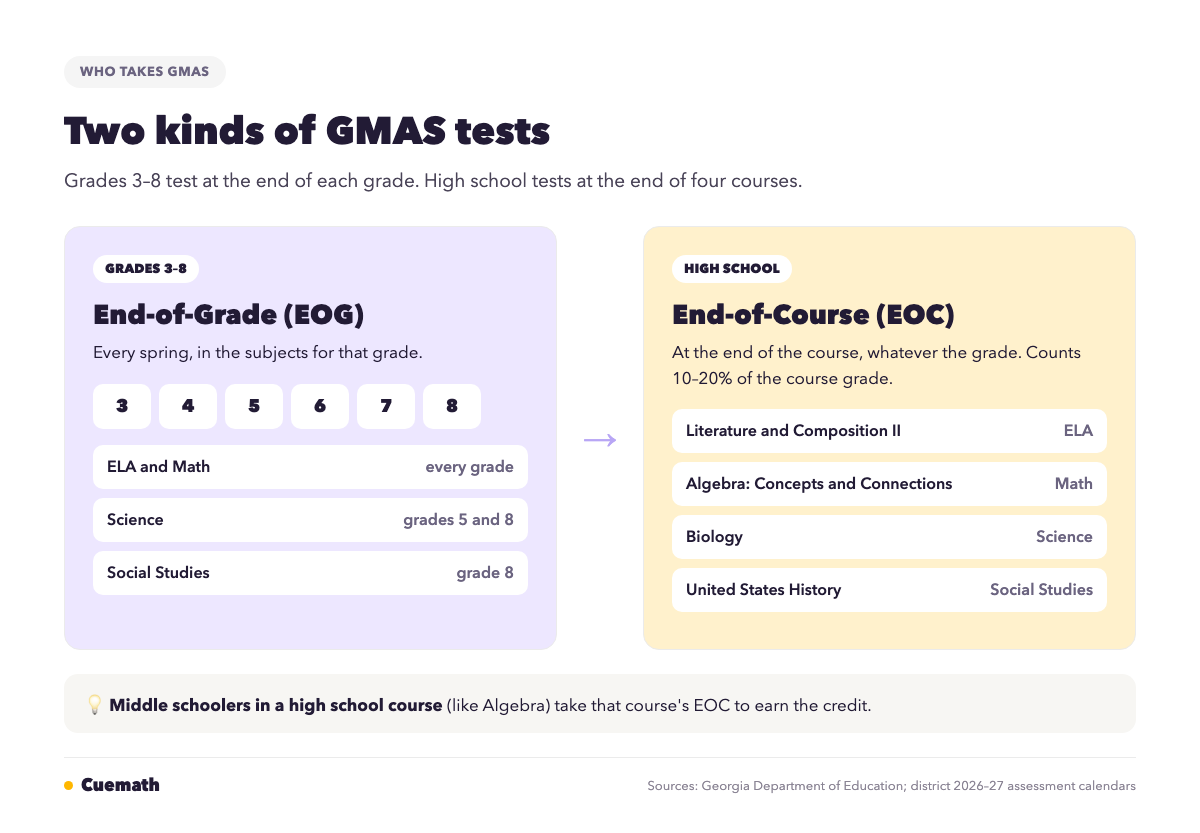
- End-of-Grade (EOG) tests: Grades 3–8, taken every spring.
- End-of-Course (EOC) tests: Taken when a student finishes one of four high school courses, whatever their grade.
- Middle schoolers in high school courses: A 7th or 8th grader taking a high school course such as Algebra takes that course's EOC and must take it to earn the course credit.
- Grade 8 Physical Science: An 8th grader enrolled in Physical Science takes the Physical Science test instead of the grade 8 science test.
| Grade | ELA | Math | Science | Social Studies |
|---|---|---|---|---|
| Grade 3 | ✓ | ✓ | — | — |
| Grade 4 | ✓ | ✓ | — | — |
| Grade 5 | ✓ | ✓ | ✓ | — |
| Grade 6 | ✓ | ✓ | — | — |
| Grade 7 | ✓ | ✓ | — | — |
| Grade 8 | ✓ | ✓ | ✓ | ✓ |
GMAS Subjects: What Each Test Covers
GMAS tests up to four subjects, depending on your child's grade. Each subject checks a specific set of skills.
English Language Arts (ELA)
- Reading and understanding stories and informational texts
- Finding evidence in a passage to support an answer
- Vocabulary and grammar
- Writing a full response based on what the student read
Mathematics
- Numbers and operations, like fractions in grades 4–5 and ratios in grade 6
- Algebraic thinking and equations
- Geometry, measurement, and data
- Multi-step, real-world problems, with the steps explained
Science
- Grade 5: earth, physical, and life science from grades 3–5
- Grade 8: the grade 8 science standards
- Reading data, charts, and experiment results
Social Studies
- Georgia history, geography, government, and economics
- Reading maps, timelines, and primary sources
GMAS End-of-Course Tests in High School
High school students take a GMAS End-of-Course (EOC) test in four courses, and the score counts toward the final course grade. Since July 2023, Georgia's State Board of Education has let each district choose a weight between 10% and 20%. Some districts use 20%, and others use 10%, so check your school's policy.
| Subject | Course |
|---|---|
| ELA | Literature and Composition II |
| Math | Algebra: Concepts and Connections |
| Science | Biology |
| Social Studies | United States History |
When Are GMAS Tests Given?
GMAS end-of-grade tests take place in spring, between mid-April and mid-May. Each district picks its own days inside the state window, so dates differ from county to county, and your child's school calendar has the real ones.
| Test | Dates |
|---|---|
| End-of-Grade, Cobb County | April 15 – May 14, 2027 |
| End-of-Grade, DeKalb County | April 26 – May 10, 2027 |
| End-of-Grade, Marietta City | April 28 – May 14, 2027 |
| End-of-Course | December 2026, spring 2027, and June 2027 |
What a testing week can look like: in spring 2026, one Gwinnett elementary school tested ELA over three days (April 21–23, 2026), math over two days (April 28–29, 2026), and grade 5 science on one day (April 30, 2026).
How Is the GMAS Test Scored?
Each GMAS test gives your child a scale score and one of four achievement levels. Proficient Learner or higher means your child is on track for the next grade or course.
| Level | Scale score | Meaning |
|---|---|---|
| Distinguished Learner | Varies by test | Advanced mastery |
| Proficient Learner | 525 and up | On track for the next grade |
| Developing Learner | 475 to 524 | Partial mastery |
| Beginning Learner | Below 475 | Needs substantial support |
The scale score is a three-digit number. The score needed for Distinguished Learner and the full score range differ from test to test, so don't compare scores across subjects.
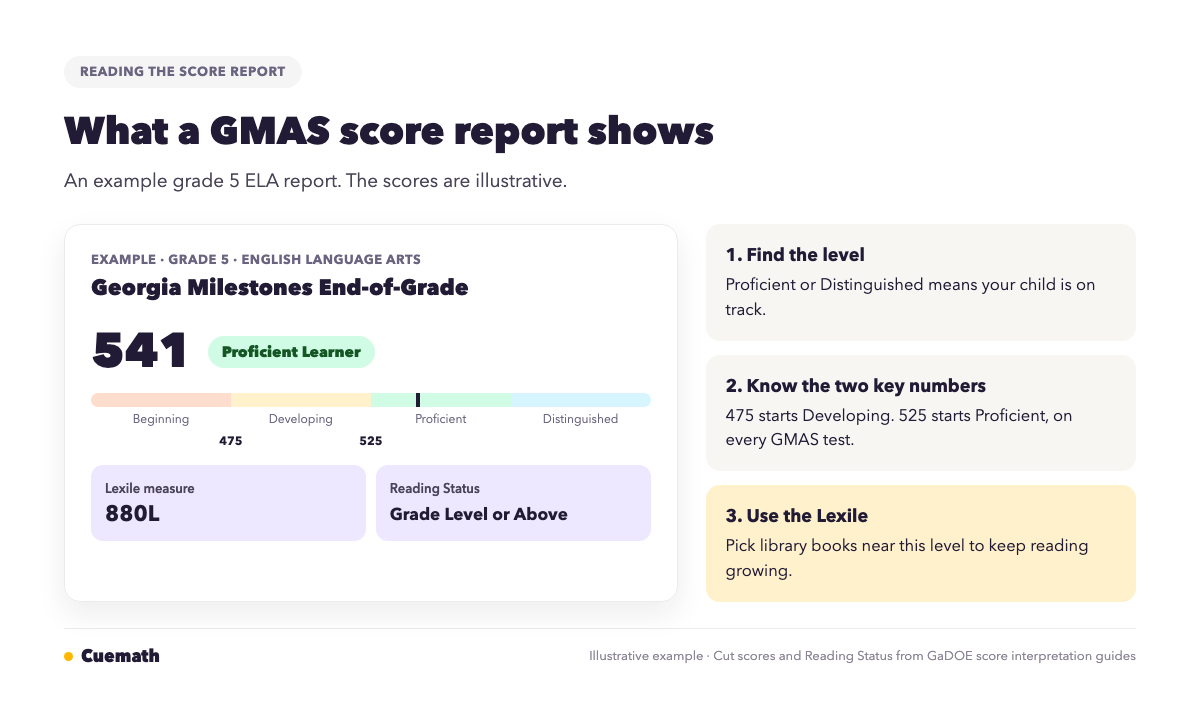
The Lexile measure on the ELA report shows the difficulty of text your child can read, and the report adds a Reading Status: "Grade Level or Above" or "Below Grade Level." Use the Lexile to pick library books at the right level.
GMAS Results: When and How Parents Get Them
Families usually get GMAS scores in early summer through their district's parent portal (such as Infinite Campus) or on an Individual Student Report from the school. The report shows the scale score, achievement level, performance in each skill area, and the Lexile measure with reading status.
How schools use GMAS results:
- Plan extra help or enrichment for next year
- Place students in classes, such as advanced math
- Report school performance on Georgia's school report card (CCRPI)
- Check promotion at three grades: Georgia law looks at reading in grades 3, 5, and 8, and math in grades 5 and 8. A student who scores low gets extra help and a retest, and a placement committee that includes the parent makes the final call.
How to Prepare for the GMAS Test
The best GMAS preparation is steady practice on grade-level skills, plus a little time with the online test format. Cramming the week before doesn't help much. (For study habits that work for any math test, see how to study for a math test.)
- Try the free official practice site: Experience Online Testing Georgia lets your child practice real GMAS question types and online tools on a computer.
- Review class material: Ask the teacher which units carry the most weight, and revisit homework and quizzes from those units.
- Practice explaining answers: Constructed-response questions give points for the steps, so ask, "How did you get that?" at homework time. This step-by-step method for word problems helps.
- Read every day: Twenty minutes of reading builds the ELA skills GMAS checks.
- Use last year's report: Start with any skill area where your child scored low.
- Get enough sleep: A normal bedtime and a good breakfast on test days help more than extra worksheets the night before.
Find Out Where Your Child Stands Before Spring GMAS
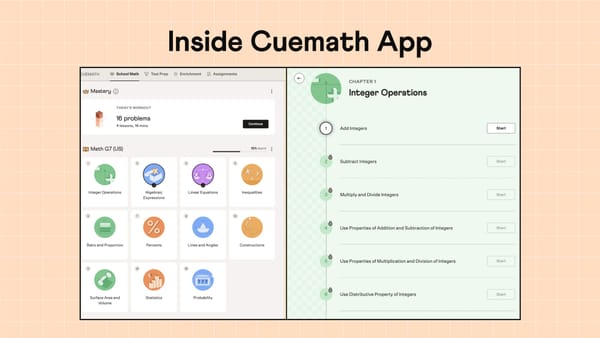
Book a free 1:1 evaluation with a Cuemath math specialist. They check your child's grade-level math skills against the Georgia standards, including the multi-step and "explain your steps" questions, and show you exactly what to work on.
Rated 4.5+ on Trustpilot by parents like you
100% Free • No Credit Card • Grades K–12
Frequently Asked Questions
What does GMAS stand for?
GMAS stands for the Georgia Milestones Assessment System. It is Georgia's state testing program for grades 3–8 and four high school courses.
What is the GMAS test?
The GMAS test is Georgia's yearly state test that checks how well students have learned the Georgia Standards of Excellence. Students in grades 3–8 take end-of-grade tests, and high school students take end-of-course tests in four courses.
What is a good score on GMAS?
A good GMAS score is Proficient Learner or Distinguished Learner. Both mean your child has met or exceeded grade-level expectations.
What is a scale score on GMAS?
A GMAS scale score is the three-digit number that places your child in one of the four achievement levels. On every test, 475 or higher reaches Developing Learner, and 525 or higher reaches Proficient Learner.
How are GMAS scores grouped for reporting?
GMAS scores are grouped into four achievement levels: Beginning Learner, Developing Learner, Proficient Learner, and Distinguished Learner.
What happens if you fail GMAS?
GMAS has no simple pass or fail, and a low score alone does not hold a child back. In grades 3, 5, and 8, a low reading or math score leads to extra help and a retest before a promotion decision, and in high school a low EOC score lowers the course grade.
When is GMAS testing in 2026–27?
GMAS end-of-grade testing for 2026–27 runs in spring 2027, between mid-April and mid-May. Each district sets its own days, for example, April 15 – May 14, 2027 in Cobb County.
How do I check my child's GMAS scores?
You can check your child's GMAS scores in your district's parent portal, such as Infinite Campus, or on the Individual Student Report the school sends home. In 2026, ELA scores arrive in late fall.
Is there a free GMAS practice test?
Yes, Experience Online Testing Georgia is the free official GMAS practice site. It shows real question types and the online test tools.
Does GMAS count toward my child's grade?
GMAS does not count toward report card grades in grades 3–8. High school EOC tests count for 10% to 20% of the final course grade, depending on the district.
Sources
What GMAS is, grades, subjects
- Georgia Department of Education: Georgia Milestones Assessment System: official program page
- Georgia Cyber Academy: Georgia Milestones: current EOC courses and EOG subjects
High school EOC tests
- AllOnGeorgia: Georgia moves state testing to the federal minimum: four EOCs eliminated in 2020
- Capitol Beat: State Board lets districts lower EOC weight (July 2023): 10–20% EOC weight
Scoring
- GaDOE Score Interpretation Guide (hosted by a Georgia district): 475/525 cut scores on every test, Lexile Reading Status
- Fulton County Schools: Understanding the Georgia Milestones Achievement Levels: level descriptions
Dates, results, and promotion
- Cobb County Schools: 2026–27 testing calendar: sample spring 2027 EOG window
- Georgia Partnership for Excellence in Education: 2025–26 results released: August 6, 2026 release; ELA later in fall
- Georgia SBOE Rule 160-4-2-.11 (Cornell LII): grades 3, 5, and 8 promotion checkpoints
Practice and reviews
- Experience Online Testing Georgia: official free practice site
- Trustpilot reviews of Cuemath: parent review quotes used in this post

I was never the kid who loved math. I was much more interested in books, stories, and writing, and, somewhere along the way, I became even more curious about people. Why do we learn differently? Why does something make sense to one child but not another? And what makes a student feel confident enough to keep trying?
That curiosity led me to study Applied Psychology, where I learned more about how children think, learn, and make sense of the world around them.
My love for writing did the rest. What started as something I simply enjoyed became a career. Over the past five years, I've worked as a freelance writer across edtech, SaaS, B2B, travel, lifestyle, and healthcare, learning how to write for very different audiences without losing the human side of the story.
Today, I'm an SEO Content Writer & Editor at Cuemath, where I get to bring many of these interests together. Working in education, and especially around math, has made me even more curious about what happens behind the screen or textbook: what parents worry about, what students struggle with, and what actually helps them learn.
That's also how I like to research. I don't just look at search results and call it a day. I go where parents and students actually talk: forums, reviews, communities, and conversations with real families. Because sometimes the most useful insight isn't hiding in a keyword; it's in a parent's question, a student's frustration, or a small detail someone shares about their learning experience.
I write because I'm curious. I research because I want to understand. And I love turning what I learn into content that feels genuinely useful to the people reading it.